Nuclear Stress Test: What the Tracer Actually Does
Short answer
A nuclear stress test checks whether blood flow to the heart falls short under demand, using a radioactive tracer and a camera to compare images at rest and under stress. The stress comes from exercise or a medicine, for men who cannot exercise enough. The medicine causes real, expected side effects — and caffeine beforehand can quietly produce a false result.
This page belongs to the heart section, and it covers a test that two other articles here already lead toward without explaining. Chest pain after 40 and heart attack vs cardiac arrest both end at the same place for a man whose story points toward the heart but whose symptoms have passed: further testing. For a large share of those men, the test ordered is some version of this one.
The name causes most of the anxiety. “Nuclear” and “radioactive” are not words anyone wants attached to their own chest, and the test itself can feel alarming while it is happening — a flushed face, a racing heart, a headache, sometimes chest tightness, induced on purpose by a medicine injected into your arm. None of that is a complication. It is most of how the test works.
We earn nothing from any of this. There are no affiliate links on this site, nothing here is sponsored, and there is no device or scan to sell, which is why this page can walk through what the side effects actually mean instead of glossing past them.
What the test is actually checking
MedlinePlus states the purpose directly: the test is done to see if your heart muscle is getting enough blood flow and oxygen when it is working hard, under stress. That is a narrower question than it sounds. A heart at rest can look completely fine on every measure while still failing this specific test, because a narrowed artery may supply enough blood for an idle heart but not enough when demand rises — the same way a partly blocked pipe might keep up with a trickle but not a flood.
Providers order it for several reasons, per MedlinePlus: to evaluate new chest pain or worsening angina, to see how well a treatment such as medicine, angioplasty or heart surgery is working, or to assess whether a patient is at high risk for heart disease or complications. It is a test built around a question — how does this heart behave under demand — not a general checkup.
Two ways to create the stress
“Stress” in the test’s name just means demand placed on the heart, and there are two ways to produce it.
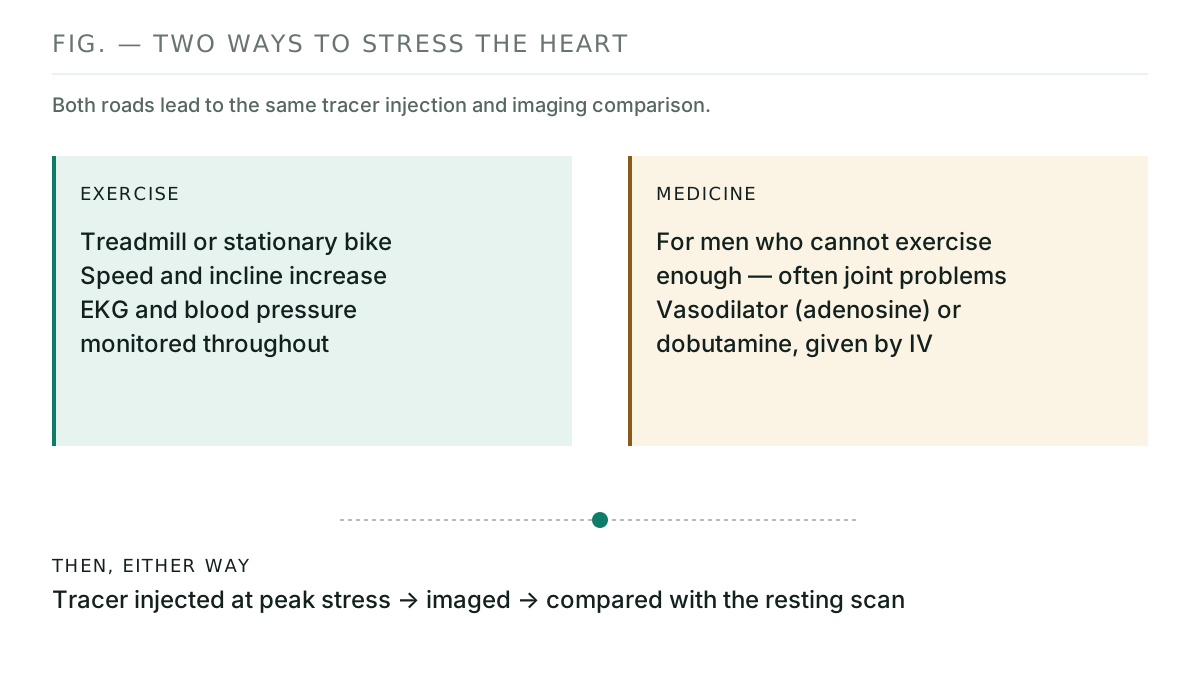
The first is exercise. MedlinePlus: most people will walk on a treadmill, or pedal on an exercise machine, after the treadmill starts moving slowly, you will be asked to walk faster and on an incline. Blood pressure and heart rhythm are monitored throughout.
The second is a medicine, for men who cannot exercise hard enough for the treadmill to answer the question — a limitation that connects directly to the joints section of this site, since bad knees, hips or a recent joint replacement are common, ordinary reasons a man cannot push a treadmill to target heart rate even with a perfectly capable heart. MedlinePlus describes two drug families used instead:
- A vasodilator — adenosine or dipyridamole — which widens the heart’s arteries, mimicking what exercise does to blood flow.
- Dobutamine, a different drug that makes the heart beat faster and harder, similar to exercise itself, used in other cases.
Either route ends at the same place: a heart working as hard as the test needs it to, at which point the tracer goes in.
What makes it “nuclear”: the tracer and two sets of pictures
The word describes the imaging method, not a separate procedure. MedlinePlus: a nuclear stress test is an imaging method that uses radioactive material to show how well blood flows into the heart muscle, both at rest and during activity. A small amount of a radioactive tracer — MedlinePlus names thallium and sestamibi as examples — is injected into a vein, and a special camera scans the heart and creates pictures to show how the substance has traveled through the blood and into the heart muscle.
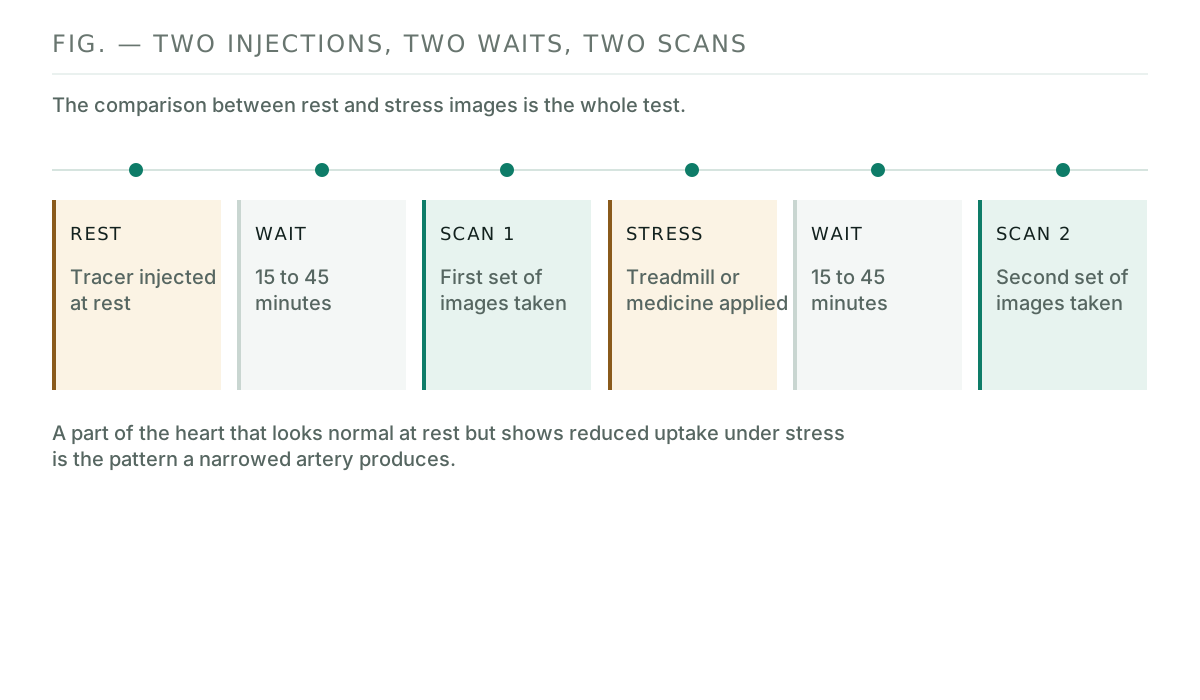
The test is built around two separate imaging passes, one at rest and one under stress, with a wait between each injection and its scan. MedlinePlus: you will lie down and wait for between 15 and 45 minutes before the first set of pictures; after stress is applied and a second dose of tracer is injected, you wait 15 to 45 minutes again before the second set. Your provider will compare the first and second set of pictures using a computer. A part of the heart that lights up normally at rest but shows reduced tracer uptake under stress is the pattern consistent with a narrowed artery — the test is designed to catch exactly that contrast.
The side effects during a drug test are not a red flag
This is the part that scares people who have not been warned about it. MedlinePlus describes what the vasodilator drugs feel like directly: you may feel a sting as it is injected, followed by a feeling of warmth; some people also have a headache, nausea, and a feeling that their heart is racing. With dobutamine: you may have a headache, nausea, or your heart may pound faster and more strongly. During exercise or drug-induced stress generally, MedlinePlus lists chest pain, fatigue, muscle cramps and shortness of breath among what some people feel.
A direct comparison of the two most common vasodilator drugs shows how routine this is.
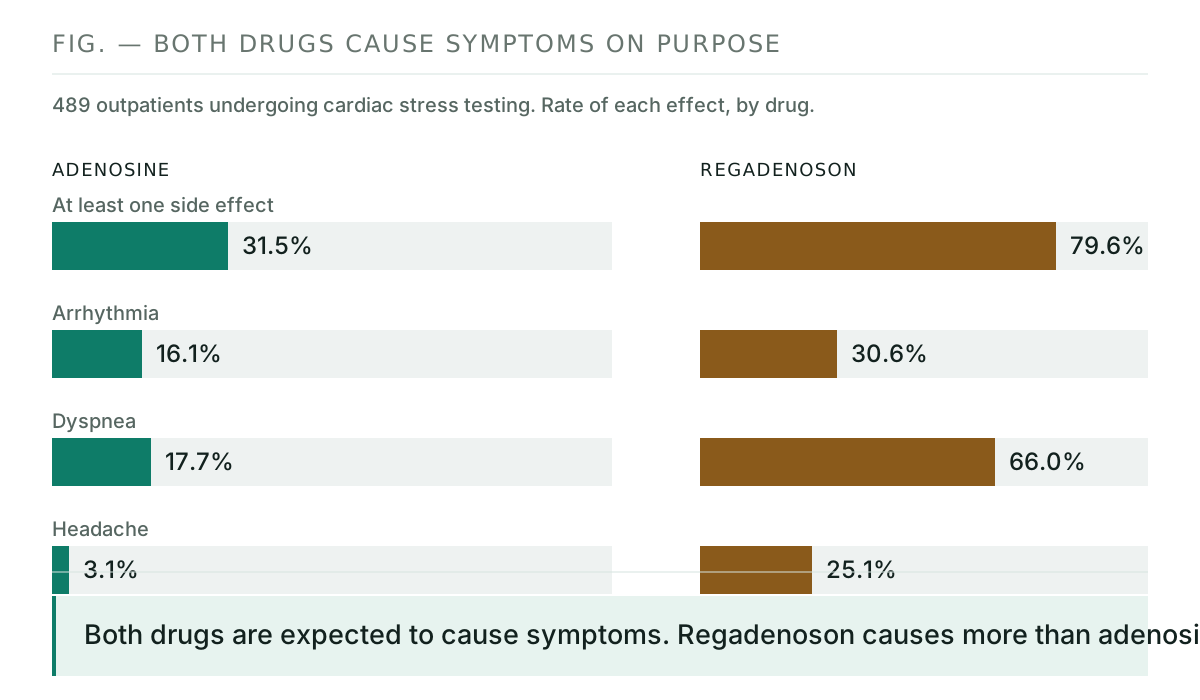
Among 489 outpatients undergoing cardiac stress testing, at least one adverse effect occurred in 79.6% of patients given regadenoson versus 31.5% given adenosine, including significantly more arrhythmia, dyspnea and headache with regadenoson, and a higher rate of needing the rescue agent aminophylline. Brink et al., Pharmacotherapy, 2015
Read that correctly and it is reassuring rather than alarming: these are documented, expected rates of a known response to the drug, tracked precisely enough to compare two brands against each other, not signs of a test going wrong. MedlinePlus lists the genuinely rare complications separately — arrhythmias, increased angina pain, breathing problems, extreme blood pressure swings, skin rashes — and for the exercise version states plainly that stress tests are generally safe, and that a heart attack or dangerous irregular heart rhythm is rare.
The one prep instruction that can quietly ruin the test
Of everything to get right before this test, one instruction does the most damage if skipped, and it is easy to underestimate because the substance involved is legal, common, and often labeled as if it does not count.
MedlinePlus is specific: you will need to avoid caffeine for 24 hours before the test, including tea and coffee, all sodas, even ones that are labeled caffeine-free, chocolates, and certain pain relievers that contain caffeine. The reason is pharmacological, not a general wellness instruction. Caffeine is a well-recognized antagonist of adenosine, and a potential cause of false-negative functional measurements during vasodilator myocardial perfusion, as a 2018 systematic review of 14 studies summarizes it.
In patients with known coronary artery disease, caffeine infusion attenuated the vasodilator’s effect on blood pressure and heart rate, and converted the imaging result from abnormal to falsely normal in 6 of 8 patients — reducing the measured perfusion defect score from 9.0 to 2.0 on average. Smits et al., Journal of Nuclear Medicine, 1991
MedlinePlus’s page for the plain exercise version sets the same expectation, in two steps: you must not eat, smoke, or drink beverages containing caffeine or alcohol for 3 hours or more before the test, and in most cases, you will be asked to avoid caffeine or caffeine-like substances for 24 hours before the test. The 3-hour line is a floor, not the real target — 24 hours is what most patients are actually told, with or without imaging. Either way, the coffee on the way to the appointment is not a minor lapse. It can make a real blockage look invisible.
MedlinePlus adds a second instruction that is easy to miss: your provider will tell you if you need to stop taking any medicines before the test, and separately tells patients on the exercise version to disclose sildenafil, tadalafil or vardenafil. Never stop a prescribed medicine without confirming with the provider first.
Is the radiation actually worth worrying about?
It is a real exposure, not a nothing, and the honest answer sits between the two extremes a man might land on — “radioactive” meaning nothing, or meaning something to fear.
The field has been actively working to bring the dose down for over a decade. A 2015 paper in the Journal of Nuclear Medicine frames why: because of a steep growth in nuclear imaging use in the mid-2000s, concerns about inappropriate use of the test and about imaging-related radiation exposure both increased, prompting professional societies to develop appropriate-use criteria alongside new technology for low-dose and ultra-low-dose protocols.
A 2023 single-institution survey gives a sense of where that effort has landed in practice: reported radiotracer doses for standard one-day stress/rest protocols were in line with published national diagnostic reference levels, with ongoing work to optimize patient radiation burden further without compromising image quality.
The dose depends heavily on which tracer and protocol the facility uses — a stress-only protocol, where a normal-looking stress image can skip the rest scan entirely, cuts the exposure meaningfully compared with doing both. Asking whether the facility uses a low-dose or stress-first protocol is a reasonable question, not an unusual one.
Reading the result
MedlinePlus frames the two outcomes plainly. A normal result most often means you were able to exercise as long as or longer than most people of your age and sex, and that blood flow through the coronary arteries is probably normal. Abnormal results may be due to reduced blood flow to part of the heart, or scarring of the heart muscle from a previous heart attack — the imaging can distinguish a live blockage limiting blood flow right now from old, settled damage.
A normal stress test is reassuring but not absolute. It answers the specific question it was built to ask — does blood flow fall short under this level of demand, today — and a result years from now, or under a different kind of strain, is a separate question.
Who actually needs one
A 2013 multisociety appropriate-use document rated when stress testing and comparable imaging are a reasonable use of the test, based on eighty clinical scenarios. Its broad pattern: testing for new or worsening cardiac symptoms, or for abnormal results following a prior test, was generally found Appropriate or May Be Appropriate. Testing in people without symptoms was generally found Rarely Appropriate, with exceptions for higher-risk individuals, and routine retesting without new symptoms was also generally rated Rarely Appropriate — within 1 year of a prior normal test before low-risk surgery, within 2 years of a prior angioplasty, and within 5 years of bypass surgery.
The 2021 AHA/ACC chest pain guideline’s broader approach reinforces the same idea from the clinical side: it presents an evidence-based approach to risk stratification for the evaluation of chest pain, incorporating cost-value considerations in diagnostic testing and recommending shared decision-making with patients — this is a test matched to a specific clinical question, not a routine addition to an annual physical.
What to do with this before the appointment
- Cut caffeine a full 24 hours beforehand, including decaf-labeled products and chocolate — MedlinePlus states this as the typical instruction even for the plain exercise version, not only when a drug or imaging is involved. This is the instruction most likely to quietly invalidate the result.
- Confirm which medications to hold, and disclose any erectile dysfunction medication if the exercise protocol is used.
- Expect real symptoms if you get the drug version. Flushing, a racing heart, headache or nausea with a vasodilator, or a pounding heart with dobutamine, are the drug working, documented in roughly a third to four in five patients depending on which one is used — not signs something has gone wrong.
- Ask about dose-reduction protocols if the nuclear imaging version is planned; stress-only and low-dose approaches are established options, not experimental ones.
- Treat a normal result as answering today’s question, not a lifetime guarantee — and a new or worsening symptom afterward is still worth reporting, not dismissed because of a clean prior test.
Key takeaways
- A nuclear stress test checks whether blood flow to the heart muscle falls short under demand, by comparing tracer images taken at rest and under stress.
- Stress comes from a treadmill or from a medicine (a vasodilator such as adenosine, or dobutamine) for men who cannot exercise hard enough, including many with joint problems that limit walking or pedaling.
- A direct comparison found at least one side effect in 79.6% of patients given regadenoson versus 31.5% given adenosine — expected, documented responses to the drug, not signs of a complication.
- Caffeine is a known adenosine antagonist and can cause a false-negative result; in the original 1991 study, caffeine converted an abnormal nuclear imaging result to falsely normal in 6 of 8 patients.
- MedlinePlus instructs avoiding caffeine for 24 hours before a nuclear or drug stress test, including decaf-labeled products, chocolate and certain pain relievers.
- Radiation dose has been an active focus of dose-reduction efforts since the mid-2000s; stress-only and low-dose protocols are established ways to reduce it, worth asking a facility about.
- A 2013 multisociety appropriate-use review found stress testing generally appropriate for new or changing symptoms, and generally not appropriate for routine testing in people without symptoms or for most retesting soon after a prior normal result.
Where to go from here
A stress test is one of several ways this site covers how heart problems actually get found and treated. These sit alongside it:
- Chest Pain After 40: When It's the Heart, and When It's Not — the symptom that often leads to this test being ordered.
- Heart Attack vs Cardiac Arrest: Plumbing vs Electrical — the blockage this test is built to detect before it becomes an emergency.
- Heart Palpitations vs AFib: Why a Normal EKG Proves Little — a different test, for a different question: rhythm over time, not blood flow under demand.
- Statins: The Benefit Is a Share of Your Own Risk — what often follows a stress test that finds a problem.
- Heart Health After 40: What the Numbers Mean — the pillar, and where this test fits among the numbers.
Frequently asked questions
What is the difference between a regular stress test and a nuclear stress test?
A regular (exercise) stress test monitors your EKG and blood pressure while you walk on a treadmill. A nuclear stress test adds a radioactive tracer and a special camera, taking images of blood flow into the heart muscle at rest and under stress, which can show a blockage an EKG alone might miss.
Why would I get a medicine instead of walking on a treadmill?
For patients who cannot exercise hard enough for the treadmill to produce a meaningful result — often because of joint problems, lung disease or other limits unrelated to the heart. A vasodilator (adenosine or dipyridamole) or dobutamine is used instead to create the same demand on the heart that exercise would.
Is it normal to feel awful during a nuclear stress test?
Yes, with the drug version. A direct comparison found at least one side effect — flushing, a racing heart, headache, shortness of breath — in 79.6% of patients given regadenoson and 31.5% given adenosine. These are documented, expected responses to the medication, not signs that something has gone wrong.
How much radiation does a nuclear stress test involve?
A real but managed exposure. Since the mid-2000s, professional societies and facilities have developed low-dose and stress-only protocols specifically to reduce it, and a 2023 survey found typical doses for standard protocols in line with published national reference levels. Asking your facility whether a low-dose or stress-only protocol is used is a reasonable question.
Why do I have to avoid caffeine before the test?
Caffeine blocks the same adenosine receptors the vasodilator drug acts on, which can blunt the test’s effect and produce a false-negative result. In the original 1991 study, caffeine turned an abnormal result falsely normal in 6 of 8 patients. MedlinePlus instructs avoiding caffeine, including decaf-labeled products and chocolate, for 24 hours beforehand.
What does an abnormal nuclear stress test result mean?
It usually means reduced blood flow to part of the heart muscle under stress, or scarring from a previous heart attack. The comparison between rest and stress images helps distinguish a current blockage limiting blood flow from older, already-settled damage, guiding what testing or treatment comes next.
Sources
- MedlinePlus, National Library of Medicine — Nuclear Stress Test
- MedlinePlus, National Library of Medicine — Exercise Stress Test
- MedlinePlus, National Library of Medicine — Stress Tests
- Brink HL et al. Pharmacotherapy, 2015 — Comparison of the Safety of Adenosine and Regadenoson in Patients Undergoing Outpatient Cardiac Stress Testing
- Smits P et al. Journal of Nuclear Medicine, 1991 — False-Negative Dipyridamole-Thallium-201 Myocardial Imaging After Caffeine Infusion
- van Dijk R et al. Nutrients, 2018 — Effects of Caffeine on Myocardial Blood Flow: A Systematic Review
- Dorbala S et al. Journal of Nuclear Medicine, 2015 — Approaches to Reducing Radiation Dose from Radionuclide Myocardial Perfusion Imaging
- Alkhybari E et al. Tomography, 2023 — Radiation Dose Assessment for Myocardial Perfusion Imaging: A Single Institution Survey
- Wolk MJ et al. Journal of the American College of Cardiology, 2014 — 2013 Multimodality Appropriate Use Criteria for the Detection and Risk Assessment of Stable Ischemic Heart Disease
- Gulati M et al. Circulation, 2021 — 2021 AHA/ACC/ASE/CHEST/SAEM/SCCT/SCMR Guideline for the Evaluation and Diagnosis of Chest Pain

Male Health Guide Editorial Team
We write about the health problems men over 40 actually search for at 3 a.m. — and we say plainly when the evidence for a popular claim is thin. We do not invent credentials and we do not publish sponsored copy as editorial. Read more about how we work.
Medical disclaimer: This article is general information about nuclear and exercise stress testing, and is not medical advice. It is not a substitute for diagnosis or treatment, and it is not a reason to request, decline or interpret any cardiac test on your own. Please speak to a qualified healthcare professional about your own situation, and always follow your provider’s specific preparation instructions, which may differ from the general guidance described here.