Weak Urine Stream After 50: What It Actually Means
Short answer
A weak stream usually means urine is meeting resistance on the way out, most often from an enlarged prostate. But it can also mean the bladder muscle itself has weakened, and it can be caused by ordinary cold and allergy medicine. The symptom is identical in all three. The fix is not.
Of everything that changed, this is the one I noticed first. Not the frequency, not the getting up at night — the stream. It takes longer to start than it used to, and when it does start it does not have the force I remember. Some days I stand there long enough to read the back of a shampoo bottle.
For a long time I filed it under getting older and left it there. What changed my mind was not fear. It was finding out, while reading for the piece I wrote about having mild symptoms, that a weak stream is the symptom men notice most and the symptom that tells you least. Three different problems produce it, and one of them is sitting in most people's medicine cabinet.
I am not a doctor and I still have not been to one about this. What follows is what I have learned, checked by the editorial team here, who sent me back to read things properly more than once.
What does a weak urine stream actually mean?
It means the urine is meeting resistance somewhere between the bladder and the outside world, or that the bladder is not pushing it hard enough. In men over 50 the usual explanation is an enlarged prostate squeezing the urethra, which runs directly through the middle of the gland — a piece of anatomy that explains almost everything about this subject.
Urologists sort prostate symptoms into two groups. Voiding symptoms are about getting urine out: a weak or interrupted stream, hesitancy before it starts, dribbling at the end. Storage symptoms are about holding it: urgency, frequency, waking at night. A weak stream sits firmly in the first group, and it usually arrives before the second group does.
That order is worth knowing. It means the stream is often the early warning, and the night-time trips come later. The full mechanism is laid out in the site's guide to an enlarged prostate after 40.
Is a weaker stream just part of getting older?
Partly, yes. Flow rate does decline gradually across adult life in most men, and the prostate does keep growing after 40. So some change is genuinely expected, and a man of sixty comparing himself to himself at thirty is not making a fair comparison.
But "common" and "harmless" are different words, and I had quietly been treating them as the same one. The distinction that matters is not how weak the stream is. It is how fast it changed.
A stream that has drifted downward over a decade behaves like ordinary prostate growth. A stream that has clearly changed inside a few months is behaving like something else, and that something else deserves a name. Mine drifted. If yours dropped, that is a different article and it belongs in a consulting room.
Could it be something other than my prostate?
Yes, and this was the part I had not considered at all. The prostate is the most common cause in men my age, but it is not the only structure that can narrow the pipe, and it is not the only thing that can weaken the push.
The alternatives worth knowing about:
- Urethral stricture — scar tissue narrowing the urethra itself, often years after an infection, an injury, or a catheter. It produces the same weak, sometimes split or spraying stream, and no prostate treatment touches it.
- Bladder neck problems — the outlet fails to open properly even though the prostate is not especially large.
- Nerve conditions — diabetes, spinal problems, Parkinson's and multiple sclerosis can all interfere with the signal that tells the bladder to contract and the outlet to relax.
- Medication — the one nobody mentions, which gets its own section below.
None of these are things I can sort out from my own bathroom, and that is rather the point. I had assumed the cause was obvious because the symptom was familiar. Those are not the same thing.
Can the problem be the bladder instead of a blockage?
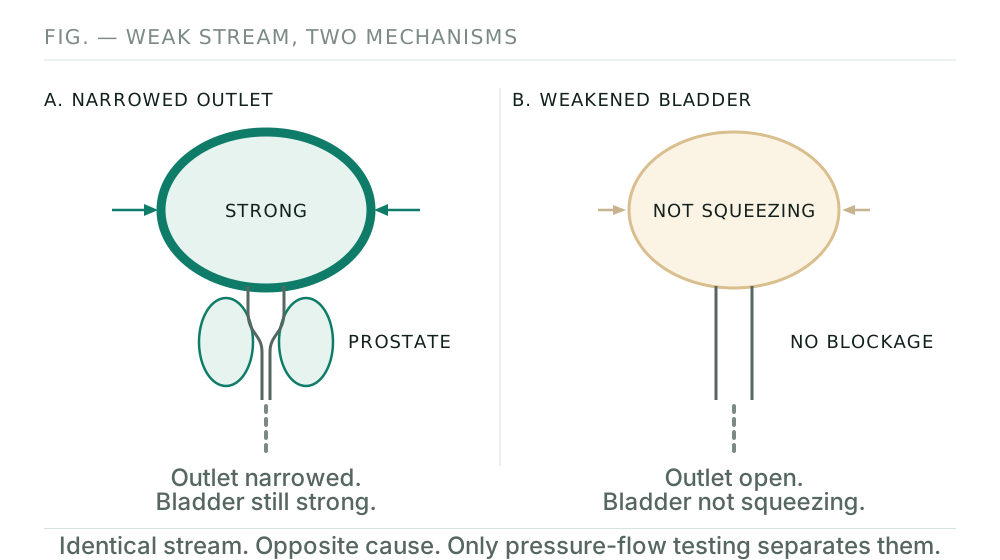
It can, and this is the distinction that changed how I think about the whole subject. A bladder that has spent years pushing against resistance can lose strength, in the way any muscle working against a load eventually does. The result is a weak stream with no significant blockage left to blame.
Urologists call this detrusor underactivity — the detrusor being the bladder's muscular wall. From the outside it is indistinguishable from an obstruction. From the inside it is the opposite problem: not a pipe that is too narrow, but a pump that is too tired.
| Obstruction | Weakened bladder | |
|---|---|---|
| What is wrong | The outlet is narrowed | The bladder is not squeezing hard enough |
| Stream | Weak | Weak — identical from the outside |
| Typical treatment aim | Relax or reduce the blockage | Manage emptying; drugs that open the outlet help less |
| How it is told apart | Pressure-flow testing, not symptoms and not a scan alone | |
The practical consequence is uncomfortable for anyone hoping to solve this by buying something. If your bladder is the weak link, a product designed around shrinking or relaxing the prostate is aimed at the wrong organ — and you would have no way of knowing. The two can also coexist, which is more common still.
Is anything in my medicine cabinet making it worse?
Possibly, and this is the cheapest thing on the list to check. Oral decongestants — the ones in cold and sinus remedies — work by tightening smooth muscle, and there is smooth muscle at the bladder outlet. Older antihistamines, the sedating kind in night-time cold medicine, work in the opposite direction and can reduce the bladder's ability to contract.
Both effects push the same way: a weaker stream, and in some men an inability to go at all. You do not have to take my word for it, because the manufacturers already say so.
Over-the-counter decongestant and antihistamine packages sold in the United States carry a standard warning directing men with trouble urinating due to an enlarged prostate to ask a doctor before use.
US Food and Drug Administration — Over-the-Counter Drug Facts label requirementsI find this genuinely striking. The warning is printed on the box, in the aisle, in front of millions of men every winter — and it is written in the one phrasing guaranteed to be skipped, because a man with a mildly weaker stream does not think of himself as someone with "trouble urinating due to an enlarged prostate gland".
Prescription medicines can contribute too — some antidepressants, some drugs for bladder urgency, and opioid painkillers among them. This is a pharmacist question, and pharmacists are free, walk-in, and considerably less intimidating than the alternative. The same logic applies to what you might add on top, which is covered in prostate supplements and blood pressure medication.
If something on your prescription list might be contributing, that is a conversation, not a decision to make alone. Stopping a blood pressure or antidepressant medication without supervision carries real risk, and a weak stream does not outrank it.
How is a weak stream actually measured?
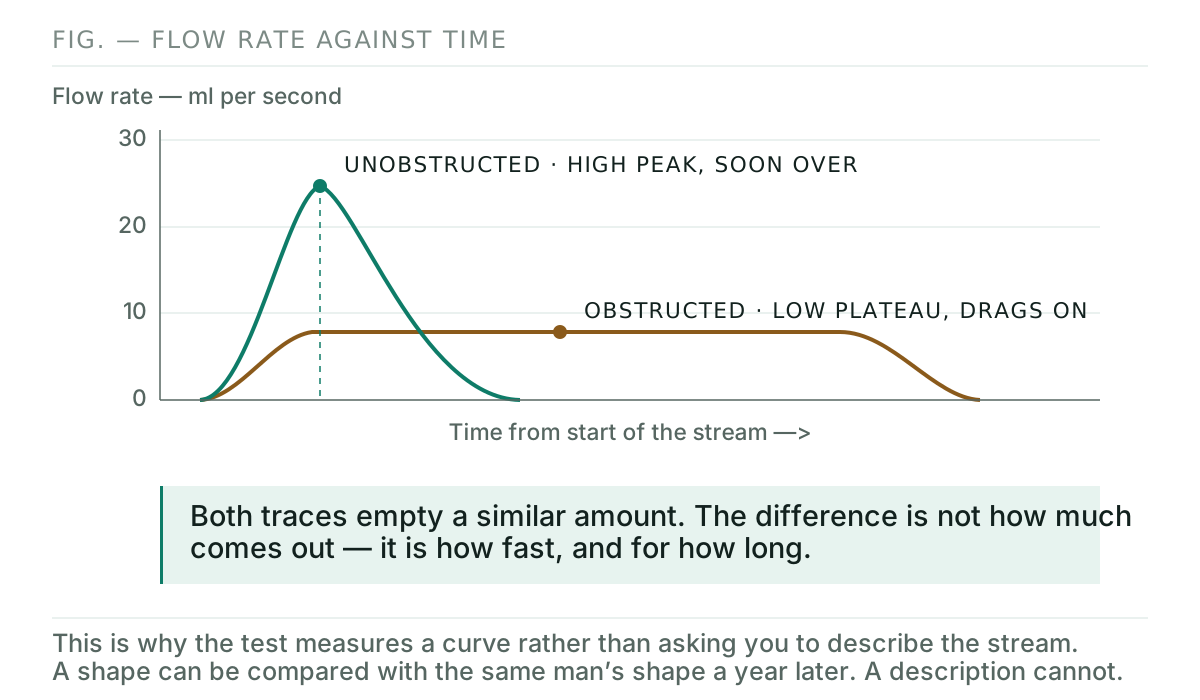
With a test called uroflowmetry, which is far less dramatic than it sounds. You urinate into a device that records the rate over time, and it produces a curve and a peak flow figure in milliliters per second. No needles, no camera, and it takes as long as urinating takes.
There is a catch that I think explains a lot of unnecessary alarm. The test needs a reasonable amount of urine in the bladder to be meaningful — go in with a nearly empty bladder and the result will look poor regardless of how healthy the outlet is. A single bad reading on a small volume is not a diagnosis.
Alongside it, a bladder scan measures how much urine is left behind afterwards. That number matters more than the stream itself, and it is the subject of the piece on why the bladder never feels empty. A weak stream that empties completely and a weak stream that leaves a reservoir behind are different situations wearing the same clothes.
What did I try, and did it help?
Two products, and no. The first was built around saw palmetto, which appears in nearly everything sold for this. The second was a tomato extract. I gave each a fair run and my stream was exactly what it had been — no more force, no faster start.
I want to be honest about the weight of that. One man noticing nothing proves very little. The reason I mention it is that it matches what the large trials found rather than contradicting them: the editorial team's summary of what the Cochrane review found on saw palmetto reports no improvement over placebo in symptom scores or in peak flow — the exact measurement this article is about.
If you intend to try something anyway, and plenty of reasonable men do, read how long prostate supplements take to work before you order — particularly the part about the refund window closing before the recommended trial period ends, which caught me out.
I was trying to fix a measurement I had never measured. That is the sentence I would put at the top of my own year, if I could go back and write it there.
When does a weak stream stop being a nuisance?
There is a short list, and it is short on purpose. These are not "keep an eye on it" items. They are reasons to be seen rather than to keep reading, and none of them require you to decide how bad things have become first.
- Blood in the urine, at any amount, even once
- Pain or burning when urinating
- Fever alongside urinary symptoms
- Deterioration over weeks rather than years
- Leaking between trips, which can mean the bladder is overfull rather than overactive
Being unable to urinate at all, with a full and painful bladder, is acute urinary retention. That is immediate care tonight — not a call in the morning, and not a decision to see whether it passes.
And one thing that is not on the list, which matters just as much: a weak stream is not a cancer symptom, and a strong stream is not protection against one. The two questions run on separate tracks, for reasons of anatomy that are explained in BPH versus prostate cancer.
What I would do differently
I am not going to finish by claiming I have reformed. I have not been to a doctor and the stream is what it was. But I know what I got out of order.
- Empty the medicine cabinet onto the table first. It costs nothing, takes ten minutes, and it is the only cause on this list you can investigate alone.
- Write down when it changed, as precisely as you can. Years or months is the single most useful thing you will bring to an appointment.
- Get it measured before treating it. I spent money aimed at a number I had never seen, which in any other part of my life I would have found ridiculous.
- Ask the pharmacist. No appointment, no examination, and they will tell you in two minutes whether anything on your list is working against you.
If your stream has changed and you are where I was — noticing, filing it under age, not alarmed — I would not tell you that you are in trouble. Most men in this position are not. I would only say that "it is just my age" is a conclusion, and I reached it without doing any of the work.
Key takeaways
- A weak urine stream usually means resistance on the way out, most often from an enlarged prostate.
- It can also mean the bladder muscle itself has weakened. That is a different problem with a different fix.
- Ordinary cold and allergy medicine can cause it — which is why those packages carry an FDA-required warning about it.
- The symptom feels identical in all three cases, so it tells you less than almost any other symptom.
- Flow is measured as a curve rather than a description, because a curve can be compared with your own a year later.
Where to go from here
If a weaker stream is what brought you here, these are the pieces that follow on:
- Enlarged Prostate After 40: Symptoms, Causes and What Actually Helps — the full guide, including what happens at an appointment.
- Can't Fully Empty Your Bladder? What's Going On — the symptom that most often travels with a weak stream.
- My Prostate Symptoms Are Mild. Should I Be Doing Something? — what I did before I understood any of this.
- Why Do I Wake Up 3 Times a Night to Pee? — for when the storage symptoms arrive too.
- BPH vs Prostate Cancer: How to Tell the Difference — the fear worth resolving properly.
- Prostatitis or Enlarged Prostate? How to Tell — the other condition that produces the same symptom list.
Frequently asked questions
What does a weak urine stream mean in a man over 50?
It usually means urine is meeting resistance on the way out, most often because an enlarged prostate is pressing on the urethra. It can also mean the bladder muscle itself has weakened, or that a medication is interfering. The symptom does not identify the cause.
Is a weaker stream just a normal part of aging?
Flow does decline gradually with age in most men, so some change is expected. But common is not the same as harmless. A stream that has changed noticeably within months, rather than drifting over years, is worth having assessed rather than accepted.
Can cold and allergy medicine cause a weak urine stream?
Yes. Oral decongestants and older antihistamines can tighten the bladder outlet or reduce bladder contraction. This is why those packages carry a warning telling men with prostate trouble to ask a doctor first. It is the cheapest cause to rule out.
Can a weak stream be caused by the bladder rather than the prostate?
It can. A bladder that has pushed against resistance for years can lose contractile strength, producing an identical weak stream with no significant blockage. The distinction matters because treatments aimed at opening the outlet do little for a bladder that is not squeezing.
How is a weak urine stream measured?
With uroflowmetry — you urinate into a device that records the rate. It reports a peak flow in milliliters per second. The test needs a reasonable volume in the bladder to be valid, which is why a small void can produce a misleadingly poor result.
When should a weak urine stream be seen urgently?
Blood in the urine, pain or burning, fever with urinary symptoms, or a stream that has deteriorated within weeks. Being unable to urinate at all is acute urinary retention, which is a medical emergency and needs immediate care rather than an appointment.
Sources
- National Institute of Diabetes and Digestive and Kidney Diseases (NIH) — Prostate Enlargement (Benign Prostatic Hyperplasia)
- Urology Care Foundation (American Urological Association) — Benign Prostatic Hyperplasia (BPH)
- Cleveland Clinic — Urethral Stricture
- Mayo Clinic — Benign prostatic hyperplasia: diagnosis and treatment
- Cleveland Clinic — Benign prostatic enlargement
- Cochrane Library — Serenoa repens for benign prostatic hyperplasia

Ray H.
Ray H. is a pen name. He is a real contributor in his sixties writing from his own experience, and he asked us not to publish his name or photograph — for exactly the reasons this site exists. He is not a doctor and does not give medical advice. His articles are fact-checked by our editorial team. Read why we publish him this way.
Medical disclaimer: This article describes one person's experience and is general information, not medical advice. The author is not a doctor. Nothing here diagnoses, treats or cures any condition, and a symptom that is common is not necessarily harmless. Please speak to a qualified healthcare professional about your own situation, and never start, stop or change a prescribed medication based on what you read online.