My Prostate Symptoms Are Mild. Should I Be Doing Something?
Short answer
Mild prostate symptoms mean you have noticed changes but they are not disrupting your life yet. Waiting and watching is a legitimate medical approach — but it is meant to be supervised. Doing it alone skips the step that rules out other causes, which is the step that actually matters.
These are mild prostate symptoms, and they started fairly recently. The stream is not what it was. There is the occasional sense of not being quite finished. Nothing dramatic — I am not up four times a night, I have not cancelled anything, and on most days I do not think about it at all.
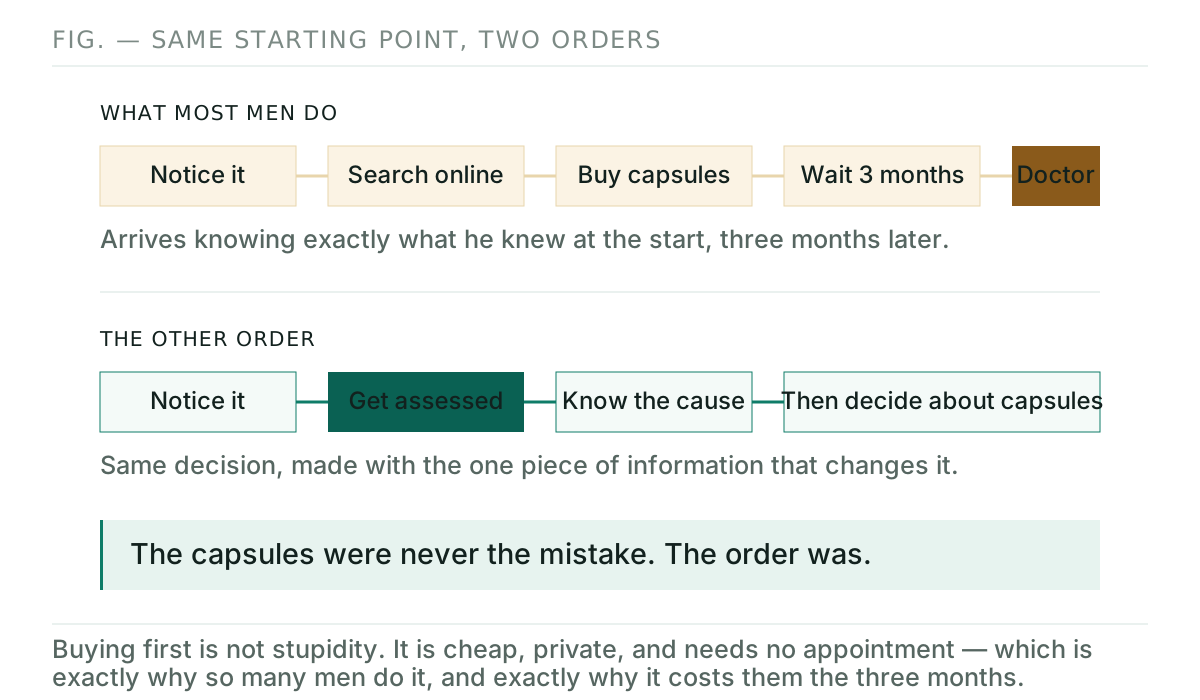
Which is exactly why I have not been to a doctor. And why, when I did decide to do something, the something I did was order two bottles of capsules.
I am writing this because I suspect a lot of men are exactly where I am — noticing, not panicking, quietly hoping it sorts itself out. I am not going to pretend I handled it well. But I have learned some things worth passing on, including from the editorial team here who fact-check what I write and who kept pointing me at research I had not read.
What does "mild" actually mean here?
It turns out this is not a vague word. Urologists grade severity using a seven-question symptom score, and the lowest band is formally classed as mild. It covers exactly what I have: noticeable changes to stream or frequency that are not yet interfering with sleep, work or daily routine.
Finding that out was oddly useful. "Mild" stopped being my own reassuring guess and became a category with a definition — and, more importantly, a number I could record now and compare against later. The full picture of what causes these changes is in the site's guide to an enlarged prostate after 40.
Fill in the symptom score and write down the date. It takes five minutes. Whatever you decide to do next — wait, try something, see someone — you will have a baseline, and without one you are comparing today against a memory of how things were a year ago. Memory is a terrible instrument for this.
Why did I buy supplements before seeing a doctor?
Because it required nothing of me. No appointment, no waiting room, no describing my urine stream to a stranger, no examination. I could take an action, feel that I had addressed it, and stay entirely inside my own house. That is the honest reason, and I suspect it is not only mine.
There was a second reason underneath the first. As long as I had not been examined, there was nothing to find out. Buying capsules let me feel proactive while remaining, in the way that mattered, completely passive.
Ordering something is not the same as doing something. It took me longer than I would like to admit to see the difference.
What happened when I tried them?
Nothing. I took two products. The first was built around saw palmetto, which is in almost everything sold for this. The second was based on a tomato extract. I gave each a fair run and noticed no change at all — not in the stream, not in frequency, not in the sense of incomplete emptying.
What I did not know at the time is that this is roughly what the research would have predicted. When I later read what the editorial team had written about the Cochrane review of saw palmetto, the finding was that it performed no better than placebo — including at double and triple the usual dose.
Cochrane's systematic review of Serenoa repens for benign prostatic hyperplasia found no improvement over placebo in urinary symptom scores or peak urine flow.
Cochrane Database of Systematic Reviews — Serenoa repens for benign prostatic hyperplasiaI want to be careful here, because "it did not work for me" is a weak kind of evidence and I know it. One man noticing nothing over a few weeks proves very little on its own. The reason I mention it at all is that it lines up with what large trials found — and if it had worked for me, that would also have proved very little.
If you are going to try something anyway, and plenty of sensible men do, the useful reading is how long prostate supplements take to work — particularly the part about refund deadlines expiring before the trial period ends, which I did not know and which cost me.
Is waiting actually harmful?
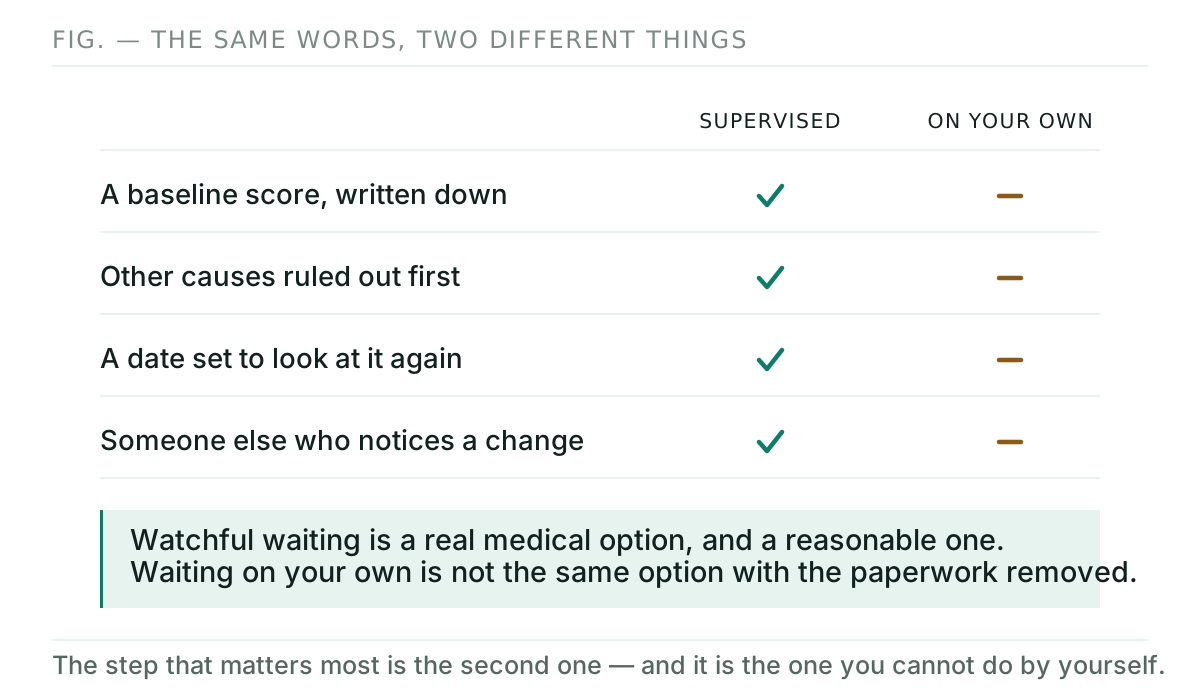
This is the question I most wanted a straight answer to, and the straight answer has two halves. Watchful waiting is a recognized medical approach for mild symptoms — it is not neglect, and doctors recommend it. But it is meant to be supervised, and mine has not been.
The difference is not a technicality. A doctor practicing watchful waiting has already ruled out infection, diabetes and other causes, and has a baseline to measure against. My version of waiting has ruled out nothing. We are using the same word for two completely different situations.
| Supervised monitoring | What I was doing | |
|---|---|---|
| Other causes ruled out | Yes — urine test, examination, bloods | No |
| Baseline recorded | Yes — symptom score and measurements | No |
| Review scheduled | Yes | No |
| Plan if it worsens | Yes | Worry about it then |
There is one more thing I had not considered. Symptoms alone cannot tell you what is causing them — mild symptoms are not proof of a mild cause, and the same changes can come from things that are not the prostate at all. That distinction is covered properly in BPH versus prostate cancer.
Do mild symptoms always get worse?
No, and this surprised me. Symptoms can remain stable for years, fluctuate with no obvious pattern, or occasionally settle. Progression varies a lot between men. That is genuinely reassuring — and it is also precisely why guessing from the inside does not work.
Because symptoms wander on their own, any change you notice after starting something might be the something, or might be the wandering. Without a recorded starting point you cannot tell the two apart. I could not, which is why my two-bottle experiment told me almost nothing.
What would make me stop waiting?
The editorial team here has a list, and it is short and specific. These are not "keep an eye on it" items — they are reasons to be seen rather than to research further, and I have written them on the inside of a kitchen cupboard.
- Blood in the urine, at any amount, once
- Pain or burning when urinating
- Fever alongside urinary symptoms
- A sudden change over weeks rather than years
- Waking repeatedly at night, once it costs you sleep — the reasons are in why you wake up three times a night to pee
Being unable to urinate at all is acute urinary retention. It is a medical emergency and needs immediate care — not a phone call in the morning, and not a decision to see whether it passes.
What I would do differently
I am not going to end this by claiming I have reformed and booked everything. I have not been yet. But I know what I got wrong, and the order was the main thing — I bought a solution before I had a diagnosis, which is a strange way to treat anything.
If I were starting again, four steps, in this order:
- Record a baseline. Symptom score plus one day of noting times and rough volumes. Five minutes and one day.
- Get assessed before buying anything. Not to start treatment — just to find out what I am dealing with. Most of it is a questionnaire, a urine sample and a short examination.
- Then decide about supplements, if at all, with a fixed end date and the refund deadline written in the calendar.
- Tell someone. Saying it out loud once removes most of its power. I told my wife months after I started buying capsules, which is its own small piece of evidence about how this works.
If you are where I am — noticing, not panicking, quietly hoping — I would not tell you that you are in danger. Mild is mild, and the research says it may well stay that way. I would only say that the appointment is smaller than the thing you are imagining, and the waiting is bigger.
Key takeaways
- “Mild” means noticed but not yet disruptive. It is a band on a score, not a feeling.
- Watchful waiting is a legitimate medical approach, and it is meant to be supervised.
- Waiting on your own leaves out the step that matters most: ruling out the other causes.
- Buying capsules first is not stupidity. It is cheap, private and needs no appointment — it just costs you the months.
- The capsules were never the mistake. The order was.
Where to go from here
If you are at the same stage, these are the pieces I found most useful:
- Enlarged Prostate After 40: Symptoms, Causes and What Actually Helps — the full picture, including what happens at an appointment.
- Saw Palmetto for Prostate: What the Cochrane Review Actually Found — the evidence on the ingredient I tried first.
- How Long Do Prostate Supplements Take to Work? — including the refund deadline trap I walked into.
- Why Do I Wake Up 3 Times a Night to Pee? — for when mild stops being mild.
- Prostate Supplements and Blood Pressure Medication — read this before buying anything if you take prescriptions.
- What Actually Happens at a Prostate Exam — the appointment described plainly, start to finish.
- Prostate Medications: What Each One Actually Does — the two prescription classes, what each does and how fast.
- Foods and Drinks That Make Prostate Symptoms Worse — the drink changes worth testing first, and why drinking less backfires.
Frequently asked questions
What counts as mild prostate symptoms?
Urologists grade severity with a seven-question symptom score, and the lowest band is classed as mild. In practice it means you have noticed changes to your stream or frequency, but they are not yet disrupting your sleep, work or daily routine.
Is it safe to wait if my symptoms are mild?
Monitoring is a recognized medical approach for mild symptoms, but it is meant to be supervised rather than done alone. The difference matters: a doctor watching you has ruled out other causes first, whereas waiting by yourself has ruled out nothing.
Do mild symptoms always get worse over time?
Not necessarily. Symptoms can stay stable for years, fluctuate, or occasionally improve. Progression varies considerably between men, which is one reason doctors record a baseline score — so change can be measured rather than guessed at.
Should I try a supplement before seeing a doctor?
I did, and I would not repeat it. The evidence for the main ingredients is weak, and the real cost is the time spent. Getting assessed first tells you what you are treating, which no capsule can do.
What symptoms mean I should stop waiting?
Blood in your urine, pain or burning, fever alongside urinary symptoms, or a sudden change over weeks rather than years. Being unable to urinate at all is a medical emergency requiring immediate care, not an appointment.
What should I bring to a first appointment?
A completed symptom score, a 24-hour record of when you urinated and roughly how much, a list of all medications and supplements, and a note of when the changes started. That turns a vague complaint into something a doctor can work with.
Sources
- National Institute of Diabetes and Digestive and Kidney Diseases (NIH) — Prostate Enlargement (Benign Prostatic Hyperplasia)
- Urology Care Foundation (American Urological Association) — Benign Prostatic Hyperplasia (BPH)
- Cochrane Library — Serenoa repens for benign prostatic hyperplasia
- Mayo Clinic — Benign prostatic hyperplasia: diagnosis and treatment
- Cleveland Clinic — Benign prostatic enlargement

Ray H.
Ray H. is a pen name. He is a real contributor in his sixties writing from his own experience, and he asked us not to publish his name or photograph — for exactly the reasons this site exists. He is not a doctor and does not give medical advice. His articles are fact-checked by our editorial team. Read why we publish him this way.
Medical disclaimer: This article describes one person's experience and is general information, not medical advice. The author is not a doctor. Nothing here diagnoses, treats or cures any condition, and mild symptoms are not proof of a harmless cause. Please speak to a qualified healthcare professional about your own situation, and never start, stop or change a prescribed medication based on what you read online.