What Actually Happens at a Prostate Exam
Short answer
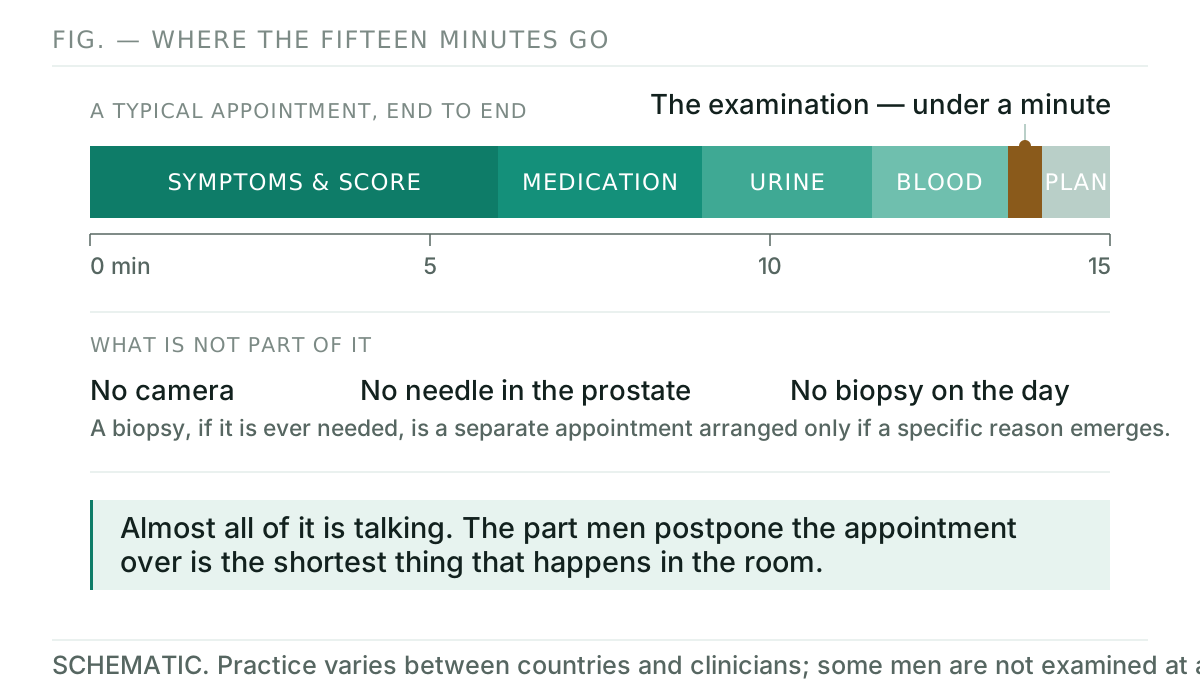
Most of a prostate appointment is talking. A clinician asks about your symptoms using a standard seven-question score, reviews your medication, and tests a urine sample. A blood test and a brief physical examination may follow. The whole thing usually takes ten to fifteen minutes, and the rectal examination, if it happens at all, lasts under a minute.
There is a specific reason men delay this appointment, and it is not that they are unaware of the symptoms. It is a picture in the head of what the appointment involves — and that picture is almost always worse, and stranger, than the real thing.
The most useful thing anyone can do about that is describe the appointment plainly, in order, with nothing left out. So that is what this page does.
It is part of our complete guide to an enlarged prostate after 40, and it is written for the man who has read everything else on this site and still has not booked anything.
What actually happens, in order
The appointment is mostly a conversation, and the physical part is the shortest section of it. A typical sequence looks like this.
- Questions about your symptoms. When they started, how they have changed, how often you get up at night, whether the stream has weakened, whether you feel emptied.
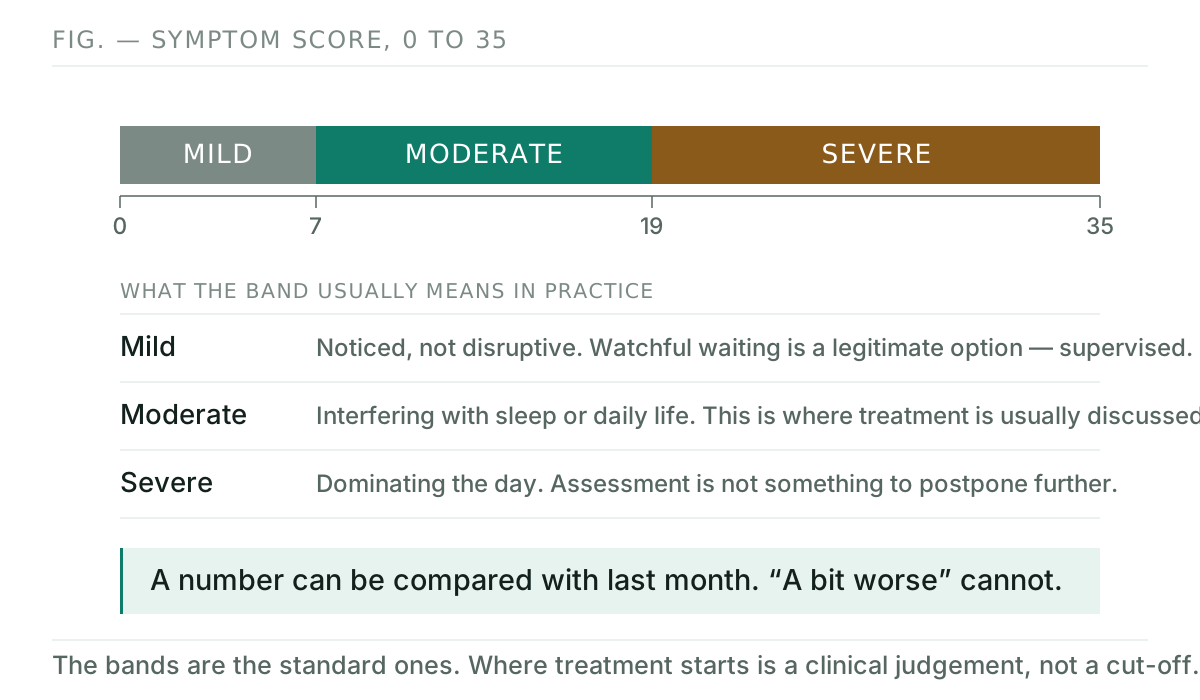
- A symptom score. Seven standard questions, answered on a scale, producing a number between 0 and 35. This is the baseline everything later is compared against.
- Your medication list. Including things you would not think to mention, which is why bringing the actual boxes helps.
- A urine sample. Checked for infection and blood, because both change the interpretation of everything else.
- Possibly a blood test. Kidney function, and PSA if you have discussed and agreed to it.
- Possibly a brief physical examination. Abdomen, and in some cases the rectal examination described below.
- What happens next. Which is often nothing dramatic: a plan, a repeat measurement, or a referral for a flow test and bladder scan.
Note what is not on the list. No undressing beyond what a brief examination requires, no camera, no needle in the prostate, no procedure. A biopsy is a separate appointment arranged only if a specific reason emerges, and most men never reach that point.
What the physical examination is actually like
The digital rectal examination is the part that keeps men out of the room, so it is worth describing precisely rather than delicately.
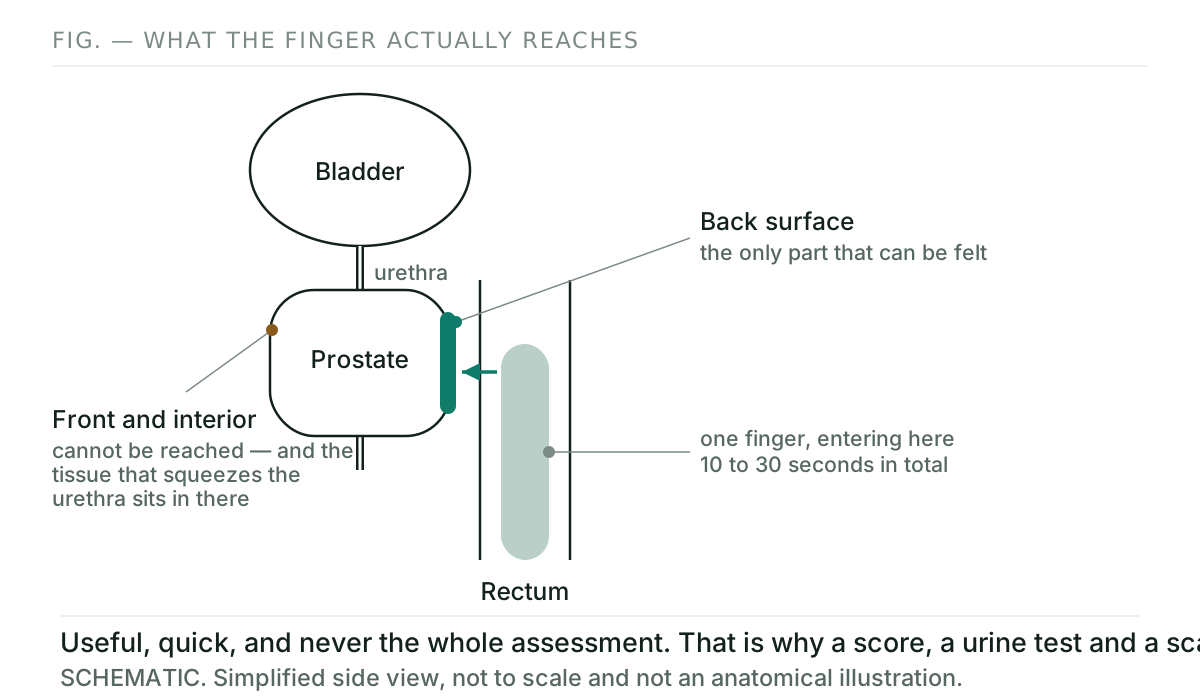
You are asked to lower your trousers and lie on your side on the couch, knees drawn up towards your chest. Some clinicians instead ask you to stand and lean forward. A glove and lubricant are used. A single finger is inserted a short distance — the prostate sits just beyond the entrance, against the front wall — and the clinician feels across the back surface of the gland, checking its size, its texture and whether it is even. Then it is over.
The examination itself typically takes between ten and thirty seconds. Most men describe pressure and a brief urge to urinate rather than pain.
NHS and National Cancer Institute patient information — see sources belowTwo practical details that nobody mentions and everybody wonders about. Clinicians will ask you to breathe out as they begin, because tensing is what makes it uncomfortable. And the urge to urinate is normal and expected — the prostate sits directly against the outlet, so pressure on it produces exactly that sensation.
Will you definitely have one?
No, and this has changed. The value of a routine rectal examination as a screening test in men with no symptoms is increasingly questioned, because its ability to detect early disease on its own is limited. Many pathways now lead with the symptom score, a urine test and a blood test.
Where it retains clear value is as part of assessing a man who does have symptoms: it gives an immediate sense of the size and character of the gland, which helps direct what comes next.
You can also say what you would prefer. Asking to begin with the questionnaire, the urine sample and the blood test, and to discuss the examination afterwards, is a reasonable request that clinicians hear regularly. The appointment is not a fixed sequence you must submit to in full.
You may ask for a chaperone to be present. You may ask for a clinician of a particular sex, where the practice can accommodate it. You may ask what is about to happen before it happens, and you may ask to stop at any point. None of these requests is unusual, and you do not have to explain any of them.
What you will be asked
The seven-question symptom score is the backbone of the appointment, and you can complete it before you arrive. It covers, over the past month: incomplete emptying, how often you go, whether the stream stops and starts, how hard it is to postpone, how weak the stream is, whether you have to strain, and how many times you get up at night.
Each is scored, and the total places you in a band. That band is not a diagnosis; it is a measurement of how much this is affecting your life, and a fixed point to compare against in a year.
The last question is usually separate and matters more than men expect: how would you feel about spending the rest of your life with your symptoms exactly as they are now? Treatment decisions for a benign problem rest heavily on that answer, so it is worth thinking about honestly rather than stoically.
What to bring, and why it changes the appointment
Five minutes of preparation converts a vague conversation into a measured one. The difference is real: a clinician working from "it has got a bit worse, I think" has far less to act on than one holding a number and a count.
- Everything you take, in the box. Prescriptions, and also cold and allergy remedies and supplements. Ordinary decongestants and antihistamines can weaken the stream on their own, which is covered in weak urine stream after 50.
- A few nights of counts. How many times you actually got up, rather than your impression of it. The method is in waking up to pee at night.
- A completed symptom score. Filled in calmly at home rather than under time pressure in the room.
- When it started, as precisely as you can. Months or years is the single most useful thing you can offer.
- Any previous PSA result, with its date. The trend matters more than one figure, as explained in PSA levels by age.
What happens after
For most men with moderate symptoms and a benign examination, the answer is a plan rather than a procedure. That may be supervised watchful waiting, with a date to reassess and a score to compare against. It may be a trial of medication. It may be a referral for a flow test and a bladder scan, both quick and neither invasive.
Those two measurements answer questions the appointment alone cannot: how forcefully urine leaves, and how much stays behind. What each one means is set out in can't fully empty your bladder.
Ask for your numbers before you leave, and write them down with the date — the symptom score, the PSA if one was taken, any measured volume. This is the single most valuable thing you take home, and almost nobody is offered it unprompted.
The part nobody says out loud
It is worth naming the actual obstacle. For most men it is not fear of illness. It is the prospect of describing their urine stream to a stranger and then being examined, and the quiet hope that if left alone the problem might resolve itself.
That reluctance is not unusual or shameful, and clinicians in this field encounter it every day of their working lives. Nothing you describe will be new to them, and nothing about the examination is remarkable from their side of it.
The appointment is smaller than the thing you are imagining. The waiting is bigger.
One of our contributors has written about this from the inside, including the part where he bought supplements rather than book anything, in my prostate symptoms are mild. He still has not made the appointment, and he says so.
Who will you actually see?
For urinary symptoms the first appointment is almost always with a general practice or primary care clinician rather than a specialist. That is the right place to start, and it is worth knowing because men sometimes delay on the assumption that the first conversation will be with a urologist and will therefore be a bigger event than it is.
That first clinician can do most of what the early assessment requires: take the history, score the symptoms, test the urine, review your medication, order the blood test and examine you if that is agreed. In many cases nothing further is needed, because the picture is a common benign one with a straightforward plan.
A referral follows when something specific calls for it — a result that needs explaining, symptoms that are not settling, a finding on examination, or a measurement that warrants a specialist opinion. A urologist then has access to the tests a general practice does not, including flow studies and scanning.
It is also worth knowing that some practices offer a nurse-led or telephone first appointment for exactly this. If the prospect of the room is what is stopping you, ask what the options are when you book. The person on the phone will have been asked before.
If you genuinely cannot face the examination
This is worth addressing directly, because for a proportion of men it is not nerves that can be talked away. It is a firm no, and the result is that nothing gets done at all for years.
The useful thing to understand is that the appointment is not all-or-nothing. There is a ladder, and every rung on it is worth more than staying at home.
- Book to talk only. Say at the outset that you want to discuss symptoms and are not consenting to an examination today. That is a complete and legitimate appointment.
- Complete the symptom score at home and bring it. That alone gives a clinician most of what the conversation would have established.
- Start with the urine test and the blood test. Neither involves being examined, and between them they exclude infection and give a PSA figure to work from.
- Ask what an examination would add in your case. Sometimes the answer is very little, and knowing that changes the decision.
- Decide afterwards. You can agree to be examined at a second appointment, once you know the person and what they are looking for.
None of that is a workaround or an awkward request. It is how a reasonable consultation works when a patient says what they are and are not comfortable with. The alternative — which is what most men in this position actually choose — is another two years of not knowing, and that is the option with a real downside.
When not to wait for a routine appointment
Everything above assumes symptoms that have come on gradually. A short list of situations needs attention sooner, and they involve no judgement about severity.
- Being unable to pass urine at all, with a full, painful lower abdomen. This is treated the same day.
- Blood in the urine, at any amount and even once.
- Fever alongside urinary symptoms, or pain low down or in the back.
- New weakness or numbness in the legs or groin alongside a change in urination.
- Symptoms that worsen quickly, over days or a few weeks rather than gradually.
Complete inability to pass urine needs care the same day — not a call in the morning and not a wait to see whether it resolves. It is treated quickly and simply when seen early, and it becomes considerably more serious when it is not.
Key takeaways
- Most of the appointment is conversation. It typically runs ten to fifteen minutes in total.
- The rectal examination, where it happens, lasts roughly ten to thirty seconds and should not be painful.
- You will not necessarily have one. Its role as a routine screening test in men without symptoms is increasingly questioned.
- You may ask for a chaperone, ask questions before anything happens, and stop at any point, without explaining why.
- Bring your medication boxes, a few nights of counts and a completed symptom score. Leave with your numbers written down.
Where to go from here
If you are working out whether to book something, these are the pieces that go with this one:
- PSA Levels by Age: What Your Number Actually Means — the blood test, and why the trend beats a single figure.
- Enlarged Prostate After 40: Symptoms, Causes and What Actually Helps — the complete guide.
- My Prostate Symptoms Are Mild. Should I Be Doing Something? — one contributor on why he waited.
- Weak Urine Stream After 50: What It Actually Means — including the medicine-cabinet causes worth checking first.
- Can't Fully Empty Your Bladder? What's Going On — the measurement a scan produces, and what it means.
- Prostate Medications: What Each One Actually Does — the two prescription classes, what each does and how fast.
- Prostatitis or Enlarged Prostate? How to Tell — the other condition that produces the same symptom list.
Frequently asked questions
What happens at a prostate exam?
Most of the appointment is talking. A clinician asks about your urinary symptoms, usually through a standard seven-question score, checks your medication list and tests a urine sample for infection. A blood test and a brief physical examination may follow. It typically takes ten to fifteen minutes.
How long does a digital rectal exam take?
The examination itself lasts roughly ten to thirty seconds. A gloved, lubricated finger is inserted a short distance to feel the back surface of the prostate for size, texture and irregularity. It is usually described as uncomfortable and briefly odd rather than painful.
Will I definitely have a rectal examination?
Not necessarily. Its value as a routine screening test in men without symptoms is increasingly questioned, and many pathways now lead with a symptom score, a urine test and a blood test. You can also ask to start with those and discuss the examination afterwards.
Does a prostate exam hurt?
It should not. Most men report pressure and a brief urge to urinate rather than pain. Tensing makes it more uncomfortable, so clinicians ask you to breathe out as they begin. Tell them if anything hurts, because pain itself is useful information.
Can I ask for a chaperone or a different clinician?
Yes, and neither request is unusual. You may ask for a chaperone to be present, request a clinician of a particular sex where the practice can accommodate it, and stop the examination at any point. You do not have to explain why.
What should I bring to a prostate appointment?
A complete list of everything you take, including cold and allergy medicine and supplements, plus a few days of night-time bathroom counts and a completed symptom score. That turns a vague conversation into a measured one and takes about five minutes to prepare.
Sources
- National Institute of Diabetes and Digestive and Kidney Diseases (NIH) — Prostate Enlargement (Benign Prostatic Hyperplasia)
- National Cancer Institute — Prostate-Specific Antigen (PSA) Test
- National Cancer Institute — Digital rectal examination (NCI Dictionary of Cancer Terms)
- NHS — Prostate problems
- US Preventive Services Task Force — Prostate Cancer: Screening

Male Health Guide Editorial Team
We write about the health problems men over 40 actually search for at 3 a.m. — and we say plainly when the evidence for a popular product is thin. We do not invent credentials and we do not publish sponsored copy as editorial. Read more about how we work.
Medical disclaimer: This article is general information, not medical advice. We are not doctors, and nothing here diagnoses, treats or cures any condition. Practice varies between countries and between clinicians, so your own appointment may differ from the sequence described here. Please speak to a qualified healthcare professional about your own situation.