Can't Fully Empty Your Bladder? What's Going On
Short answer
The feeling that your bladder never empties and the amount actually left inside it are two different things, and they often disagree. Only one of them can harm you. A two-minute ultrasound measures the real figure, which is why this symptom is worth having checked rather than interpreted.
Of everything I have noticed, this is the one I would find hardest to say out loud in a doctor's office. The stream I could describe. This I could not.
You finish, you leave, and a minute later something tells you the job was not done. Then you go back and produce almost nothing, which somehow makes it worse rather than better.
I have had this on and off for about seven months. Not every day. But I know where the bathroom is in whatever building I am in, and I did not use to. That is not a dramatic change to a life, but it is a change, and it happened without my agreeing to it.
Seven months, and I still have not been to a doctor about it. I am not one either. What follows is what I went and read, checked by the editorial team here, who as usual sent me back to read it properly.
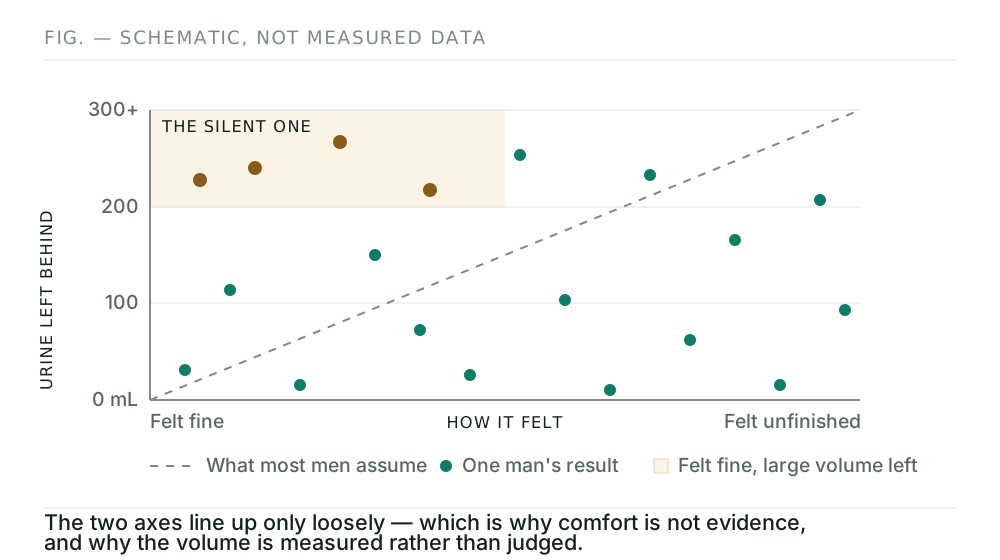
Almost everything written about this symptom treats the feeling as the fact. It is not. There is a measurement underneath it — the volume of urine genuinely left in the bladder after urinating — and the gap between the two is the single most useful thing to understand here. Men who feel fine sometimes have a substantial amount left behind. Men who feel permanently unfinished sometimes have almost nothing.
This article is about that gap: what causes it, how the real number is taken, what the number means, and the point at which this stops being an annoyance and starts being a medical problem.
What does it mean when your bladder never feels empty?
Most often it means urine really is being left behind, because something is standing in the way. In men over 40 the usual candidate is an enlarged prostate narrowing the urethra, so the bladder cannot fully discharge before the stream gives out. The residue then triggers the feeling almost immediately.
Urologists include this among the voiding symptoms, alongside a weakening stream, hesitancy, and dribbling at the end. These tend to arrive together because they share a mechanism, which is why a man with one of them usually recognizes the others when they are described.
But there is a second possibility that changes the whole picture. An irritated or overactive bladder can generate the same sensation while emptying perfectly well — the urge returns because the bladder wall is signaling, not because there is anything left in it. From the inside, the two feel identical.
Does the feeling match what is actually left behind?
Frequently it does not, and this is the point on which most coverage of this symptom goes wrong. The volume left after urinating is called the post-void residual, and it correlates loosely with how complete the emptying felt. Doctors do not accept the sensation as a proxy for the number, and neither should you.
The mismatch runs in both directions, and both directions matter:
| What you feel | What the scan can show | Why it matters |
|---|---|---|
| Never quite finished | Almost nothing left | The bladder is emptying; the problem is irritation or urgency, and outlet-focused treatment is aimed at the wrong thing |
| Never quite finished | A large volume left | Genuine retention — this is the version that carries risk and needs following |
| Perfectly normal | A large volume left | The dangerous one. It is silent, it is not rare, and nothing about it prompts you to act |
That third row is the reason this article exists. A bladder can stretch and accommodate gradually enough that the fullness stops registering, which means the men with the most urine retained are not necessarily the men who feel it most. Comfort is not evidence.
I had to read that row twice. If you had asked me a year ago whether my bladder was emptying properly, I would have answered from the sensation — I feel more or less fine, so it is more or less fine. I would not have thought of that as a guess. The whole reason the measurement exists is that the men in the third row would have answered exactly the same way.
How is residual urine measured?
With a bladder scan, which is far less involved than most men expect. You urinate normally, then a small ultrasound probe is placed on the lower abdomen and the volume remaining is read off in milliliters. There are no needles, no catheter and no preparation, and the whole thing takes about two minutes.
It is usually done alongside a flow test, where you urinate into a device that records the rate. Together they answer two separate questions — how forcefully it came out, and how much stayed in — and either one alone can mislead.
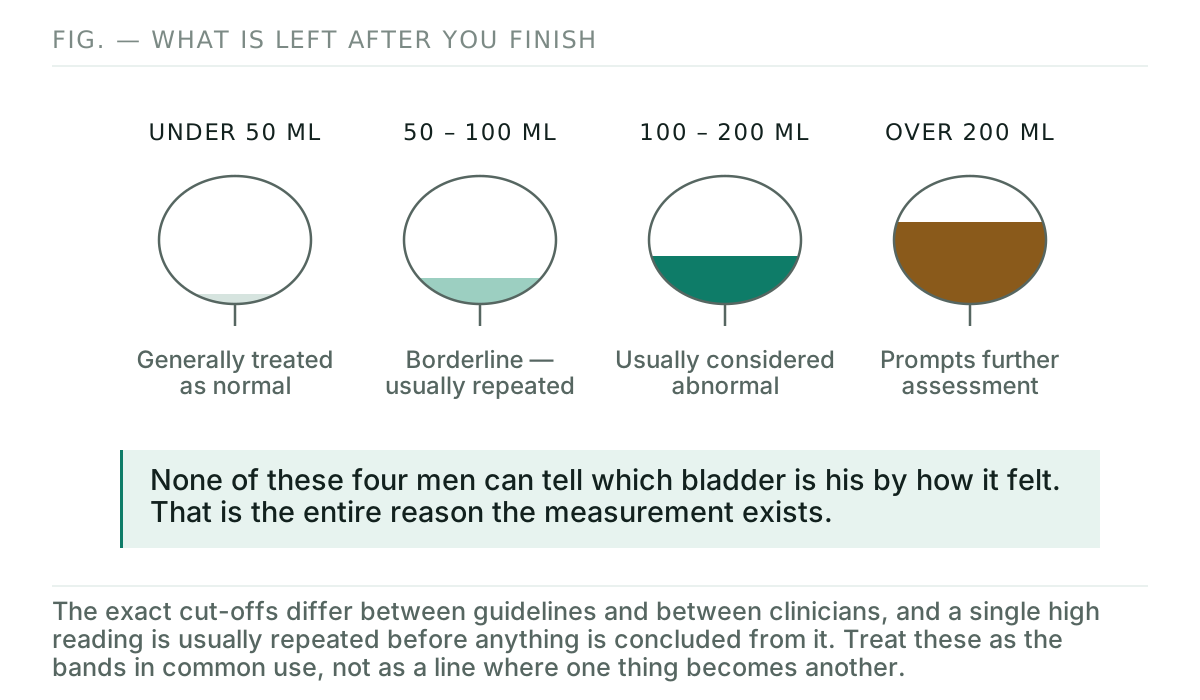
As for what counts as too much: there is no universally agreed threshold, and any site quoting one as settled is overstating the evidence. Broadly, very small volumes are treated as normal emptying and volumes in the hundreds of milliliters are treated as abnormal and worth investigating. What clinicians pay most attention to is not a single figure but whether it is climbing over successive visits.
If you have a bladder scan, ask what the reading was and record it with the date. A single measurement tells you comparatively little; the same measurement repeated in a year tells you the one thing that actually guides decisions here. Nobody will volunteer this, and nobody will mind you asking.
There is something I did not expect from paying attention to this. It feels worse than it did when it started. I want to be careful with that sentence, because I have never written a single thing down — so what I am comparing is this month's impression against my memory of an earlier one, and somewhere in between I started actively checking for it. It feels worse. I cannot tell you that it is worse. Those are two different sentences, and from the inside they feel identical.
That is not an argument for ignoring it. It is an argument for the thing I keep arriving at from a different direction each time I write one of these: a number written down on a Tuesday can be compared with a number written down three months later. A memory of how Tuesday felt cannot.
What causes incomplete emptying?
Three broad mechanisms, and they are not mutually exclusive. Working out which one is operating is the entire diagnostic task, and it cannot be done from symptoms because all three produce the same complaint.
- Obstruction. An enlarged prostate is the common one, but a urethral stricture — scar tissue in the urethra, often long after an infection, injury or catheter — does the same job and responds to none of the same treatments.
- A bladder that is not contracting properly. After years of pushing against resistance, the bladder muscle can lose strength. It can also be affected by nerve conditions: diabetes is the most common, and spinal problems, Parkinson's and multiple sclerosis also interfere with the signal.
- Medication. Oral decongestants tighten the bladder outlet. Older sedating antihistamines, some antidepressants, opioid painkillers and drugs prescribed for bladder urgency all reduce the bladder's ability to contract. Several of these are sold over the counter and carry a printed warning about exactly this.
The medication route deserves particular attention because it is the only one on the list that can be investigated without leaving the house, and because it is reversible. A pharmacist can review the whole list in a few minutes at no cost and without an appointment. Anything you are considering adding belongs in the same conversation — see prostate supplements and blood pressure medication.
If something on your list may be contributing, that is a discussion with the prescriber, not a decision to make alone. Stopping an antidepressant or a pain medication without supervision carries risks that outweigh a urinary symptom.
Can incomplete emptying be dangerous?
Yes, in its more advanced form, and this is where the symptom earns serious attention. Urine that sits in the bladder repeatedly raises the risk of urinary tract infections and bladder stones, because stagnant fluid gives bacteria and mineral deposits time to establish themselves.
The more serious concern is pressure. When a bladder is chronically full, that pressure can transmit backward toward the kidneys, and in a minority of men that leads to measurable kidney impairment. This form of chronic retention is frequently painless, which removes the one signal that would otherwise prompt a man to seek help.
There is also a symptom that is regularly misread. Leaking urine when the bladder is chronically overfull — overflow incontinence — looks from the outside like a weak or overactive bladder, and men often treat it as embarrassing rather than as a warning. It is pointing at the opposite problem from the one it appears to indicate.
Chronic urinary retention can develop without pain and may present through complications — recurrent infections, bladder stones, overflow leaking, or reduced kidney function — rather than through discomfort.
National Institute of Diabetes and Digestive and Kidney Diseases — Urinary RetentionDoes sitting down to urinate actually help?
For men with an enlarged prostate, the evidence says it may — modestly, measurably, and at no cost. It is one of the few interventions in this whole subject that has been studied directly and can be tested by anyone reading this within a week.
A systematic review and meta-analysis published in PLOS ONE compared urinating standing with urinating sitting. In men with prostate enlargement, sitting was associated with less urine left behind and a modestly higher peak flow rate. In men without urinary symptoms, position made no measurable difference at all.
In men with lower urinary tract symptoms from prostate enlargement, the sitting position was associated with a reduction in post-void residual volume and an improvement in maximum urinary flow rate. In healthy men, no significant difference was found.
PLOS ONE, 2014 — Urinating Standing versus Sitting: Position Is of Influence in Men with Prostate EnlargementWe report this with the caveat it deserves: the improvements were small, and small improvements in a measurement are not the same as feeling better. But it is free, carries no risk, and unlike almost everything else marketed for this symptom, someone has actually tested it.
What can you do about it yourself?
Four things, none of which require a purchase, and all of which are worth doing before or alongside anything else. They will not cure an obstruction, but several of them are standard advice from urology clinics rather than internet folklore.
- Double voiding. After you finish, wait roughly thirty seconds, then try again without straining. For some men this recovers a meaningful amount.
- Sit down. Based on the evidence above. Give it a week before deciding.
- Do not rush or strain. Straining raises abdominal pressure without helping the bladder contract, and can make emptying worse rather than better.
- Review every medication and supplement with a pharmacist, including anything bought over the counter for a cold or for sleep.
What none of these do is empty a bladder that is not contracting, and that is worth stating plainly because it is the honest limit of self-management. It is also the limit of what any capsule can do. If you are weighing up a product for this, the timelines and refund terms are covered in how long prostate supplements take to work.
When does this become urgent?
There is a short list, and unlike much of this subject it involves no judgment calls about severity. These are reasons to be seen rather than to read further.
- Unable to urinate at all, with a full and painful lower abdomen — acute urinary retention
- Fever alongside urinary symptoms
- Blood in the urine, at any amount
- Leaking between trips, which may mean overflow from a full bladder
- New weakness or numbness in the legs or groin alongside urinary change
Being completely unable to pass urine needs immediate care the same day — not a call in the morning and not a wait to see whether it resolves. It is treated quickly and simply when seen early, and it becomes a great deal more serious when it is not.
Everything else on this page points in one direction: this is a symptom with a number underneath it, and the number is easy to obtain. If a bladder scan and a flow test are two minutes each and settle a question you have been carrying around for months, the arithmetic is not close.
What I would do differently
There is no appointment at the end of this. I have not made one. But there is a specific thing I would change, and it is smaller than an appointment.
I would find out the number. Two minutes, an ultrasound, no needle. Whatever it says, it replaces a sensation I cannot trust — including the possibility that it says everything is fine and I stop thinking about it.
I have now written a version of that sentence in three articles, from three different symptoms, and I notice I still have not acted on it. I am leaving that in rather than tidying it up, because I suspect it is the most useful thing on this page for the man who is where I am.
Key takeaways
- The feeling that your bladder never empties and the amount actually left behind are two separate facts.
- They disagree in both directions: you can feel fine and be retaining a lot, or feel terrible and be emptying normally.
- The dangerous case is the one that feels fine. That is the whole argument for measuring instead of interpreting.
- The measurement is an ultrasound that takes about two minutes and involves no needle.
- A single high reading is usually repeated before anything is concluded from it.
Where to go from here
If incomplete emptying is what brought you here, these are the next pieces to read:
- Enlarged Prostate After 40: Symptoms, Causes and What Actually Helps — the full guide and what happens at an appointment.
- Weak Urine Stream After 50: What It Actually Means — the symptom that almost always travels with this one.
- Why Do I Wake Up 3 Times a Night to Pee? — because a bladder that never empties fills again sooner.
- My Prostate Symptoms Are Mild. Should I Be Doing Something? — one contributor on why he waited.
- BPH vs Prostate Cancer: How to Tell the Difference — why these symptoms cannot answer that question.
Frequently asked questions
Why does my bladder never feel empty?
Usually because urine is genuinely being left behind, most often when an enlarged prostate obstructs the outlet or the bladder muscle has weakened. But the sensation can also occur with an irritated bladder that is emptying perfectly well. The feeling alone does not settle it.
How much urine left in the bladder is too much?
There is no single agreed cutoff. Very small volumes are generally regarded as normal emptying, and volumes in the hundreds of milliliters are generally regarded as abnormal and worth investigating. What matters more than one reading is whether the figure is rising over time.
How is residual urine measured?
With a bladder scan — a small ultrasound device placed on the lower abdomen straight after you urinate. It is painless, takes about two minutes, involves no needles or catheter, and gives a number in milliliters that the sensation cannot give you.
Is it dangerous to have urine left in the bladder?
It can be. Persistently retained urine raises the risk of infections and bladder stones, and in some men it raises pressure inside the system enough to affect the kidneys. The concerning form is often painless, which is precisely why it needs measuring rather than judging.
Does sitting down to urinate help empty the bladder?
For men with prostate enlargement, a meta-analysis found that sitting was associated with less urine left behind and a modestly better flow rate. In men without urinary symptoms, position made no measurable difference. It costs nothing to test for a week.
When is incomplete emptying an emergency?
Being unable to urinate at all, with a full and painful lower abdomen, is acute urinary retention and requires immediate care. Fever with urinary symptoms, blood in the urine, or leaking because the bladder is overfull also need to be seen promptly.
Sources
- National Institute of Diabetes and Digestive and Kidney Diseases (NIH) — Urinary Retention
- National Institute of Diabetes and Digestive and Kidney Diseases (NIH) — Prostate Enlargement (Benign Prostatic Hyperplasia)
- Urology Care Foundation (American Urological Association) — Benign Prostatic Hyperplasia (BPH)
- de Jong Y, et al., PLOS ONE (2014) — Urinating Standing versus Sitting: Position Is of Influence in Men with Prostate Enlargement
- Mayo Clinic — Benign prostatic hyperplasia: diagnosis and treatment
- Cleveland Clinic — Urinary retention

Ray H.
Ray H. is a pen name. He is a real contributor in his sixties writing from his own experience, and he asked us not to publish his name or photograph — for exactly the reasons this site exists. He is not a doctor and does not give medical advice. His articles are fact-checked by our editorial team. Read why we publish him this way.
Medical disclaimer: This article is for general information only. We are not doctors and nothing here diagnoses, treats or cures any condition. Retained urine can be serious and can be painless, which is why it needs assessing by a clinician rather than estimating at home. Please speak to a qualified healthcare professional about your own situation, and never start, stop or change a prescribed medication based on what you read online.