BPH vs Prostate Cancer: How to Tell the Difference

Short answer
BPH and prostate cancer cannot be told apart by symptoms, and that is the whole point. Benign enlargement grows in the zone wrapped around the urethra, so it causes urinary trouble early. Most prostate cancers begin in the outer zone, away from the urethra, and cause nothing at all until much later.
Most men arrive at the BPH vs prostate cancer question the same way. Something changed — the stream, the frequency, the nights — and after a week or two of noticing it, a quieter question surfaced underneath. It is rarely asked out loud, and it is almost never asked of a doctor first.
The answer the internet usually gives is a comparison table: BPH does this, cancer does that, check which column matches you. We are not going to publish one of those, because the premise is wrong. Symptoms cannot separate these two conditions, and building a table that implies they can is worse than useless — it hands a worried man a false reassurance and sends him away.
What we can do is explain why symptoms cannot separate them. The reason is anatomical, it is not complicated, and once you have it, everything else on this page — including why the digital rectal examination exists at all — follows from it.
Can symptoms tell BPH and prostate cancer apart?
No. Urinary symptoms in a man over 40 are far more likely to come from benign enlargement than from cancer, so the odds are genuinely on your side. But likelihood is not exclusion. Symptoms shift the probability; they do not close the question, and early prostate cancer typically produces no symptoms whatsoever.
That last clause is the part that catches men out, because it runs the wrong way from intuition. We are used to disease announcing itself, and to feeling well as evidence of being well. Here, the absence of symptoms carries almost no information.
Having urinary symptoms does not mean you have cancer — and this is the common fear. Having no urinary symptoms does not mean you do not — and this is the common mistake. The second one is quieter and does more damage, because nothing about it prompts anyone to act.
Why does one cause symptoms early and the other does not?
Because they grow in different parts of the same gland. The prostate is not uniform tissue; urologists divide it into zones, and the two conditions have strong preferences about which zone they start in. That single fact explains the entire symptom picture.
The urethra runs directly through the middle of the prostate. Wrapped around it is the transition zone — and that is where benign enlargement arises. Growth there has nowhere to expand except inward, against the tube carrying urine out of the body. Even a modest amount of it is felt immediately.
Most prostate cancers begin in the peripheral zone, the outer region toward the back of the gland, furthest from the urethra. A tumor can grow there for a long time without touching the urethra at all, and a structure that is not being compressed produces no urinary symptoms. By the time it does, the disease is no longer early.
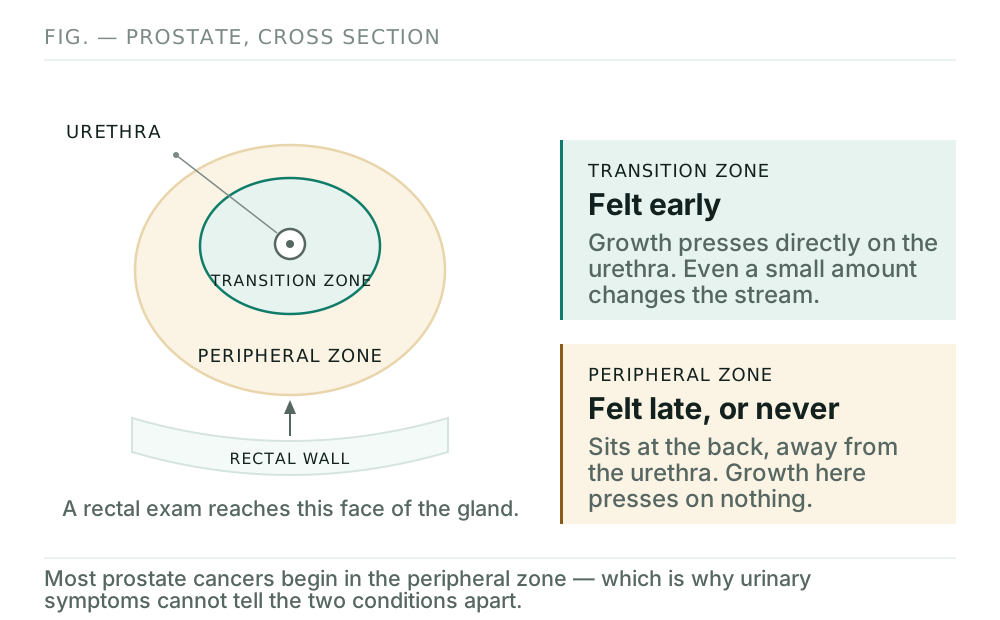
There is a practical payoff to knowing this. The peripheral zone sits against the rectal wall, which is why a digital rectal examination can reach exactly the region where most cancers start. The examination men dread most is aimed precisely at the tissue that symptoms cannot report on. It is not thoroughness for its own sake — it is the only part of the gland that can be felt directly.
Does an enlarged prostate turn into prostate cancer?
No. These are different diseases, involving different cells, in different parts of the gland, and benign enlargement has not been established as a cause of prostate cancer. Having BPH does not put you on a path toward the other diagnosis.
They do appear together often, and that is where the confusion comes from. Both become steadily more common with age, so plenty of men have both — in the way that plenty of men over 60 have both reading glasses and stiff knees. Sharing a risk factor is not the same as one causing the other.
| Benign enlargement (BPH) | Prostate cancer | |
|---|---|---|
| Where it usually starts | Transition zone, around the urethra | Most often the peripheral zone, at the back |
| Early urinary symptoms | Common — that is the mechanism | Usually none |
| Spreads elsewhere in the body | No | Can, if not detected and managed |
| Effect on PSA | Can raise it | Can raise it |
| Can be identified by symptoms | No — this is the point of the article | |
What about PSA — does that answer it?
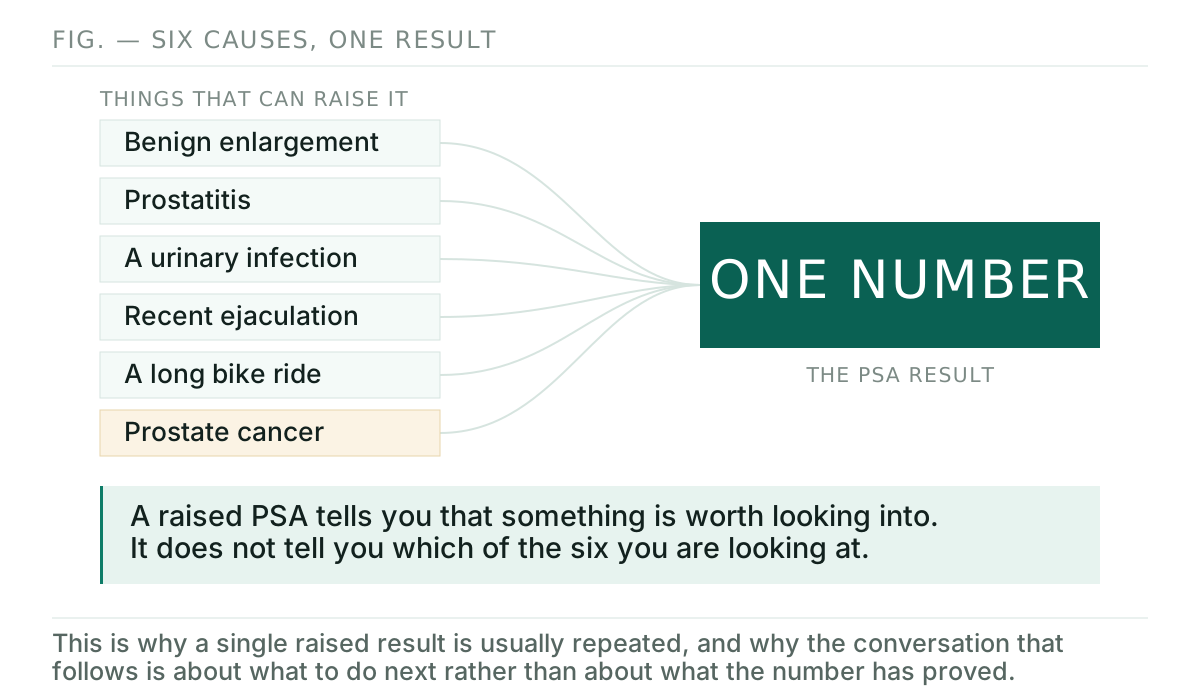
Partly, and less than most men assume. PSA is prostate-specific but not cancer-specific: it is a protein made by prostate tissue, and anything that irritates, enlarges or disturbs that tissue can push the number up. A raised PSA is a reason to look further. It is not a diagnosis.
Things other than cancer that can raise a PSA reading:
- Benign enlargement — more prostate tissue produces more PSA
- Prostatitis — inflammation of the gland, which can raise it sharply
- A urinary tract infection
- Recent ejaculation, typically within a day or two of the test
- Vigorous cycling shortly before the test
- Recent instrumentation — catheterization, biopsy, or a rectal examination immediately beforehand
This is why a single elevated result is usually repeated rather than acted on, and why the instructions that come with the test — no ejaculation, no long ride, mention any infection — are not bureaucratic fussiness. They are the difference between a number that means something and one that does not.
Prescription 5-alpha-reductase inhibitors — finasteride and dutasteride — lower PSA substantially, and clinicians adjust the interpretation when they know you are taking one. If they do not know, a reading that looks reassuring may not be. Studies have not shown saw palmetto to meaningfully alter PSA, but the safe rule is the same: declare the whole list, prescribed or not.
Are there symptoms that do point toward cancer?
There are, but they carry an important qualification: they are mostly symptoms of advanced disease, and they are not specific. Each of them has other, more common explanations. None of them is a reason to panic, and none of them is a reason to wait either.
- Blood in the urine or in semen, at any amount, even once
- Persistent bone pain, particularly in the spine, hips or ribs, that does not behave like a strain
- Unexplained weight loss
- New weakness or numbness in the legs, or difficulty walking
- A change in erectile function arriving alongside other changes
Notice what is absent from that list: the ordinary urinary complaints. A weak stream, waking at night, and a bladder that never feels empty are not on it, because they are the language of the transition zone. Those symptoms have their own articles — weak urine stream after 50, waking three times a night, and the bladder that never feels empty — and none of them answers this question.
Who should be tested, and when?
This is a genuine decision rather than a rule, and honest sources present it that way. US preventive guidance frames PSA screening for men roughly between 55 and 69 as an individual decision to be made with a clinician after discussing benefits and harms, and does not recommend routine screening after 70.
The reason it is framed as a decision rather than an instruction is that screening carries real costs as well as real benefits. It finds cancers that would never have caused harm, and finding them leads to biopsies and treatments with their own consequences. It also finds cancers early enough to matter. Both of those things are true at once, which is why nobody credible issues a blanket answer.
For men aged 55 to 69, the decision to undergo periodic PSA-based screening should be an individual one, made after discussing the potential benefits and harms with a clinician. Routine PSA-based screening is not recommended for men aged 70 and older.
US Preventive Services Task Force — Prostate Cancer: ScreeningRisk is not evenly distributed, and that changes the timing rather than the logic. Black men and men with a father or brother diagnosed with prostate cancer are at higher risk, and guidance generally suggests having the conversation earlier — often in the mid-forties, and sometimes earlier still where the family history is strong. Earlier discussion, not automatic testing.
How is the difference actually established?
Through a sequence, and each step exists because the one before it cannot settle the question alone. No single test on this list is a verdict, which is worth knowing before you start, because it stops any one result from feeling like the end of the story.
- History and symptom score. Standardized questions that place your symptoms on a scale, giving a baseline to measure against later.
- Examination. The digital rectal examination, reaching the peripheral zone that symptoms cannot report on. Seconds, not minutes.
- PSA blood test, interpreted alongside your age, prostate size and medication list rather than against a single universal threshold.
- MRI. Multiparametric imaging is now widely used before any biopsy, and it lets some men avoid one altogether.
- Biopsy, if indicated. The only step that establishes a diagnosis, and the only one that grades how aggressive a cancer is.
The whole of the first three steps is typically one appointment. Men routinely imagine this process as far larger and more invasive than it is, and that imagined version is the main thing keeping them out of the room.
Where do supplements fit into this?
Nowhere, on the cancer question, and we would rather say that plainly than leave a commercially convenient silence. No supplement sold for urinary symptoms has been shown to prevent, detect or treat prostate cancer, and any page implying otherwise is describing a product that does not exist.
There is a stronger version of this warning, and it comes from the evidence rather than from caution. A large trial of vitamin E — an ingredient still found in products marketed for prostate health — reported a significant increase in prostate cancer diagnoses among the men taking it. That finding, and what it means for how you read a label, is covered in prostate supplement side effects.
If your interest is in the urinary symptoms — a separate question from this one, and a legitimate one — then the relevant evidence is in what the Cochrane review found on saw palmetto. Keep the two questions apart: nothing we publish about urinary symptoms has anything to say about cancer.
So what should you actually do?
Stop using symptoms as evidence in either direction. That is the single change this article is asking for, and everything practical follows from it.
If you have urinary symptoms, they are most likely benign — and they are still worth assessing, because they are affecting your life and because the assessment covers this question at the same time. If you have no symptoms at all and you are in the age range where screening is discussed, that absence has not answered anything, and the conversation is still yours to have.
The goal is not to work out which condition you have. It is to stop treating a quiet bladder as proof, and a noisy one as a sentence.
And if the reason you have not made the appointment is the fear of what might be found rather than the inconvenience — which is more common than most men admit, including to themselves — that is worth naming. One contributor here has written about doing exactly that in his account of buying supplements before booking a doctor. The waiting is almost always larger than the appointment.
Key takeaways
- Urinary symptoms cannot separate benign enlargement from prostate cancer, and the reason is anatomical.
- Benign growth starts in the zone wrapped around the urethra, so it causes trouble early. Most cancers begin in the outer zone and cause nothing for a long time.
- So having symptoms is not evidence of cancer, and having none is not evidence against it.
- A raised PSA can come from enlargement, infection, recent ejaculation or a long bike ride. It says look into this, not here is what you have.
- An enlarged prostate does not turn into cancer. They are different diseases that share an organ.
Where to go from here
If this question is what brought you here, these are the pieces that follow on:
- Enlarged Prostate After 40: Symptoms, Causes and What Actually Helps — the full guide to the benign condition, including what happens at an appointment.
- Weak Urine Stream After 50: What It Actually Means — the symptom most men notice first.
- Can't Fully Empty Your Bladder? What's Going On — the symptom with a measurement underneath it.
- Prostate Supplement Side Effects: What to Watch For — including the vitamin E trial finding.
- My Prostate Symptoms Are Mild. Should I Be Doing Something? — on postponing the appointment.
- PSA Levels by Age: What Your Number Actually Means — what the figure means, what moves it, and why the trend beats one reading.
- Prostatitis or Enlarged Prostate? How to Tell — the other condition that produces the same symptom list.
Frequently asked questions
Can urinary symptoms tell BPH and prostate cancer apart?
No. Benign enlargement grows in the zone wrapped around the urethra and causes urinary symptoms early. Most prostate cancers begin in the outer zone, away from the urethra, and cause no symptoms until much later. Symptoms point toward BPH but rule nothing out.
Does an enlarged prostate turn into prostate cancer?
No. They are different diseases involving different cells in different parts of the gland, and benign enlargement is not established as a cause of prostate cancer. They often appear in the same man because both become more common with age, not because one produces the other.
Does a high PSA mean I have prostate cancer?
Not on its own. PSA is prostate-specific but not cancer-specific: benign enlargement, inflammation, a urinary infection, recent ejaculation and vigorous cycling can all raise it. A raised result is a reason for further assessment, not a diagnosis.
Can prostate medication or supplements change my PSA reading?
Prescription 5-alpha-reductase inhibitors such as finasteride and dutasteride lower PSA substantially, and doctors adjust for this. Studies have not shown saw palmetto to meaningfully alter PSA. Either way, tell whoever orders the test everything you take, prescribed or not.
Which symptoms should prompt urgent assessment?
Blood in the urine or semen, persistent bone pain in the spine, hips or ribs, unexplained weight loss, or new weakness in the legs. These are not specific to cancer and often have other explanations, but none should be watched and waited on.
At what age should men discuss prostate cancer screening?
US guidance frames screening between roughly 55 and 69 as an individual decision made with a clinician, and does not recommend routine screening after 70. Men at higher risk, including Black men and those with a close family history, are usually advised to have that conversation earlier.
Sources
- National Cancer Institute (NIH) — Prostate Cancer
- US Preventive Services Task Force — Prostate Cancer: Screening
- National Institute of Diabetes and Digestive and Kidney Diseases (NIH) — Prostate Enlargement (Benign Prostatic Hyperplasia)
- National Cancer Institute (NIH) — Prostate Cancer Screening (PDQ)
- American Cancer Society — American Cancer Society Recommendations for Prostate Cancer Early Detection
- Mayo Clinic — Prostate cancer: symptoms and causes

Male Health Guide Editorial Team
We write about the health problems men over 40 actually search for at 3 a.m. — and we say plainly when the evidence for a popular product is thin. We do not invent credentials and we do not publish sponsored copy as editorial. Read more about how we work.
Medical disclaimer: This article is for general information only. We are not doctors, this page cannot diagnose or exclude any condition, and nothing here is a substitute for assessment by a clinician. Prostate cancer cannot be ruled in or out by symptoms, by a single blood test, or by anything you read online. Please speak to a qualified healthcare professional about your own situation, and never start, stop or change a prescribed medication based on what you read here.