Blood in Urine After 40: What It Usually Means
Short answer
Blood in urine after 40 has many possible causes, and an enlarged prostate is one of the most common. It can be visible to the eye or found only on a routine test, and either kind needs evaluation rather than guessing. Doctors sort cases into three risk tiers based on age, smoking history and how much blood is present, and each tier gets a different workup.
You looked down, or a routine urine test came back with a note nobody fully explained, and now there is a sentence running through your head that you cannot quite finish: blood in urine after 40 usually means... what, exactly?
The honest answer is that it depends on which kind you have, and that the most common reason for men in this age group — an enlarged prostate — is also the reason doctors will not let you stop there. This article sets out the two different things called hematuria, what actually causes each one, the risk system clinicians use to decide what test comes next, and why being on a blood thinner is not the explanation it sounds like.
Two different things get called “blood in the urine”
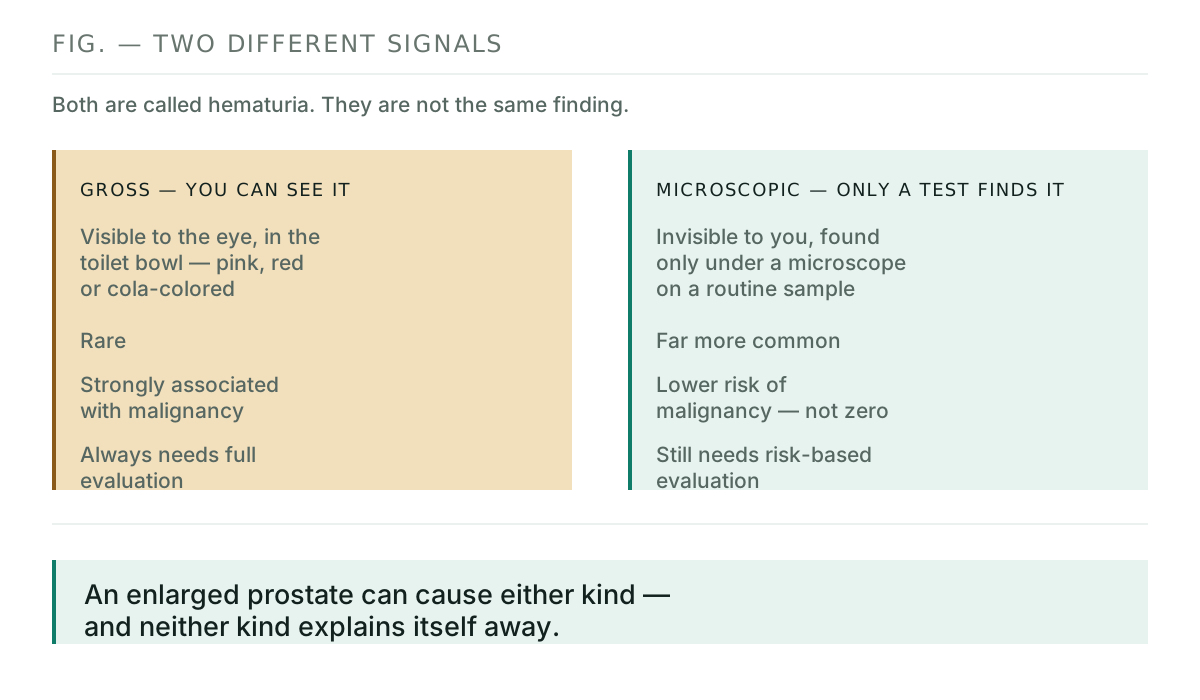
The word hematuria covers two situations that look, feel and behave nothing alike, and conflating them is the single most common source of either needless panic or false reassurance.
Blood you can see with your own eyes — turning the water pink, red or cola-colored — is called gross hematuria. It is the rarer of the two, and it is the one clinicians take most seriously on sight alone, because of what it tends to be associated with.
Blood that nobody can see, picked up only because a urine sample was tested and counted under a microscope, is microscopic hematuria. It is far more common, and it is the kind that quietly turns up on a routine test ordered for an entirely different reason — a general checkup, a physical before a procedure, a workup for something unrelated.
Although gross hematuria is strongly associated with malignancy, microscopic hematuria is more common and has a lower malignancy risk.
American Family Physician, summarizing the AUA/SUFU microhematuria guidelineRead that carefully, because both halves matter. The visible kind carries a real signal and should never be dismissed as “probably nothing.” The invisible kind is common enough that most of it is not cancer — but “lower risk” is not the same sentence as “no risk,” which is why it still gets a structured evaluation rather than a shrug.
What actually causes blood in the urine
The list is longer than most men expect, and the prostate is only one entry on it. MedlinePlus, drawing on standard clinical references, lists the usual suspects plainly.
- Infection. Of the bladder, kidney, prostate or urethra — one of the more common and more easily treated causes.
- Stones. In the kidney or bladder, often with pain that makes the diagnosis easier rather than harder.
- Inflammation. Of the bladder, urethra, prostate or kidney.
- Injury to the bladder or kidney, including after a fall or a blow.
- An enlarged prostate. Benign prostatic hyperplasia, covered in depth below.
- Cancer. Of the bladder or kidney — the reason none of this gets waved away.
- Blood or clotting disorders, and medicines that affect clotting.
- A recent urinary procedure, including a catheter, a cystoscopy or a biopsy.
There is also a specific confusion worth naming early, because it sends some men down the wrong worry entirely. What looks like blood in the urine can sometimes be coming from somewhere else in the same stream.
MedlinePlus notes that blood which appears to be in the urine may actually be coming from other sources, including ejaculation — often due to a prostate problem. If you have noticed blood in semen rather than, or alongside, blood in urine, say so specifically when you describe it; it changes which explanation is most likely.
Where an enlarged prostate actually fits in
This is the part most relevant to readers of this site, and it cuts both ways. Benign prostatic hyperplasia is a genuinely common, genuinely recognized cause of microscopic blood in the urine. An enlarged prostate grows new blood vessels across its surface, and those vessels are more fragile than ordinary bladder lining; straining to urinate past a narrowed outlet, covered in our guide to an enlarged prostate after 40, can be enough to make one of them bleed.
The guideline that governs how doctors evaluate hematuria lists BPH explicitly as a condition that commonly produces microscopic blood and that needs an initial workup for that reason. It is a legitimate, ordinary explanation.
It is not, however, a free pass to stop asking questions. The same symptom — a narrowed, slower stream, which this site covers separately in weak urine stream after 50 — is produced by benign enlargement and by a bladder tumor obstructing the outlet in a man who also happens to have an enlarged prostate. Having the common cause does not rule out the uncommon one sitting alongside it, which is the entire reason risk-based testing exists instead of a single universal rule of thumb.
The three risk tiers doctors actually use
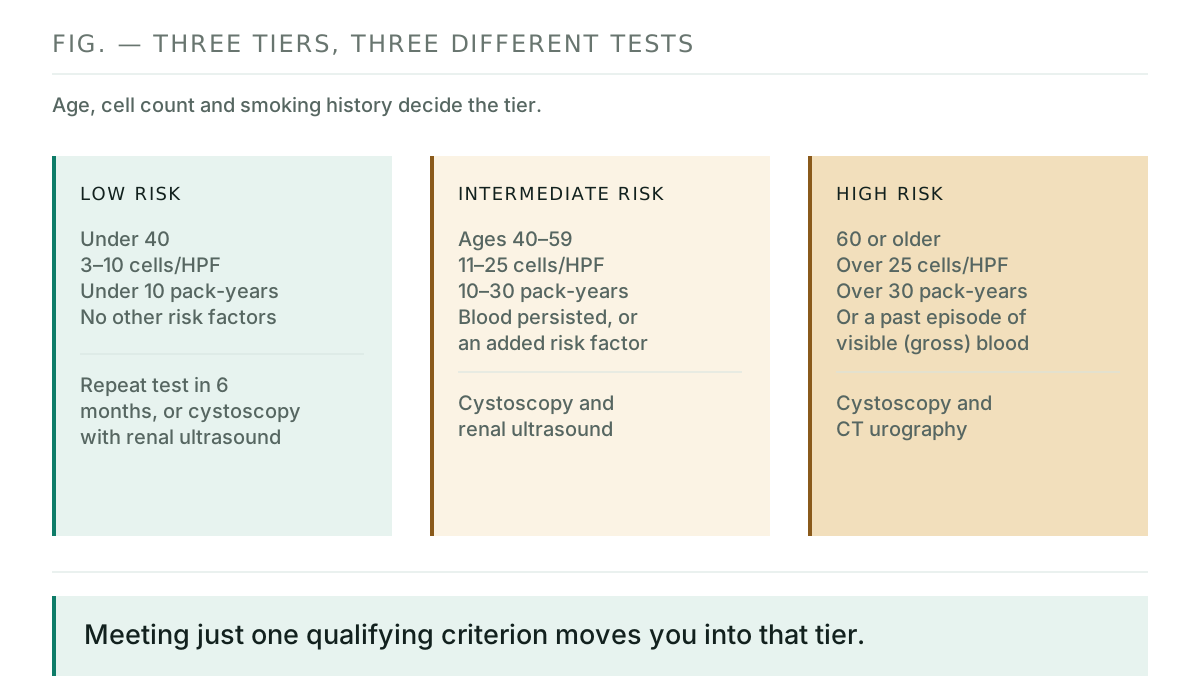
Microscopic hematuria is formally defined as three or more red blood cells per high-power field on a single urine sample examined under a microscope — one isolated trace on a dipstick is not, by itself, the diagnosis. Once that threshold is met, the American Urological Association and the Society of Urodynamics, Female Pelvic Medicine & Urogenital Reconstruction sort the case into one of three risk tiers for an underlying urinary tract cancer.
| Risk tier | Who falls into it | What gets ordered |
|---|---|---|
| Low | Men under 40, 3–10 cells per high-power field, never smoked or under 10 pack-years, no other cancer risk factors | Repeat urine test in 6 months, or cystoscopy with a renal ultrasound |
| Intermediate | Ages 40–59, 11–25 cells per high-power field, 10–30 pack-years, blood that persisted after a low-risk check, or an added risk factor | Cystoscopy and renal ultrasound |
| High | Age 60 or older, more than 25 cells per high-power field, more than 30 pack-years, or a past episode of visible (gross) blood | Cystoscopy and CT urography |
Notice what the table is actually doing. It is not ranking men by how frightened they should be. It is matching the thoroughness of the look to the combination of factors that make a serious cause statistically more or less likely in that specific case, and it uses the same logic whether the first finding was BPH, a stone, an infection or nothing identified at all.
You do not need every intermediate- or high-risk factor to be present at once. A single qualifying item — being 60 or older, on its own, is enough — moves you into that tier. Most men clear the low-risk bar only when every single criterion is met.
“I take a blood thinner — isn’t that the explanation?”
This is one of the most common assumptions this site hears from readers already managing a prescription covered in prostate supplements and blood pressure medication, and it is worth correcting directly, because the research says the opposite of what it feels like it should.
Anticoagulation does not appear to explain microscopic hematuria, and the appropriate workup should be performed in these patients.
American Family Physician, summarizing the AUA/SUFU microhematuria guidelineBeing on warfarin, aspirin or another antithrombotic medicine makes bleeding easier to notice, not more likely to happen for no reason. If anything, the relationship runs the other way in a way worth sitting with:
Patients taking antithrombotic medications are more likely to be diagnosed with bladder cancer, suggesting these medications may increase bleeding from underlying malignancies. American Family Physician, summarizing the AUA/SUFU microhematuria guideline
Read plainly, that means a blood thinner can be the reason a tumor that was already there started bleeding enough to be noticed — not a benign explanation that lets the finding go unexamined. If a clinician ever suggests skipping the workup because “it’s probably just the blood thinner,” that is worth pushing back on, politely and in writing if you have to.
When blood in urine is an emergency, and when it is an appointment
Most of what is on this page is not an emergency, and most of it also is not nothing. Knowing which situation needs a same-day emergency department and which needs a scheduled appointment saves both unnecessary panic and unnecessary delay.
- Fever, nausea, vomiting, shaking chills, or pain in your abdomen, side or back along with the bleeding
- Inability to urinate at all
- Blood clots passing in the urine
MedlinePlus, National Library of Medicine
Outside those specific signs, blood in the urine — visible or found on a test — is an “appointment soon” finding rather than a “go to the emergency room” finding. The one instruction that applies to every version of this, visible or invisible, mild or heavy, is simple and worth repeating.
Never ignore blood you see in your urine. Get checked by your provider.
What actually happens at the appointment
The visit itself is less dramatic than most men picture, and it overlaps heavily with what actually happens at a prostate exam, which covers the physical part of this in full. For blood in the urine specifically, expect a urine test to confirm and quantify what was found, a conversation about smoking history and any prior episodes of visible blood, and a decision about which risk tier you fall into.
From there, the path follows the table above. A cystoscopy is a short procedure in which a thin scope examines the inside of the bladder directly; a renal ultrasound or CT urography images the kidneys and the rest of the urinary tract. Neither is pleasant to anticipate and both are brief in practice, and the point of either is the same: to look at the parts of the system that a urine sample alone cannot show.
If the workup turns up nothing beyond an enlarged prostate, that is a genuinely good outcome, not an anticlimax. It is also not necessarily the end of the conversation if the blood keeps coming back, which is exactly what the intermediate tier's “persisted after a low-risk check” criterion exists to catch.
What if it only happened once?
A single trace on one test, especially below the three-cell threshold, is common and often resolves on its own — a hard workout, mild dehydration or a minor irritation can all produce a passing trace that is gone on the next sample. This is precisely why the low-risk tier's own option is a repeat test in six months rather than an immediate invasive workup for every isolated finding.
What should not happen is deciding on your own that a single episode counts as explained. The repeat test exists specifically to confirm that it really was a one-off. Skipping it because the first reading felt reassuring defeats the purpose of ordering it in the first place.
If a routine test flagged blood you never noticed, ask directly which risk tier you fall into and what the plan is for confirming it — a specific repeat date, or a referral for cystoscopy and imaging. “We'll keep an eye on it” without a concrete next step is the version of this that quietly goes nowhere.
Key takeaways
- Visible blood (gross hematuria) is rarer and more strongly linked to malignancy; blood found only on a test (microscopic hematuria) is far more common and carries a lower, but not zero, risk.
- An enlarged prostate is a recognized, common cause of microscopic blood — and the guideline still calls for an initial workup rather than assuming it explains everything.
- The AUA/SUFU sort cases into low, intermediate and high risk by age, cell count and smoking history, and each tier gets a specific, different test.
- Being on a blood thinner does not explain microscopic hematuria; patients on these medications are actually more likely to be diagnosed with bladder cancer once investigated.
- Seek immediate care for fever, chills, pain, blood clots or an inability to urinate; otherwise this is an appointment to book, not an emergency to panic over — but never one to ignore.
Where to go from here
If blood in your urine is what brought you here, these pages cover the ground around it:
- Enlarged Prostate After 40: Symptoms, Causes and What Actually Helps — the complete guide to the most common benign explanation.
- What Actually Happens at a Prostate Exam — the appointment itself, described plainly.
- What Actually Happens at a Cystoscopy — the test named above, explained step by step.
- BPH vs Prostate Cancer: How to Tell the Difference — why symptoms alone cannot answer that question.
- Weak Urine Stream After 50: What It Actually Means — the symptom that often travels alongside this one.
- Prostate Supplements and Blood Pressure Medication — for readers managing a prescription alongside prostate symptoms.
- PSA Levels by Age: What Your Number Actually Means — the other number this workup often runs alongside.
Frequently asked questions
Is blood in urine after 40 usually serious?
Usually not, but it always needs evaluation. Blood you can see is strongly associated with malignancy and should never be ignored; blood found only on a routine test is far more common and carries a lower risk, but neither kind can be explained away by guessing, including by assuming it is the prostate.
Can an enlarged prostate cause blood in urine?
Yes, benign prostatic hyperplasia is a recognized and common cause of microscopic blood in the urine, and doctors expect it as one explanation among several. The guideline that governs this evaluation still lists it as something requiring an initial workup, not something to assume and move on from.
What are the risk categories for blood in urine?
The AUA and SUFU sort cases into low, intermediate and high risk for a urinary tract cancer, based on age, how much blood is present on the test, smoking history and whether blood has ever been visible to the eye. Each tier gets a different, specific workup rather than one test fits all.
I take a blood thinner. Does that explain blood in my urine?
No, and this is a common and risky assumption. Anticoagulation does not appear to actually cause microscopic hematuria, and guidance is explicit that the standard workup should still be performed. Men on these medications who are later diagnosed with a urinary cancer are not a small group.
When is blood in urine an emergency?
Seek immediate care if you cannot urinate at all, pass blood clots, or have fever, chills, nausea or pain in your abdomen, side or back along with the bleeding. Outside of those signs, blood in urine still needs an appointment, just not necessarily the emergency room.
What tests will I actually be given?
Depending on your risk tier, the options are a repeat urine test in six months, a cystoscopy with a renal ultrasound, or a cystoscopy with a CT urography scan. Higher risk means a more thorough look, not a worse prognosis decided in advance.
Sources
- MedlinePlus (National Library of Medicine) — Blood in urine
- Barocas D.A. et al., American Urological Association / SUFU — Microhematuria: AUA/SUFU Guideline, Journal of Urology, 2020 (amended 2023)
- American Family Physician — Microscopic Hematuria in Adults: Updated Recommendations from the American Urological Association
- MedlinePlus (National Library of Medicine) — Prostate Diseases

Male Health Guide Editorial Team
We write about the health problems men over 40 actually search for at 3 a.m. — and we say plainly when the evidence for a popular product is thin. We do not invent credentials and we do not publish sponsored copy as editorial. Read more about how we work.
Medical disclaimer: This article is general information, not medical advice. We are not doctors, and nothing here diagnoses, treats or cures any condition. Blood in urine always needs to be evaluated by a qualified healthcare professional who can see your own results and history. Please speak to one about your own situation rather than acting on what you read online, and seek emergency care for the warning signs described above.