What Actually Happens at a Cystoscopy
Short answer
A cystoscopy is a short procedure in which a urologist passes a thin lighted scope through the urethra to look directly inside the bladder, usually to investigate blood in the urine, recurring infections or trouble urinating. Most are done awake with local numbing and take 15 to 30 minutes; mild burning and a little blood afterward are normal for about a day.
The word alone sends a lot of men looking for reasons to put off calling the office. A cystoscopy sounds worse in the imagination than it usually is in practice — and the vague mental picture is often scarier than the actual list of what happens, when, and for how long.
This article covers what a cystoscopy actually is, why a doctor orders one, what it can find that a blood or urine test only suggests, what the appointment itself involves, and what is and is not normal to feel in the day after.
What a cystoscopy actually is
The National Institute of Diabetes and Digestive and Kidney Diseases (NIDDK) describes a cystoscopy as a procedure that uses a cystoscope — a long, thin optical instrument with an eyepiece at one end, a rigid or flexible tube in the middle, and a tiny lens and light at the other end — to look inside the urethra and bladder. A urologist fills the bladder with fluid and views detailed images of the urethra and bladder lining on a monitor.
MedlinePlus adds the detail that matters for understanding what you will actually feel: as fluid fills the bladder, it stretches the bladder wall, which is what lets the doctor see the entire surface — and it is also what produces the strong urge to urinate that most men report during the exam.
Why it gets ordered
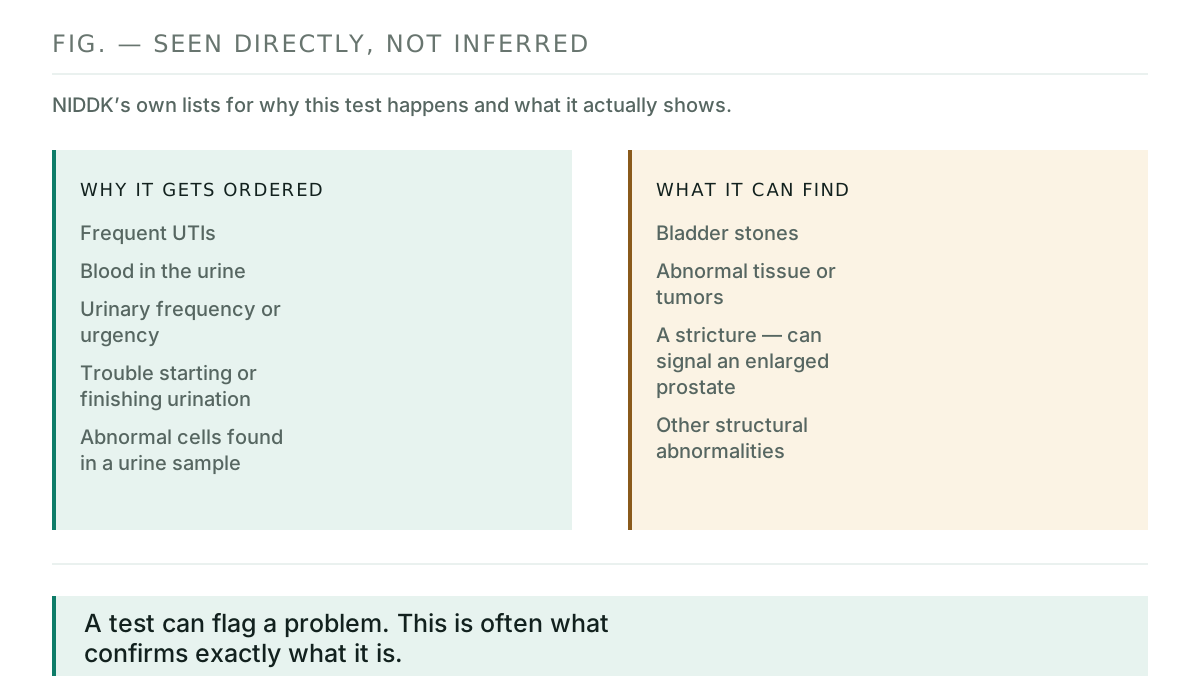
NIDDK lists the reasons a urologist performs a cystoscopy: frequent urinary tract infections, blood in the urine, urinary frequency or urgency, incontinence, urinary retention, pain or burning before, during or after urination, trouble starting or completing urination, or abnormal cells found in a urine sample. MedlinePlus adds diagnosing the cause of repeated bladder infections and helping determine the cause of pain during urination to the same list.
If blood in the urine is what brought you here, this site's own blood in urine after 40 article covers the three risk tiers that decide whether a cystoscopy is the next step, or whether a simpler repeat urine test is enough first.
What it can find that other tests can't
A blood or urine test can tell a doctor that something is probably wrong. A cystoscopy is often what confirms exactly what, and where. NIDDK's list of what shows up during the exam includes stones, abnormal tissue or tumors in the urethra or bladder, and a stricture — a narrowing of the urethra that can be a sign of an enlarged prostate in men, or of scar tissue in the urethra. It also lists secondary signs of obstruction, such as an enlarged prostate gland itself, and other structural abnormalities present from birth or acquired later.
MedlinePlus's list of what an abnormal result can mean overlaps and adds detail: bladder cancer, bladder stones, chronic inflammation of the urethra or bladder, scarring, cysts, and — specifically relevant to this site's readers — prostate problems such as bleeding, enlargement or blockage. A cystoscopy does not exist only to rule out cancer; it is also one of the few tests that looks at the prostate's effect on the urethra from the inside, rather than inferring it from a blood test or an external exam.
A cystoscopy is not only diagnostic. In the same visit, NIDDK notes a urologist can sometimes treat what they find — removing a small stone, taking a biopsy of suspicious tissue, injecting material into the wall of the urethra to treat leakage, or injecting medicine into the bladder itself for the same reason. Seeing and fixing in the same appointment is one reason this test gets ordered before more invasive options are even discussed.
Preparing for it
NIDDK describes a fairly light prep process. Your urologist will ask about your medical history and may test a urine sample for infection first — if you have one, you will likely take antibiotics before the procedure rather than during it. They will also ask about any medicines you take, particularly blood thinners, since some need to be paused beforehand.
For a straightforward cystoscopy, NIDDK notes you may not need any special preparation at all beyond emptying your bladder beforehand. If sedation or general anesthesia is planned — more likely if a biopsy or treatment is expected — you will need someone to drive you home afterward.
What actually happens, step by step
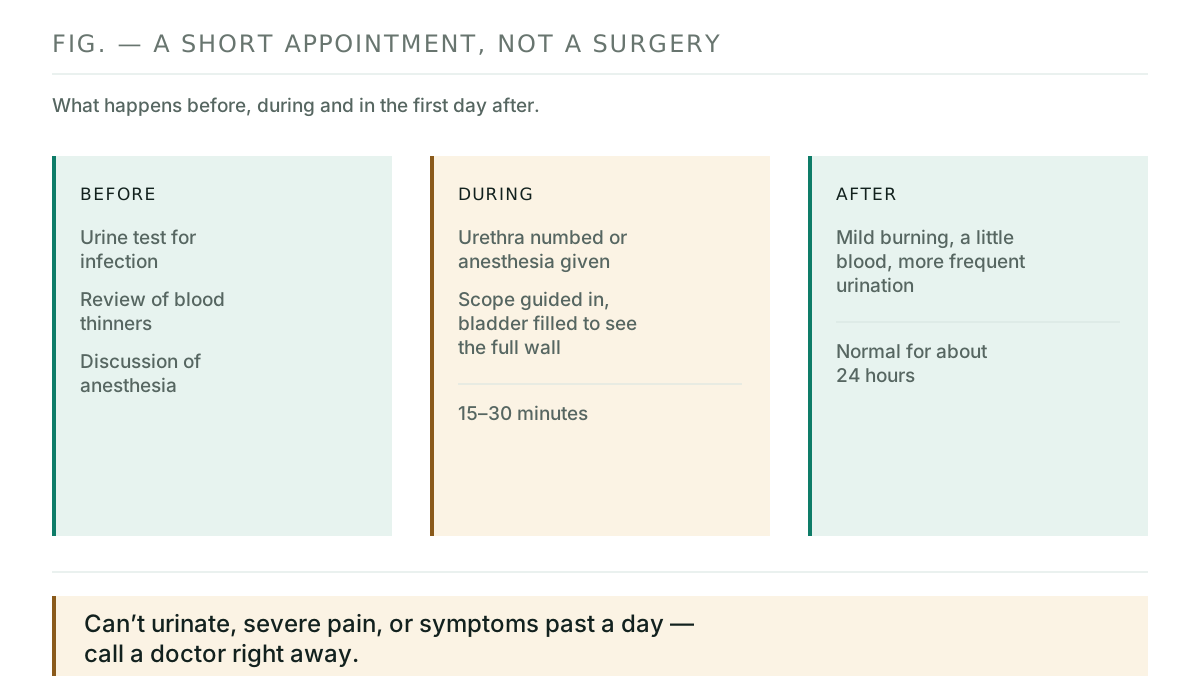
NIDDK puts a simple exploratory cystoscopy at about 15 to 30 minutes including preparation; MedlinePlus puts the procedure itself at about 5 to 20 minutes. Neither source explains the gap between the two figures, but either way, it is a short appointment, not a surgery with a recovery ward.
The urethra is cleaned and numbed — MedlinePlus specifies this is done with a topical numbing medicine, without needles. The cystoscope is then guided through the urethra into the bladder, which is filled with sterile water or saline to let the doctor see the entire bladder wall. That filling is what produces the strong, hard-to- ignore urge to urinate — MedlinePlus is direct that you may be asked to describe the feeling, since your answer is itself diagnostic information. The bladder has to stay full until the exam finishes, uncomfortable as that sounds in the moment.
If a biopsy is needed, MedlinePlus describes it as a quick pinch rather than a sustained pain, taken through the same scope and sent to a lab. NIDDK is specific about which versions more often use sedation or general anesthesia rather than local numbing alone: a biopsy, or injecting material into the wall of the urethra, the ureters, or the bladder itself.
Recovery, and what counts as normal
NIDDK describes the typical day-after experience plainly: a mild burning feeling when urinating, small amounts of blood in the urine, mild discomfort in the bladder or kidney area, and needing to urinate more frequently or urgently. These symptoms, per NIDDK, should not last more than 24 hours.
NIDDK is specific about what crosses the line from normal to concerning: bleeding or pain that is severe, being unable to urinate at all, a fever with or without chills, or any of the ordinary after-effects lasting more than a day — none of that is something to wait out until your next appointment. MedlinePlus separately lists bladder infection among the real risks of the procedure itself.
For the ordinary mild version, NIDDK's home-care suggestions are simple: drink plenty of water for a few hours afterward, a warm bath or a warm damp washcloth over the area for burning, an over-the-counter pain reliever if needed, and sometimes a short course of antibiotics to prevent infection.
The real risks, stated plainly
NIDDK lists the risks of cystoscopy directly: urinary tract infection, abnormal bleeding, pain or a burning feeling during urination, the inability to urinate, swelling, injury to the urethra, bladder or ureters, urethral narrowing from scar tissue forming afterward, and the usual risks of anesthesia when it is used. MedlinePlus's shorter list adds a slight risk of excess bleeding specifically when a biopsy is taken, and rupture of the bladder wall.
None of this is unusual for a procedure this common, and serious complications are not the expected outcome — they are the reason the after-visit instructions exist, and the reason to actually read them rather than assume any discomfort is routine.
Why some men do this more than once
If a cystoscopy finds a bladder tumor, a single look is rarely the end of the story. A 2021 systematic review of worldwide surveillance practices found no single, universally agreed schedule for how often to repeat cystoscopy after treatment — follow-up regimens varied widely across the studies it reviewed. The one point of actual agreement: every study included used an initial follow-up cystoscopy around three months after the original treatment, even though what came after that point differed study to study.
If blood in the urine was the reason for the first cystoscopy rather than a found tumor, how many more you might need — and how soon — depends on the risk tier covered in this site's blood in urine after 40 article, not on a single fixed rule that applies to everyone.
Key takeaways
- A cystoscopy is a short procedure, 15 to 30 minutes per NIDDK, in which a thin scope lets a urologist see directly inside the urethra and bladder.
- It's ordered for blood in the urine, recurring UTIs, urinary frequency or retention, trouble urinating, or abnormal cells on a urine test.
- It can find what other tests only suggest — stones, tumors, a stricture that can signal an enlarged prostate — and sometimes treat it in the same visit.
- Mild burning, a little blood and urinary frequency are normal for about 24 hours; severe pain, inability to urinate or symptoms lasting longer are not.
- If it finds a bladder tumor, repeat cystoscopy becomes part of monitoring — schedules vary, but a check around three months after treatment is close to universal.
Where to go from here
If a cystoscopy is what brought you here, these pages cover the surrounding ground:
- Blood in Urine After 40: What It Usually Means — the risk tiers that decide whether this test comes next.
- What Actually Happens at a Prostate Exam — the same plain-language treatment for a different appointment men postpone.
- What Actually Happens at a Prostate Biopsy — another procedure with a real trade-off most men are never told about.
- PSA Levels by Age: What Your Number Actually Means — the blood test that often comes before any of this.
- Enlarged Prostate After 40 — the complete guide, if a stricture or obstruction is what's being investigated.
Frequently asked questions
What exactly is a cystoscopy?
A cystoscopy is a procedure where a urologist passes a thin lighted scope, called a cystoscope, through the urethra to look directly at the inside of the urethra and bladder, according to the National Institute of Diabetes and Digestive and Kidney Diseases (NIDDK). It lets a doctor see tissue, stones and abnormal growths that blood tests, urine tests and imaging can only suggest are there.
Does a cystoscopy hurt?
Most men feel discomfort rather than sharp pain. MedlinePlus describes an uncomfortable, strong need to urinate as the bladder fills, a brief pinch if a biopsy is taken, and a sore urethra afterward. A numbing gel or local anesthetic is used for a straightforward cystoscopy; sedation or general anesthesia is used for more involved versions.
Will I get a flexible or rigid cystoscope?
It depends on why it's being done. A flexible cystoscope is thinner and more common for a straightforward look, often done awake with local anesthetic. A rigid cystoscope is used when a biopsy, stone removal or treatment is planned; a biopsy or injecting material into the urethra or bladder more often involves sedation or general anesthesia than a simple look does.
What can a cystoscopy find that other tests can't?
NIDDK lists bladder stones, abnormal tissue or tumors, a urethral stricture (which can be a sign of an enlarged prostate), and other structural abnormalities — all seen directly, not inferred. A blood or urine test can flag that something is wrong; a cystoscopy is often what confirms exactly what and where.
What's normal to feel afterward, and what's not?
Mild burning when urinating, a little blood in the urine, and needing to go more often are normal for up to 24 hours, per NIDDK. Call a doctor right away if you can't urinate at all, bleeding or pain is severe, you develop a fever, or any of these problems last more than a day.
Will I need more than one?
Sometimes. If a cystoscopy finds a bladder tumor, repeat cystoscopies become part of monitoring afterward — a 2021 systematic review found no single worldwide-agreed schedule, but every study it reviewed included a cystoscopy about three months after initial treatment. If blood in the urine prompted the first one, how many more depends on your risk tier, covered in this site's blood in urine article.
Sources
- National Institute of Diabetes and Digestive and Kidney Diseases (NIDDK, NIH) — Cystoscopy & Ureteroscopy
- MedlinePlus (National Library of Medicine) — Cystoscopy
- American Urological Association / SUFU — Microhematuria: AUA/SUFU Guideline, published 2020, amended 2025
- Russell B, Kotecha P, et al., Translational Andrology and Urology, 2021 — Endoscopic Surveillance for Bladder Cancer: A Systematic Review of Contemporary Worldwide Practices

Male Health Guide Editorial Team
We write about the health problems men over 40 actually search for at 3 a.m. — and we say plainly when the evidence for a popular product is thin. We do not invent credentials and we do not publish sponsored copy as editorial. Read more about how we work.
Medical disclaimer: This article is general information, not medical advice. We are not doctors, and nothing here diagnoses, treats or cures any condition. Whether you need a cystoscopy, and what it may find, requires evaluation by a qualified healthcare professional who can examine your own history and results. Please speak to one about your own situation.