What Actually Happens at a Prostate Biopsy
Short answer
A prostate biopsy takes about 10 minutes: a provider uses ultrasound to guide a needle and take 10 to 18 small samples from the gland, most often through the rectum or through the skin behind the scrotum. The route changes your risk profile — the rectal route carries more infection risk, the skin route carries more urinary retention risk.
The appointment letter says “prostate biopsy” and very little else, so most men fill in the blank with whatever version they've heard secondhand — usually the scariest one. The reality is a short, well-defined procedure, with real but specific risks that are worth knowing in advance rather than discovering afterward.
This article covers what actually happens in the room, the choice of route that most men are never told they have, what counts as normal afterward versus a reason to go to the ER, how to read the result once it comes back, and what happens if it comes back negative but the suspicion doesn't go away.
Who actually gets sent for one
A biopsy isn't the first response to any single prostate symptom — it follows a specific trigger, most often an elevated or rising PSA covered in PSA levels by age, an abnormal finding on a digital rectal exam, or a suspicious area found on an MRI done for another reason. None of those triggers means cancer is present; each just means the next step is a direct look rather than another blood draw.
How to actually prepare for it
Most clinics ask you to stop blood thinners and anti-inflammatory medication like aspirin or ibuprofen for about a week beforehand, specifically to reduce bleeding risk — never stop a prescribed blood thinner without your prescriber's sign-off first. You'll typically start a course of antibiotics the day of or the day before, and a transrectal procedure may call for an enema a few hours ahead. Arrange a ride home; some clinics use light sedation, and soreness alone makes most men glad they didn't drive themselves.
What actually happens in the room
MedlinePlus describes the standard version plainly: a provider inserts a finger-sized ultrasound probe to see the prostate, injects numbing medicine around the gland, then uses the ultrasound image to guide a needle into the prostate and take a sample. Expect mild discomfort as the probe goes in and a brief sting each time a sample is taken.
About 10 to 18 samples will be taken and sent to the lab for examination... The entire procedure will take about 10 minutes.
MedlinePlus, National Library of MedicineThat sample count can sound alarming on its own — eighteen of anything taken from one small gland — but it's coverage, not severity. The prostate is sampled in a systematic pattern precisely because a tumor can sit in one small region and be missed entirely by a handful of samples, which is also why the count has crept up over the years rather than down.
The route most men are never told they have a choice about
MedlinePlus lists three ways to reach the prostate: transrectal, through the rectum; transperineal, through the skin between the scrotum and anus; and transurethral, through the urethra, which is far less common. In practice almost every man ends up choosing, or being assigned, between the first two.
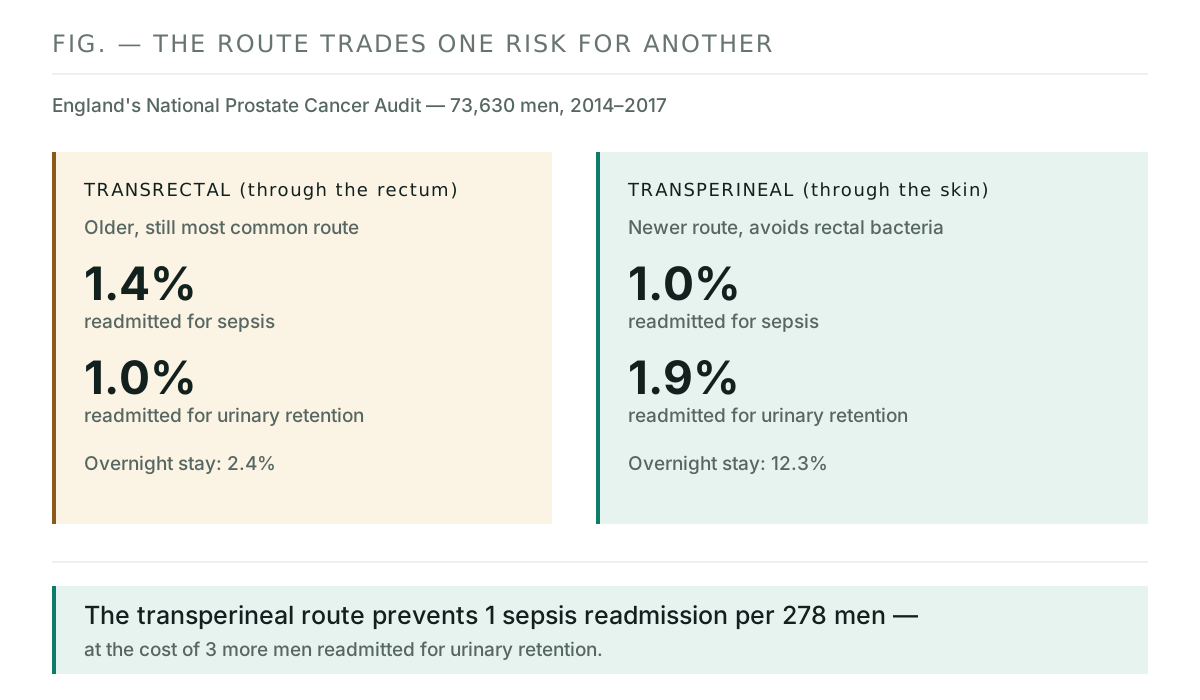
The transrectal route is older and still the most common, but it means the needle passes through tissue that carries ordinary rectal bacteria on its way to the prostate — which is the direct mechanical reason it carries more infection risk. The transperineal route reaches the gland through the skin instead, avoiding that bacteria altogether.
Those undergoing TP biopsy... were less likely to be readmitted because of sepsis (1.0% vs 1.4%)... and were more likely to be readmitted with urinary retention (1.9% vs 1.0%) than those undergoing a TR biopsy.
Berry et al., BJU International, 2020 — 73,630 men, National Prostate Cancer Audit (England)Read the trade exactly as the authors frame it, because the honest version isn't “newer is better”:
Use of the TP route would prevent one readmission for sepsis in 278 patients, at the cost of three additional patients readmitted for urinary retention. Transperineal patients were also far more likely to need an overnight hospital stay (12.3% vs 2.4%).
For most men, sepsis is the scarier of the two complications, and some clinics have shifted toward offering transperineal as the default for that reason. But it isn't a universal upgrade, and it isn't available everywhere — it's a real trade-off worth a direct question to whoever is doing yours: which route, and why that one for you specifically.
What's normal afterward, and what isn't
Some bleeding and soreness is expected and not a sign anything went wrong.
Soreness in your rectum... small amounts of blood in your stools, urine, or semen, which may last for days to weeks.
MedlinePlus, National Library of MedicineMost men are also prescribed antibiotics to take for several days afterward specifically to reduce infection risk, and finishing the full course matters even once you feel completely normal. A small number of symptoms, though, mean the biopsy has tipped from “recovering normally” into “needs care now.”
- A fever, even a mild one
- Trouble passing urine at all
- Heavy bleeding, or bleeding that isn't slowing down
Based on MedlinePlus (National Library of Medicine) on this procedure's risks and on sepsis symptoms
Fever is on that list for a specific reason. MedlinePlus names infection or severe infection of the blood (sepsis) as a risk of this exact procedure, and on its own page about sepsis, fever is listed among the earliest, most recognizable signs. Post-biopsy sepsis can move fast, which is why “I'll see how I feel in the morning” is the wrong instinct here, even if the fever feels mild.
Waiting for results: what the numbers mean
Results typically take about a week to come back, and they arrive as a report most men have never been taught to read. The two terms doing the real work are the Gleason score and the Grade Group.
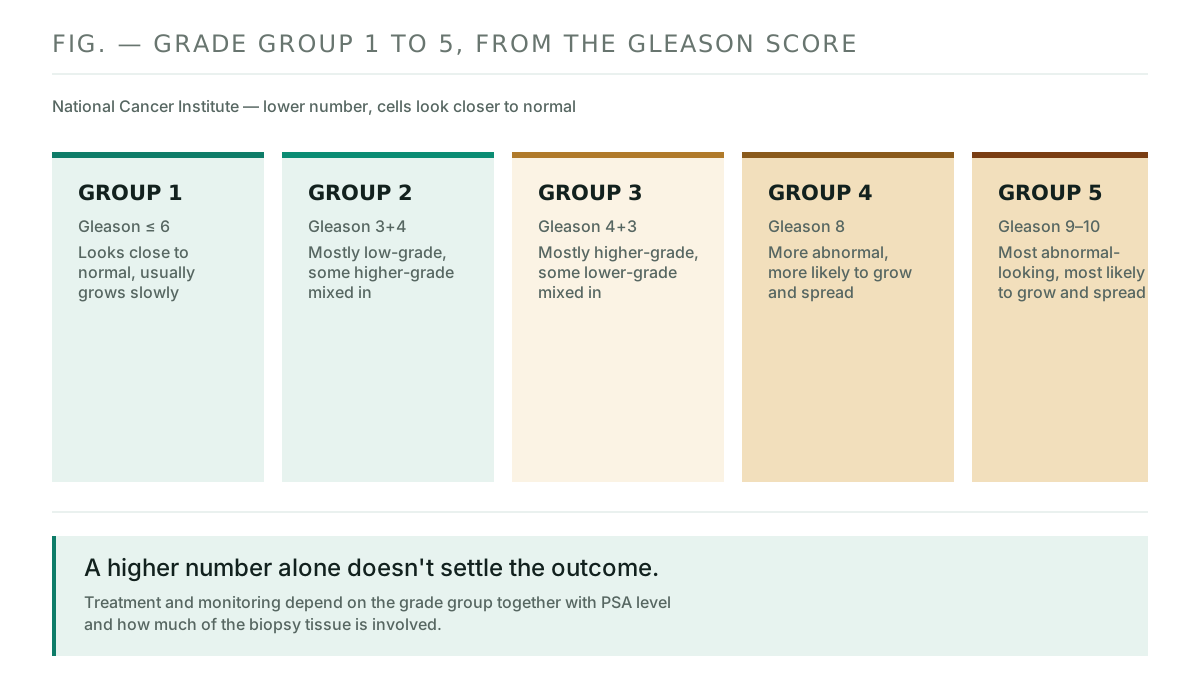
The Gleason score grades how abnormal the cancer cells look, from 3 to 5, and adds the most common pattern to the highest other pattern found — a 3+4 and a 4+3 both add up to 7, but they are not the same result, because which pattern dominates matters. Grade Group translates that combination into a single number from 1 to 5 that's easier to compare across reports.
Grade Group is a way of describing prostate cancer based on how abnormal the cancer cells in a biopsy sample look under a microscope and how quickly they are likely to grow and spread.
National Cancer InstituteA higher number is a real signal, not a scare tactic — but it is one input into a treatment decision, not the whole decision. PSA level, how many of the samples contained cancer, and how much of each sample was involved all factor into what happens next, which is why two men with the same Grade Group can reasonably end up on different paths.
What if it comes back negative, but something still feels off
A biopsy samples a small fraction of a gland that can be walnut-sized or larger, which means it's possible to miss cancer that's genuinely present in an area the needle didn't reach. A negative result is good news, but it isn't automatically the end of the conversation if the clinical picture still points somewhere.
When high-quality prostate MRI is available, it should be strongly considered in any patient with a prior negative biopsy who has persistent clinical suspicion for prostate cancer and who is undergoing a repeat biopsy.
American Urological Association & Society of Abdominal Radiology, consensus statementIn plain terms: if your PSA, exam or other findings still point toward cancer despite a clear biopsy, and a repeat biopsy is on the table, the modern next step isn't automatically redoing the same blind procedure. It's an MRI, read against the PI-RADS scoring system, followed by a targeted biopsy of whatever area the MRI flags — a more precise second look rather than a repeat of the first one. This connects directly to the number that usually starts this whole process, covered in PSA levels by age.
If the result comes back positive
A positive result is the start of a conversation about options, not a single prescribed path. Depending on the Grade Group, PSA and how much tissue is involved, the range runs from active surveillance — monitoring closely without treating yet — through medication to surgery, each covered in full in prostate medications explained and prostate surgery options. A low Grade Group with a slow-growing pattern often means watching is the medically appropriate choice, not a delay of the "real" treatment.
Which route will be used and why; what the antibiotic plan is and for how long; and, if a prior biopsy was negative but suspicion remains, whether an MRI happened first. Three specific questions that get you a specific plan, instead of a generic “it'll be fine.”
Key takeaways
- A prostate biopsy takes about 10 minutes and 10 to 18 ultrasound-guided samples — the sample count reflects coverage of the gland, not severity.
- The route matters: in a 73,630-man study, transrectal biopsy had higher sepsis risk, while transperineal had higher urinary retention risk and a much higher chance of an overnight stay — a real trade-off, not a simple upgrade.
- Some blood in urine, stool or semen for days to weeks is normal; a fever (even mild), trouble urinating, or heavy bleeding means same-day care, not wait-and-see — fever is one of the earliest signs of the sepsis risk MedlinePlus names for this procedure.
- Grade Group (1–5) is the modern, single-number version of the Gleason score — a higher number is a real signal, but PSA and how much tissue is involved matter too.
- A negative biopsy doesn't automatically close the question if suspicion stays high — current guidance points to MRI and a targeted re-biopsy rather than blindly repeating the same procedure.
Where to go from here
If a biopsy is what brought you here, these pages cover the ground around it:
- PSA Levels by Age: What Your Number Actually Means — the number that usually starts this conversation.
- What Actually Happens at a Prostate Exam — the physical exam, covered the same way.
- BPH vs Prostate Cancer: How to Tell the Difference — why symptoms alone can't answer that question.
- Blood in Urine After 40: What It Usually Means — relevant both before a biopsy and as a normal after-effect of one.
Frequently asked questions
Does a prostate biopsy hurt?
Mostly discomfort, not sharp pain. MedlinePlus describes mild discomfort as the probe is inserted and a brief sting as each sample is taken, after a numbing injection. Most men describe pressure more than pain, and the procedure itself is over in about 10 minutes.
How many samples are taken, and how long does it take?
Typically 10 to 18 samples, taken with a spring-loaded needle guided by ultrasound, and the whole procedure takes about 10 minutes. More samples means better coverage of the gland, not a sign anything is already wrong.
What's the difference between transrectal and transperineal biopsy?
The route the needle takes to reach the prostate. Transrectal goes through the rectum and is older and more common; transperineal goes through the skin between the scrotum and anus and avoids rectal bacteria. In a 73,630-man study, transperineal had lower sepsis risk but higher urinary retention risk — a real trade-off, not a simple upgrade.
Can a prostate biopsy come back negative when cancer is actually there?
Yes, sampling a small fraction of the gland can miss cancer that's present elsewhere in it. If clinical suspicion stays high after a negative result — based on PSA, exam or other findings — the AUA and Society of Abdominal Radiology recommend prostate MRI and MRI-targeted biopsy rather than just repeating the same blind procedure.
What does my Gleason score or Grade Group actually mean?
Grade Group (1 to 5) translates the Gleason score into one number showing how abnormal the cancer cells look and how fast they're likely to grow; Group 1 is Gleason 6 and under, Group 5 is Gleason 9–10. A higher number alone doesn't decide treatment — PSA and how much tissue is involved matter too.
When should I go to the ER after a biopsy?
The same day for a fever (even a mild one), trouble passing urine, or heavy bleeding that isn't slowing down. MedlinePlus names infection or sepsis as a risk of this procedure, and lists fever among the earliest signs of sepsis on its own — that combination is why a fever isn't something to wait out after a biopsy.
Sources
- MedlinePlus (National Library of Medicine) — Prostate biopsy
- Berry B. et al. — Comparison of complications after transrectal and transperineal prostate biopsy: a national population-based study, BJU International, 2020
- National Cancer Institute — Grade Group (definition) and Prostate Cancer Treatment (PDQ) (Gleason–Grade Group correspondence)
- American Urological Association & Society of Abdominal Radiology — Prostate MRI and MRI-Targeted Biopsy

Male Health Guide Editorial Team
We write about the health problems men over 40 actually search for at 3 a.m. — and we say plainly when the evidence for a popular product is thin. We do not invent credentials and we do not publish sponsored copy as editorial. Read more about how we work.
Medical disclaimer: This article is general information, not medical advice. We are not doctors, and nothing here diagnoses, treats or cures any condition. Decisions about biopsy route, antibiotics and follow-up always depend on your own history and should be made with a qualified healthcare professional. Please speak to one about your own situation rather than acting on what you read online, and seek emergency care for the warning signs described above.