Metabolic Syndrome: Five Numbers, Three Are Enough
Short answer
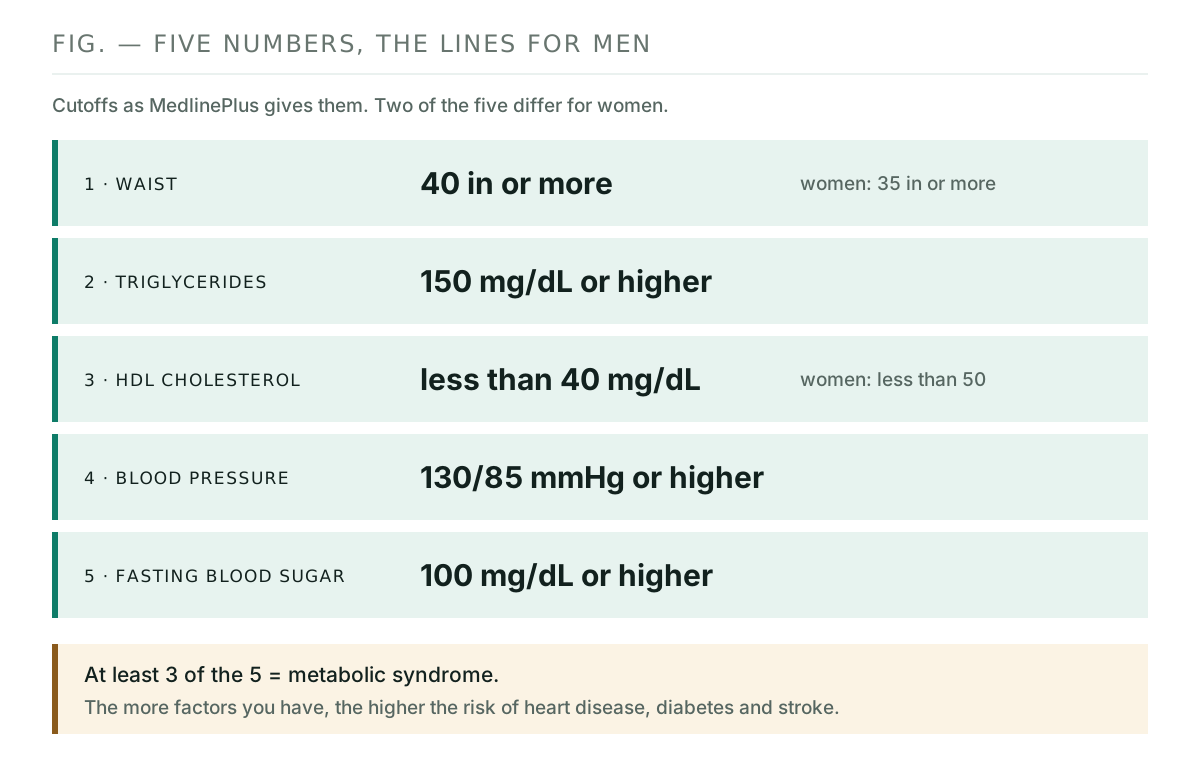
Metabolic syndrome means at least three of five risk factors. For men, MedlinePlus sets the lines at a 40-inch waist, triglycerides of 150 or higher, HDL below 40, blood pressure of 130/85 or higher, and fasting sugar of 100 or higher. The NHLBI says about 1 in 3 U.S. adults has it, mostly without symptoms.
Metabolic syndrome is rarely the reason a man walks into a doctor's office. It is a pattern that shows up in results he already has: a blood pressure reading slightly high, a fasting sugar just over the line, a triglyceride number flagged in bold. Each one on its own can sound minor. The diagnosis exists because together they are not.
This article covers what metabolic syndrome is, the five numbers and the cutoffs for men, how far each line sits from healthy, how common it is, what drives it, who is most at risk, how it is diagnosed, and what treatment looks like. It is the third article in this site's Weight section, alongside belly fat in men and fatty liver disease.
What metabolic syndrome is
The NHLBI describes metabolic syndrome as a group of conditions that together raise your risk of coronary heart disease, diabetes, stroke and other serious health problems, and says it is also called insulin resistance syndrome. MedlinePlus calls it a group of risk factors and says you can have just one, but people often have several together; when you have at least three, it is called metabolic syndrome. "The more factors you have," it says, "the higher your risk for heart disease, diabetes, and stroke is."
In our reading, the useful way to think about it is not as a disease you either have or don't, but as a count. Two of five is not a diagnosis, but it is two of the same things moving in the same direction.
The five numbers, and the cutoffs for men
MedlinePlus gives the diagnostic cutoffs, and two of them differ by sex:
- A large waistline: a waist measurement of 40 inches or more for men (35 inches or more for women).
- A high triglyceride level: 150 mg/dL or higher.
- A low HDL cholesterol level: less than 40 mg/dL for men (less than 50 mg/dL for women).
- High blood pressure: a reading of 130/85 mmHg or higher.
- A high fasting blood sugar: 100 mg/dL or higher.
The NHLBI's wording differs at the edges: it says a waist of more than 40 inches, blood pressure consistently at 130/85 or higher, and triglycerides consistently above 150. On blood sugar, it calls a fasting level of 100 to 125 high blood sugar or prediabetes, and attaches the label "a condition of metabolic syndrome" to the diabetes range of 126 or higher. It adds that you may have metabolic syndrome if you are taking medicines to treat high blood sugar or diabetes, and that your provider may use different waist values depending on your race and ethnicity.
For the waist, the NHLBI's measuring instructions are to stand, place a tape measure around your middle just above your hipbones, and measure just after you breathe out. This site's belly fat article covers why the waist carries so much weight in the calculation, and the lower lines some experts have proposed.
How far each line sits from healthy
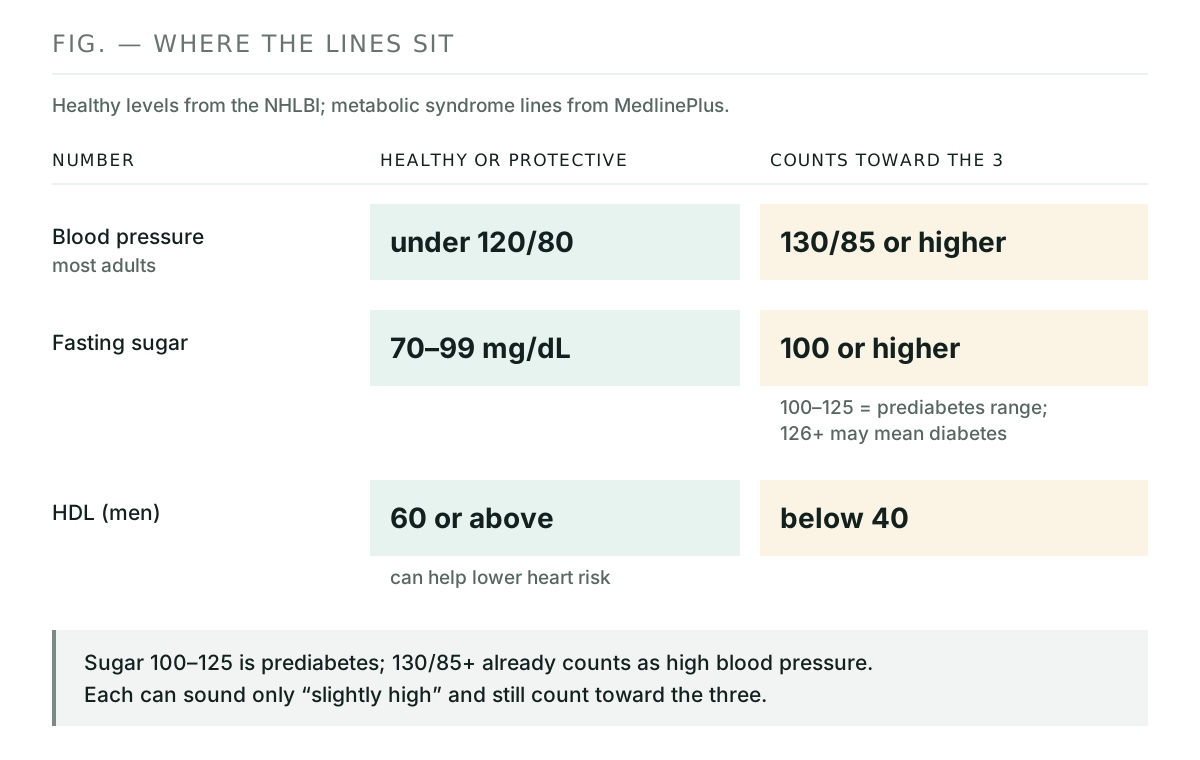
The five lines are not all the same kind of line. For blood sugar, the line comes before the diagnosis of diabetes. The NHLBI says a healthy fasting blood sugar is 70 to 99 mg/dL, that 100 to 125 means high blood sugar or prediabetes, and that 126 or higher may mean diabetes. The metabolic syndrome line, per MedlinePlus, is 100. A man in the prediabetes range has already crossed it, as covered in this site's prediabetes article.
Blood pressure is different: the line is not a step before disease. The NHLBI says a healthy blood pressure for most adults is less than 120/80, and that you may have high blood pressure, one of the conditions of metabolic syndrome, if your blood pressure is consistently 130/85 or higher. The same page calls healthy triglycerides less than 150, so the line sits right where healthy ends. HDL cholesterol, the "good" kind, has a protective level of 60 mg/dL or above, per the NHLBI, while the line for men is below 40.
In our reading, the trap is in how the results are delivered. A man can hear "slightly high" about his sugar, "a bit high" about his blood pressure and "could be better" about his HDL at three separate visits, and never be told that, taken together, those three meet the definition. A reading of 130/85 or higher is worth taking seriously on its own, as this site's high blood pressure article explains.
In our reading, the simplest check is to take your most recent waist measurement, blood pressure, fasting glucose, triglycerides and HDL, and count how many cross the lines above. If it is three or more, that is a question worth asking your provider directly. If it is two, it is worth knowing which two.
How common it is
The NHLBI says metabolic syndrome is common in the United States: about 1 in 3 adults have it. It says your risk increases as you get older, and that the condition is largely preventable through healthy lifestyle changes. MedlinePlus says Mexican Americans have the highest rate, followed by White and Black people.
What drives it
The NHLBI calls a person's weight a major cause. Fat cells, especially in the abdomen, can raise levels of chemicals called free fatty acids, which can affect the way the body controls blood sugar; the body may stop responding well to insulin, the hormone that controls how much sugar muscles and organs absorb from the blood. That is insulin resistance. Free fatty acids and insulin resistance can raise "bad" LDL cholesterol, lower "good" HDL, and raise blood pressure and triglycerides.
It adds a second mechanism: immune cells can cause extra fat cells to make chemicals that increase inflammation, which can cause plaque to build up inside blood vessels and can itself cause insulin resistance and high blood pressure. MedlinePlus says people with metabolic syndrome often also have excessive blood clotting and inflammation throughout the body, and that researchers don't know whether these cause the syndrome or worsen it. It names abdominal obesity, an inactive lifestyle and insulin resistance as the most important risk factors.
The risk factors you can and can't change
The habits the NHLBI lists as raising the risk are being inactive, eating an unhealthy diet and large portions, not getting enough good-quality sleep, smoking, and drinking a lot of alcohol. It also names shift work, because shift workers often have body clocks that are out of step with their environment, which can affect how the body handles nutrients from food.
Among the risks you may not be able to control, it lists age, family history and genes, and certain medical conditions, including sleep problems such as sleep deprivation, circadian rhythm disorders and sleep apnea. It says some medicines used to treat allergies, bipolar disorder, depression, HIV and schizophrenia also raise the risk. This site's snoring or sleep apnea and how much sleep after 40 articles cover the sleep side.
What is different for men
The NHLBI is direct that, in older adults, women have a higher risk of metabolic syndrome than men, because hormone changes after menopause can raise the risk of a large waistline, high blood sugar and low HDL. So the honest answer to whether this is a "men's" condition is no. What is specific to men is the cutoffs: the waist line is higher (40 inches rather than 35) and the HDL line is lower (40 mg/dL rather than 50).
Being on diabetes medicine can count, too. The NHLBI says you may have metabolic syndrome if you are taking medicines to treat high blood sugar or diabetes. The NHLBI says this about blood sugar medicines only; in our reading, the same question is worth asking about a blood pressure pill: ask your provider how it is counted.
How it is diagnosed
Mostly from tests you may already have had. The NHLBI says that if you have risk factors, your provider will do blood tests and may measure your waist, weight and blood pressure, and may screen for the conditions during a routine checkup. MedlinePlus says most of the risk factors have no obvious signs or symptoms, except for a large waistline, and the NHLBI says high blood pressure, high triglycerides and low HDL usually cause no symptoms at all. Besides a large waistline, the exception it names is high blood sugar, which may cause blurred vision, increased thirst, increased urination, especially at night, and tiredness and weakness; those are worth reporting to your provider rather than waiting for the next checkup.
The NHLBI says your provider may also order heart tests to check how well your heart is working, to find out whether you have complications. Because the NIDDK says metabolic syndrome, or even one of its traits, makes fatty liver disease more likely, it is reasonable to ask whether your liver tests were checked; this site's fatty liver article explains what those tests show.
What treatment looks like
The NHLBI says the main goals are to lower the risk of heart disease and to prevent type 2 diabetes if it hasn't already developed, and that heart-healthy lifestyle changes are the first line of treatment. Its list: a heart-healthy eating plan, which may include the DASH plan, with fruits, vegetables and whole grains and limits on saturated fats, sodium, added sugars and alcohol; aiming for a healthy weight; regular physical activity; managing stress; quitting smoking; and getting 7 to 9 hours of sleep a day.
On weight, the NHLBI says if you are overweight, losing just 3% to 5% of current weight can help manage some risk factors, such as high blood cholesterol and diabetes. The NIDDK says lifestyle changes that help you control your weight may help you prevent and reduce metabolic syndrome. If lifestyle changes don't work, the NHLBI says you may need medicines or, for people with obesity and complications, weight-loss medicines or surgery.
The medicines, and one nuance
The NHLBI lists medicines for each part: blood pressure drugs such as ACE inhibitors, angiotensin receptor blockers, diuretics and beta blockers; statins and niacin for triglycerides and cholesterol; and insulin sensitizers such as thiazolidinediones for high blood sugar, which it says can cause liver damage, anemia, heart failure, and blood sugar that is too low or too high.
It also notes that some diuretics and beta blockers, and some statins, can raise the risk of type 2 diabetes in people who have metabolic syndrome. In our reading, that is a reason to ask about the trade-off, not a reason to stop anything: these medicines are prescribed because they lower heart risk, which is the main goal of treatment. This site's statins and blood pressure medication articles cover those decisions.
The diabetes-risk note above applies to some drugs in some people with metabolic syndrome. It is a question for your provider, who can weigh it against the heart protection the drug gives you. Stopping a blood pressure or cholesterol medicine without that conversation removes the protection without removing the risk.
Key takeaways
- Metabolic syndrome means at least three of five risk factors, per MedlinePlus, and the NHLBI says about 1 in 3 U.S. adults has it.
- For men, the lines are a 40-inch waist, triglycerides of 150 or higher, HDL below 40, blood pressure of 130/85 or higher, and fasting sugar of 100 or higher.
- The sugar line of 100 sits in the prediabetes range, below diabetes; the blood pressure line of 130/85 already counts as high blood pressure, per the NHLBI.
- Most of the five cause no symptoms, so the diagnosis comes from routine measurements and blood tests.
- Lifestyle changes are the first line of treatment; for men who are overweight, the NHLBI says losing 3% to 5% of weight can help manage some risk factors.
Where to go from here
Each of the five numbers has its own article on this site:
- Belly Fat in Men — the waist, and the deep fat that drives the rest.
- High Blood Pressure After 40 — what the readings mean.
- Prediabetes After 40 — the fasting sugar range that already crosses the line.
- Cholesterol After 40 — triglycerides and HDL.
- Fatty Liver Disease — the liver condition metabolic syndrome makes more likely.
- All weight articles
Frequently asked questions
What are the five criteria for metabolic syndrome?
MedlinePlus lists five risk factors and says at least three are needed for the diagnosis. For men: a waist of 40 inches or more, triglycerides of 150 mg/dL or higher, HDL cholesterol below 40 mg/dL, blood pressure of 130/85 mmHg or higher, and a fasting blood sugar of 100 mg/dL or higher.
What are the symptoms of metabolic syndrome?
Mostly none. MedlinePlus says most of the metabolic risk factors have no obvious signs or symptoms, except for a large waistline. The NHLBI says high blood pressure, high triglycerides and low HDL cholesterol usually do not cause any symptoms, which is why the diagnosis comes from routine tests. The NHLBI says high blood sugar may cause blurred vision, increased thirst, increased urination, especially at night, and tiredness and weakness.
How common is metabolic syndrome?
Very. The NHLBI says about 1 in 3 adults in the United States has metabolic syndrome, and that the risk rises with age. It also says the condition is largely preventable through healthy lifestyle changes.
Can metabolic syndrome be reversed?
Its parts can be improved. The NHLBI calls heart-healthy lifestyle changes the first line of treatment and says if you are overweight, losing just 3% to 5% of current weight can help manage some risk factors. The NIDDK says lifestyle changes that help control weight may help prevent and reduce metabolic syndrome.
What causes metabolic syndrome?
The NHLBI calls weight a major cause. Fat cells, especially in the abdomen, can raise free fatty acids, which can lead the body to respond poorly to insulin. That insulin resistance can raise blood pressure and triglycerides and lower HDL cholesterol. Inactivity, poor sleep, age and genes also play a part.
Is metabolic syndrome more common in men or women?
In older adults, the NHLBI says women have a higher risk than men, because hormone changes after menopause can raise the risk of a large waistline, high blood sugar and low HDL. For men, the cutoffs differ on two of the five numbers: the waist line is higher and the HDL line is lower.
Sources
- National Heart, Lung, and Blood Institute (NIH) — What Is Metabolic Syndrome?
- National Heart, Lung, and Blood Institute (NIH) — Metabolic Syndrome: Symptoms
- National Heart, Lung, and Blood Institute (NIH) — Metabolic Syndrome: Causes and Risk Factors
- National Heart, Lung, and Blood Institute (NIH) — Metabolic Syndrome: Diagnosis
- National Heart, Lung, and Blood Institute (NIH) — Metabolic Syndrome: Treatment
- MedlinePlus (National Library of Medicine) — Metabolic Syndrome
- National Institute of Diabetes and Digestive and Kidney Diseases (NIH) — Health Risks of Overweight & Obesity
- National Institute of Diabetes and Digestive and Kidney Diseases (NIH) — Symptoms & Causes of NAFLD & NASH
- National Heart, Lung, and Blood Institute (NIH) — Aim for a Healthy Weight

Male Health Guide Editorial Team
We write about the health problems men over 40 actually search for at 3 a.m. — and we say plainly when the evidence for a popular product is thin. We do not invent credentials and we do not publish sponsored copy as editorial. Read more about how we work.
Medical disclaimer: This article is general information, not medical advice. We are not doctors, and nothing here diagnoses, treats or cures any condition. Don't stop or change a blood pressure, cholesterol or diabetes medicine without talking to your provider.