Belly Fat in Men: Measure the Waist, Not Just the Scale
Short answer
For men, belly fat becomes a measured health risk past a 40-inch waist, per the NHLBI, and the deep fat inside the abdomen carries the most risk. Trials of abdominal exercises are small and mixed. Aerobic exercise reduced the deep fat even without dieting, and the waist can shrink while the scale barely moves.
Most men notice it in the same order: a belt that moves out a notch, then trousers that sit lower, then a photograph from the side. The weight on the scale may have changed less than the shape. That pattern is exactly why this site's new Weight section opens here, with the waist, rather than with the scale.
This article covers how to measure your waist, the 40-inch line and the lower lines experts have proposed, the two kinds of fat in your midsection, what extra belly fat raises the risk of, what the trials of abdominal exercises found, what did reduce the deep fat, and how much weight loss actually matters. The connected conditions, fatty liver and metabolic syndrome, each have their own article.
How to measure your waist
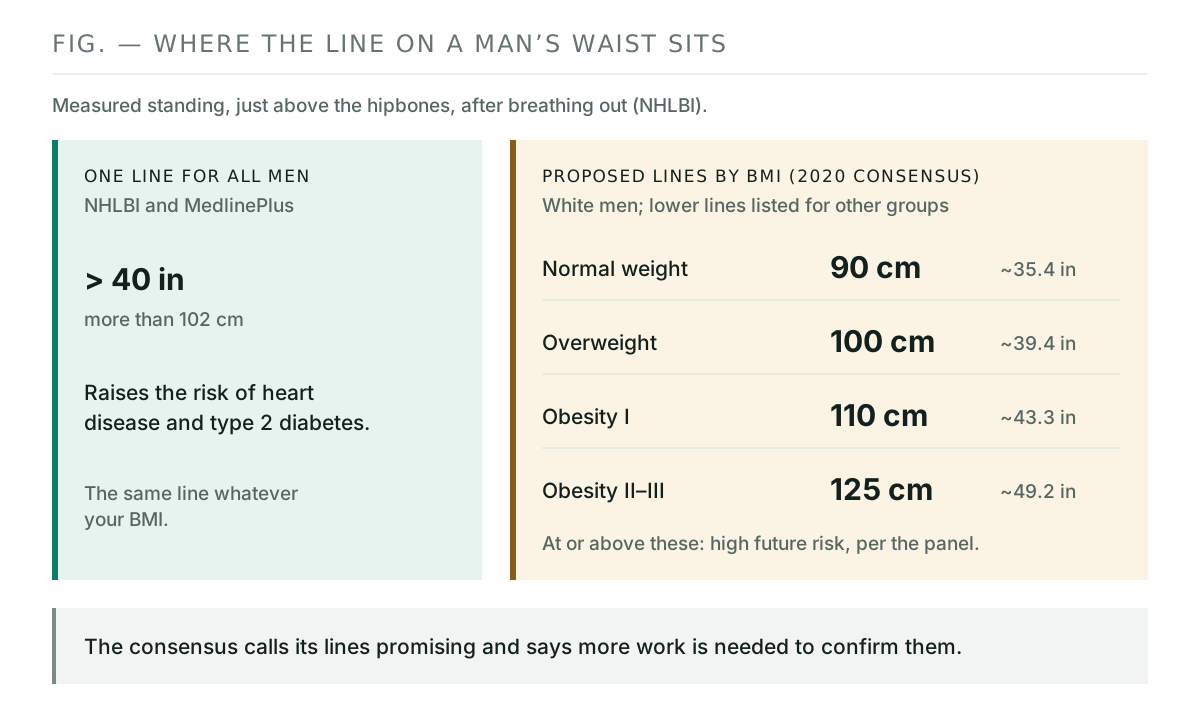
The NHLBI's instructions are short: stand, place a tape measure around your middle just above your hipbones, and measure your waist just after you breathe out. In our reading, that is not the same thing as your trouser size, which depends on where the waistband sits; the tape at the hipbone is the number the guidance refers to.
A 2020 consensus statement from the International Atherosclerosis Society and the International Chair on Cardiometabolic Risk, published in Nature Reviews Endocrinology, adds a useful honesty: there is no consensus on the best way to measure waist circumference. It cites a 2008 expert panel, which reviewed 120 studies and judged two protocols probably more reliable and feasible, the WHO's (midway between the lower edge of the rib cage and the top of the hipbone) and the NIH's (the top of the hipbone), because both use bony landmarks. In our reading, the practical lesson is to pick one method and use it the same way every time, so that a change is a real change.
The 40-inch line, and the lower lines
The NHLBI says that if most of your fat is around your waist rather than at your hips, you are at higher risk for heart disease and type 2 diabetes, and that a waist of more than 40 inches for men increases your risk. MedlinePlus gives the same figure in metric, 102 centimeters, and adds that people with "apple-shaped" bodies, where the waist is bigger than the hips, also have an increased risk.
The 2020 consensus argues that one line for everyone is too blunt. It presented waist thresholds that depend on BMI, developed by Christopher Ardern and colleagues, for white adults: for men, 90 centimeters (about 35.4 inches) at normal weight, 100 centimeters (about 39.4 inches) when overweight, 110 centimeters (about 43.3 inches) at obesity class I, and 125 centimeters (about 49.2 inches) at obesity class II and III. It describes these as promising and says more work is needed to firmly establish them, and it lists separate ethnicity-specific thresholds, from 80 to 98 centimeters for men, that are not tied to BMI. The NHLBI also notes that a provider may use different measurement values depending on race and ethnicity.
In our reading, the proposed thresholds matter most for the man whose BMI is normal. Under the single line, a 38-inch waist sounds safe. Under the consensus table, a normal-weight white man is already above the proposed line at 90 centimeters, about 35.4 inches. These are proposed lines, not a diagnosis, but they are a reason to bring the measurement to a checkup rather than dismiss it.
Why the waist tells you more than the scale
The consensus statement's central argument is that BMI alone is not enough to assess the risk that comes with extra body fat, and it recommends that waist circumference be measured routinely, as a "vital sign." It cites a pooled analysis by James Cerhan and colleagues of 11 prospective cohort studies, with 650,386 white adults aged 20 to 83 in the USA, Australia and Sweden, which found waist size was associated with higher mortality within every BMI category examined, from 20 to 50.
It also cites work by Tobias Pischon and colleagues in which the highest fifth of waist size, 102.7 centimeters or more in men, was associated with a 1.33 times higher risk of death from any cause before adjusting for BMI, and 2.05 times higher after adjusting for it. In plain terms, at the same BMI, the bigger waist carried the higher risk. These are observational studies, so they show an association, not proof that the waist itself is the cause.
The two kinds of belly fat
Fat in the midsection is not one tissue. Some of it sits just under the skin, the part you can pinch, called subcutaneous fat. The rest sits inside the abdomen: intra-abdominal or visceral fat. The 2020 consensus calls visceral fat "the fat depot that conveys the strongest health risk," and says the waist measurement alone is more strongly associated with the amount of it than the waist-to-hip ratio is.
A 2013 meta-analysis in PLoS One, by Dirk Vissers and colleagues, describes why it draws so much attention: excess visceral fat "appears to trigger a cascade of metabolic disturbances" that seem to coexist with fat stored where it shouldn't be, in muscle, the liver, the heart and the insulin-producing cells. The NHLBI explains part of the mechanism: fat cells, especially in the abdomen, can raise levels of free fatty acids, which can lead the body to respond poorly to insulin, called insulin resistance.
What extra belly fat raises the risk of
The NHLBI says that extra fat in the stomach area is a bigger risk factor for heart disease than extra fat in other parts of the body, and that a large waistline, also called abdominal obesity, is one of the five conditions that define metabolic syndrome. The NIDDK says overweight and obesity may increase your risk for many health problems, "especially if you carry extra fat around your waist," and that a large amount of fat around the waist may raise the risk of gallstones.
The NIDDK's list of conditions linked to overweight and obesity also includes type 2 diabetes, high blood pressure, heart disease, and nonalcoholic fatty liver disease, which this site covers in its own article. For men specifically, it says overweight and obesity are linked to a higher risk of cancers of the colon, rectum and prostate, and to erectile dysfunction. The NIDDK and MedlinePlus also list sleep apnea and osteoarthritis, which this site covers in its sleep apnea and joint pain articles.
Do sit-ups shrink belly fat? Two small trials disagree
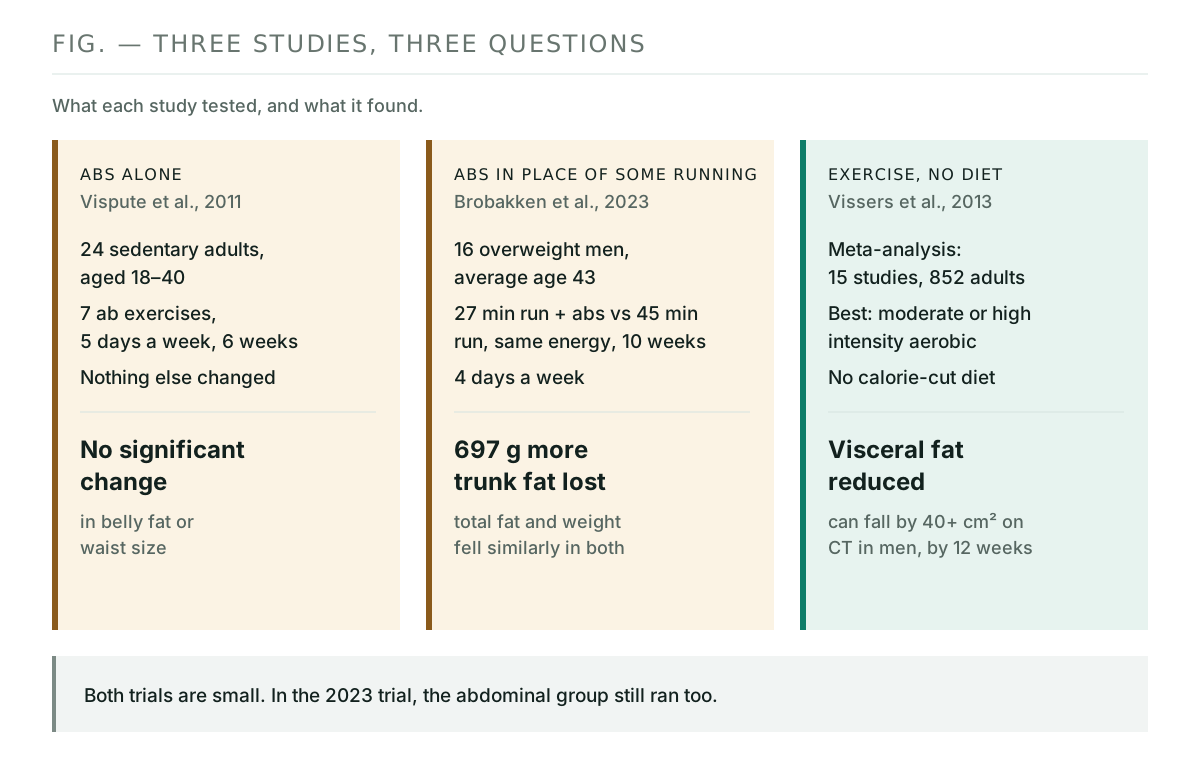
The idea that working a muscle burns the fat on top of it, sometimes called spot reduction, is the logic behind most belly-fat routines. A 2011 trial in the Journal of Strength and Conditioning Research, by Sachin Vispute and colleagues, tested it directly. Twenty-four healthy, sedentary adults (14 men and 10 women, aged 18 to 40) were randomly assigned either to do seven abdominal exercises, two sets of ten repetitions, five days a week for six weeks, or to do nothing. Everyone kept eating the same number of calories.
Abdominal exercise had no significant effect on body weight, body fat percentage, belly fat, waist size, or the skinfold measurements over the abdomen. The exercise group did get stronger: they managed more curl-ups at the end. The authors' conclusion was that six weeks of abdominal exercise alone was not sufficient to reduce abdominal fat under the skin.
A 2023 trial in Physiological Reports, by Brobakken and colleagues, points the other way, and its participants look more like this site's readers: 16 overweight men, average age 43. For 10 weeks, 4 days a week, one group ran on a treadmill for 27 minutes and then did torso rotations and abdominal crunches; the other group ran for 45 minutes. The two sessions were matched to burn a similar amount of energy. Trunk fat fell by 697 grams more in the abdominal group, while total fat and body weight fell similarly in both. The authors concluded that spot reduction exists in adult men, noting that the question has been debated for half a century and that the evidence is equivocal.
In our reading, the two trials are less contradictory than they look. In the first, abdominal exercise was done alone, with no other exercise and no change in eating, and nothing moved. In the second, the abdominal work took the place of part of a running session, everyone still ran, and the extra effect was modest: about 700 grams more trunk fat over 10 weeks, with similar total fat loss. Both trials are small. Neither suggests that abdominal exercises on their own, without other exercise, are a route to a smaller waist.
What did shrink the deep fat
The Vissers meta-analysis asked a different question: what happens to visceral fat when overweight adults exercise, without a calorie-restricted diet? It pooled 15 studies with 852 participants. Overall, exercise reduced visceral fat, and in the subgroup analysis, aerobic training of moderate or high intensity had the highest potential to reduce it in both men and women. The authors concluded that the results suggest an aerobic program, without a diet, can reduce visceral fat by more than 40 square centimeters on CT scanning in men, even after 12 weeks.
The 2020 consensus reaches a similar view from the evidence it reviewed. It says exercise and diet consistent with guidelines are associated with substantial reductions in waist size, and that available evidence from randomized trials suggests exercise is associated with substantial reductions in waist size independent of the quantity or intensity of exercise, and it says clinically relevant reductions can be achieved by routine, moderate-intensity exercise. In our reading, that suggests moderate activity such as brisk walking can count, which is good news for a man who hates the gym.
The NHLBI's general advice is to ask, before starting any exercise program, what level of physical activity is right for you. Separately, in our reading, chest pain, pressure or unusual breathlessness on exertion is not something to raise at a routine visit or push through: get it checked first. This site's chest pain after 40 article covers the symptoms that need emergency care.
When the scale doesn't move
This is the part most men are never told. The 2020 consensus says that exercise-induced or diet-induced reductions in waist size are observed with or without weight loss, and that several reviews have observed significant reductions in visceral fat in response to exercise in the absence of weight loss.
In our reading, that changes how to judge your own progress. A man who starts walking, measures only his weight, and sees little change after two months may conclude it isn't working and stop. The same man measuring his waist at the hipbone might have seen it shrink. The consensus recommends that practitioners routinely measure waist size precisely because it shows whether lifestyle changes aimed at abdominal obesity are working.
How much weight loss actually matters
If you do want to lose weight, the target is smaller than most men assume. For people diagnosed with overweight or obesity, the NHLBI says health professionals recommend losing 5% to 10% of initial weight over about six months, and that even before reaching that goal, a loss of just 3% to 5% of current weight can lower triglycerides and blood sugar and the risk of developing type 2 diabetes. It says losing more than 3% to 5% can improve blood pressure readings, lower "bad" LDL cholesterol and raise "good" HDL cholesterol.
For a 220-pound man, 3% to 5% is about 7 to 11 pounds. For people with obesity, MedlinePlus says a starting goal of losing 5% to 10% of current weight will significantly reduce the risk of obesity-related diseases. Speed matters too: the NIDDK warns that, while a large amount of fat around the waist may raise the risk of gallstones, losing weight quickly also increases it, and that rapid weight loss can make fatty liver disease worse.
When to bring it up with a doctor
A growing waist is not an emergency, but it is a reason for a checkup that includes blood work. The NHLBI says that if you have risk factors for metabolic syndrome, your provider will do blood tests and may measure your waist, weight and blood pressure. The useful numbers are blood pressure, fasting blood sugar, triglycerides and HDL cholesterol, which together with the waist make up the five measurements in this site's metabolic syndrome article.
It is also worth asking about the liver. The NIDDK says fatty liver disease is usually silent, with few or no symptoms, and that it is more common in people with obesity and type 2 diabetes. If your waist has grown and your blood sugar is creeping up, as covered in this site's prediabetes article, the three often travel together.
Key takeaways
- The NHLBI says a waist of more than 40 inches raises a man's risk of heart disease and type 2 diabetes; measure just above the hipbones, after breathing out.
- A 2020 expert consensus presented lower, BMI-specific lines for white men, starting at 90 centimeters (about 35.4 inches) at normal weight.
- The deep, visceral fat inside the abdomen carries the strongest health risk, per that consensus.
- Two small trials of abdominal exercises disagree; in a meta-analysis, aerobic exercise without dieting reduced visceral fat.
- The waist can shrink without weight loss, so measure it; for people with overweight, the NHLBI says losing 3% to 5% already helps.
Where to go from here
Belly fat rarely travels alone. These pages cover what it is linked to:
- Fatty Liver Disease — the silent condition that often comes with it.
- Metabolic Syndrome Explained — the waist plus four blood and pressure numbers.
- Prediabetes After 40 — when blood sugar starts to climb.
- High Blood Pressure After 40 — another of the five numbers.
- All weight articles
Frequently asked questions
What waist size is too big for a man?
The NHLBI and MedlinePlus both say a waist of more than 40 inches (102 centimeters) raises a man's risk of heart disease and type 2 diabetes. An international expert consensus published in 2020 presented lower lines for white men in lower BMI categories, starting at 90 centimeters, about 35.4 inches, for a man of normal weight.
How do I measure my waist correctly?
The NHLBI says to stand, place a tape measure around your middle just above your hipbones, and measure just after you breathe out. The 2020 consensus says there is no agreed best protocol, so in our reading the practical step is to measure the same way every time.
Can sit-ups get rid of belly fat?
The evidence is small and mixed. In a 2011 trial, six weeks of abdominal exercises alone did not significantly change belly fat or waist size in 24 sedentary adults aged 18 to 40. In a 2023 trial of 16 overweight men averaging 43, replacing part of a running session with abdominal exercise, at a similar energy cost, reduced trunk fat more than running alone.
What is visceral fat?
Visceral fat is the fat stored inside the abdomen, as opposed to the fat just under the skin. The 2020 waist consensus calls intra-abdominal or visceral fat the fat depot that conveys the strongest health risk, and says waist size alone tracks the amount of it better than the waist-to-hip ratio does.
Can you lose belly fat without losing weight?
The evidence says the waist can shrink even when the scale barely moves. The 2020 consensus says exercise-induced or diet-induced reductions in waist size are observed with or without weight loss, and that several reviews found visceral fat fell with exercise in the absence of weight loss.
How much weight do I need to lose to make a difference?
Less than most men expect. For people with overweight or obesity, the NHLBI says a loss of just 3% to 5% of current weight can lower blood triglycerides and blood sugar and the risk of type 2 diabetes. It says health professionals recommend losing 5% to 10% of initial weight over about six months.
Sources
- National Heart, Lung, and Blood Institute (NIH) — Aim for a Healthy Weight
- MedlinePlus (National Library of Medicine) — Health risks of obesity
- National Institute of Diabetes and Digestive and Kidney Diseases (NIH) — Health Risks of Overweight & Obesity
- National Heart, Lung, and Blood Institute (NIH) — Metabolic Syndrome: Causes and Risk Factors
- National Heart, Lung, and Blood Institute (NIH) — Metabolic Syndrome: Diagnosis
- National Heart, Lung, and Blood Institute (NIH) — What Is Metabolic Syndrome?
- National Heart, Lung, and Blood Institute (NIH) — Metabolic Syndrome: Treatment
- National Institute of Diabetes and Digestive and Kidney Diseases (NIH) — Symptoms & Causes of NAFLD & NASH
- National Institute of Diabetes and Digestive and Kidney Diseases (NIH) — Treatment for NAFLD & NASH
- Ross R, Neeland IJ, Yamashita S, et al. — Waist circumference as a vital sign in clinical practice: a Consensus Statement from the IAS and ICCR Working Group on Visceral Obesity, Nature Reviews Endocrinology, 2020
- Vispute SS, Smith JD, LeCheminant JD, Hurley KS — The effect of abdominal exercise on abdominal fat, Journal of Strength and Conditioning Research, 2011
- Brobakken MF, Krogsaeter I, Helgerud J, Wang E, Hoff J — Abdominal aerobic endurance exercise reveals spot reduction exists: A randomized controlled trial, Physiological Reports, 2023
- Vissers D, Hens W, Taeymans J, et al. — The effect of exercise on visceral adipose tissue in overweight adults: a systematic review and meta-analysis, PLoS One, 2013

Male Health Guide Editorial Team
We write about the health problems men over 40 actually search for at 3 a.m. — and we say plainly when the evidence for a popular product is thin. We do not invent credentials and we do not publish sponsored copy as editorial. Read more about how we work.
Medical disclaimer: This article is general information, not medical advice. We are not doctors, and nothing here diagnoses, treats or cures any condition. Ask your provider what level of exercise is right for you before starting. Chest pain, pressure or unusual breathlessness on exertion needs to be checked first; see our chest pain article for the symptoms that need emergency care.