Fatty Liver Disease: Silent, Common, and What Helps
Short answer
Fatty liver disease, now called MASLD, is fat buildup in the liver not caused by heavy drinking. The NIDDK estimates it affects about 24% of U.S. adults, usually silently. If you're overweight, losing at least 3% to 5% of body weight can cut liver fat. Since 2024, the FDA has approved two drugs, but only for the inflamed form with scarring.
Fatty liver disease is usually discovered by accident. MedlinePlus says it is often found during routine blood tests used to see how well the liver is working, and that most people who have it do not know it. For a man over 40 whose waist has grown, whose blood sugar is creeping up, or whose triglycerides came back high, in our reading it is worth asking about, because the NIDDK says it is more common in people with obesity and type 2 diabetes.
This article covers the new names, the two forms and why only one of them scars, how common it is, who is most likely to have it, how it is diagnosed, the role of alcohol, how much weight loss helps, the two drugs the FDA has approved, and why the heart matters as much as the liver. It sits next to this site's belly fat and metabolic syndrome articles because the three conditions so often turn up together.
NAFLD, MASLD, NASH, MASH: the new names
If your results say MASLD and everything you read says NAFLD, you are reading about the same thing. MedlinePlus says metabolic dysfunction-associated steatotic liver disease, or MASLD, used to be called nonalcoholic fatty liver disease, or NAFLD. Its more serious form, metabolic dysfunction-associated steatohepatitis, or MASH, was previously called nonalcoholic steatohepatitis, or NASH. MedlinePlus now files all of it under steatotic liver disease, "formerly called fatty liver disease."
The NIDDK's own pages still use the older names alongside the new ones. This article uses MASLD and MASH, with the older names where a source uses them. Either way, the definition is the same: too much fat in the liver, not caused by heavy alcohol use. When heavy drinking causes the fat, it is a different condition, alcohol-associated liver disease.
Two forms, and only one usually scars
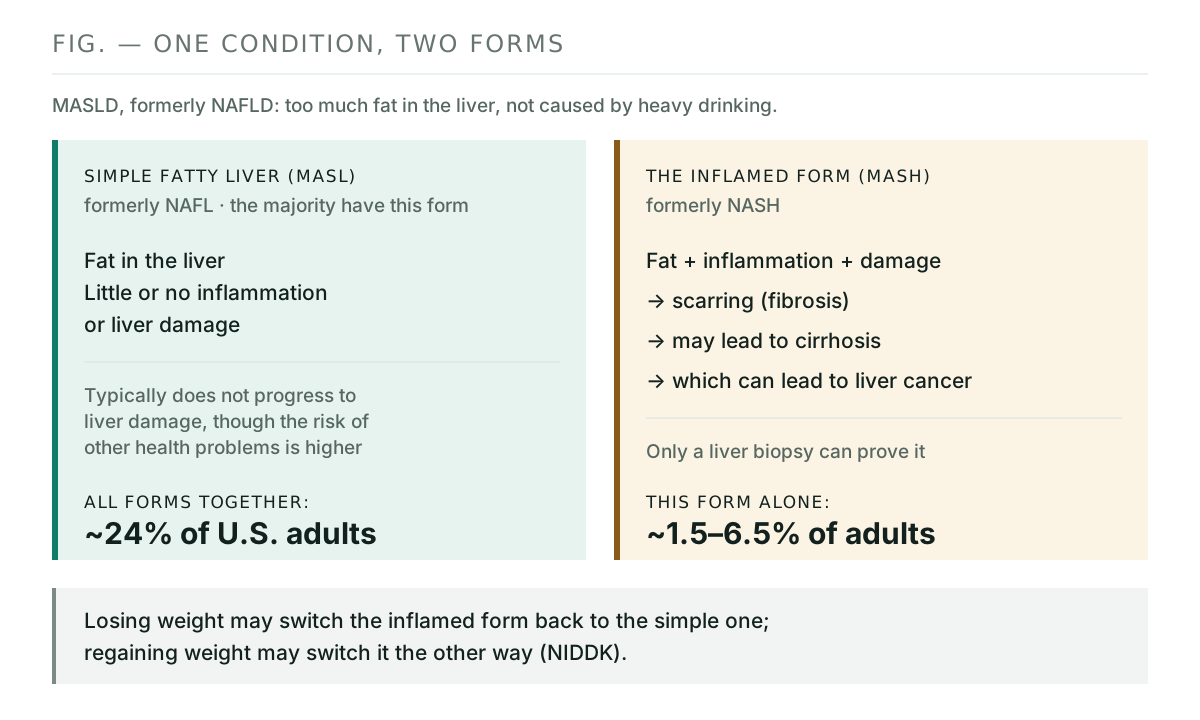
The NIDDK describes two types. In the simple form, you have fat in your liver but little or no inflammation or liver damage; it typically does not progress to cause liver damage or complications, although it can cause pain from enlargement of the liver. In the inflamed form, MASH, you have inflammation and liver damage in addition to the fat. That can cause fibrosis, or scarring, which may lead to cirrhosis, in which the liver is permanently damaged, and cirrhosis can lead to liver cancer.
Experts are not sure why some people develop one form rather than the other, the NIDDK says. It adds that having more of the conditions linked to the disease raises the chance of the inflamed form, and that losing weight may cause it to switch back to the simple form, while regaining weight may cause the simple form to switch to the inflamed one.
How common it is
The NIDDK calls it one of the most common causes of liver disease in the United States. Experts estimate about 24% of U.S. adults have the overall condition and about 1.5% to 6.5% have the inflamed form, it says; the majority have the simple form. MedlinePlus calls it the most common long-term liver disease, which it attributes to increasing rates of obesity, type 2 diabetes and high cholesterol.
The numbers climb sharply with weight and blood sugar. The NIDDK says studies suggest one-third to two-thirds of people with type 2 diabetes have it, and research suggests it is present in up to 75% of people who are overweight and more than 90% of people with severe obesity. It says people are more likely to develop it as they age.
Why there are usually no symptoms
The NIDDK calls it "a silent disease with few or no symptoms," and says you may not have symptoms even if you develop cirrhosis from the inflamed form. If you do have symptoms, it says, you may feel tired or have discomfort in the upper right side of your abdomen. MedlinePlus lists fatigue and pain in the upper right abdomen as the most common.
MedlinePlus lists a separate set of symptoms in people with the inflamed form who have developed cirrhosis: weakness, loss of appetite, nausea, yellow skin and eyes (jaundice), itching, fluid buildup and swelling in the legs and abdomen, mental confusion, and bleeding in the digestive tract.
MedlinePlus's cirrhosis page says to contact your provider if you develop symptoms of cirrhosis, and to get emergency medical help right away for: abdominal or chest pain; abdominal swelling that is new or suddenly worse; a fever above 101°F (38.3°C); diarrhea; confusion or a change in alertness, or confusion that gets worse; rectal bleeding, vomiting blood, or blood in the urine; shortness of breath; vomiting more than once a day; or yellowing of the skin or eyes that is new or gets worse quickly.
Who is most likely to have it
MedlinePlus lists being overweight or obese ("the more overweight you are, the higher the risk"), prediabetes, type 2 diabetes, high cholesterol, high triglycerides and high blood pressure. Other risk factors it names include rapid weight loss and a poor diet, gastric bypass surgery, bowel disease, lack of exercise, and certain medicines, such as calcium channel blockers (a type of blood pressure medicine), and some cancer medicines. It adds that the condition also occurs in people with no known risk factors.
The NIDDK adds metabolic syndrome, or even one of its traits, to the list. Separately, it notes that some medicines, including corticosteroids, some HIV treatments and estrogens, can themselves cause fat to build up in the liver, one of the other causes a doctor checks for before calling it MASLD. It says researchers are studying whether diets high in fructose, a sugar in table sugar and many sweetened drinks, may increase the risk.
How it is diagnosed
The NIDDK says doctors use your medical history, a physical exam and tests. Your doctor may suspect it if blood tests show increased levels of the liver enzymes ALT (alanine aminotransferase) and AST (aspartate aminotransferase), and may use routine results to calculate scores such as FIB-4 or APRI, which help identify or rule out advanced scarring. Routine imaging, such as ultrasound, CT or MRI, can show fat in the liver but cannot show inflammation or scarring.
Elastography, a newer type of imaging, measures the stiffness of the liver, and increased stiffness may be a sign of scarring. MedlinePlus names one version, FibroScan. A liver biopsy, the NIDDK says, is the only test that can prove the inflamed form and show how severe it is, but doctors don't recommend it for everyone; it is used when advanced scarring is more likely, when other tests suggest advanced disease, or to rule out other liver diseases.
Where alcohol fits
Your doctor will ask about drinking, because it decides the diagnosis. The NIDDK says that if you have a history of heavy alcohol use and fat in your liver, your doctor may determine you have alcohol-associated liver disease instead. If you have risk factors for MASLD and also drink excessively, you could have both at the same time, and no tests can easily tell how much each plays a role.
The NIDDK's advice for people who have the condition is to minimize alcohol use, which can further damage the liver. MedlinePlus lists not drinking alcohol among the healthy choices a provider may recommend.
How much weight loss helps
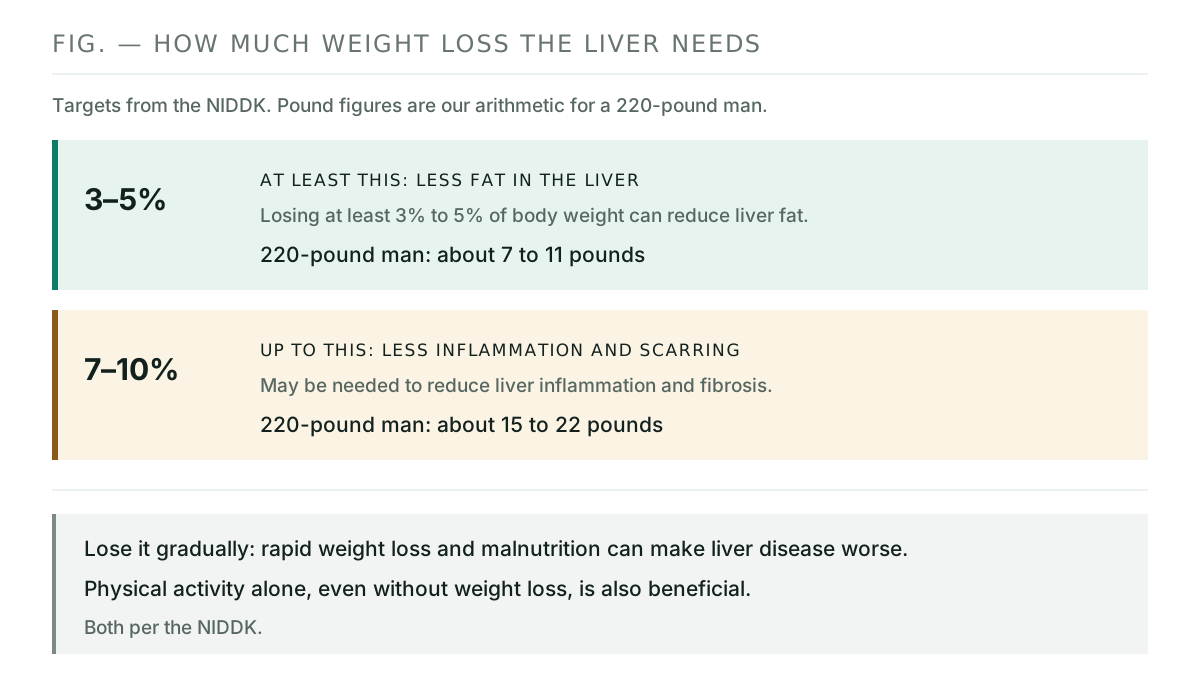
Weight loss is the first treatment. For people who are overweight or have obesity, the NIDDK says losing at least 3% to 5% of your body weight can reduce fat in the liver, and that you may need to lose up to 7% to 10% to reduce liver inflammation and scarring. It says physical activity alone, even without weight loss, is also beneficial. MedlinePlus says losing weight and managing diabetes can slow or sometimes reverse the deposit of fat in the liver.
The NIDDK also says to lose it gradually: rapid weight loss and malnutrition can make liver disease worse. On diet, it says your doctor may suggest limiting fats, replacing saturated and trans fats with unsaturated fats, especially omega-3s, eating more low-glycemic foods such as most fruits, vegetables and whole grains, and avoiding foods and drinks with large amounts of simple sugars, especially fructose, which it says is found in sweetened soft drinks, sports drinks, sweetened tea and juices.
The two drugs the FDA has approved
Here the government pages disagree with each other, partly because of timing. The NIDDK's treatment page, last reviewed in April 2021, says no medicines have been approved to treat the condition. The MedlinePlus topic page, marked as updated in July 2026, still says "currently, no medicines are approved for treatment," so it has not caught up. The FDA has, in fact, approved two, both for the same narrow group, and the MedlinePlus encyclopedia page on the disease already names the first.
In March 2024, the FDA approved Rezdiffra (resmetirom) for adults with noncirrhotic NASH with moderate to advanced liver scarring, used along with diet and exercise. In its trial of 888 people, 26% to 27% on the 80 mg dose and 24% to 36% on the 100 mg dose had the inflammation resolve without the scarring getting worse at 12 months, compared with 9% to 13% on placebo. The FDA lists diarrhea and nausea as the most common side effects, warns about drug-induced liver toxicity and gallbladder problems, and says taking it with certain other drugs, in particular statins, may cause significant interactions.
In August 2025, the FDA approved Wegovy (semaglutide) injection for adults with MASH with moderate to advanced scarring. Its prescribing information, like the Rezdiffra approval, limits the use to noncirrhotic MASH, with fibrosis consistent with stages F2 to F3, and the trial participants were also on lifestyle changes. In an interim analysis of 800 people at 72 weeks, 63% on Wegovy had the inflammation resolve without the scarring getting worse, compared with 34% on placebo, and 37% had improved scarring, compared with 22%. Both approvals came through the accelerated pathway, based on liver biopsy results, and both trials are still running to confirm a clinical benefit; for Wegovy, the FDA names fewer deaths, liver transplants and other liver-related events. The FDA lists nausea, diarrhea, vomiting, constipation and abdominal pain among Wegovy's most common side effects, and says people with a personal or family history of medullary thyroid cancer, or with multiple endocrine neoplasia type 2, should not take it.
In our reading, neither approval covers the most common situation, simple fatty liver with no scarring, and the FDA says Rezdiffra should be avoided in decompensated cirrhosis. Rezdiffra is approved for use along with diet and exercise, and the Wegovy trial added it to lifestyle changes: in both cases, on top of them, not instead of them. If you take a statin, that is one specific question to raise before Rezdiffra.
Supplements and herbal remedies
Liver supplements are heavily marketed, so the official position is worth stating plainly. The NIDDK says to talk with your doctor before using dietary supplements, such as vitamins, or any complementary or alternative medicines, "for safety reasons," and that "some herbal remedies can actually damage your liver." MedlinePlus says the same: check with your provider first, because some supplements or herbal remedies can damage the liver. This site's ashwagandha article covers one popular example with a rare liver injury signal.
Why the heart matters as much as the liver
In our reading, for most people with fatty liver disease, the bigger danger is not the liver. The NIDDK says cardiovascular disease is the most common cause of death in people who have the condition, and that they have a higher risk of conditions that may be part of metabolic syndrome, such as high blood pressure and abnormal cholesterol and triglyceride levels. People with the simple form typically don't develop liver complications, it says, though they have a higher risk of other health problems.
In our reading, that is why a fatty liver result is a reason to look at the whole picture: waist, blood pressure, blood sugar and cholesterol. This site's heart health after 40 and cholesterol after 40 articles cover those numbers. MedlinePlus also suggests talking with your provider about vaccinations, such as hepatitis A and B, because people with chronic liver disease are more likely to get infections.
Key takeaways
- Fatty liver disease, now called MASLD, affects an estimated 24% of U.S. adults, per the NIDDK, and usually causes no symptoms.
- Most people have the simple form; the inflamed form, MASH, can scar the liver and lead to cirrhosis.
- If you are overweight, losing at least 3% to 5% of body weight can reduce liver fat; 7% to 10% may be needed to reduce inflammation and scarring. Lose it gradually.
- The FDA approved Rezdiffra in 2024 and Wegovy in 2025, but only for MASH with moderate to advanced scarring, not simple fatty liver.
- Cardiovascular disease is the most common cause of death in people with the condition, so the heart numbers matter too.
Where to go from here
Fatty liver rarely shows up on its own. These pages cover the conditions that travel with it:
- Belly Fat in Men — the waist measurement and the deep fat that matters.
- Metabolic Syndrome Explained — the five numbers that often come with it.
- Prediabetes After 40 — one of the strongest links.
- Cholesterol After 40 — the blood fats behind the heart risk.
- All weight articles
Frequently asked questions
What are the symptoms of fatty liver disease?
Usually none. The NIDDK calls it a silent disease with few or no symptoms, even in some people who develop cirrhosis. When symptoms do occur, they are usually tiredness or discomfort in the upper right side of the abdomen. It is often found by accident, on routine blood tests that check the liver.
What is the difference between NAFLD and MASLD?
They are the same condition under an old and a new name. MedlinePlus says metabolic dysfunction-associated steatotic liver disease, or MASLD, used to be called nonalcoholic fatty liver disease, or NAFLD. Its more serious form, MASH, was previously called nonalcoholic steatohepatitis, or NASH.
Can fatty liver be reversed?
It can be improved. For people who are overweight, the NIDDK says losing at least 3% to 5% of body weight can reduce fat in the liver, and that losing up to 7% to 10% may be needed to reduce inflammation and scarring. MedlinePlus says losing weight and managing diabetes can slow or sometimes reverse the fat buildup.
Is there a medicine for fatty liver disease?
For one specific group, yes. The FDA approved Rezdiffra (resmetirom) in March 2024 and Wegovy (semaglutide) in August 2025 for adults with MASH, the inflamed form, with moderate to advanced liver scarring and without cirrhosis. Neither is approved for simple fatty liver.
How is fatty liver diagnosed?
The NIDDK says doctors use blood tests, imaging and sometimes a liver biopsy. Raised liver enzymes called ALT and AST can raise suspicion, scores such as FIB-4 help rule out advanced scarring, ultrasound can show fat, elastography can measure stiffness, and only a biopsy can prove the inflamed form, MASH.
Does fatty liver affect the heart?
Yes. The NIDDK says cardiovascular disease is the most common cause of death in people who have NAFLD, the older name for MASLD. People with the condition also have a higher risk of high blood pressure and abnormal cholesterol and triglyceride levels.
Sources
- National Institute of Diabetes and Digestive and Kidney Diseases (NIH) — Definition & Facts of NAFLD & NASH
- National Institute of Diabetes and Digestive and Kidney Diseases (NIH) — Symptoms & Causes of NAFLD & NASH
- National Institute of Diabetes and Digestive and Kidney Diseases (NIH) — Diagnosis of NAFLD & NASH
- National Institute of Diabetes and Digestive and Kidney Diseases (NIH) — Treatment for NAFLD & NASH
- National Institute of Diabetes and Digestive and Kidney Diseases (NIH) — Eating, Diet, & Nutrition for NAFLD & NASH
- MedlinePlus (National Library of Medicine) — Steatotic Liver Disease
- MedlinePlus (National Library of Medicine) — Nonalcoholic fatty liver disease
- MedlinePlus (National Library of Medicine) — Cirrhosis — adults
- U.S. Food and Drug Administration — FDA Approves First Treatment for Patients with Liver Scarring Due to Fatty Liver Disease (March 14, 2024)
- U.S. Food and Drug Administration — FDA Approves Treatment for Serious Liver Disease Known as ‘MASH’ (August 15, 2025)
- DailyMed (National Library of Medicine) — Wegovy (semaglutide) injection: prescribing information

Male Health Guide Editorial Team
We write about the health problems men over 40 actually search for at 3 a.m. — and we say plainly when the evidence for a popular product is thin. We do not invent credentials and we do not publish sponsored copy as editorial. Read more about how we work.
Medical disclaimer: This article is general information, not medical advice. We are not doctors, and nothing here diagnoses, treats or cures any condition. Don't stop or start a medicine, or take a liver supplement, without talking to your provider. If you have symptoms of cirrhosis, contact your provider; for the warning signs MedlinePlus says need emergency help right away, see above.