Tamsulosin (Flomax): How to Take It, Side Effects, Warnings
Short answer
Tamsulosin (Flomax) is an alpha blocker for an enlarged prostate: it relaxes muscle in the prostate and bladder so urine flows more easily, but it does not shrink the gland. U.S. capsules are taken once a day, about half an hour after the same meal. Watch for ejaculation changes and dizziness, and tell any eye surgeon you take it.
Tamsulosin is a common prescription for an enlarged prostate. This site's prostate medications article compares it with the drugs that shrink the gland. This page goes narrower: how to take tamsulosin, what the trials behind its label actually measured, the side effects that matter to men, and the handful of warnings worth knowing before the first capsule.
Most of what follows comes from the FDA prescribing information for tamsulosin hydrochloride capsules, from MedlinePlus, the National Library of Medicine's consumer drug page, and from the NHS. Where they say different things, we say so.
What tamsulosin does, and what it doesn't
MedlinePlus says tamsulosin is used to treat benign prostatic hyperplasia (BPH), an enlarged prostate that can cause difficulty urinating, painful urination, or increased urinary frequency or urgency. It belongs to a class called alpha blockers and works by relaxing the muscles in the prostate and bladder so that urine can flow easily.
The NHS adds that it is sometimes also used to treat kidney stones, which this site covers in kidney stones explained.
What it does not do matters as much. MedlinePlus says tamsulosin may help control your condition, but it will not cure it, and that you should keep taking it even if you feel well.
The FDA label also says tamsulosin capsules are not indicated for the treatment of high blood pressure, even though the NHS lists doxazosin, another alpha blocker, among the blood pressure medicines that may not mix well with it.
How to take it: the half-hour-after-a-meal rule
The FDA label sets the usual tamsulosin dose at 0.4 mg once daily, taken approximately one-half hour following the same meal each day. MedlinePlus puts it the same way: once a day, 30 minutes after a meal, at around the same time every day.
Both say to swallow the capsule whole; the label says the capsules should not be crushed, chewed or opened.
If 0.4 mg does not help after 2 to 4 weeks, the label says the dose can be increased to 0.8 mg once daily, and MedlinePlus says your doctor will probably start low and may increase after 2 to 4 weeks.
One rule surprises people: if you stop or interrupt tamsulosin for several days at either dose, the label says to restart at 0.4 mg once daily, and MedlinePlus says to call your doctor before restarting.
The NHS says you usually take tamsulosin once a day, with or without food, and that it comes as tablets or capsules. The U.S. label and MedlinePlus, which describe the capsules sold in the United States, tie the dose to a meal. The practical answer is to follow the instructions on your own prescription label, and to ask your pharmacist if they are unclear.
What the trials behind the label measured
The tamsulosin label's main evidence comes from two 13-week U.S. trials in 1,486 men with BPH symptoms (1,487 in the label's safety tables), randomized to placebo, 0.4 mg or 0.8 mg. Symptoms were scored on the American Urological Association questionnaire, which runs from 0 to 35, and urine flow was measured.
Both doses improved symptom scores significantly more than placebo in both trials.
The tamsulosin label reports the average fall in the 0-to-35 symptom score at week 13:
| Average fall in symptom score | Placebo | 0.4 mg | 0.8 mg |
|---|---|---|---|
| Study 1 (average start about 20) | 5.5 | 8.3 | 9.6 |
| Study 2 | 3.6 | 5.1 | 5.8 |
Peak urine flow rose by 1.75 mL per second on 0.4 mg in Study 1, against 0.52 on placebo; in Study 2 the 0.4 mg increase was not significantly different from placebo, while the 0.8 mg increase was, though Study 2 measured flow 24 to 27 hours after the dose, near its lowest level, while Study 1 measured it 4 to 8 hours after.
Two things follow, in our reading. Placebo improved scores too, so on average part of the improvement seen in the trials was not due to the drug. And the label says that, overall, the 0.4 mg and 0.8 mg groups did not differ significantly, except that 0.8 mg improved symptom scores more in Study 1.
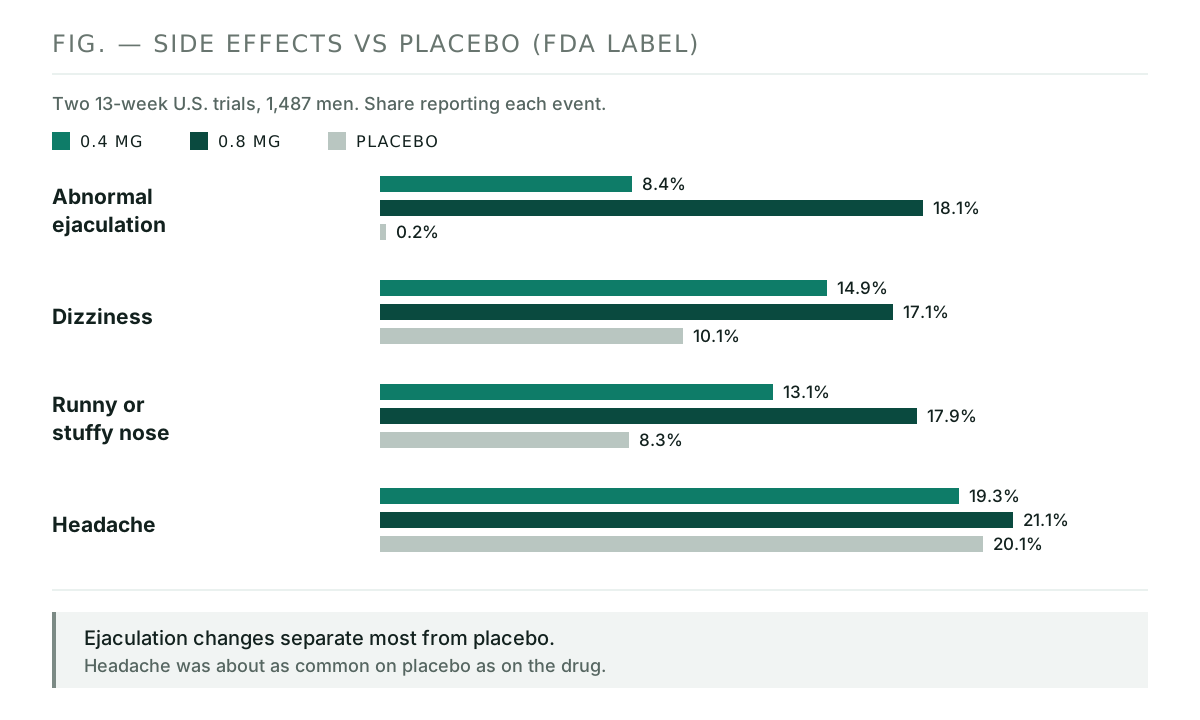
The higher dose also roughly doubled abnormal ejaculation (18.1% against 8.4%), and 8 of 492 men (1.6%) on 0.8 mg left the trials because of it, against none on 0.4 mg.
Ejaculation changes: the side effect men ask about
Abnormal ejaculation is the tamsulosin side effect that separates most clearly from placebo. In the two U.S. trials on the FDA label, abnormal ejaculation was reported by 8.4% of men on 0.4 mg and 18.1% on 0.8 mg, against 0.2% on placebo.
The NHS lists ejaculation problems among the common side effects, and MedlinePlus lists difficulty ejaculating among those to tell your doctor about if severe or persistent.
MedlinePlus adds a note on fertility: the medicine may decrease the ability to have children in men and in women, though that does not mean pregnancy cannot happen, so effective contraception is still needed. Sex and the prostate more broadly are covered in this site's enlarged prostate and sex article.
Dizziness, standing up, and the trip to the bathroom at night
In the label's U.S. trials, dizziness was reported by 15% of men on tamsulosin 0.4 mg, 17% on 0.8 mg and 10% on placebo. In standing (orthostatic) tests, which counted a drop in blood pressure, a jump in pulse or dizziness on standing, 16% of men on 0.4 mg had at least one positive result, against 11% on placebo.
On 0.8 mg the figure was 19%. Fainting was rare: 1 of 502 men on 0.4 mg, 2 of 492 on 0.8 mg and 3 of 493 on placebo. But because dizziness on standing was more common on the drug, the label warns of a potential risk of fainting and advises avoiding situations where a faint could cause injury.
MedlinePlus says dizziness, lightheadedness, a spinning sensation and fainting are more likely when you first start or after a dose increase, especially when you get up too quickly from lying down.
Its advice is to get out of bed slowly, resting your feet on the floor for a few minutes before standing. For men who are already waking up to pee at night, that is the moment to apply it.
MedlinePlus says not to drive or operate machinery until you know how the medicine affects you, and to call your doctor if dizziness is severe or does not go away. The NHS says not to drive, ride a bike or use machinery while you feel dizzy, and that it is best not to drink alcohol, as it can increase the risk of side effects.
Why your eye surgeon has to know
The FDA label warns about Intraoperative Floppy Iris Syndrome (IFIS), seen during cataract and glaucoma surgery in some patients on, or previously treated with, alpha blockers including tamsulosin. The iris can billow, and the pupil can narrow during the operation. The label says IFIS may increase the risk of eye complications during and after the operation.
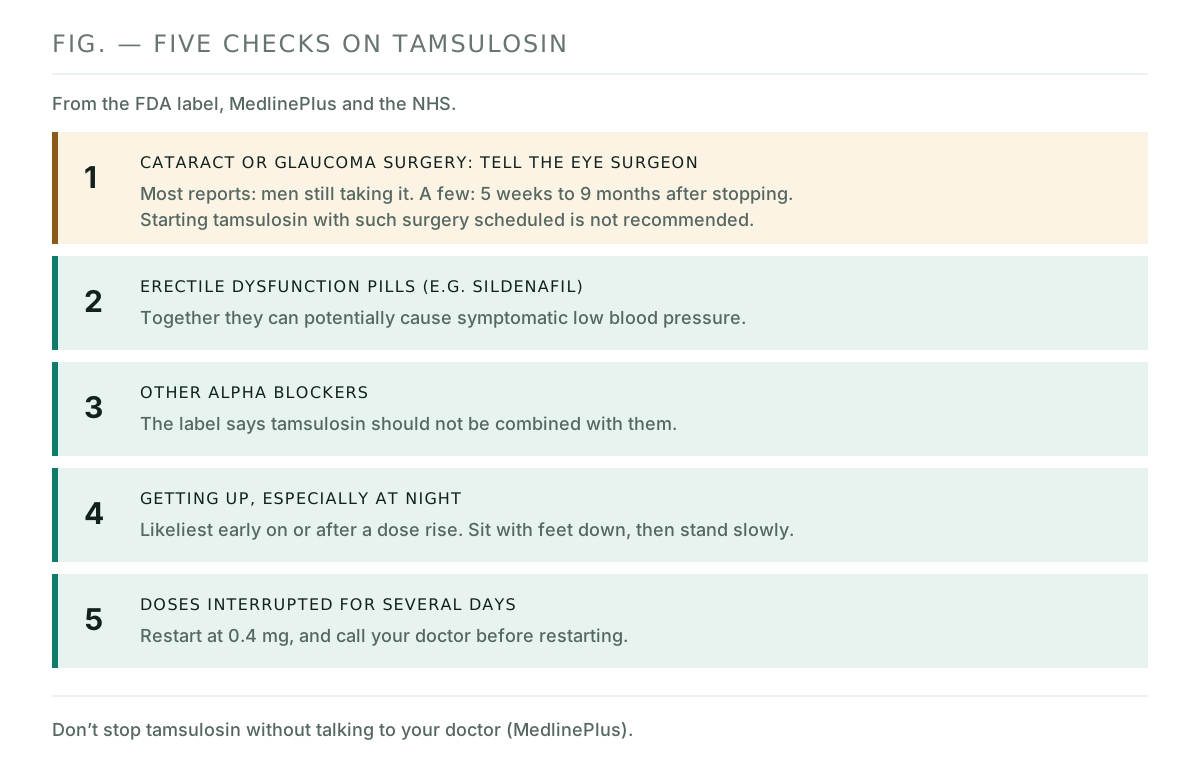
The timing is the part to remember. The label says most reports involved men still taking the drug, but in some cases it had been stopped 2 to 14 days before surgery, and in a few, 5 weeks to 9 months before.
It says the benefit of stopping before cataract or glaucoma surgery has not been established, and that starting tamsulosin in a man whose cataract or glaucoma surgery is already scheduled is not recommended. MedlinePlus says to tell your doctor if you need eye surgery at any time during or after treatment.
Medicines that don't mix well
The FDA label says tamsulosin 0.4 mg should not be used with strong inhibitors of the liver enzyme CYP3A4, such as the antifungal ketoconazole, and should not be combined with other alpha blockers. It advises caution with moderate CYP3A4 inhibitors such as the antibiotic erythromycin, with paroxetine or terbinafine, with cimetidine, particularly at 0.8 mg, and with warfarin.
The interaction that matters to many men is with erectile dysfunction pills. The label advises caution when alpha blockers are taken with PDE5 inhibitors, because both lower blood pressure and together can potentially cause symptomatic low blood pressure. The NHS list of medicines that may not mix well includes sildenafil (Viagra), some blood pressure medicines such as doxazosin and diltiazem, some antibiotics such as erythromycin, some antifungals, and HIV medicines.
MedlinePlus names cimetidine as a nonprescription product that may interact. If you also take a prostate supplement and a blood pressure medicine, this site's article on prostate supplements and blood pressure medication covers that combination; ask your pharmacist about any supplement taken with tamsulosin.
Prostate cancer screening on tamsulosin
The label makes a point that is easy to skip: prostate cancer and BPH frequently coexist, so it says patients should be screened for prostate cancer before starting tamsulosin and at regular intervals afterwards. MedlinePlus also asks you to tell your doctor if you have, or have ever had, prostate cancer.
In our reading, the point is that easier urination on tamsulosin is not evidence about cancer either way. This site's BPH vs prostate cancer and PSA levels by age articles cover what screening involves.
Serious side effects and when to get help
The FDA label for tamsulosin says priapism, a persistent, painful erection unrelated to sexual activity, has rarely been linked to the drug, probably in fewer than 1 in 50,000 patients, and that it can lead to permanent impotence if not properly treated.
MedlinePlus says to call your doctor immediately for a painful erection that lasts for hours, for rash, itching, hives, difficulty breathing or shortness of breath, and for swelling of the eyes, face, tongue, lips, throat, arms, hands, feet, ankles or lower legs.
The NHS says to call its emergency number (911 in the U.S.) if you take tamsulosin and think you might be having anaphylaxis, which can cause a swollen throat or tongue, a raised itchy rash or difficulty breathing, or Stevens-Johnson syndrome, which causes flu-like symptoms, a rash, blisters and sores.
For an overdose, MedlinePlus gives the poison control line (1-800-222-1222) and says to call 911 immediately if the person has collapsed, had a seizure, has trouble breathing or can't be awakened.
The label adds that allergic reactions to tamsulosin have rarely been reported in people with a sulfa allergy, and that caution is warranted if you have had a serious or life-threatening sulfa allergy. The NHS says tamsulosin may not be suitable if you have liver or kidney problems, have ever fainted during or after peeing, or have been told you have orthostatic hypotension.
Stopping, missing a dose, and what comes next
MedlinePlus says not to stop tamsulosin without talking to your doctor. For a missed dose, it says to take it as soon as you remember unless the next dose is nearly due, in which case skip it, and never take a double dose. After an interruption of several days, the restart rule above applies.
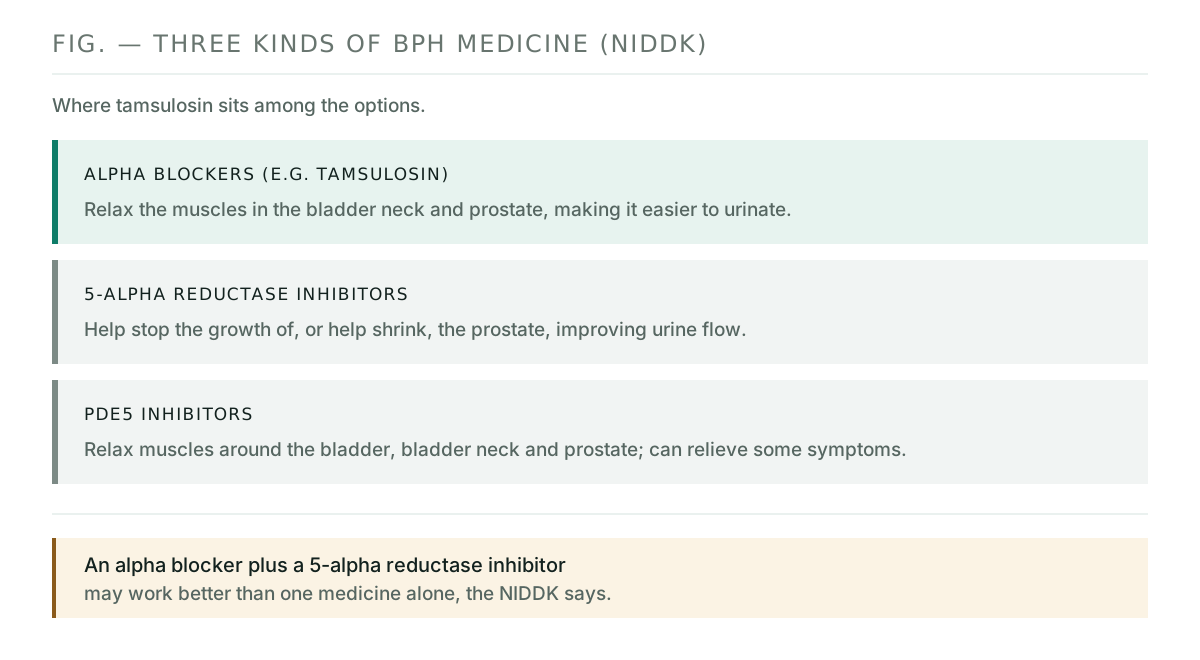
The NIDDK lists three kinds of medicine for BPH: alpha blockers such as tamsulosin, 5-alpha reductase inhibitors that help stop the growth of or shrink the prostate, and PDE5 inhibitors, which relax muscles around the bladder and prostate.
It says research shows that combining an alpha blocker with a 5-alpha reductase inhibitor may work better than one medicine alone, and to tell a health care professional about any side effects. Those options, and procedures, are covered in prostate medications explained and prostate surgery options.
Key takeaways
- Tamsulosin relaxes muscle in the prostate and bladder so urine flows more easily; MedlinePlus says it helps control BPH but will not cure it.
- U.S. capsules: 0.4 mg once daily, about half an hour after the same meal; the NHS says with or without food, so follow your own label.
- In the label's U.S. trials, abnormal ejaculation affected 8.4% on 0.4 mg and 18.1% on 0.8 mg, against 0.2% on placebo.
- Dizziness is most likely when you first start or after a dose increase, especially when you stand up quickly from lying down; get out of bed slowly.
- Tell any eye surgeon you take, or have taken, tamsulosin; floppy iris syndrome has been reported, in a few cases, months after stopping.
- Use caution with erectile dysfunction pills, and don't combine tamsulosin with other alpha blockers.
Where to go from here
If tamsulosin is what brought you here, these pages cover the surrounding ground:
- Prostate Medications Explained — tamsulosin next to the drugs that shrink the gland.
- Enlarged Prostate After 40 — the condition tamsulosin treats.
- Enlarged Prostate and Sex — ejaculation and erections, answered properly.
- Waking Up to Pee at Night — causes and fixes for night-time trips to the bathroom.
- All prostate articles
Frequently asked questions
What is the best time to take tamsulosin?
The FDA label for U.S. tamsulosin capsules says to take 0.4 mg once a day, about half an hour after the same meal each day, and MedlinePlus says to take it 30 minutes after a meal at around the same time daily. The NHS says once a day with or without food, so follow the instructions on your own prescription.
Does tamsulosin affect ejaculation?
It can. In two 13-week U.S. trials on the FDA label, abnormal ejaculation was reported by 8.4% of men on 0.4 mg and 18.1% on 0.8 mg, against 0.2% on placebo. The NHS lists ejaculation problems as a common side effect, and MedlinePlus says the drug may decrease fertility.
Can I take tamsulosin with Viagra?
Only with your doctor's knowledge. The FDA label advises caution when alpha blockers such as tamsulosin are taken with PDE5 inhibitors such as sildenafil (Viagra), because both lower blood pressure and together can potentially cause symptomatic low blood pressure. The NHS also lists medicines for erectile dysfunction among those that may not mix well.
Why do I need to tell my eye surgeon I take tamsulosin?
The FDA label says Intraoperative Floppy Iris Syndrome has been seen during cataract and glaucoma surgery in some men on, or previously treated with, alpha blockers including tamsulosin, in a few cases 5 weeks to 9 months after stopping. Telling the surgeon lets them prepare to adjust their technique.
Is tamsulosin a blood pressure medicine?
No. The FDA label says tamsulosin capsules are indicated for the signs and symptoms of benign prostatic hyperplasia and are not indicated for the treatment of high blood pressure. It can still cause dizziness on standing: in the label's U.S. trials, 16% of men on 0.4 mg had at least one positive orthostatic test (a drop in blood pressure, a jump in pulse, or dizziness on standing), against 11% on placebo.
Does tamsulosin shrink the prostate?
No. MedlinePlus says tamsulosin works by relaxing the muscles in the prostate and bladder so urine can flow more easily, and that it may help control the condition but will not cure it. It says to keep taking it even if you feel well, and not to stop without talking to your doctor.
Sources
- U.S. Food and Drug Administration prescribing information (DailyMed) — Tamsulosin hydrochloride capsules, label version effective September 1, 2026
- MedlinePlus (National Library of Medicine) — Tamsulosin
- NHS — Tamsulosin: a medicine for an enlarged prostate
- National Institute of Diabetes and Digestive and Kidney Diseases (NIH) — Prostate Enlargement (Benign Prostatic Hyperplasia)

Male Health Guide Editorial Team
We write about the health problems men over 40 actually search for at 3 a.m. — and we say plainly when the evidence for a popular product is thin. We do not invent credentials and we do not publish sponsored copy as editorial. Read more about how we work.
Medical disclaimer: This article is general information, not medical advice. We are not doctors, and nothing here diagnoses, treats or cures any condition. Do not start, stop or change tamsulosin without your doctor. Call 911 for signs of a severe allergic reaction, and get help right away for a painful erection that lasts for hours.