Kidney Stones: Why Being Pain-Free Doesn't Mean It Passed
Short answer
Kidney stones are hard, pebble-like pieces that form in the kidneys when urine carries high levels of certain minerals. Men are more likely to get them: about 11% of US men versus 6% of women, per NIDDK. Small stones often pass on their own. After a diagnosed blockage, MedlinePlus warns that being pain free does not confirm the stone has passed.
Kidney stones have a reputation built almost entirely on the pain. Ask a man who has had one and the story is usually about a night on the bathroom floor or in an emergency room. What gets less attention is what happens after the pain eases — and one line in the MedlinePlus encyclopedia changes how that moment is worth reading.
This article covers what kidney stones are, why men get them more often, the four main types, what raises the risk, the symptoms, how they are diagnosed and treated, why the end of the pain is not the end of the story, when to get care, and what prevention looks like. It sits in this site's Prostate section because the urinary tract is one system, and several of the articles here meet stones from a different direction.
What kidney stones are
The National Institute of Diabetes and Digestive and Kidney Diseases (NIDDK) describes kidney stones as hard, pebble-like pieces of material that form in one or both kidneys when high levels of certain minerals are in your urine. MedlinePlus puts it as a solid mass made up of tiny crystals, and notes that one or more stones can be in the kidney or ureter at the same time. The crystals, it says, can develop into stones over weeks or months.
Size varies a lot. NIDDK says stones may be as small as a grain of sand or as large as a pea, and that rarely, some are as big as golf balls. They may be smooth or jagged and are usually yellow or brown. A small stone may pass through the urinary tract on its own, causing little or no pain; a larger one may get stuck along the way, and a stuck stone can block the flow of urine and cause severe pain or bleeding. The scientific names a provider may use include renal calculus, nephrolith, nephrolithiasis, urolithiasis and urinary stones.
NIDDK opens with a reassurance worth holding onto: kidney stones rarely cause permanent damage if treated by a health care professional. MedlinePlus says the same thing in other words — stones are painful, but most of the time they can be removed without causing lasting damage.
Why men get them more often
NIDDK states it directly: men are more likely to develop kidney stones than women. It puts numbers on it, citing the Urologic Diseases in America project: about 11 percent of men and 6 percent of women in the United States have kidney stones at least once during their lifetime. It also notes that kidney stones are common and on the rise.
MedlinePlus adds detail by stone type. Calcium stones, the most common kind, are most likely to occur in men between ages 20 and 30. Uric acid stones are more common in men than in women, and can occur with gout or after chemotherapy for some types of cancer. Gout has its own article on this site, the gout after 40 page, which lists kidney stones linked to uric acid among the reasons a provider may move toward long-term treatment.
For a man past 40, the more relevant line may be the one about history. NIDDK states that you are more likely to develop kidney stones again if you have had them once, and that a family history of kidney stones also raises the odds. MedlinePlus agrees that kidney stones often come back, and says this happens more often if the cause is not found and treated. In our view, that makes a first stone at any age a good reason to find out its type.
The four main types
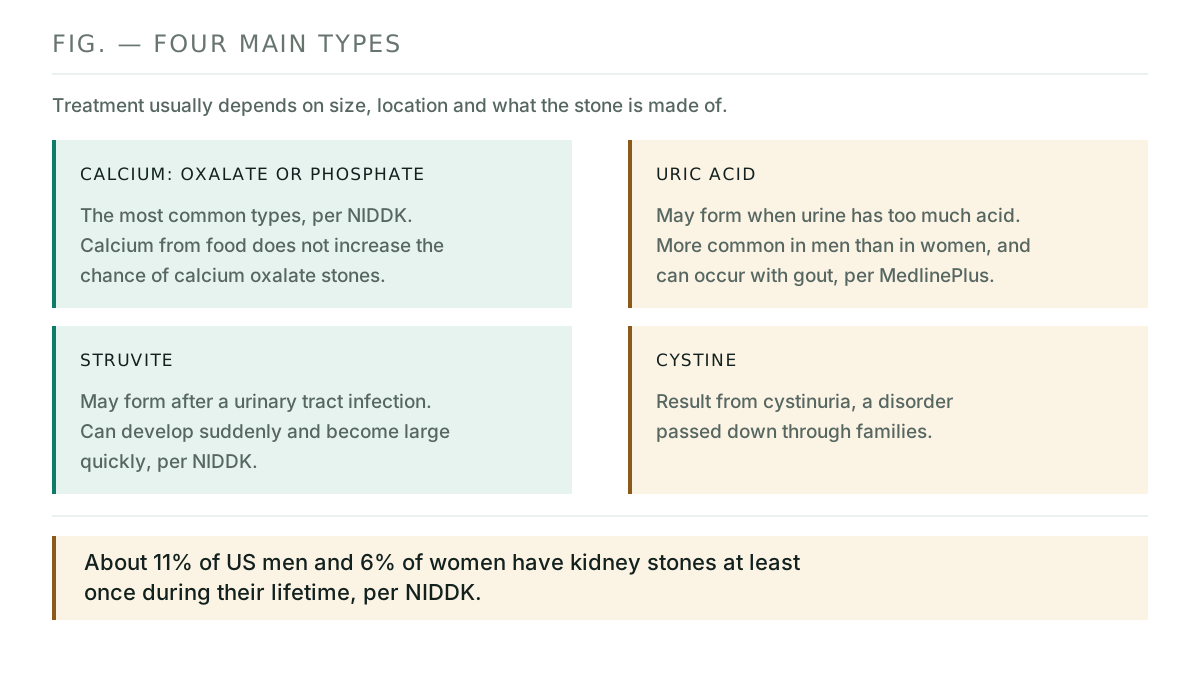
NIDDK says you probably have one of four main types, and that treatment usually depends on the stone's size, location and what it is made of. Calcium stones, including calcium oxalate and calcium phosphate stones, are the most common; calcium oxalate stones are more common than calcium phosphate. MedlinePlus explains that calcium can combine with other substances to form the stone, oxalate being the most common, and that oxalate is present in certain foods such as spinach and is also found in vitamin C supplements.
Uric acid stones may form when urine contains too much acid, and NIDDK says eating a lot of fish, shellfish and meat, especially organ meat, may increase uric acid in urine. Struvite stones may form after a urinary tract infection; NIDDK says they can develop suddenly and become large quickly, and MedlinePlus says they can grow very large and block the kidney, ureter or bladder. Cystine stones result from cystinuria, a disorder passed down through families that causes the amino acid cystine to leak through the kidneys into the urine.
One sentence in NIDDK's description of calcium stones runs against what most people assume: "Calcium from food does not increase your chance of having calcium oxalate stones." That matters when it comes to prevention, covered below.
What raises the risk
MedlinePlus is unusually blunt about the top of the list: the biggest risk factor for kidney stones is not drinking enough fluids. It adds a number — stones are more likely if you make less than 1 liter (32 ounces) of urine a day. Fluids, and what happens when there are not enough of them, are the subject of this site's dehydration article in the Energy section.
NIDDK lists certain conditions that raise the risk, including a blockage of the urinary tract, chronic inflammation of the bowel, cystic kidney diseases, cystinuria, digestive problems or a history of gastrointestinal surgery, gout, hypercalciuria (which it calls the most common condition found in people who form calcium stones), hyperoxaluria, hyperparathyroidism, hyperuricosuria, obesity, repeated urinary tract infections and renal tubular acidosis.
It also names medicines that raise the risk when taken over a long period of time: diuretics, often called water pills; calcium-based antacids; indinavir, used to treat HIV; and topiramate, an anti-seizure medicine. Diuretics are a common blood pressure treatment, covered in this site's blood pressure medication article. Water pills also appear on the other side of the ledger: MedlinePlus lists thiazide diuretics among the medicines a provider may prescribe to prevent stones, covered under treatment below. The two sources do not explain how those fit together, and this article will not guess. Our suggestion: do not stop or start one on your own, and mention a stone history to the provider who prescribes it.
The symptoms, and where the pain travels
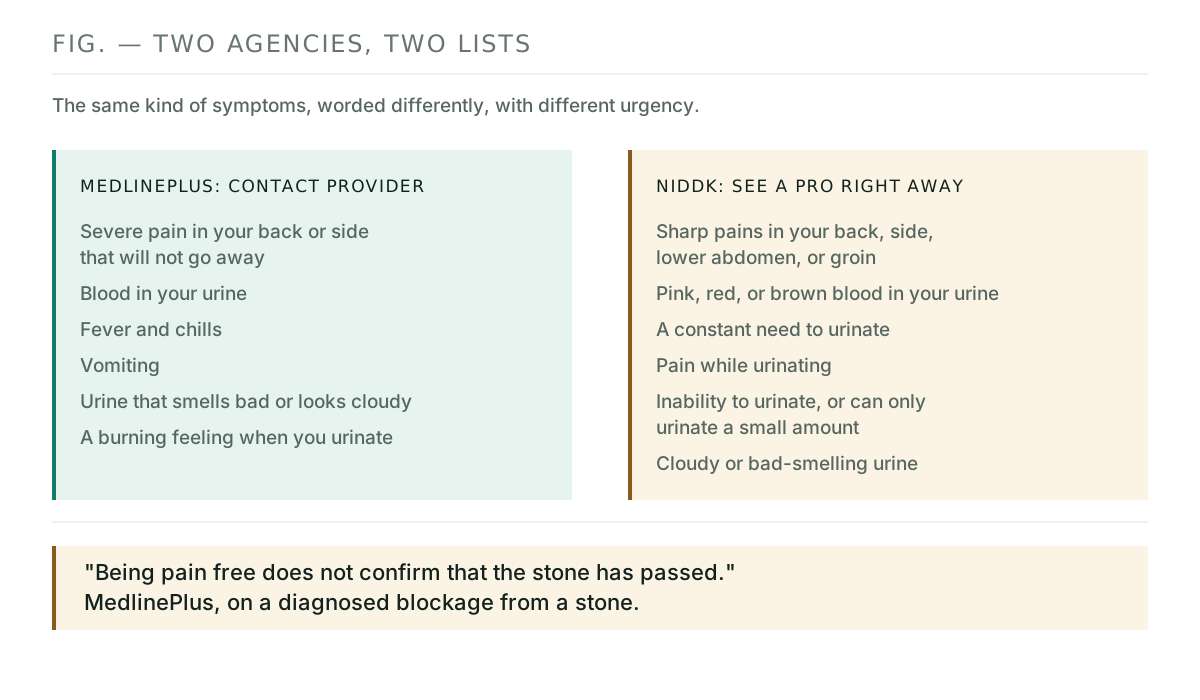
MedlinePlus explains that you may not have symptoms until the stone moves down the ureter, the tube through which urine empties into the bladder. When that happens, the stone can block the flow of urine out of the kidney and cause pain. The main symptom is severe pain that starts and stops suddenly. It may be felt in the belly area or the side of the back (the flank), and may move to the groin and, in men, to the testicles. Other symptoms can include abnormal urine color, blood in the urine, chills, fever, nausea and vomiting.
NIDDK's list is worded differently: sharp pains in the back, side, lower abdomen or groin; pink, red or brown blood in the urine; a constant need to urinate; pain while urinating; inability to urinate or only passing a small amount; and cloudy or bad-smelling urine. It adds that the pain may last a short or long time or come and go in waves, that along with pain you may have nausea and vomiting, and it lists fever and chills as other symptoms.
Two of those symptoms overlap with other articles here. Blood in the urine has its own page, blood in urine after 40, and flank pain can be mistaken for an ordinary sore back — this site's lower back pain article lists kidney stones among the causes of back pain that have nothing to do with the spine.
How they're diagnosed
MedlinePlus says the provider will do a physical exam, and the belly or back may feel sore. Tests that may be done include blood tests to check calcium, phosphorus, uric acid and electrolyte levels; kidney function tests; a urinalysis to check for crystals and red blood cells in the urine; and an examination of the stone itself to determine its type.
Stones or a blockage can be seen on an abdominal CT scan, abdominal x-rays, a kidney ultrasound or a retrograde pyelogram. The stone examination is the step people tend to skip without realizing it matters: MedlinePlus says your urine should be strained so a passed stone can be saved and tested, and NIDDK's food advice depends on knowing which type you had.
Treatment, from waiting it out to surgery
MedlinePlus states that treatment depends on the type of stone and how severe the symptoms are. Kidney stones that are small most often pass through the system on their own. Its advice while that happens: drink at least 6 to 8 glasses of water per day to produce a large amount of urine, which helps the stone pass, and strain the urine so the stone can be saved and tested.
It does not downplay the pain. Over-the-counter pain medicines such as ibuprofen and naproxen, alone or with narcotics, can be very effective, and some people with severe pain need to stay in the hospital and get fluids through an IV.
The same two pain relievers MedlinePlus suggests here, ibuprofen and naproxen, appear on its heart failure page among medicines that may make heart failure worse. That page is covered in this site's heart failure article. If you have heart failure, ask your provider which pain reliever to use for a stone.
For some types of stones, MedlinePlus says a provider may prescribe medicine to prevent stones or help them pass. These medicines can include allopurinol (for calcium oxalate or some uric acid stones), antibiotics (for struvite stones), calcium channel blockers (nifedipine), phosphate solutions, potassium citrate, water pills (thiazide diuretics), tadalafil, and tamsulosin or silodosin to relax the ureter and help the stone pass. Tamsulosin and silodosin may sound familiar to men with an enlarged prostate — they are among the alpha-blockers covered in this site's prostate medications article.
Surgery is often needed, MedlinePlus says, if the stone is too large to pass on its own, is growing, is blocking urine flow and causing an infection or kidney damage, if the pain cannot be controlled, or if there is a urinary tract infection or fever. It notes that most treatments today are much less invasive than in the past. Lithotripsy (extracorporeal shock-wave lithotripsy, or ESWL) uses sound or shock waves to break up stones slightly smaller than one half an inch (1.25 centimeters) in the kidney or ureter, and the fragments leave in the urine. Procedures through a small cut in the back and into the kidney or ureters are used for large stones or unusual anatomy; ureteroscopy, with a laser to break up the stone, may be used for stones in the lower urinary tract. Rarely, open surgery may be needed if other methods do not work or are not possible.
Why "the pain stopped" isn't proof
This is the line from the MedlinePlus encyclopedia that gives this article its title. If you have been diagnosed with a blockage from a stone, it says, passage must be confirmed either by capture in a strainer during urination or by a follow-up x-ray. Then: "Being pain free does not confirm that the stone has passed."
It is easy to see why the instinct runs the other way. MedlinePlus describes the pain as starting and stopping suddenly, and NIDDK says it can come and go in waves — so a quiet stretch can feel like the end of it. The source is clear that it is not proof. That is also why the strainer matters twice: it confirms the stone is out, and it gives the lab something to test, which is how you learn the type that NIDDK's food advice depends on.
The stakes are spelled out on both pages. MedlinePlus lists the obstruction of the ureter (acute unilateral obstructive uropathy) as a complication, and says kidney damage or scarring can happen if treatment is delayed too long. NIDDK says that untreated stones can cause blood in the urine, severe pain, urinary tract infections including kidney infections, and loss of kidney function — while noting that complications are rare if you seek treatment before problems occur.
When to get care
MedlinePlus says to contact your provider if you have symptoms of a kidney stone: severe pain in your back or side that will not go away, blood in your urine, fever and chills, vomiting, urine that smells bad or looks cloudy, or a burning feeling when you urinate.
NIDDK is more urgent in its wording. For its own list of symptoms — sharp pains in the back, side, lower abdomen or groin; pink, red or brown blood in the urine; a constant need to urinate; pain while urinating; inability to urinate or only a small amount; and cloudy or bad-smelling urine — it says to see a health care professional right away, because these symptoms may mean you have a kidney stone or a more serious condition. It repeats the point elsewhere: if you have symptoms including severe pain or bleeding, seek care right away.
Prevention, and why the type matters
NIDDK states that drinking enough liquid, mainly water, is the most important thing you can do to prevent kidney stones. Unless you have kidney failure, it says many health care professionals recommend six to eight 8-ounce glasses a day, and to talk with a professional about how much is right for you. MedlinePlus gives the same 6 to 8 glasses for people with a history of stones. NIDDK also notes that studies have shown the DASH diet can reduce the risk, and that being overweight increases it.
Beyond that, NIDDK says the type of stone you had shapes the food choices. For calcium oxalate stones, it lists foods you may want to avoid to reduce oxalate: nuts and nut products, peanuts, rhubarb, spinach and wheat bran. For calcium stones in general, it advises reducing sodium, says a health care professional may tell you to limit animal protein while still getting enough protein, and it says adults should aim for less than 2,300 mg of sodium a day.
Then comes the counterintuitive part: "Even though calcium sounds like it would be the cause of calcium stones, it's not." NIDDK explains that in the right amounts, calcium can block other substances in the digestive tract that may cause stones, and advises getting enough calcium from foods, talking with a professional about how much. For uric acid stones it stresses limiting animal protein, and that losing weight if overweight is especially important. For cystine stones, drinking enough liquid is the most important change. MedlinePlus adds that you may need to take medicine or make changes to your diet for some types of stones, and that a provider may want to do blood and urine tests to work out the right prevention steps.
Key takeaways
- Men are more likely to get kidney stones: about 11% of US men versus 6% of women have one at least once, per NIDDK.
- There are four main types — calcium (the most common), uric acid, struvite and cystine — and NIDDK's food advice depends on which one you had.
- The main symptom is severe pain that starts and stops suddenly; it may be felt in the belly area or the side of the back, and may move to the groin and, in men, the testicles.
- MedlinePlus: being pain free does not confirm a stone has passed; after a diagnosed blockage, passage is confirmed by a strainer or a follow-up x-ray.
- Not drinking enough fluids is the biggest risk factor, per MedlinePlus; NIDDK states that calcium from food does not increase the chance of calcium oxalate stones.
Where to go from here
If a kidney stone is what brought you here, these pages cover the surrounding ground:
- Blood in Urine After 40 — one of the symptoms on both official lists.
- Dehydration After 40 — the fluid side of the biggest risk factor.
- Gout After 40 — uric acid stones can occur with gout, per MedlinePlus.
- Prostate Medications Explained — where tamsulosin and silodosin usually come up.
- All prostate articles
Frequently asked questions
Are kidney stones more common in men?
Yes. The National Institute of Diabetes and Digestive and Kidney Diseases (NIDDK) states that men are more likely to develop kidney stones than women, and that about 11 percent of men and 6 percent of women in the United States have kidney stones at least once during their lifetime.
What does kidney stone pain feel like?
MedlinePlus describes the main symptom as severe pain that starts and stops suddenly. It may be felt in the belly area or the side of the back (flank) and may move to the groin area, and in men to the testicles. NIDDK adds that the pain may last a short or long time or come and go in waves.
If the pain stops, has the kidney stone passed?
Not necessarily. MedlinePlus states that being pain free does not confirm that the stone has passed. If you have been diagnosed with a blockage from a stone, it says passage must be confirmed either by capture in a strainer during urination or by a follow-up x-ray.
Does eating calcium cause kidney stones?
NIDDK states that calcium from food does not increase your chance of having calcium oxalate stones. It explains that in the right amounts, calcium can block other substances in the digestive tract that may cause stones, and advises talking with a health care professional about how much calcium you should eat.
What is the biggest risk factor for kidney stones?
MedlinePlus states that the biggest risk factor for kidney stones is not drinking enough fluids, and that stones are more likely if you make less than 1 liter (32 ounces) of urine a day. NIDDK calls drinking enough liquid, mainly water, the most important thing you can do to prevent them.
When should I contact a provider about a kidney stone?
MedlinePlus says to contact your provider if you have severe pain in your back or side that will not go away, blood in your urine, fever and chills, vomiting, urine that smells bad or looks cloudy, or a burning feeling when you urinate. NIDDK says to see a health care professional right away for its own list of symptoms, which includes sharp pains in the back, side, lower abdomen or groin and blood in the urine.
Sources
- MedlinePlus (National Library of Medicine) — Kidney stones
- National Institute of Diabetes and Digestive and Kidney Diseases (NIH) — Definition & Facts for Kidney Stones
- National Institute of Diabetes and Digestive and Kidney Diseases (NIH) — Symptoms & Causes of Kidney Stones
- National Institute of Diabetes and Digestive and Kidney Diseases (NIH) — Eating, Diet, & Nutrition for Kidney Stones
- MedlinePlus (National Library of Medicine) — Heart failure (for the pain-reliever observation)

Male Health Guide Editorial Team
We write about the health problems men over 40 actually search for at 3 a.m. — and we say plainly when the evidence for a popular product is thin. We do not invent credentials and we do not publish sponsored copy as editorial. Read more about how we work.
Medical disclaimer: This article is general information, not medical advice. We are not doctors, and nothing here diagnoses, treats or cures any condition. Kidney stone pain, blood in the urine, fever or being unable to urinate needs care from a qualified healthcare professional. Do not start, stop or change a medicine to prevent or pass a stone without talking to the provider managing your care.