Dehydration After 40: Don't Wait for the Signs to Show Up
Short answer
Dehydration means your body doesn't have as much water and fluids as it needs. Mild signs include thirst, darker yellow urine, headache and muscle cramps; confusion, dizziness or no urine at all point to something severe. MedlinePlus says to drink plenty of fluids every day, not to wait for signs, and not to take salt tablets.
Most men think of dehydration as a summer problem, something for marathon runners and people working outside in July. The official guidance is broader than that, and one instruction in the MedlinePlus encyclopedia runs against the way most people actually drink: do not wait for signs of dehydration.
This article covers what dehydration is, what causes it, why the risk climbs with age and with certain medicines, the mild and severe signs, where tiredness fits and where it doesn't, how a provider checks for it, what to drink and what not to take, how heat changes the picture, when to call 911, and what prevention looks like for a man past 40. It sits in this site's Energy section because the questions that bring people here usually start with feeling off.
What dehydration is
MedlinePlus defines dehydration as what happens when your body does not have as much water and fluids as it needs. It can be mild, moderate or severe, based on how much of the body's fluid is lost or not replaced, and MedlinePlus is direct about the top of that scale: severe dehydration is a life-threatening emergency.
The outlook at the other end is just as clear. If you notice signs of dehydration and treat it quickly, MedlinePlus says, you should recover completely. Untreated severe dehydration is a different story; MedlinePlus lists death, permanent brain damage and seizures as possible complications. The whole point of knowing the early signs is to stay on the first side of that line.
What causes it
MedlinePlus explains that you can become dehydrated if you lose too much fluid, do not drink enough water or fluids, or both. The body may lose a lot of fluid from sweating too much (for example, from exercising in hot weather), fever, vomiting or diarrhea, and urinating too much. On that last one it names two causes: uncontrolled diabetes, and some medicines, like diuretics, that make you urinate a lot.
The other side is not drinking enough. MedlinePlus lists not feeling like eating or drinking because you are sick, being nauseated, and having a sore throat or mouth sores. Put the two lists side by side and one illness, such as a stomach bug, can cause items on both: vomiting makes you lose fluid, and nausea makes it harder to replace. MedlinePlus says dehydration caused by a stomach or intestinal virus should get better on its own after a few days.
Who is at higher risk
MedlinePlus states that older adults and people with certain diseases, such as diabetes, are also at higher risk for dehydration. It does not attach an age to "older adults." The National Institute on Aging (NIA) addresses a related but separate question — why hot weather is more dangerous for older adults — and its answer is about temperature: older adults typically do not adjust as well as others to sudden temperature changes, are more likely to have chronic medical conditions that affect the body's response to temperature, and are more likely to take prescription medicines that alter the body's ability to control temperature or sweat.
Medicines are worth a look at any age. MedlinePlus names diuretics among the medicines that can make you urinate a lot, one of the ways the body loses fluid. Diuretics are also used for blood pressure, covered in this site's blood pressure medication article. Separately, NIA's list of factors that may put older adults at greater risk of heat-related illness includes taking diuretics, sedatives, tranquilizers and some heart and high blood pressure medicines that may make it harder for the body to cool itself, and being on several prescription drugs at the same time.
That NIA list goes on: health problems such as cardiovascular, lung or kidney disease; changes in the skin caused by normal aging; any illness that causes weakness or results in a fever; obesity, overweight or underweight; drinking alcoholic beverages; living without air conditioning or fans; and becoming dehydrated itself. None of this is a reason to stop a prescribed medicine. It is a reason to ask the provider who prescribed it how much to drink, especially in hot weather.
The mild to moderate signs
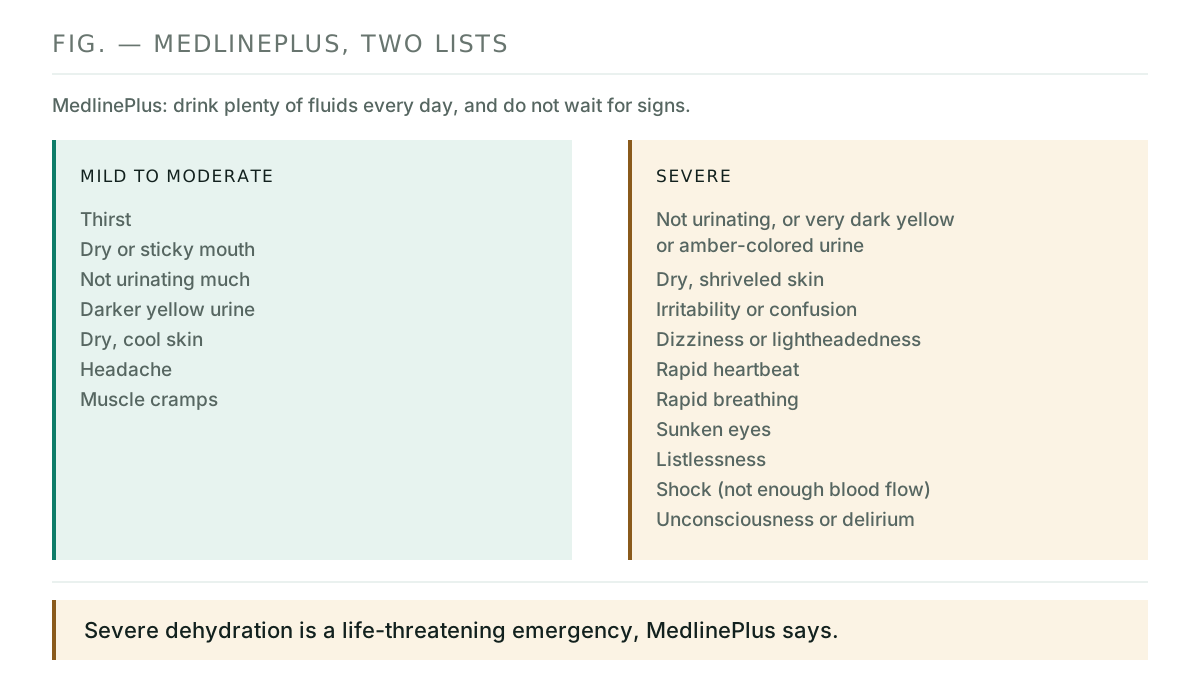
MedlinePlus says the signs of mild to moderate dehydration include thirst, a dry or sticky mouth, not urinating much, darker yellow urine, dry and cool skin, headache, and muscle cramps. MedlinePlus also says that if you notice signs of dehydration and treat it quickly, you should recover completely — which, in our reading, is the case for catching it early.
Two of them, how much you urinate and how dark it is, can be noticed without any equipment. Urine output matters for another reason too. MedlinePlus's kidney stones page states that the biggest risk factor for kidney stones is not drinking enough fluids, and that stones are more likely if you make less than 1 liter (32 ounces) of urine a day — covered in this site's kidney stones article.
The severe signs
MedlinePlus keeps a separate list for severe dehydration, whose signs include: not urinating, or very dark yellow or amber-colored urine; dry, shriveled skin; irritability or confusion; dizziness or lightheadedness; rapid heartbeat; rapid breathing; sunken eyes; listlessness; shock (not enough blood flow through the body); and unconsciousness or delirium.
The jump from the first list to the second is not just more of the same. Confusion, a racing heart and fast breathing are signs that the shortage is affecting how the body runs, and MedlinePlus treats severe dehydration as a life-threatening emergency. The specific situations that mean calling 911 are listed further down.
Where tiredness fits, and where it doesn't
Because this is an Energy article, the honest answer on tiredness matters. MedlinePlus's list of mild to moderate dehydration signs, quoted above, does not name fatigue. Listlessness does appear, but on the severe list. Fatigue shows up on a different MedlinePlus page — heat emergencies — where it is listed among the early symptoms of heat illness, alongside muscle cramps, thirst and very heavy sweating. Weakness also appears among MedlinePlus's later symptoms of heat exhaustion, and NIA describes heat exhaustion this way: you might feel thirsty, dizzy, weak, uncoordinated and nauseated.
So the sources support a narrow link, not a broad one. Feeling weak and drained after hours of sweating in the heat fits the picture. Weeks of tiredness on ordinary days is a different question, with a long list of possible causes; this site's fatigue after 40 article walks through them, and the caffeine and tiredness article covers the drink many men reach for instead of water.
How a provider checks
MedlinePlus lists the signs a provider will look for: low blood pressure; blood pressure that drops when you stand up after lying down; white fingertips that do not return to a pink color after the provider presses on them; skin that is not as elastic as normal, which may slowly sag back into place after being pinched into a fold instead of springing back right away; and a rapid heart rate.
Lab tests may include blood tests to check kidney function, urine tests to see what may be causing the dehydration, and other tests aimed at the cause — MedlinePlus gives the example of a blood sugar test for diabetes. That last example connects back to the causes list: uncontrolled diabetes is one of the reasons the body can lose fluid through urinating too much.
What to drink, and what not to take
MedlinePlus's treatment advice is short. Try sipping water or sucking on ice cubes. Try drinking water or sports drinks that contain electrolytes. Ask your provider what you should eat if you have diarrhea. For more severe dehydration or a heat emergency, you may need to stay in a hospital and receive fluid through a vein (IV), and the provider will also treat whatever caused the dehydration.
MedlinePlus is explicit: "Do not take salt tablets. They can cause serious complications." Its heat emergencies page repeats the warning in its first-aid section: do not give the person salt tablets. A drink with electrolytes is on the list; a tablet is not.
The heat emergencies page adds first-aid detail for when you think a person may have heat illness or a heat emergency. If the person is alert, give a beverage to sip, such as a sports drink, or a salted drink made by adding a teaspoon (6 grams) of salt per quart (1 liter) of water, a half cup (120 milliliters) every 15 minutes; cool water will do if salt beverages are not available. Its list of what not to do includes: do not give medicines used to treat fever, such as aspirin or acetaminophen, because they will not help and may be harmful; do not give liquids that contain alcohol or caffeine; do not use alcohol rubs on the skin; and do not give anything by mouth, not even salted drinks, if the person is vomiting or unconscious.
How heat changes the picture
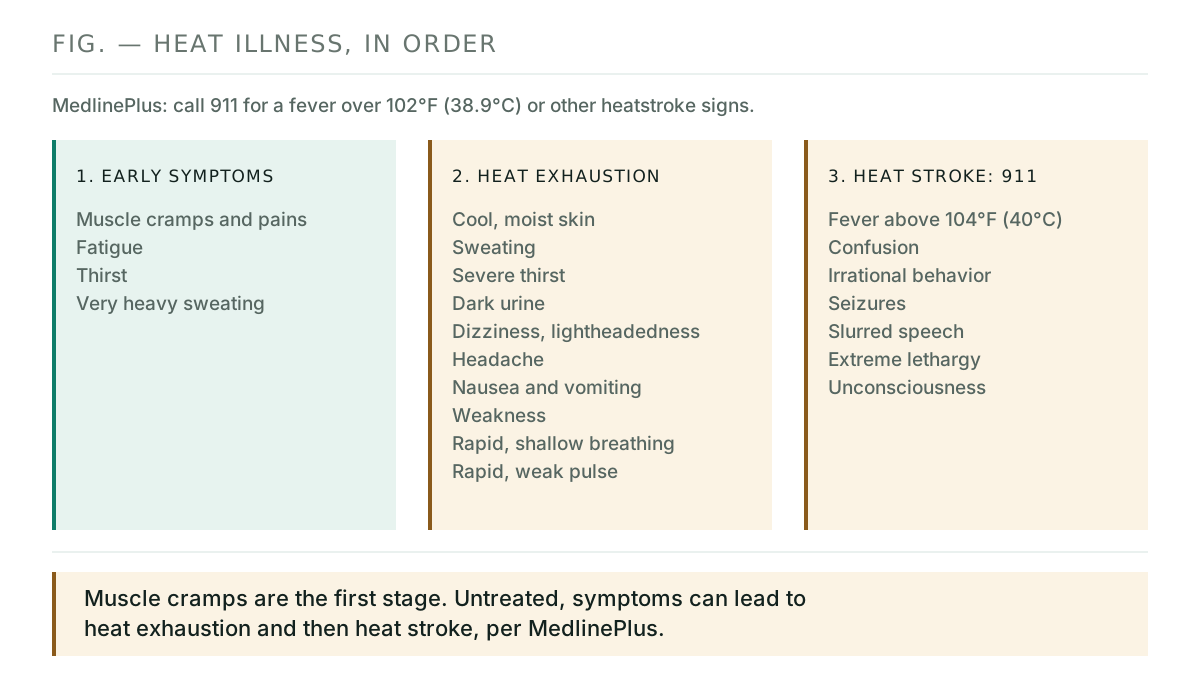
MedlinePlus says muscle cramps are the first stage of heat illness, and that if heat exposure continues and the symptoms are not treated, they can lead to heat exhaustion and then heat stroke. Heat stroke happens when the body is no longer able to regulate its temperature and it keeps rising; at that point, sweating may stop, and heat stroke can cause shock, brain damage, organ failure and death.
It names what makes a heat emergency more likely: drinking alcohol before or during exposure to heat or high humidity, not drinking enough fluids when you are active on warm days, heart disease, certain medicines (it gives beta-blockers, water pills or diuretics, and some medicines used to treat depression, psychosis or ADHD as examples), sweat gland problems, and wearing too much clothing. It also says you are more likely to feel the effects of heat sooner if you are not used to high temperatures or high humidity, are a child or an older adult, are already ill or injured, are obese, or are also exercising. And it adds that even a person who is in good shape can suffer heat illness if warning signs are ignored.
NIA adds a detail for men on heart medicines. Heat syncope is a sudden dizziness that can happen when you are active in hot weather, and NIA says that if you take a beta blocker or are not acclimated to hot weather, you are even more likely to feel faint. Its advice: rest in a cool place, put your legs up, and drink water. For heat cramps it advises stopping the activity and resting in the shade or a cool building, drinking plenty of fluids such as water and sports drinks containing electrolytes, and not consuming alcohol or caffeinated beverages.
When to call 911
MedlinePlus says to call 911 or the local emergency number if the person loses consciousness at any time; if there is any other change in the person's alertness, for example confusion or seizures; if the person has a fever over 102°F (38.8°C); if you notice symptoms of heatstroke, such as a rapid pulse or rapid breathing; or if the person's condition does not improve or gets worse despite treatment.
It also has an instruction for before any of that happens: if you think you or someone in your family may become dehydrated, call your provider, and do this before the person becomes dehydrated. A man with a stomach bug who cannot keep fluids down, or an older parent who has stopped drinking during an illness, is exactly the case that line is written for.
Prevention, and the man who drinks less on purpose
MedlinePlus's prevention list for dehydration is short. Drink plenty of fluids every day, even when you are well. Drink more when the weather is hot or you are exercising. If anyone in your family is ill, pay attention to how much they are able to drink. Pay close attention to children and older adults. Anyone with a fever, vomiting or diarrhea should drink plenty of fluids. And the line this article is named for: "Do not wait for signs of dehydration."
There is a group of men who drink less on purpose: men with prostate symptoms trying to cut down on trips to the bathroom. This site's waking up to pee at night and foods and drinks for prostate symptoms articles give the same advice for that situation: move fluids earlier in the day rather than cutting total intake. That is our guidance, and it fits with the MedlinePlus line on drinking plenty every day.
There is one important exception, and NIA names it: if your doctor has told you to limit your liquids, ask what you should do when it is very hot. Fluid limits are part of the care for some conditions — MedlinePlus mentions possibly limiting fluids for heart failure, covered in this site's heart failure article. For those men, "drink more" is not a safe default, and the answer has to come from the provider.
Key takeaways
- Dehydration means the body doesn't have as much water and fluids as it needs; severe dehydration is a life-threatening emergency, per MedlinePlus.
- Mild to moderate signs include thirst, dry mouth, not urinating much, darker yellow urine, dry cool skin, headache and muscle cramps.
- MedlinePlus says older adults and people with diseases such as diabetes are at higher risk; diuretics can make you urinate a lot, and NIA says some heart and blood pressure medicines may raise the risk of heat illness in older adults.
- Sip water or a drink with electrolytes; MedlinePlus says not to take salt tablets.
- Call 911 for loss of consciousness, any other change in alertness (for example confusion or seizures), fever over 102°F, signs of heatstroke, or no improvement despite treatment.
Where to go from here
For the separate question of raised blood glucose, read about prediabetes after 40. New thirst or frequent urination needs assessment rather than a guess about hydration or blood sugar.
If dehydration is what brought you here, these pages cover the surrounding ground:
- Fatigue After 40 — when tiredness lasts and the cause is somewhere else.
- Kidney Stones Explained — where not drinking enough is the biggest risk factor.
- Caffeine and Tiredness — the drink many men reach for first.
- Blood Pressure Medication — where diuretics come in.
- All energy articles
Frequently asked questions
What are the first signs of dehydration?
MedlinePlus says the signs of mild to moderate dehydration include thirst, a dry or sticky mouth, not urinating much, darker yellow urine, dry and cool skin, headache, and muscle cramps.
What are the signs of severe dehydration?
MedlinePlus says the signs of severe dehydration include not urinating or very dark yellow or amber-colored urine, dry and shriveled skin, irritability or confusion, dizziness or lightheadedness, rapid heartbeat, rapid breathing, sunken eyes, listlessness, shock, and unconsciousness or delirium. It states that severe dehydration is a life-threatening emergency.
Are older adults at higher risk of dehydration?
Yes. MedlinePlus states that older adults and people with certain diseases, such as diabetes, are at higher risk for dehydration. It also notes that some medicines, like diuretics, can make you urinate a lot, which is one of the ways the body loses fluid.
Should I take salt tablets for dehydration?
No. MedlinePlus says not to take salt tablets because they can cause serious complications. For dehydration it suggests sipping water or sucking on ice cubes, and drinking water or sports drinks that contain electrolytes. More severe dehydration may need fluid through a vein in a hospital.
Can dehydration make you tired?
MedlinePlus lists listlessness among the signs of severe dehydration, and its heat emergencies page lists fatigue among the early symptoms of heat illness. Its list of mild to moderate dehydration signs does not name fatigue, so ongoing tiredness on its own is worth discussing with a provider rather than assuming it is dehydration.
When is dehydration an emergency?
MedlinePlus says to call 911 or the local emergency number if the person loses consciousness at any time, has any other change in alertness such as confusion or seizures, has a fever over 102°F (38.8°C), shows symptoms of heatstroke such as a rapid pulse or rapid breathing, or does not improve or gets worse despite treatment.
Sources
- MedlinePlus (National Library of Medicine) — Dehydration
- MedlinePlus (National Library of Medicine) — Heat emergencies
- National Institute on Aging (NIH) — Hot Weather Safety for Older Adults
- MedlinePlus (National Library of Medicine) — Kidney stones (for the fluid risk factor)
- MedlinePlus (National Library of Medicine) — Heart failure (for fluid limits)

Male Health Guide Editorial Team
We write about the health problems men over 40 actually search for at 3 a.m. — and we say plainly when the evidence for a popular product is thin. We do not invent credentials and we do not publish sponsored copy as editorial. Read more about how we work.
Medical disclaimer: This article is general information, not medical advice. We are not doctors, and nothing here diagnoses, treats or cures any condition. If your provider has limited how much you drink, follow that advice and ask what to do in hot weather. Never stop a prescribed medicine on your own, and call 911 for loss of consciousness, confusion, seizures, a fever over 102°F, signs of heatstroke, or a condition that is not improving despite treatment.