Overactive Bladder in Men: Urgency, Causes and Treatment
Short answer
Overactive bladder describes urinary urgency, usually with frequent urination or waking at night, with or without urgency-related leaks, after infection and other explanations are considered. Men can have bladder and prostate problems together. Assessment guides treatment, which may combine behavioral approaches, medicines or procedures according to symptoms, risks and personal preferences.
The difficult part may not be how often you urinate. It may be how little warning you get: leaving a meeting abruptly, scanning a restaurant for the restroom, or cutting a walk short. Overactive bladder is one possible explanation for that urgency, with or without leakage. It is not a diagnosis that follows automatically from being a man over 40.
Prostate enlargement can overlap with bladder symptoms, but not every urgent trip is a prostate problem. This guide separates urgency from difficulty emptying, explains what an initial assessment can involve, and compares ways to manage symptoms. Sudden inability to urinate, visible blood or fever with urinary pain needs medical attention rather than a trial of bladder training.
What counts as overactive bladder rather than frequent urination alone?
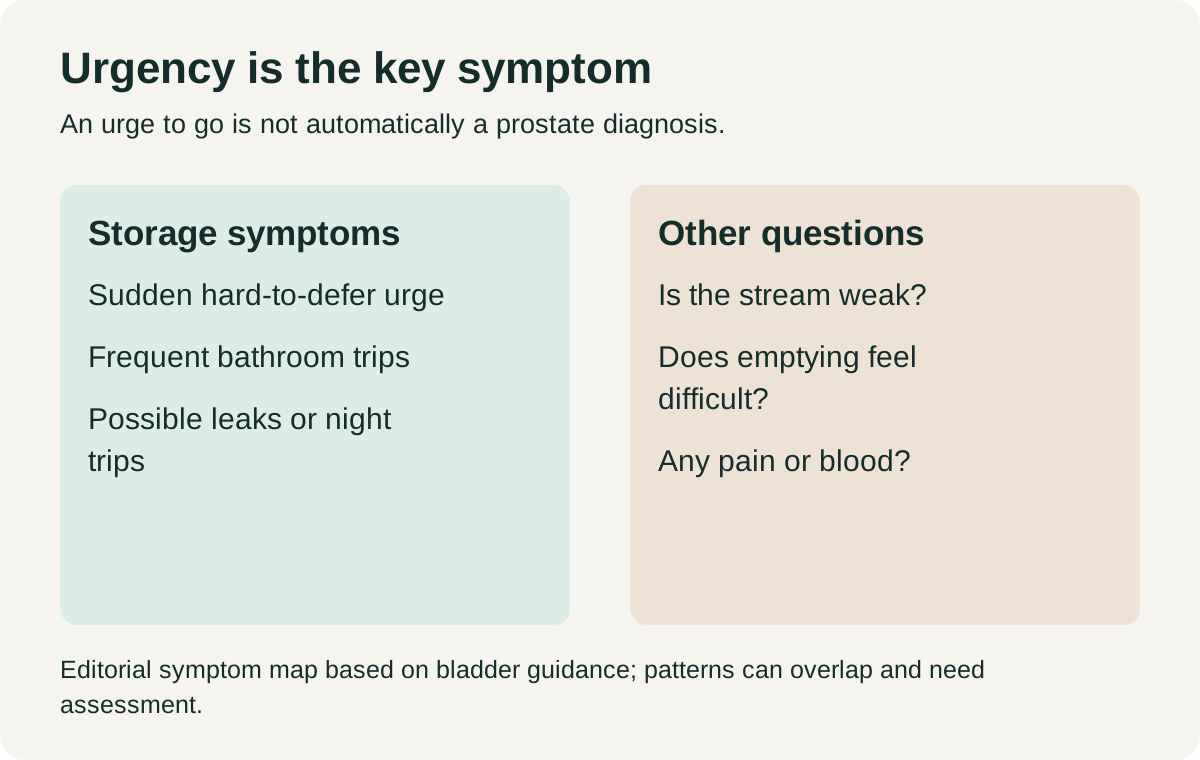
The central feature of overactive bladder is urgency: a sudden need to urinate that is difficult to defer. Frequent trips and nighttime urination often accompany it, and leaks may occur but are not required. Frequency alone does not establish OAB because fluid intake, urine production and other conditions can also change bathroom habits.
The Mayo Clinic overview of overactive bladder describes urgency with possible frequency, nighttime trips and unintended urine loss. OAB is a symptom syndrome; identifying it involves considering other explanations rather than counting trips in isolation.
The NIDDK guide to bladder control problems distinguishes urgency leakage from stress leakage, which occurs with pressure from actions such as coughing or physical activity. Both can happen in the same person. A pad becoming wet tells you there was leakage, but not which mechanism explains it.
| Term | What to describe | What it does not establish |
|---|---|---|
| Urgency | A sudden need that is hard to postpone. | That your prostate is enlarged. |
| Frequency | Going more often than usual. | That the bladder is necessarily overactive. |
| Nocturia | Waking from sleep to urinate. | That every disturbed night has one urinary cause. |
| Urgency leakage | Losing urine with an urgent need to go. | That leakage must happen for OAB to be considered. |
For example, frequent large voids and repeated urgent small voids are different descriptions to bring to an appointment. Neither example makes a diagnosis. They show why the amount, timing and sensation can be more useful than a single daily total.
The point of these terms is clearer communication. You do not need to memorize them or meet a threshold before asking for help. A pattern that is disrupting work, travel or ordinary routines deserves discussion even if you have never leaked.
Is urgency always an enlarged prostate problem in men?
No. Prostate enlargement can contribute to urinary symptoms, but urgency does not prove obstruction. Men may also have OAB alongside difficulty emptying. A weak stream, trouble starting or a persistent sense of incomplete emptying should be described separately because those features can change the assessment and the safety of a proposed treatment.
The NIDDK symptoms and causes guide explains that bladder control problems have several possible contributors, including prostate problems in men. An infection, a medicine effect or another medical condition may also be relevant. Age provides context, not an explanation that rules those possibilities out.
Our complete guide to an enlarged prostate after 40 is the cluster starting point for prostate questions. This article focuses on urgency and storage symptoms. Those two conversations can overlap without becoming interchangeable.
The NIDDK urinary retention guide describes chronic retention that can include frequent small voids, a slow stream or needing to go again after finishing. Repeated trips therefore do not prove that the bladder is emptying effectively. A feeling of urgency and actual emptying are different questions.
Read our guides to a weak urine stream and a bladder that does not feel empty if those are part of your experience. Use them to prepare descriptions for a clinician, not to decide at home whether the explanation is obstruction, a bladder problem or both.
This distinction matters when judging treatment. A stronger stream and less urgency are different outcomes. If one improves but the other remains troublesome, explain that rather than concluding that the whole plan either worked or failed. A clinician can review which problem was being treated and whether another contributor needs attention.
What does an initial overactive bladder assessment involve?
An initial assessment usually includes your urinary and medical history, a physical examination and urinalysis to check for infection or blood. A clinician may measure urine remaining after a void, particularly with emptying symptoms. Invasive tests are not routine requirements for every uncomplicated presentation; uncertainty or concerning findings can justify further investigation.
The NIDDK diagnosis overview describes history, examination and selected tests. Relevant information includes medicines, previous urinary treatment and what symptoms actually occur. An examination and urine sample can answer questions that an online symptom score cannot.
The 2024 AUA/SUFU guideline supports checking a post-void residual when incomplete emptying is a concern, especially with voiding symptoms. It advises against routine urodynamics, cystoscopy or urinary imaging in every initial OAB assessment. Additional testing is appropriate when findings or diagnostic uncertainty call for it.
A post-void residual, or PVR, measures urine left after urination. Think of it as a question about emptying, rather than a score for how strongly you feel urgency. Ask what an abnormal finding would change in your plan. A result still needs interpretation alongside the history and examination.
Cystoscopy looks inside the urinary tract, while urodynamic testing investigates how it stores and releases urine. Not needing these immediately is not evidence of an incomplete consultation. Conversely, avoiding them as a universal rule would be wrong when a clinician identifies a reason for further investigation.
It helps to distinguish establishing a working explanation from investigating a warning sign. Someone with uncomplicated urgency and someone with visible blood may need different pathways. Ask which question the clinician is answering and how the results will guide treatment, rather than expecting every man with frequent trips to receive an identical testing package.
What can a bladder diary reveal that memory misses?
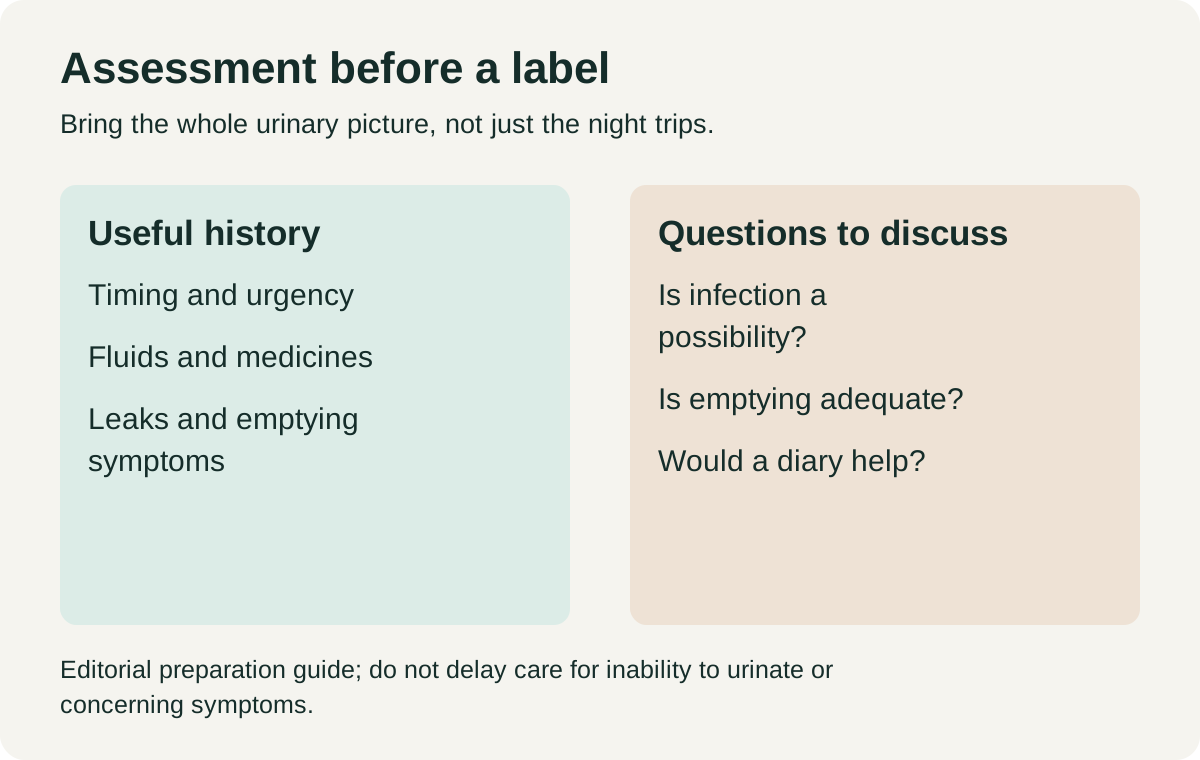
A bladder diary records drinks, voiding times, urine amounts when practical, urgency and any leaks. It can show whether the main problem is urgency, large urine volumes, nighttime output or another pattern. Record ordinary behavior rather than forcing yourself to hold urine, and do not delay assessment of pain or warning signs to finish it.
NIDDK suggests that a short record, often covering two or three days, can help a clinician understand patterns. The useful information is not limited to leaks. What you drink and the circumstances of each urgent episode help put bathroom visits into context.
Our editorial suggestion is to use a few clear columns rather than a long narrative. Record what happened as accurately as is practical; a partly completed record is more useful than inventing amounts afterward. Ask the clinic whether it has a preferred form and how it wants urine volume recorded.
| Entry | Useful detail | Avoid this interpretation |
|---|---|---|
| Drink | Time, type and approximate amount. | One drink proves the cause. |
| Urination | Time and measured amount if requested. | Every small void has the same explanation. |
| Urgency or leak | How urgent it felt and what happened. | A dry day means there is no problem. |
| Nighttime | When you woke and whether you passed urine. | Every awakening was necessarily caused by the bladder. |
A diary is an observation tool, not a challenge. Do not drink unusually large amounts to test your capacity or postpone urination until it hurts to produce an impressive interval. If your routine differs between a workday and a day off, explain that difference instead of trying to make both days look alike.
For the separate nighttime question, see waking up to pee at night. The diary helps describe what happens; the clinician determines whether the pattern fits OAB, another explanation or more than one contributor. You do not need to decide that before bringing the record.
Should you drink less water or cut out coffee completely?
Fluid management should fit your health, activity and symptom pattern, not aim for dehydration. Caffeine and alcohol may worsen symptoms for some people, and timing can matter. Discuss sensible adjustments rather than severely restricting water or changing prescribed fluid limits. A diary can help make a targeted change instead of banning every drink.
The NIDDK treatment guidance explicitly warns against limiting liquids to the point of dehydration. Appropriate intake depends on the person and circumstances. Someone working outdoors in heat and someone with a prescribed medical fluid limit cannot safely borrow the same online water target.
Rather than treating thirst as proof of determination, ask what adjustment is actually proposed. Is the plan to change caffeine, the size of drinks, their timing or an unusually high intake? These are different changes. If you have heart or kidney disease or another reason for a prescribed fluid plan, discuss modifications with the treating clinician.
A practical example is the man who stops drinking during work to avoid leaving his station, then drinks most of his daily fluids in the evening. The useful question is how to make intake and bathroom access workable across his day. Simply telling him to drink less overlooks the routine that needs discussing.
Constipation can also contribute to bladder control problems. Mention it rather than managing the urinary complaint in isolation. This is especially relevant when reviewing a medicine that may worsen bowel symptoms. The answer is an individualized plan, not automatically adding several over-the-counter products.
Bathroom access matters too. If symptoms are keeping you from activities, identify the practical barrier: long meetings, limited breaks, a distant restroom or worry about leakage. Planning access or using an appropriate absorbent product can make daily life more manageable while care proceeds. A backup product is support, not a treatment failure and not a reason to abandon assessment.
How do bladder training and pelvic floor therapy work?
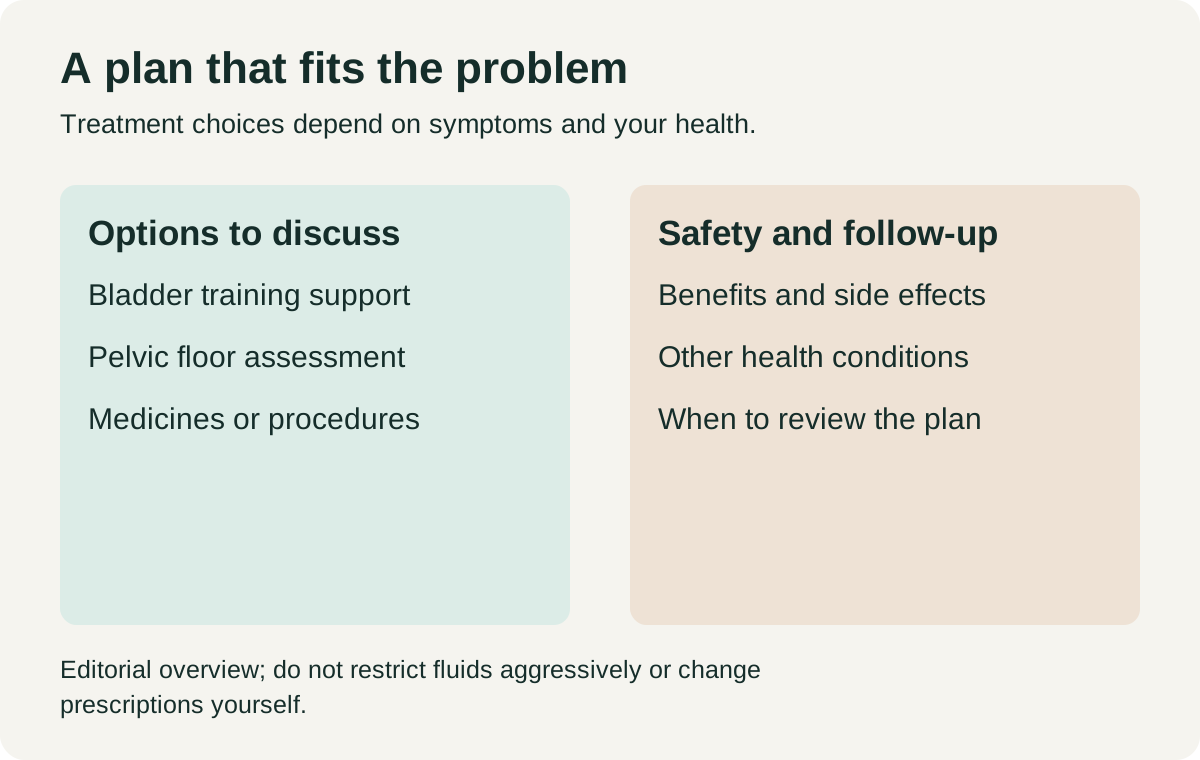
Bladder training uses a planned approach to timing and urgency rather than repeatedly rushing or holding until pain. Pelvic floor therapy can help selected men learn appropriate contraction, relaxation and control. The plan should follow assessment and be adjusted to your symptoms; copying a fixed exercise count is not a substitute for correct technique.
The NHS non-surgical treatment guide describes bladder training and assessment-based pelvic floor programs. Training aims to change the response to urgency and the pattern of voiding. It is not simply a demand to tolerate increasingly uncomfortable sensations.
NIDDK describes techniques such as pausing, relaxed breathing and pelvic floor control as possible components of urgency management. A professional can teach the approach and decide how it fits your circumstances. If there is pain, infection or concern about retention, those issues need attention rather than an automatic instruction to wait longer.
Our pelvic floor exercises guide for men provides background for that discussion. Knowing how to contract and how to release matters more than selecting the largest number of repetitions from a video. NIDDK advises against doing the exercises while urinating; repeatedly stopping the stream is not the recommended practice routine.
Ask the therapist to explain how each part of the plan connects to your main complaint. Leakage with coughing is not the same description as a sudden urgent need, and a program should reflect the problem being assessed. If you cannot tell whether you are using the intended muscles, ask for technique feedback instead of assuming that effort alone establishes correctness.
Choose a functional goal for review, such as completing a familiar walk with less urgency or managing a meeting more comfortably. That goal complements symptom measures rather than replacing them. Report discomfort or difficulty with the plan so it can be adapted; improvement is not measured by how much pain you can tolerate while delaying a bathroom trip.
Which medicines and procedures can help, and what are the tradeoffs?
Medicines include antimuscarinics and beta-3 agonists, chosen after discussing benefits, other conditions and adverse effects. Cognitive concerns, constipation, retention and blood pressure may influence selection. Procedures such as nerve stimulation or bladder botulinum toxin are options for appropriate patients. Treatment choices are individualized, not an obligatory sequence that everyone must complete.
Antimuscarinics reduce certain signals involved in bladder contraction; beta-3 agonists help the bladder relax during storage. Both categories require a discussion of suitability. The AUA/SUFU 2024 guideline publication calls for discussion of potential cognitive and dementia risks with antimuscarinics. A risk discussion is not a prediction that an individual will develop dementia.
Dry mouth and constipation can be troublesome with antimuscarinics, and difficulty emptying matters when considering treatment. Review the whole medicine list with the prescriber, including nonprescription products. Ask how a proposed medicine interacts with existing symptoms instead of evaluating it only by the promise of fewer trips.
MedlinePlus explains mirabegron, one beta-3 agonist. Blood pressure can rise and needs monitoring; the prescriber should know about bladder outlet obstruction and other medicines. Problems emptying can occur, particularly with certain combinations. These details apply to the named medicine and should not be assumed identical across every product in its class.
For men already using prostate treatment, our prostate medications explainer addresses that separate role. Do not change, combine or stop prescriptions yourself. Ask which medicine targets which symptom and how response and unwanted effects will be reviewed.
The 2024 AUA/SUFU approach emphasizes shared decisions rather than a rigid treatment ladder. Discussing an appropriate procedure does not always require trying every behavioral strategy and pill first. Suitability, your preferences and the burden of treatment still matter.
- Tibial nerve stimulation: ask about the proposed method and visit commitments.
- Sacral neuromodulation: ask about testing, implantation and device follow-up.
- Bladder botulinum toxin: discuss infection and incomplete-emptying risks, including possible temporary catheterization.
Those options are not interchangeable purchases. Ask what practical follow-up each involves and what happens if it does not help. A treatment that fits your goals and circumstances is the aim, rather than reaching the final box on a generic diagram.
When is urgency a warning sign, and where do you go from here?
Suddenly being unable to urinate, particularly with lower abdominal pain or swelling, needs emergency assessment. Visible blood needs prompt checking even once. Fever with painful urinary symptoms also needs urgent care. For ongoing urgency without those signs, arrange assessment and a treatment discussion rather than accepting the problem as inevitable with age.
Cannot pass urine suddenly? Seek emergency care, especially with a painful or swollen lower abdomen. NIDDK identifies acute urinary retention as potentially life-threatening. Do not force fluids or try to train through the urge while waiting for a routine appointment.
The NHS blood in urine guidance advises getting suspected blood checked even when the amount is small or you are unsure it is blood. A one-time episode is not automatically harmless. Our blood in urine after 40 guide explains that assessment question without assuming the cause is the prostate.
Fever or chills with painful urination, side or back pain, or feeling significantly unwell requires urgent medical advice. An infection can produce urgency, but an OAB label should not be used to explain away new infection symptoms. If you are severely ill or symptoms are rapidly worsening, seek emergency care.
For nonemergency symptoms, start with the feature that is disrupting life most. Is it almost no warning, leakage before reaching the toilet, repeated nighttime waking, or difficulty emptying? Explain any combination. The plan can address more than one problem without pretending they all have the same cause.
Where to go from here: begin with our prostate and urinary symptoms hub for the broader male-health picture, then use the emptying, nighttime and pelvic floor guides linked above for the relevant questions. They support a clinical conversation; they do not replace urinalysis, examination or urgent assessment.
Before choosing a treatment, agree on the expected benefit, the main risks and a review point. A useful outcome might be fewer disruptive urges or more confidence leaving home, not necessarily never thinking about a restroom again. Age is not a reason to dismiss the problem, and treatment should be judged by meaningful improvement rather than a promise of complete control.
Key takeaways
- Urgency is central to OAB; leakage may occur but is not required.
- Prostate enlargement, incomplete emptying and OAB can overlap, so describe storage and voiding symptoms separately.
- Initial assessment usually starts with history, examination and urinalysis; extra tests answer individual clinical questions.
- Fluid changes and bladder training should avoid dehydration and painful holding; pelvic floor technique needs appropriate guidance.
- Medicines and procedures involve shared decisions about benefits, risks and practical commitments.
- Acute inability to urinate is an emergency; visible blood or urinary symptoms with fever need prompt medical attention.
Where to go from here
Frequently asked questions
Can men have overactive bladder without leaking?
Yes. Urgency can occur without urine leakage. OAB usually involves a sudden need to urinate, often alongside frequent trips or waking at night. A clinician considers other explanations before making the diagnosis. Symptoms that disrupt daily life deserve discussion even if you always reach the toilet in time.
Is overactive bladder always caused by an enlarged prostate?
No. Prostate enlargement may contribute, and OAB can coexist with difficulty emptying, but urgency alone does not prove obstruction. Mention a weak stream, trouble starting or incomplete emptying separately. The assessment needs to consider bladder symptoms and other possible causes rather than attributing everything to being over 40.
Should I stop drinking water to reduce bathroom trips?
No. Do not restrict fluids to the point of dehydration. Appropriate intake and timing depend on your health and circumstances, including any prescribed fluid limits. Discuss targeted changes to caffeine, alcohol or drinking patterns with a clinician rather than adopting a severe restriction or a universal water target.
Does bladder training mean holding urine through pain?
No. Bladder training is an individualized plan for timing and responding to urgency, not a test of pain tolerance. Ask for professional guidance and report discomfort, difficulty emptying or suspected infection. Sudden inability to urinate needs emergency assessment rather than a longer attempt to wait out the urge.
Are bladder medicines suitable for every man with urgency?
No. Selection depends on the assessment, other medicines and health conditions. Antimuscarinics need discussion of cognitive concerns and other adverse effects, while individual beta-3 agonists have their own precautions, including blood pressure considerations with mirabegron. Review benefits and risks with the prescriber; do not alter existing prescriptions yourself.
Do I have to try every medicine before discussing a procedure?
Not necessarily. The 2024 AUA/SUFU guideline supports individualized shared decisions rather than an obligatory treatment ladder. Procedures can be discussed when appropriate, taking account of your preferences, suitability and treatment burden. Ask about realistic benefits, follow-up and risks such as infection or incomplete emptying before choosing an option.
Sources
- NIDDK / NIH: Definition and Facts for Bladder Control Problems
- NIDDK / NIH: Symptoms and Causes of Bladder Control Problems
- NIDDK / NIH: Diagnosis of Bladder Control Problems
- NIDDK / NIH: Treatments for Bladder Control Problems
- NIDDK / NIH: Symptoms and Causes of Urinary Retention
- Mayo Clinic: Overactive bladder: symptoms and causes
- AUA/SUFU, Cameron and colleagues, 2024: Guideline on the Diagnosis and Treatment of Idiopathic Overactive Bladder
- MedlinePlus / ASHP: Mirabegron: drug information
- NHS: Urinary incontinence: non-surgical treatment
- NHS: Blood in urine
How we prepared this guide. We compared the named sources listed above on October 26, 2026. Practical suggestions for organizing a consultation are labeled as ours; they are not results of a clinical trial. This article is not medically reviewed, and no personal treatment experience is claimed.

Male Health Guide Editorial Team
We write about the health problems men over 40 actually search for at 3 a.m. — and we say plainly when the evidence for a popular product is thin. We do not invent credentials and we do not publish sponsored copy as editorial. Read more about how we work.
Medical disclaimer: This article is general information, not individual medical advice. We are not doctors. A qualified clinician should assess your symptoms, test results and treatment. Seek urgent care for severe or sudden symptoms.