Urinary Incontinence in Men: The Type Decides the Fix
Short answer
Urinary incontinence means leaking urine by accident. The NIDDK says as many as 1 in 3 men over 65 may have it, and links it in men to prostate problems and prostate cancer treatment. Treatment depends on the type, such as stress, urgency or overflow. MedlinePlus says sudden loss of bladder control together with signs such as trouble talking or sudden limb weakness means calling 911.
Many men never mention leaking urine to a doctor; the NIDDK notes that many people feel too embarrassed to talk about bladder control problems. It feels like an old man's problem, or an embarrassing one, or simply the price of getting older. The NIDDK's message is different: it calls bladder control problems common, says proper treatment may improve your quality of life, and adds that the sooner you get help, the sooner it may improve.
This article covers what urinary incontinence is, how common it is in men, the different types, the prostate connection, other causes, how it is diagnosed, what you can do yourself, the medical treatments, and the warning signs that mean calling 911. It sits in this site's Prostate section because, in men, the NIDDK links it to prostate problems.
What urinary incontinence is
The NIDDK defines bladder control problems as conditions that affect the way a person holds or releases urine, and says that accidental loss or leaking of urine, called urinary incontinence, is one of the most common of them. It stresses that incontinence "is not a disease but a condition that may be related to another health problem or life event," such as prostate problems.
The effects go beyond wet clothes. The NIDDK says untreated bladder problems can lead people to avoid activities they once enjoyed, which can lead to depression or social anxiety, and that some people avoid intimacy because they worry about leaking during sex. It says to talk with a health care professional if either is happening.
How common it is in men
The NIDDK says incontinence is more common in women, but that as many as 1 in 3 men over the age of 65 may lose urine by accident, and that about half of men who seek treatment for lower urinary tract symptoms experience it. It explains the age link directly: "A man is more likely to develop UI with age because prostate problems occur more often with age."
Its list of factors that make incontinence more likely includes being older (as you age, your urinary tract muscles weaken), prostate problems in men, health problems such as diabetes, obesity, Parkinson's disease, multiple sclerosis or long-lasting constipation, and smoking.
The types, and why they matter
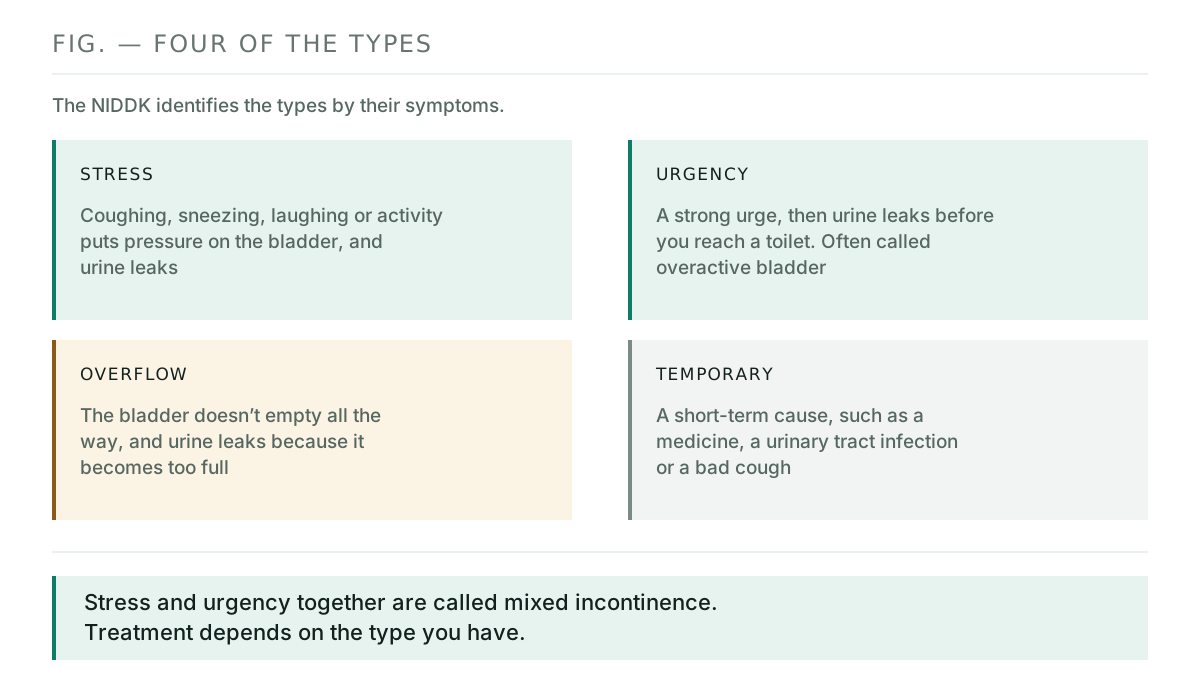
The NIDDK says types of bladder control problems are identified by their symptoms. The main ones:
- Stress incontinence: movement such as coughing, sneezing, laughing or physical activity puts pressure on the bladder and causes urine to leak.
- Urgency incontinence: a strong urge to urinate, and urine leaks before you can get to a toilet. The NIDDK says this is often referred to as overactive bladder.
- Mixed incontinence: urgency and stress incontinence at the same time.
- Overflow incontinence: the bladder doesn't empty all the way, and urine leaks because the bladder becomes too full.
- Reflex incontinence: urine leaks without warning, often because bladder nerves are damaged, for example by multiple sclerosis or a spinal cord injury.
- Functional incontinence: a physical disability or barrier, or a problem speaking or thinking, prevents you from reaching the toilet in time.
- Temporary incontinence: a short-lived cause, such as a certain medicine, a urinary tract infection or a bad cough.
MedlinePlus is clear on why the type matters: which treatment you get "depends on what caused your incontinence and what type you have." Urgency in men has its own article on this site, overactive bladder in men, and the bladder that doesn't empty, behind overflow incontinence, is covered in bladder not emptying.
The prostate connection
The NIDDK explains that the prostate surrounds the opening of the bladder and gets bigger as a man grows older. When it is enlarged but not cancerous, a condition called benign prostatic hyperplasia (BPH), a man may have trouble starting to urinate, a slow stream, and trouble fully emptying the bladder. It adds that treatment for BPH can lead to stress incontinence, "but it is usually temporary."
Prostate cancer treatment can have longer-lasting effects. The NIDDK says men who have had radiation or surgery for prostate cancer may have short-term or long-term incontinence, because these treatments can lead to nerve damage, bladder spasms or stress incontinence, and that bladder control problems after prostate cancer treatment can get better over time. MedlinePlus lists weakness of the urinary sphincter, the muscles that open and close the bladder, among the longer-term causes, and says it can be caused by prostate surgery in men.
The surgical options for an enlarged prostate are compared in this site's prostate surgery options article, and the bigger picture of enlargement is in the enlarged prostate guide.
Other causes, including temporary ones
Incontinence isn't always about the prostate. The NIDDK lists health changes and problems that can lead to it, including aging, bladder infection, constipation, a blocked urinary tract from a tumor or kidney stone, a chronic cough, diabetes, and overweight or obesity. It says bladder nerves and muscles can be affected by conditions including diabetes, stroke, Parkinson's disease, multiple sclerosis, Alzheimer's disease and brain or spinal cord injury.
Some causes pass. MedlinePlus lists causes of sudden or temporary incontinence that include bedrest after surgery, certain medicines (such as diuretics, antidepressants, tranquilizers, some cough and cold remedies and antihistamines), mental confusion, prostate infection or inflammation, stool impaction from severe constipation, a urinary tract infection, and weight gain. The NIDDK adds lifestyle factors, including alcohol and caffeinated or carbonated drinks. Prostate inflammation is covered in this site's prostatitis vs enlarged prostate article.
How it is diagnosed
The NIDDK says a health care professional will ask about your family and medical history and give you a physical exam, and may ask you to cough with a full bladder to see whether you leak. You may be asked to keep a bladder diary, recording what, when and how much you drink, when and how much you urinate, how often you leak, whether you felt a strong urge first, and what you were doing at the time. It suggests keeping one for 2 to 3 days before your appointment.
Tests may include a urinalysis, blood tests, urodynamic testing (which looks at how the bladder, urethra and sphincters store and release urine), cystoscopy, and imaging. What happens at a cystoscopy is explained in this site's cystoscopy article.
What you can do yourself
Depending on the type, the NIDDK says lifestyle changes may reduce leaks. Its advice on fluids is more careful than most people expect: ask your health care professional whether you should drink less during the day, but "don't limit liquids to the point of becoming dehydrated." Stopping drinks a few hours before bed may help with nighttime trips, but only if your provider suggests it. It says limiting caffeine may help reduce leaks, and to limit alcohol, which can increase how much urine your body makes.
Its other steps are keeping a healthy weight (it says losing weight can help you have fewer leaks), avoiding constipation, staying physically active, and stopping smoking, which it links to stress incontinence through chronic coughing. MedlinePlus adds avoiding foods and drinks that may irritate the bladder, such as spicy foods, carbonated drinks and citrus, and, for men with diabetes, keeping blood sugar under good control. Which foods and drinks affect prostate symptoms is covered in this site's foods and drinks article.
Bladder training and pelvic floor exercises
The NIDDK describes bladder training as urinating on a schedule, called timed voiding, and gradually lengthening the time between trips. On pelvic floor exercises, it is specific about men: "Men can also benefit from pelvic floor muscle exercises. Strengthening these muscles may help a man leak urine less often, especially dribbling after urination." It says a physical therapist trained in pelvic floor therapy can help, and that biofeedback can show whether you are doing the exercises correctly. How to do them properly is the subject of this site's pelvic floor exercises article.
Medical treatments
If lifestyle changes don't work, the NIDDK says a provider may prescribe medicine, a medical device, a bulking agent, or, as a last resort, surgery. For urgency incontinence, medicines to relax the bladder include anticholinergics, beta-3 agonists and tricyclic antidepressants, and Botox injected into the bladder may be used when other treatments don't work. It adds that men with incontinence who have an enlarged prostate may also be prescribed alpha-blockers, 5-alpha reductase inhibitors or phosphodiesterase-5 inhibitors. These prostate medicines are explained in this site's prostate medications article.
For other types, the NIDDK lists catheters for overflow incontinence, bulking agents injected near the urinary sphincter for stress incontinence, and electrical nerve stimulation for urgency incontinence. For stress incontinence in men, surgical options include the male sling, in which mesh is placed under the urethra to support it, and an artificial urinary sphincter, a device that helps keep the urethra closed. Overflow caused by a blockage, including an enlarged prostate, can be treated with surgery to remove the blockage. What living with a catheter involves is covered in the urinary catheter article.
For leaks that remain, the NIDDK lists protective products, including absorbent or waterproof underwear, pads, skin cleaners and creams, and an external catheter for men that drains into a bag strapped to the thigh. MedlinePlus notes that many of these products are designed so that no one else will notice.
When to see a doctor, and when to call 911
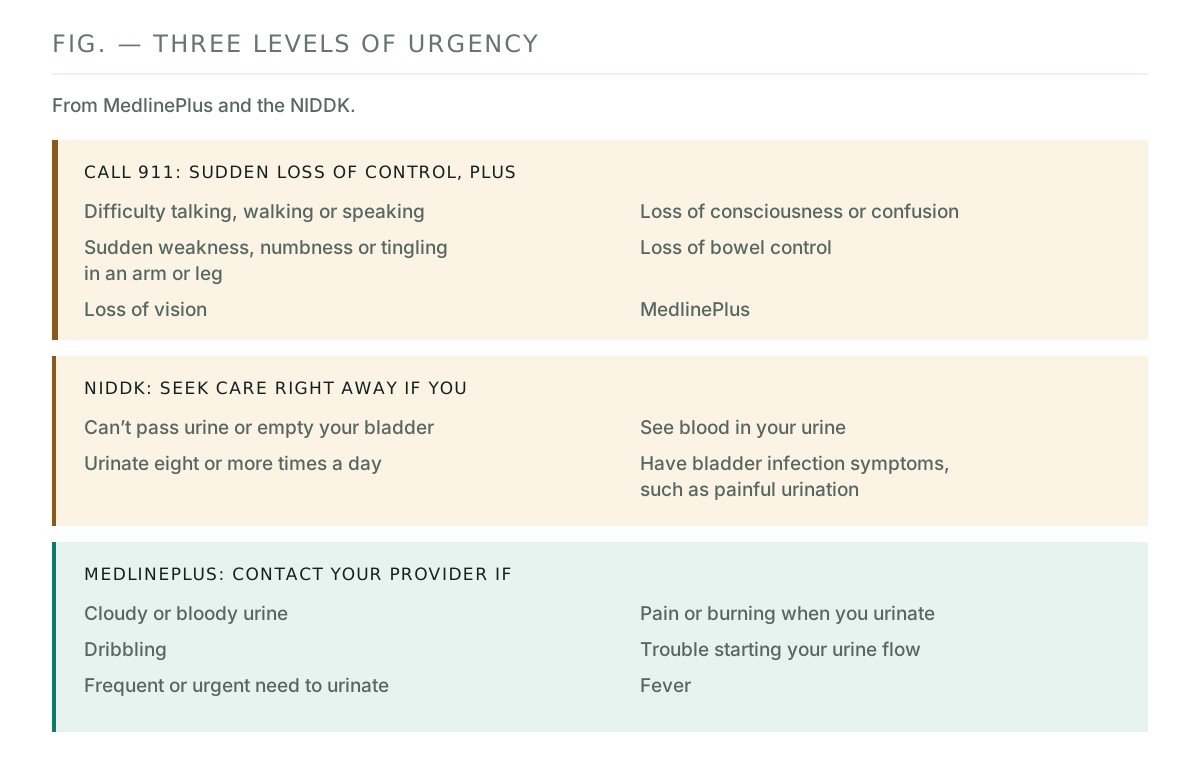
MedlinePlus says to call 911 or go to an emergency room if you suddenly lose control over urine and you have difficulty talking, walking or speaking; sudden weakness, numbness or tingling in an arm or leg; loss of vision; loss of consciousness or confusion; or loss of bowel control.
The 911 list from MedlinePlus applies when bladder control is lost suddenly and comes with one of those other symptoms. In our reading, those symptoms point beyond the bladder, which is why the answer is 911 rather than an appointment, while gradual leaking without them belongs with a regular provider visit.
Under the heading "seek care right away," the NIDDK says to see a health care professional if you can't pass urine or empty your bladder, which is a sign of urinary retention; urinate eight or more times a day; see blood in your urine; or have bladder infection symptoms, including painful urination. Blood in the urine has its own article on this site, blood in urine after 40.
MedlinePlus says to contact your provider if you have cloudy or bloody urine, dribbling, a frequent or urgent need to urinate, pain or burning when you urinate, trouble starting your urine flow, or a fever. And for incontinence itself, without any of these, the NIDDK's advice is simply not to wait: talk with a health care professional, even if you feel embarrassed.
Key takeaways
- The NIDDK says as many as 1 in 3 men over 65 may lose urine by accident, and links it in men to prostate problems, which become more common with age.
- The type, such as stress, urgency, mixed or overflow, decides the treatment, according to MedlinePlus and the NIDDK.
- Treatment for an enlarged prostate can cause stress incontinence that is usually temporary; after prostate cancer treatment, it can be short- or long-term and can improve over time.
- The NIDDK says men can benefit from pelvic floor exercises, especially for dribbling after urination, and warns against cutting fluids to the point of dehydration.
- Sudden loss of bladder control with trouble talking or walking, sudden weakness, numbness or tingling in an arm or leg, vision loss, loss of consciousness or confusion, or loss of bowel control means calling 911 (MedlinePlus).
Where to go from here
If leaking urine is what brought you here, these pages cover the surrounding ground:
- Overactive Bladder in Men — when urgency is the main problem.
- Pelvic Floor Exercises for Men — doing them in a way that actually works.
- Bladder Not Emptying — the problem behind overflow leaks.
- Prostate Surgery Options — what each procedure involves.
- All prostate articles
Frequently asked questions
How common is urinary incontinence in men?
The NIDDK says as many as 1 in 3 men over the age of 65 may lose urine by accident, and about half of men who seek treatment for lower urinary tract symptoms have urinary incontinence. It says a man is more likely to develop it with age because prostate problems occur more often with age.
What are the main types of urinary incontinence?
The NIDDK describes stress incontinence (leaking with coughing, sneezing, laughing or activity), urgency incontinence (a strong urge, then leaking before reaching a toilet), overflow incontinence (leaking because the bladder does not empty all the way), and others including reflex, functional and temporary incontinence. Stress and urgency together are called mixed incontinence.
Can prostate surgery cause incontinence?
Yes. The NIDDK says men who have had radiation or surgery for prostate cancer may have short-term or long-term urinary incontinence, and that bladder control problems after prostate cancer treatment can get better over time. It says treatment for an enlarged prostate can lead to stress incontinence, but that it is usually temporary.
Do Kegel exercises work for men?
They can help. The NIDDK says men can benefit from pelvic floor muscle exercises, and that strengthening these muscles may help a man leak urine less often, especially dribbling after urination. It notes that a physical therapist trained in pelvic floor therapy can help, and that biofeedback can show whether you are doing them correctly.
Should I drink less water if I leak urine?
Ask your provider first. The NIDDK says to ask whether you should drink less liquid during the day, but not to limit liquids to the point of becoming dehydrated. It says limiting caffeine may help reduce leaks, and to limit alcohol, which can increase how much urine your body makes.
When is urinary incontinence an emergency?
MedlinePlus says to call 911 or go to an emergency room if you suddenly lose control over urine and you also have difficulty talking, walking or speaking, sudden weakness, numbness or tingling in an arm or leg, loss of vision, loss of consciousness or confusion, or loss of bowel control.
Sources
- National Institute of Diabetes and Digestive and Kidney Diseases (NIH) — Bladder Control Problems (Urinary Incontinence)
- National Institute of Diabetes and Digestive and Kidney Diseases (NIH) — Symptoms & Causes of Bladder Control Problems
- MedlinePlus (National Library of Medicine) — Urinary incontinence
- National Institute of Diabetes and Digestive and Kidney Diseases (NIH) — Treatment for Bladder Control Problems

Male Health Guide Editorial Team
We write about the health problems men over 40 actually search for at 3 a.m. — and we say plainly when the evidence for a popular product is thin. We do not invent credentials and we do not publish sponsored copy as editorial. Read more about how we work.
Medical disclaimer: This article is general information, not medical advice. We are not doctors, and nothing here diagnoses, treats or cures any condition. Call 911 for sudden loss of bladder control with trouble talking or walking, sudden weakness, numbness or tingling in an arm or leg, vision loss, loss of consciousness or confusion, or loss of bowel control, and seek care right away if you cannot pass urine or empty your bladder.