Living With a Urinary Catheter: What to Expect
Short answer
A urinary catheter drains urine from the bladder, most often after prostate surgery, for retention, or for incontinence. MedlinePlus describes three types — indwelling (Foley), condom, and intermittent — each cared for differently. Most problems are leaking or blockage, with specific fixable causes. Fever, chills, or very little urine draining despite drinking enough fluids are the signs that need same-day attention.
The word "catheter" gets used loosely, and the devices it covers are not interchangeable. What you're handed after prostate surgery is a different object, with different daily routines, than what a man with long-term incontinence wears. Almost nobody explains the difference before you're the one managing it.
This article covers what a urinary catheter actually is, the three real types, what happens specifically after prostate surgery, the daily care that matters, why leaking happens, and the complications worth knowing — including which ones mean calling your provider the same day.
What a urinary catheter actually is, and why you might need one
MedlinePlus defines a urinary catheter simply: a tube placed in the body to drain and collect urine from the bladder. Your provider may recommend one for urinary incontinence, urinary retention (being unable to empty your bladder when you need to), surgery on the prostate or genitals, or other medical conditions such as multiple sclerosis, spinal cord injury, or dementia.
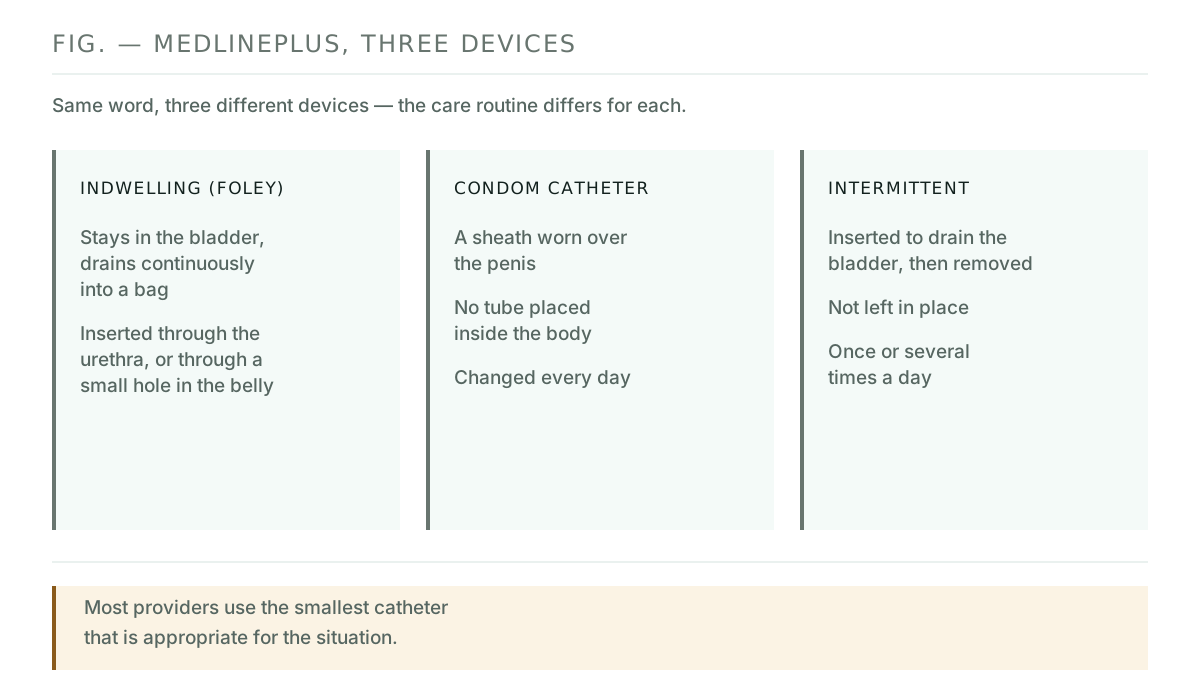
Catheters come in different sizes, materials — latex, silicone, Teflon — and tip shapes, straight or coude. MedlinePlus notes that in most cases, your provider uses the smallest catheter that is appropriate for the situation. None of these choices are things you need to decide yourself; they're clinical decisions based on your anatomy and why the catheter is needed in the first place.
It's worth separating two very different situations that both end up with someone wearing "a catheter." A short-term catheter after a procedure like a TURP is managing a temporary, expected swelling, and comes out once that settles. A long-term catheter for a chronic condition like a spinal cord injury or advanced dementia is a different commitment entirely, with the longer-term complication risks below becoming more relevant the longer it stays in. Knowing which situation you're actually in changes how worried any individual symptom should make you.
The three types, and which one you'll probably get
MedlinePlus describes three main types. An indwelling catheter is left in the bladder, either for a short time or a long time, and collects urine into a drainage bag. A Foley catheter is the common name for this type. A condom catheter is used by men to manage incontinence — a condom-like device fits over the penis, with no tube placed inside it, and leads to a drainage bag; it must be changed every day. An intermittent catheter is used only when needed: you or a caregiver insert it to drain the bladder, then remove it, once or several times a day depending on the reason.
How an indwelling catheter actually works
MedlinePlus explains that an indwelling catheter is inserted in one of two ways. Most often, it goes through the urethra — the tube that normally carries urine out of the body. Sometimes a provider instead inserts it through a small hole in the lower belly, done at a hospital or provider's office; this is called a suprapubic catheter.
A small balloon is inflated on the end of the catheter once it's in place, which keeps it from sliding out. When the catheter needs to come out, the balloon is simply deflated first. The catheter attaches to a drainage bag with a valve that opens to let urine flow out; some bags secure to the leg so they can be worn under clothing.
After prostate surgery specifically
This site's prostate surgery options coverage already notes the practical timeline: a TURP usually means one or two nights in hospital and a catheter for a day to three, with most men back to light activity within a fortnight and fully recovered by six weeks. Laser approaches tend to mean less bleeding and a shorter catheter than a standard TURP.
The catheter after prostate surgery is doing a specific job: keeping the urethra open and the bladder draining while swelling from the procedure goes down. It is temporary by design, not a sign that something went wrong.
Daily care that actually matters
- Clean where the catheter exits your body, and the catheter itself, with soap and water every day
- Clean the area again after every bowel movement, to prevent infection
- Keep the drainage bag lower than your bladder, so urine doesn't flow back up
- Empty the bag when about half full, and at bedtime
- Wash your hands before and after handling the drainage device
- Never let the outlet valve touch anything; clean it with soap and water if it does get dirty
- Drink plenty of fluids — ask your provider how much
For a suprapubic catheter specifically, MedlinePlus adds: clean the opening in your belly and the tube with soap and water every day, then cover it with dry gauze.
Why urine leaks around the catheter
MedlinePlus lists specific, fixable causes for leaking: a catheter that is blocked or has a kink in it, a catheter that is too small in diameter, bladder spasms, constipation, the wrong balloon size, or a urinary tract infection. None of these are things to just live with — each one points to a specific fix, usually a conversation with your provider about the catheter size, position, or an underlying cause like constipation.
The real complications, and which need same-day attention
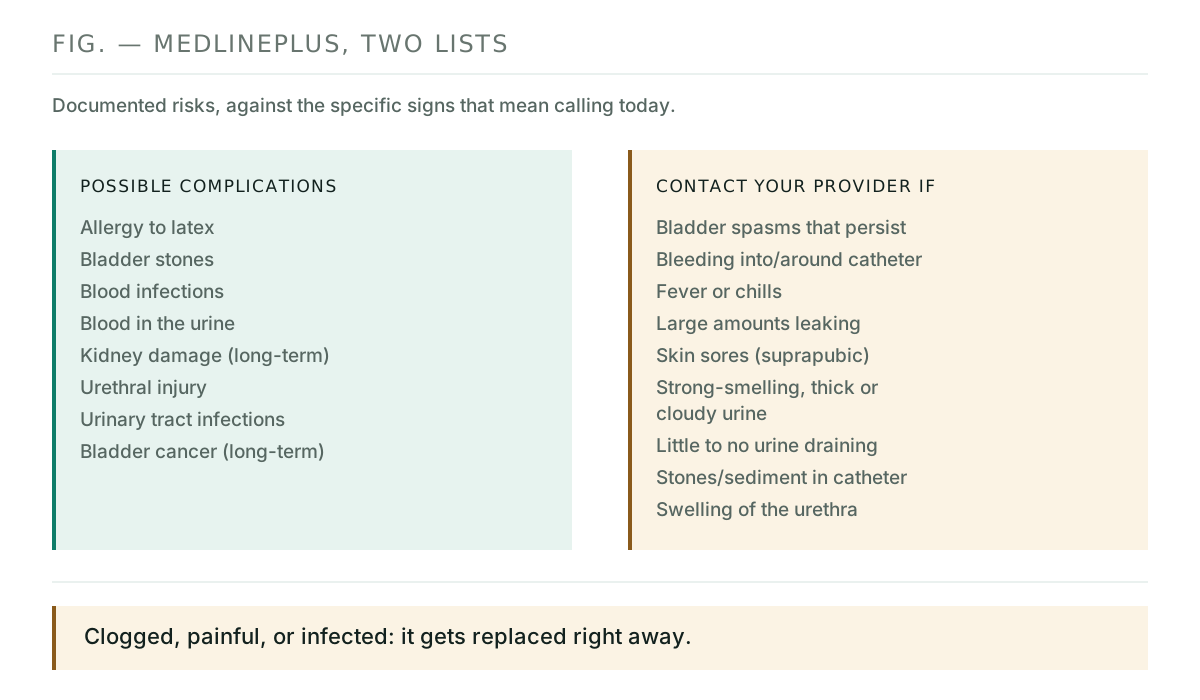
MedlinePlus lists the documented complications of catheter use: allergy or sensitivity to latex, bladder stones, blood infections (septicemia), blood in the urine (hematuria), kidney damage (usually only with long-term indwelling use), urethral injury, urinary tract or kidney infections, and — specifically after long-term indwelling use — bladder cancer. Several of these are explicitly tied to long-term indwelling use, which is why a short-term catheter after surgery and a catheter worn for years carry different risk profiles.
A recent catheter also shows up elsewhere on this site as a known, temporary cause of findings that might otherwise worry you: this site's PSA levels coverage lists a catheter among the things that can raise a PSA reading for a while, and its blood in urine coverage lists a recent urinary procedure, including a catheter, among the explanations a provider checks before assuming something more serious is going on.
When to call your provider right away
MedlinePlus is specific about what warrants contacting your provider: bladder spasms that do not go away, bleeding into or around the catheter, fever or chills, large amounts of urine leaking around the catheter, skin sores around a suprapubic catheter, stones or sediment in the catheter or drainage bag, swelling of the urethra around the catheter, urine with a strong smell or that is thick or cloudy, or very little to no urine draining from the catheter despite drinking enough fluids.
MedlinePlus states plainly: if the catheter becomes clogged, painful, or infected, it will need to be replaced right away. This isn't something to wait out until your next scheduled appointment.
Key takeaways
- There are three distinct types — indwelling (Foley), condom, and intermittent — and they're cared for differently.
- After a TURP, a catheter typically stays in for a day to three, doing a temporary job while surgical swelling resolves.
- Daily care centers on cleaning, keeping the bag below bladder level, and emptying it on a routine — not complicated, but it is daily.
- Leaking has specific, fixable causes per MedlinePlus — it's a signal to raise with your provider, not something to tolerate.
- Fever, chills, bleeding, or very little urine draining despite adequate fluids are the signs that need same-day attention.
Where to go from here
If a catheter is what brought you here, these pages cover related ground:
- Prostate Surgery Options: When Medication Is Not Enough — the procedures that typically involve a short-term catheter.
- Can't Fully Empty Your Bladder? What's Going On — urinary retention, one of the main reasons a catheter gets used.
- Weak Urine Stream After 50: What It Actually Means — the symptom that often leads here.
- Blood in Urine After 40: What It Usually Means — a recent catheter is on the list of things that can cause a raised reading.
- All prostate articles
Frequently asked questions
Why would I need a urinary catheter?
MedlinePlus lists four main reasons: urinary incontinence, urinary retention (being unable to empty your bladder when you need to), surgery on the prostate or genitals, and other medical conditions such as multiple sclerosis, spinal cord injury, or dementia. For this site's readers, recovery after prostate surgery is the most common reason.
What's the difference between the three types?
An indwelling catheter, often called a Foley catheter, stays in the bladder and drains continuously into a bag. A condom catheter fits over the penis like a sheath, with no tube inside the body, and is changed daily. An intermittent catheter is inserted to drain the bladder and then removed, used once or several times a day rather than left in place.
How long does a catheter stay in after prostate surgery?
This site's own coverage of prostate surgery options notes that a TURP usually means a catheter for a day to three, with most men back to light activity within a fortnight. The exact duration depends on the specific procedure and how your recovery is going, and your surgeon sets the actual timeline.
How do I actually take care of it day to day?
MedlinePlus instructs cleaning the area where the catheter exits your body, and the catheter itself, with soap and water every day, and after every bowel movement. Keep the drainage bag lower than your bladder, empty it when about half full and at bedtime, wash your hands before and after handling it, and never let the outlet valve touch anything.
Why does urine leak around my catheter?
MedlinePlus lists several causes: a catheter that is blocked or kinked, a catheter too small in diameter, bladder spasms, constipation, the wrong balloon size, or a urinary tract infection. Leaking is a signal to mention at your next check, not something to just tolerate indefinitely.
What are the real warning signs I shouldn't ignore?
MedlinePlus says to contact your provider for bladder spasms that do not go away, bleeding into or around the catheter, fever or chills, large amounts of urine leaking around the catheter, skin sores around a suprapubic catheter, stones or sediment in the catheter or drainage bag, swelling of the urethra around the catheter, urine with a strong smell or that is thick or cloudy, or very little to no urine draining despite drinking enough fluids.
Sources
- MedlinePlus (National Library of Medicine) — Urinary Catheters
- Male Health Guide — Prostate Surgery Options (companion coverage of the TURP recovery timeline)
- Male Health Guide — Can't Fully Empty Your Bladder? (companion coverage of urinary retention)
- Male Health Guide — Blood in Urine After 40 (companion coverage of recent-procedure causes)

Male Health Guide Editorial Team
We write about the health problems men over 40 actually search for at 3 a.m. — and we say plainly when the evidence for a popular product is thin. We do not invent credentials and we do not publish sponsored copy as editorial. Read more about how we work.
Medical disclaimer: This article is general information, not medical advice. We are not doctors, and nothing here diagnoses, treats or cures any condition. What type of catheter you need, and how to manage any problem with one, requires guidance from a qualified healthcare professional. Please speak to one about your own situation.