Restless Legs at Night: Why the Iron Test Comes First
Short answer
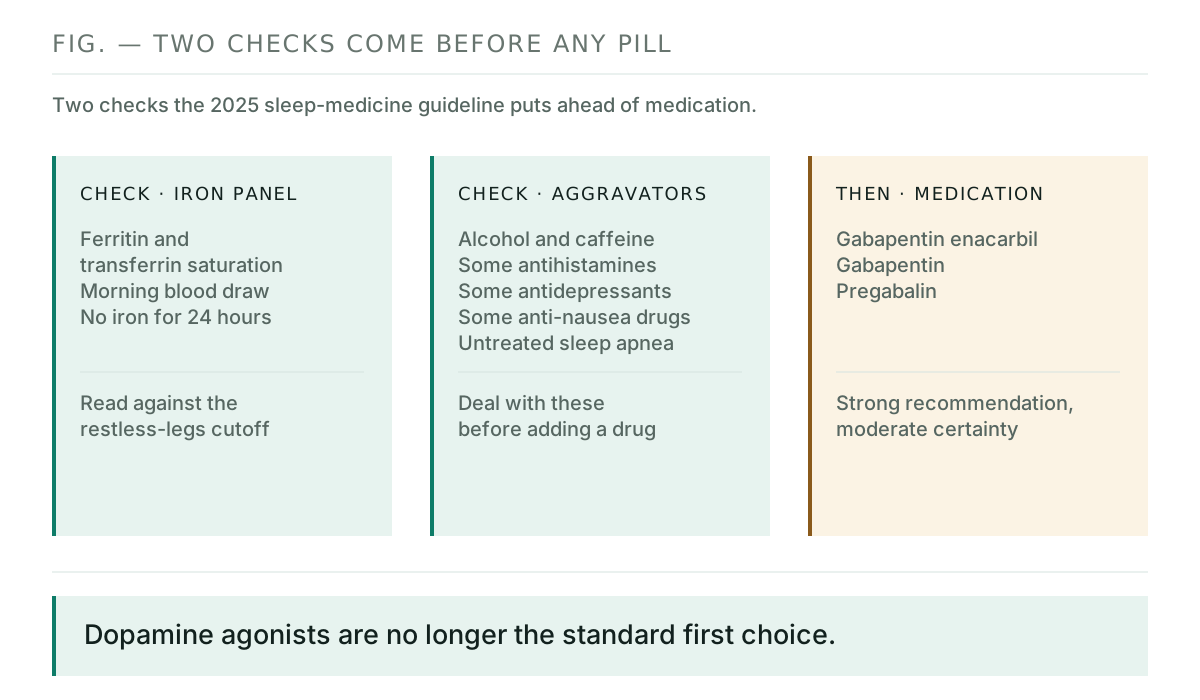
Restless legs syndrome is an urge to move the legs that starts at rest, eases with movement and peaks at night. The current sleep-medicine guideline puts two checks ahead of any prescription: an iron panel, read against a higher cutoff than the lab’s normal range, and a review of the medications and habits that aggravate it.
This page belongs to the sleep section, and it covers the one cause of a bad night that section had not yet touched. The other articles deal with a mind that will not switch off, a bladder that will not wait or an airway that keeps closing. This one is about legs that will not stay still, which is a different problem with a different workup.
It is also a subject where the advice changed recently. The medications long associated with this condition are no longer the standard first choice, and the first step in the current guideline is not a medication at all. If what you know about restless legs comes from an older leaflet, a good part of it has been revised.
We earn nothing from any of this. There are no affiliate links on this site, nothing here is sponsored, and there is no supplement or device to sell, which is why this page can simply report what the guideline says, including where it says the evidence is thin.
What restless legs actually is
The National Institute of Neurological Disorders and Stroke describes restless legs syndrome, also known as Willis-Ekbom disease, as a neurological condition that causes an irresistible urge to move the legs. It classes it two ways at once: as a sleep disorder, because it is triggered by resting and attempting to sleep, and as a movement condition, because people are forced to move their legs to find relief.
The urge usually arrives with a sensation that is hard to put into words. The same institute lists aching, throbbing, pulling, itching, crawling or creeping. MedlinePlus, the National Library of Medicine’s patient encyclopedia, adds bubbling, tugging, burning, gnawing, and pins and needles. The sensations less commonly affect the arms, and they most often affect both sides of the body, though they can affect only one.
What matters more than the exact word is the pattern the sensation follows, because the pattern is what the diagnosis rests on.
The pattern that separates it from an ordinary restless night
There is no scan and no blood marker for this. MedlinePlus states it plainly: there is no specific test for restless legs syndrome, and a provider will usually determine whether you have it based on your symptoms. Those symptoms have a recognizable shape, which the neurological institute sets out as an urge to move plus three common features.
- An urge to move, with uncomfortable sensations in the legs. The urge is the core of it, not the discomfort alone.
- It starts after rest. Sensations typically occur when you are inactive and sitting for extended periods; the institute’s examples are a plane trip or a movie.
- Movement relieves it. Walking or moving the legs typically brings temporary relief, and the sensations often return as soon as the movement stops.
- It is worse at night. Symptoms commonly appear in the late afternoon or evening, with a distinct symptom-free period in the early morning.
The formal diagnostic criteria, updated by the International Restless Legs Syndrome Study Group in 2014, added a fifth essential requirement to that list: differential diagnosis. In the group’s words, the aim was to improve specificity by requiring that the symptoms not be confused with similar symptoms from other conditions. That is the part a clinician does, and it is the reason a self-diagnosis from a checklist is a starting point and not an answer.
Four facts do most of the work: what the sensation makes you want to do, what you were doing when it started, what stops it, and what time of day it tends to happen. A man who can answer those four has already given most of the history the diagnosis needs.
How common it is, and how often it gets missed
The best-known population figures come from a study published in the Archives of Internal Medicine in 2005, which collected 15,391 fully completed questionnaires from adults using validated diagnostic questions.
Restless legs symptoms of any frequency in the past year were reported by 7.2% of respondents. They occurred at least weekly for 5.0%. They occurred at least twice a week and were rated moderately or severely distressing by 2.7%, the group the authors judged most likely to warrant medical treatment. Allen et al., Archives of Internal Medicine, 2005
The second finding from the same study is the one that explains why so many people live with this unnamed. Of the 416 people in that most-affected group, 337 reported discussing their symptoms with a primary care physician. Only 21 of those 337, or 6.2%, were given a diagnosis of restless legs syndrome. The authors’ conclusion was that the condition is common, underdiagnosed, and significantly affects sleep and quality of life.
One note for the reader this site is written for. Both federal sources say the condition is more common in women than in men, and the neurological institute adds that it most often begins in middle age. It occurs in both sexes, and nothing in the workup below differs for a man.
Why the iron test comes first
The American Academy of Sleep Medicine published its current clinical practice guideline for restless legs in the Journal of Clinical Sleep Medicine in January 2025. Before any of its treatment recommendations, it sets out what it calls good practice statements, and the first one is about a blood test.
In all patients with clinically significant RLS, clinicians should regularly test serum iron studies including ferritin and transferrin saturation (calculated from iron and total iron binding capacity).
The reason sits in the biology. The neurological institute says that low levels of iron in the brain may be responsible for the condition, and the study group’s 2018 iron guidelines open by stating that brain iron deficiency has been implicated in its pathophysiology. Ferritin is the blood measure that reflects how much iron the body has stored.
The guideline is specific about how the blood should be drawn, and the detail is easy to get wrong. Testing should ideally be done in the morning, avoiding all iron-containing supplements and foods for at least 24 hours before the draw. A multivitamin with iron taken at breakfast is exactly the kind of thing that instruction is aimed at.
“Normal” on the lab sheet is not the restless-legs number
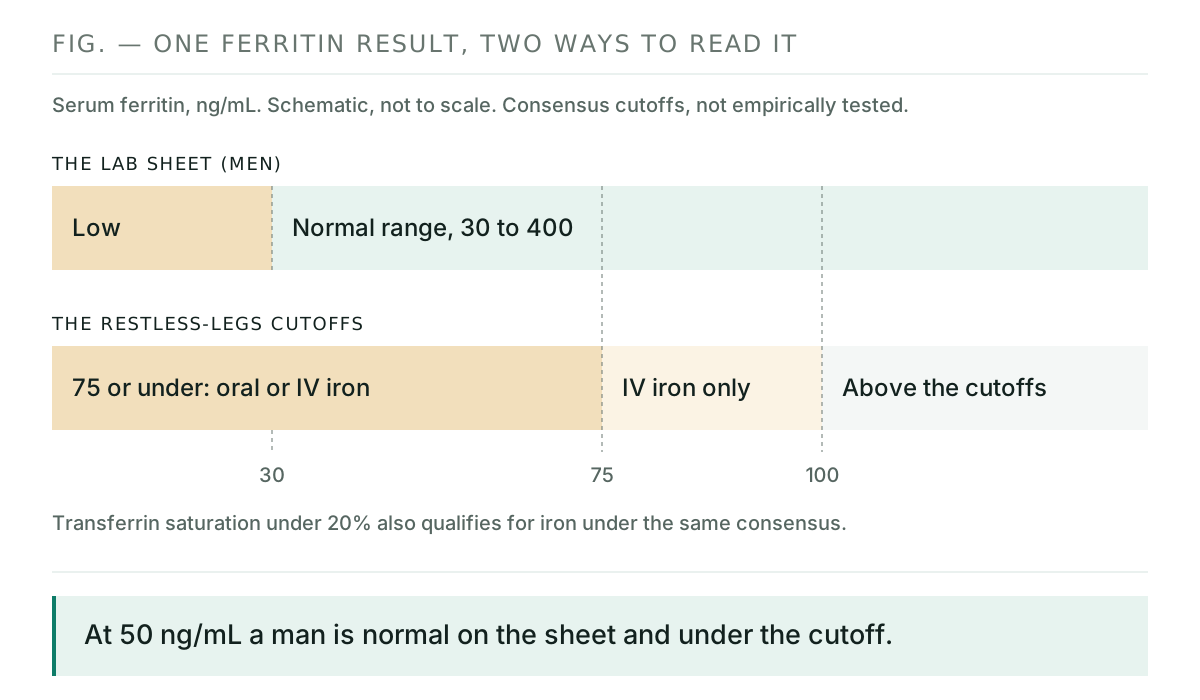
This is the part most worth carrying out of the article. The cutoff used for restless legs is not the cutoff printed on the lab report, and a result can pass one and fail the other.
The guideline reports that consensus guidelines suggest iron supplementation in adults with restless legs should be instituted with oral or intravenous iron if serum ferritin is 75 ng/mL or under, or transferrin saturation is under 20%, and only with intravenous iron if ferritin is between 75 and 100 ng/mL. Winkelman et al., Journal of Clinical Sleep Medicine, 2025
Compare that with the reference range. MedlinePlus gives the normal range for blood ferritin in men as 30 to 400 ng/mL, noting that ranges vary slightly between laboratories. A man with a ferritin of 50 is inside that range, will not be flagged on the printout, and is under the restless-legs cutoff. The guideline says so directly: these iron supplementation guidelines are different than for the general population.
It is a different line again from the one used when iron deficiency is being diagnosed in a man with anemia, which we cover in anemia after 40. The same test is being asked three different questions, and each has its own number.
Two honest limits belong next to that cutoff. First, the guideline itself describes these as consensus guidelines which have not been empirically tested. Second, the strength of the evidence depends on the form of iron. The 2018 study group report judged oral iron, at 65 mg of elemental iron, possibly effective for restless legs in people with ferritin of 75 or under. The 2025 guideline suggests ferrous sulfate as a conditional recommendation, and gives its strong recommendation to an intravenous form, ferric carboxymaltose, in patients with appropriate iron status.
Nothing above is a reason to start iron on your own. The guideline’s whole point is that the iron studies decide whether iron is used and in what form, and MedlinePlus lists too much iron in the body among the causes of a high ferritin. Get the number, then have the conversation about what it means for you.
The list to go through before any prescription
The second good practice statement is just as practical as the first. The guideline says the first step in the management of restless legs should be addressing exacerbating factors, and it names them: alcohol, caffeine, antihistaminergic, serotonergic and antidopaminergic medications, and untreated obstructive sleep apnea.
The neurological institute translates the medication classes into plainer terms. It says certain medications may aggravate symptoms, such as some anti-nausea drugs, antipsychotic drugs, antidepressants that increase serotonin, and some antihistamines. MedlinePlus adds that the condition may also occur in people who use certain medicines such as calcium channel blockers, lithium or neuroleptics, in people who are stopping sedative use, and in people who use caffeine, alcohol or nicotine.
Three items on that list connect to other pages here. Alcohol’s effect on the second half of the night is covered in alcohol and sleep. Caffeine and its long tail are covered in caffeine and tiredness. And if snoring or witnessed pauses are part of the picture, snoring or sleep apnea explains why that question deserves its own answer; the guideline lists untreated apnea as something that makes restless legs worse.
The list is for a conversation, not a decision made alone. An antidepressant or a blood pressure medicine is there for a reason, and whether it can be changed is a question for the person who prescribed it. What you can usefully do is bring the full list, including anything bought without a prescription.
What the guideline now puts first among medications
When symptoms still need a drug after iron and aggravating factors have been dealt with, the 2025 guideline’s strongest recommendations go to one family. It recommends gabapentin enacarbil, gabapentin and pregabalin, each as a strong recommendation on moderate certainty of evidence. A strong recommendation, in the guideline’s own definition, is one that clinicians should follow under most circumstances.
The 2026 update of the management algorithm written by the Restless Legs Syndrome Foundation’s scientific and medical advisory board, published in Mayo Clinic Proceedings, uses the same ordering. Its summary describes gabapentinoids as first-line pharmacologic therapy for chronic persistent restless legs.
These are prescription medicines with their own side effects and cautions, and which one fits, at what dose, is the prescriber’s call. The point here is narrower: this is the family the current guidance reaches for first.
The pills that used to come first, and why they moved
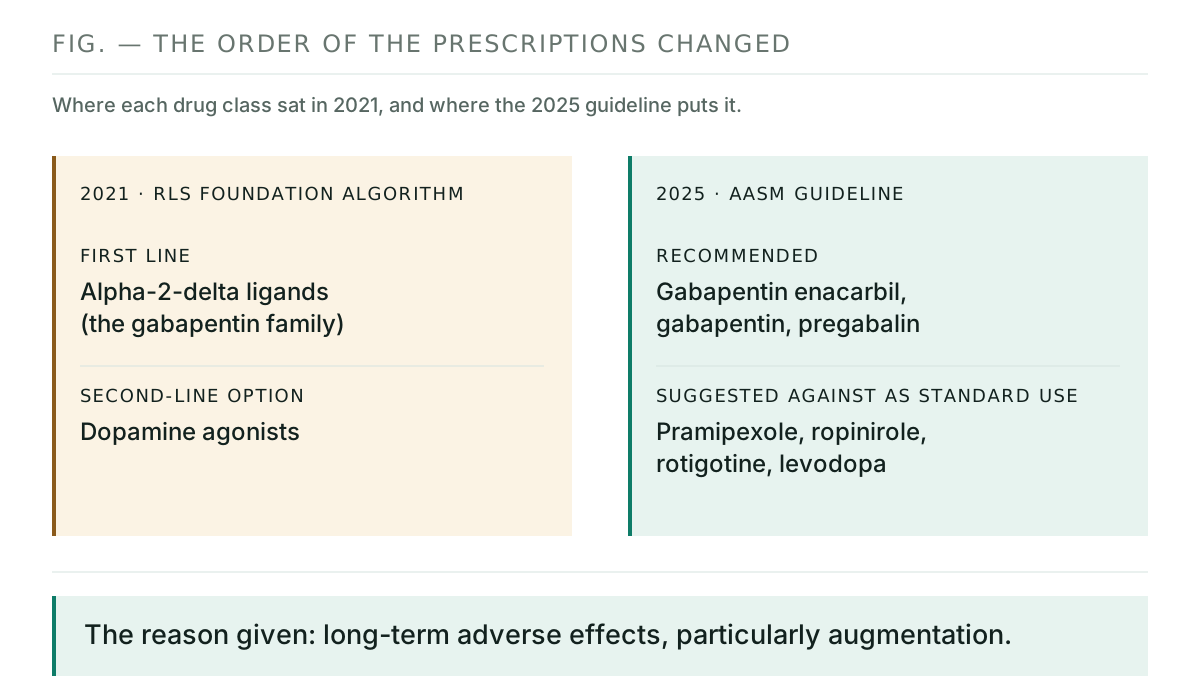
The drugs long associated with restless legs are the dopamine agonists: pramipexole, ropinirole and the rotigotine patch, along with levodopa. They do reduce symptoms in the short term, which the guideline’s own remarks acknowledge. The 2025 guideline moved them all the same.
The guideline suggests against the standard use of levodopa, pramipexole, transdermal rotigotine and ropinirole, each as a conditional recommendation. For each, its remark says the drug may be used in patients who place a higher value on the reduction of symptoms with short-term use and a lower value on adverse effects with long-term use, particularly augmentation. Winkelman et al., Journal of Clinical Sleep Medicine, 2025
Augmentation is the word that carries the change. It is the name for the treatment itself making the condition worse over time. The neurological institute puts it in one line: dopaminergic drugs can help, but long-term use may worsen symptoms. A task force of the international and European study groups and the foundation, reporting in 2016, had already warned that even low-dose dopaminergics can cause augmentation, and recommended that the family of drugs now placed first be considered for initial treatment because they are effective and carry little risk of it.
The shift was gradual. The foundation’s 2021 algorithm already placed the gabapentin family first, with dopamine agonists as a second-line option. The 2025 guideline went a step further and suggested against them as standard use. One drug in the class received a stronger verdict: the guideline recommends against cabergoline outright.
“Suggested against as standard use” is not an instruction to stop. The guideline’s own remarks leave room for these drugs in patients who weigh short-term relief more heavily, and changing a prescribed medicine is a decision to make with the person who prescribed it. If your symptoms have become worse since you started, that is worth raising at your next appointment, using the word augmentation.
What else is on the list
Beyond iron and the gabapentin family, the guideline makes several recommendations that it grades as conditional and not strong.
- A nerve stimulation device. The guideline suggests bilateral high-frequency peroneal nerve stimulation, on moderate certainty of evidence. Separately, the neurological institute describes an FDA-approved technology it calls tonic motor activation, a system of devices worn on the lower legs.
- Opioids, in selected cases. The guideline suggests extended-release oxycodone and other opioids. The institute places them for severe cases that do not respond to other treatments, and the 2026 algorithm discusses low-dose opioids and how to use them safely.
- Dipyridamole. Suggested on low certainty of evidence.
None of these is a first step. They are listed here so that a man whose symptoms have not responded to the first approach knows the list does not end there.
What you can do yourself
The neurological institute lists lifestyle changes and activities that may provide some relief. None of them is presented as a cure, and the wording is deliberately modest.
- Avoiding or decreasing the use of alcohol, nicotine and caffeine
- Maintaining a regular sleep schedule
- Exercising moderately and consistently
- Massaging the legs or taking a warm bath
- Applying a heating pad or an ice pack
The foundation’s 2021 algorithm adds one more nonpharmacologic approach: mental alerting activities. Its 2026 update includes behavioral approaches in managing intermittent restless legs, the kind that comes and goes.
The institute also notes that events or activity that further reduce sleep may worsen symptoms. That makes the general advice in sleep after 40 part of the picture here, since a short night and restless legs can feed each other.
The jerking your partner notices is related, but separate
There is a second phenomenon that travels with this one and is often confused with it. Periodic limb movement of sleep is involuntary twitching or jerking of the legs, and sometimes the arms, during sleep. The neurological institute says these movements typically happen every 15 to 40 seconds and can last throughout the night.
The relationship runs one way more than the other. In the institute’s words, while many individuals with restless legs have these movements, most people with the movements do not have restless legs. The difference is in who notices. Restless legs is something you feel while awake. The limb movements happen while you are asleep, and the person who reports them is usually the one lying next to you.
That makes them one more item on the list of things a partner sees and the sleeper does not, alongside the pauses in breathing described in my wife says I stop breathing when I sleep. The overnight test described in what actually happens at a sleep study includes sensors on the legs.
When to bring it up, and what to ask
MedlinePlus is reassuring on one point and practical on another. Restless legs syndrome is not dangerous, it says, but it can be uncomfortable, making it hard to sleep and affecting your quality of life. Its advice is to contact a provider if you have symptoms, if your sleep is disrupted, or if symptoms get worse.
Given how often the 2005 study found the condition went unnamed in primary care, it helps to arrive with the right questions. The guideline supplies them.
- Describe the pattern, not just the discomfort. Urge to move, starts at rest, eases with movement, worse at night.
- Ask for iron studies, not only a blood count. Ferritin and transferrin saturation, drawn in the morning, with no iron-containing supplements or foods for 24 hours beforehand.
- Ask what cutoff the result is being read against. For restless legs the consensus figure is a ferritin of 75 ng/mL or under, not the bottom of the lab range.
- Bring every medication and supplement you take, including the ones bought without a prescription, and ask whether any of them could be aggravating it.
- Mention snoring or witnessed pauses in breathing if they apply. Untreated sleep apnea is on the guideline’s list of things that make this worse.
- If medication comes up, ask where it sits in the current guideline. The order changed, and it is reasonable to ask why a particular drug is being chosen.
If the legs are not the only thing keeping you up, the other causes have their own pages. A mind that is awake at 3 a.m. with nothing physically wrong is covered in waking at 3 a.m., and the question of whether the bladder woke you or simply got noticed is covered in nocturia or insomnia.
Key takeaways
- Restless legs syndrome is an urge to move the legs that starts at rest, is relieved by movement and is worse at night, with a symptom-free period in the early morning.
- In a 2005 population study, 2.7% of adults had symptoms at least twice a week with moderate or severe distress; of those who discussed them with a primary care physician, 6.2% were given the diagnosis.
- The 2025 American Academy of Sleep Medicine guideline says clinicians should regularly test iron studies, including ferritin and transferrin saturation, in all patients with clinically significant restless legs.
- The consensus cutoff for iron in restless legs is a ferritin of 75 ng/mL or under, or transferrin saturation under 20% — above the bottom of the normal range for men, and described by the guideline as not empirically tested.
- The guideline’s first management step is addressing exacerbating factors: alcohol, caffeine, antihistaminergic, serotonergic and antidopaminergic medications, and untreated obstructive sleep apnea.
- Gabapentin enacarbil, gabapentin and pregabalin carry strong recommendations; pramipexole, ropinirole, rotigotine and levodopa are now suggested against as standard use because of long-term adverse effects, particularly augmentation.
Where to go from here
Restless legs is one cause of a broken night among several. These cover the others:
- Sleep After 40: What Changed and What Restores It — the guide that sorts “I slept badly” into separate problems.
- Snoring or Sleep Apnea? What Separates Them — untreated apnea is on the guideline’s list of things that make restless legs worse.
- What Actually Happens at a Sleep Study — the overnight test, which includes sensors on the legs.
- Alcohol and Sleep: What a Nightcap Really Costs You — one of the named aggravators, and what else it does to the night.
- Waking at 3 a.m. and Cannot Get Back to Sleep — if the legs are quiet and the mind is not.
- Anemia After 40: The Result That Starts a Search — the other place a ferritin result gets read, against a different number.
Frequently asked questions
What does restless legs syndrome feel like?
An irresistible urge to move the legs, usually with a sensation described as aching, throbbing, pulling, itching, crawling or creeping. It typically starts when you are sitting or lying still, eases while you move, returns when you stop, and is worse in the evening and at night than in the early morning.
Is restless legs syndrome caused by low iron?
Iron is one recognized contributor, not the only one. The National Institute of Neurological Disorders and Stroke says low levels of iron in the brain may be responsible, and that the condition often runs in families. Separately, the 2025 guideline says iron studies should be tested in all patients with clinically significant symptoms.
What ferritin level is too low for restless legs?
Consensus guidelines cited in the 2025 American Academy of Sleep Medicine guideline suggest iron if serum ferritin is 75 ng/mL or under, or transferrin saturation is under 20 percent. That is above the bottom of the normal range for men, which MedlinePlus gives as 30 ng/mL. The guideline notes these cutoffs have not been empirically tested.
Which medications make restless legs worse?
The guideline names antihistaminergic, serotonergic and antidopaminergic medications, alongside alcohol and caffeine. The National Institute of Neurological Disorders and Stroke lists some anti-nausea drugs, antipsychotic drugs, antidepressants that increase serotonin and some antihistamines. Do not stop a prescribed medicine on your own; take the full list to your prescriber.
What is the first-line treatment for restless legs now?
After iron status and aggravating factors are addressed, the 2025 guideline gives strong recommendations to gabapentin enacarbil, gabapentin and pregabalin. It suggests against the standard use of pramipexole, ropinirole, rotigotine and levodopa, citing adverse effects with long-term use, particularly augmentation, while leaving room for them in some patients.
Is restless legs syndrome dangerous?
MedlinePlus states that restless legs syndrome is not dangerous, but that it can be uncomfortable, make it hard to sleep and affect quality of life. It advises contacting a provider if you have symptoms, if your sleep is disrupted or if symptoms get worse. The harm it does is mostly to sleep.
Sources
- Winkelman JW et al. Journal of Clinical Sleep Medicine, 2025 — Treatment of Restless Legs Syndrome and Periodic Limb Movement Disorder: An American Academy of Sleep Medicine Clinical Practice Guideline
- Silber MH et al. Mayo Clinic Proceedings, 2026 — An Updated Algorithm for the Management of Restless Legs Syndrome
- Silber MH et al. Mayo Clinic Proceedings, 2021 — The Management of Restless Legs Syndrome: An Updated Algorithm
- Allen RP et al. Sleep Medicine, 2018 — Evidence-Based and Consensus Clinical Practice Guidelines for the Iron Treatment of Restless Legs Syndrome/Willis-Ekbom Disease in Adults and Children: An IRLSSG Task Force Report
- Garcia-Borreguero D et al. Sleep Medicine, 2016 — Guidelines for the First-Line Treatment of Restless Legs Syndrome/Willis-Ekbom Disease, Prevention and Treatment of Dopaminergic Augmentation
- Allen RP et al. Sleep Medicine, 2014 — Restless Legs Syndrome/Willis-Ekbom Disease Diagnostic Criteria: Updated International Restless Legs Syndrome Study Group (IRLSSG) Consensus Criteria
- Allen RP et al. Archives of Internal Medicine, 2005 — Restless Legs Syndrome Prevalence and Impact: REST General Population Study
- National Institute of Neurological Disorders and Stroke — Restless Legs Syndrome
- MedlinePlus, National Library of Medicine — Restless Legs Syndrome
- MedlinePlus, National Library of Medicine — Ferritin Blood Test

Male Health Guide Editorial Team
We write about the health problems men over 40 actually search for at 3 a.m. — and we say plainly when the evidence for a popular claim is thin. We do not invent credentials and we do not publish sponsored copy as editorial. Read more about how we work.
Medical disclaimer: This article is general information about restless legs syndrome and how it is evaluated and treated, and is not medical advice. It is not a substitute for diagnosis or treatment, and it is not a reason to start iron or any other supplement without testing. Please speak to a qualified healthcare professional about your own situation, and never start, stop or change a prescribed treatment based on what you read online.