My Wife Says I Stop Breathing When I Sleep
Short answer
My wife has watched me stop breathing for years, and she is the one who said the word apnea. I have never been tested, because there is no sleep centre in my town and it seemed like a lot of trouble. I do not feel tired during the day, and I let that settle the question. It does not settle it.
This is the second thing I have written for this site. The first was about my prostate, and the shape of it was simple enough: I noticed something, I did not go to a doctor, and instead I ordered capsules. I thought that was a one-off, a particular kind of foolishness about a particular kind of embarrassment.
It was not. I have been doing the same thing about my sleep, for considerably longer, with considerably better information available to me, and I did not see the pattern until the editorial team here asked me eight plain questions and I heard my own answers read back.
So this one is harder to write. With the prostate, nobody had told me anything. With this, somebody had.
What my wife actually says happens
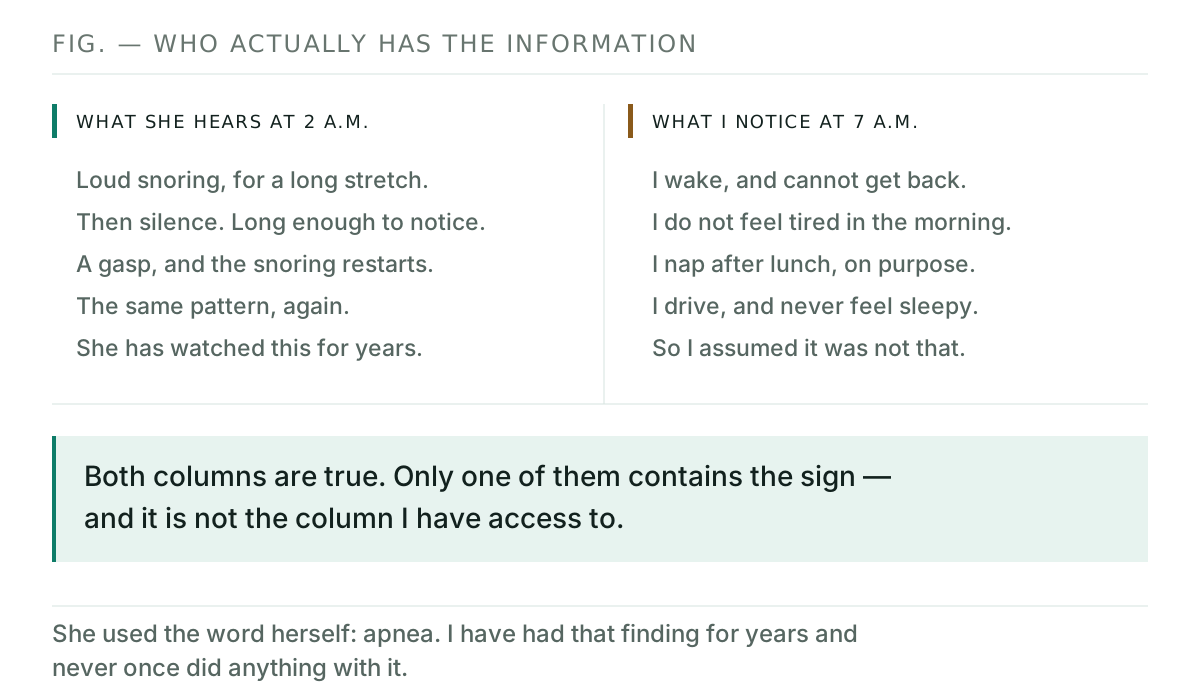
She says I snore, loudly, for a stretch. Then I stop. Not a pause for breath — a silence long enough that she has learned to wait through it. Then a gasp, and the snoring starts again. Then the same thing, later.
And she does not describe it as snoring. She says she thinks it is apnea. She used the word herself, without me asking, and she has said it more than once. It is not a joke between us and it never was.
I want to be exact about that, because I suspect a lot of men reading this have had a version of this conversation and have filed it under teasing. Mine was not teasing. Mine was a person who sleeps next to me telling me, repeatedly, in plain language, what she has observed. The site's own guide to what separates snoring from sleep apnea makes the point that the loudness is not the signal — the silence in between is. I have had a witness to that silence for years.
If someone who sleeps beside you has told you that you stop breathing, you already have the piece of information that is hardest to get. You cannot observe it yourself, no device you own can tell you, and no amount of feeling fine in the morning replaces it. Whatever else you decide, do not treat that sentence as nothing. I did, for years.
Why I did nothing with it for years
Because nothing bad appeared to be happening.
That is the honest answer and it is worth sitting with, because it is not stupidity and it is not denial in the dramatic sense. Every morning I got up. I went about my day. I did not fall asleep at my desk or nod off in company. My wife told me about the nights, and the days kept going, and one of those two pieces of evidence was mine and the other was hers. I quietly went with mine.
There is also the part where I had no idea what I would even be starting. A test somewhere else, presumably an overnight, presumably a wait. It never got as far as being a decision. It stayed at the level of a thing I would look into sometime.
I did not decide against getting tested. I never got as far as deciding anything. That is a different failure and I think it is the more common one.
I am not tired in the day, so I assumed it was not that
This was my whole defence, and it is the part where the editorial team came back at me with something I did not know.
I had a picture in my head of what a man with sleep apnea looks like. He is exhausted. He is nodding off in the afternoon against his will. He is a danger on the road. I am none of those, therefore it is not that. I built a lot on that reasoning without ever checking whether it held.
It does not hold. A 2022 review in Current Opinion in Pulmonary Medicine is specifically about this: there is a subgroup of people with sleep apnea who do not complain of sleepiness at all, and who present instead with what the paper calls non-classical symptoms. It puts numbers on some of them — nightmares in around 41 per cent of patients against 19 per cent in the general population, sleep bruxism in 26 to 54 per cent against 13 per cent. The paper's conclusion is that these presentations have a high prevalence and are underestimated.
Underestimated by doctors, it means. But it is underestimated by the patient first, and I am the proof of that. I ruled myself out using a picture I had assembled from nothing.
The nap and the steering wheel
Now the part that runs the other way, because I am not going to only report the evidence that makes my story neater.
I nap most days after lunch, for half an hour or forty minutes. But I go and lie down on purpose. I do not drop off in a chair without meaning to. That distinction matters, and it is the one this site's own apnea article draws: the sign is falling asleep when you did not intend to, not choosing to have a nap. On that measure I do not have the sign.
And I drive. I have never felt sleepy at the wheel, not once. I want that on the record because it is the answer that would have worried me most, and it is not my answer.
So the fair summary of me is this: I have the witnessed pauses and the snoring, and I do not have the daytime sleepiness. When I put it like that it sounds like a reason to relax. It is not, quite. It means I am in the group the review above is about — the ones who have it without looking like they have it, and who therefore never get sent for a test.
Waking in the night and apnea are not opposites
There is another thing I had backwards.
My actual complaint, the one that bothers me, is that I wake in the night and cannot get back to sleep. Sometimes I do not get back at all. It is not always the bathroom — sometimes I am simply awake, and the need to go only turns up afterwards, which the site covers in why you wake up several times a night to pee.
I should square this with something I wrote here before. In the prostate piece I said my symptoms were not interfering with my sleep, and that I am not up four times a night. Both of those are still true, and they are not a contradiction of this article — they are the point of it. The prostate is not what wakes me. My sleep was like this long before my stream changed, which is roughly seven months ago and no more. Two separate things, and I had quietly been letting the newer one carry the blame for the older one.
In my head, the waking made this an insomnia problem, and apnea was a different problem belonging to different men. But the same 2022 review reports a meta-analysis finding that around 36 per cent of people with sleep apnea also report insomnia complaints. More than a third. They are not alternatives you pick between. They sit together often enough that having one is a reason to ask about the other.
Which reframes what I have been doing. I have been treating the symptom I can feel and ignoring the sign I cannot, and telling myself the first one rules out the second. The article on waking at three in the morning and the one on the behavioural programme for insomnia are both about the thing I can feel. Neither of them would look at my breathing.
of people with sleep apnea also report insomnia complaints, according to a meta-analysis cited in the 2022 review. Waking in the night is not evidence against apnea.
I am taking my wife's magnesium
Here is the sentence I found hardest to write down.
I take magnesium with inositol at night, and I think it helps. It is my wife's. I did not research it, compare anything or ask anybody. It was in the cupboard, so I started taking it.
Before that I tried melatonin. It gave me a dry mouth and left me groggy in the morning, and I stopped. I tried one or two other natural things over the years with the same broad result: something happens, and it is not enough.
I asked the editorial team to tell me straight what the evidence is, and their answer was more careful than I expected. Melatonin has a real use, but it is mainly for problems of timing — a body clock running to the wrong hours — rather than for waking in the middle of the night and staying awake, which is what I have. Magnesium has a positive signal in the research, but from studies they described as low quality, and the effect looks strongest in people who were low in magnesium to begin with, which nobody has ever checked in me. For inositol they could not find evidence about sleep specifically at all.
I am not going to tell you those things do nothing, because I do not know that and neither does anyone else. What I will say is this: none of them was ever going to touch the thing my wife describes. A capsule does not hold an airway open. Whatever the magnesium is doing for me, it is not doing that — and I had been letting it stand in for the thing I had not done, exactly the way the capsules stood in for the appointment when it was my prostate. I wrote about that at length in the piece about my mild prostate symptoms and apparently learned nothing from it.
There is no sleep clinic in my town
This is the real reason, underneath all the others, and it took the eighth question to get it out of me.
It is not fear of a diagnosis. It is not that I think it is nonsense. It is that there is nowhere here to do it, and the whole thing looked like a great deal of trouble for something I was not convinced was a problem. Travel, arrangements, a night somewhere else, for a complaint I have been living with quite successfully.
I suspect that is the most common reason of all and the least discussed one. The literature talks about denial and stigma. My obstacle was logistics.
What a home test does, and what it does not
The editorial team went and looked this up after I answered, and what they found is the most useful thing in this article. I want to set it out accurately, including the part that does not help me.
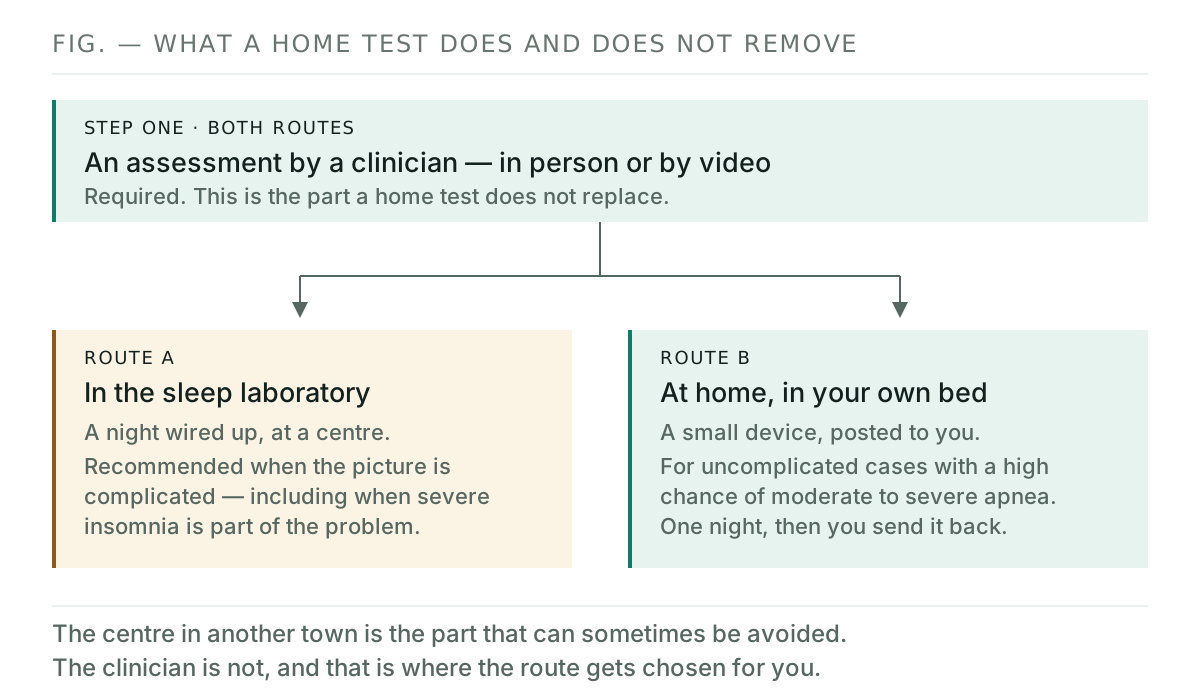
A home sleep apnea test exists. The American Academy of Sleep Medicine treats it as an alternative to a night in a laboratory for uncomplicated adults whose history suggests a good chance of moderate to severe apnea. A small device, worn for a night in your own bed.
But it does not remove the doctor. The Academy's position statement is explicit that the need for and appropriateness of a home test must be based on the patient's medical history and a face-to-face examination by a physician — either in person or via telemedicine. That last clause is the one that matters to me. The bit I cannot get to locally is the sleep centre. The consultation can be a video call.
The same guidance says the raw data has to be read by a physician, and that decisions must not be based on the device's automatic scoring alone. So it is not a gadget you buy and interpret yourself.
The Academy's diagnostic guideline lists people who should have a laboratory study rather than a home test, and the list includes severe insomnia — alongside significant heart or lung disease, neuromuscular weakness, chronic opioid use and a history of stroke. My main complaint is waking and not getting back to sleep. So the home test might not be the right test for me at all. Which route suits a particular person is a clinical judgement, and that is one more argument for the consultation rather than against it.
I had assumed the choice was between a night in a distant laboratory and doing nothing. It was never that. It was between a conversation with someone qualified and doing nothing, and I had not understood that the conversation was the actual first step, and that it did not require me to go anywhere.
I still think I do not need to go yet
The editorial team asked me, last of all, whether answering these questions had changed my mind. I said no. I do not think I need to go to a doctor yet.
They have printed that answer as I gave it, which I appreciate, and they have not gone back and softened anything to make it sit better. I found out about the home test after I answered, not before, so I cannot tell you I weighed it and declined. I did not know.
What I can tell you is what "yet" is doing in that sentence. It is holding the door open while I do nothing, which is precisely what it has been doing for years. I recognise it now because I have written it down. That is not the same as having an appointment.
I am aware of how this reads. A man with a witness, a name for what she saw, a known route to a test that does not need him to leave his town, and a reason not to yet. If you find that frustrating to read, I would gently point out that you are reading it from the outside, and everyone is on the inside of their own version.
What I would tell you, given that I am not taking my own advice
The useful part of my position is that I can see it clearly and still not act on it, and that is more instructive than a tidy ending would be.
If somebody has told you that you stop breathing, you are holding the strongest piece of information available without a test, and you are holding it because you cannot get it any other way. Feeling fine in the morning does not cancel it — there is a documented group of people who have this and do not feel sleepy, and I appear to be one of them. Waking in the night does not cancel it either; the two go together in more than a third of cases.
And if your reason is the one mine turned out to be — that it is all too much bother and there is nothing near you — then find out what the first step actually is before you decide it is too much. Mine was a conversation that could have happened by video, and I spent years not having it because I was picturing a building I would have to drive to.
I will let this site know if I change my mind. I am not going to promise here that I will.
Key takeaways
- A breathing pause witnessed by your partner is the strongest sign available without a test, because it comes from the part of the night you cannot see.
- You can have sleep apnea and not feel sleepy in the day. Non-classical presentations are described in the literature as common and underestimated.
- Choosing to nap is a habit. Falling asleep without meaning to is the sign.
- Insomnia and apnea are not alternatives — around 36 per cent of people with apnea also report insomnia complaints.
- A home test can replace the night in the laboratory. It cannot replace the clinician, and that consultation can be done by video.
- A home test is not right for everyone; severe insomnia is on the list of reasons to do the laboratory study instead.
Where to go from here
If you are somewhere near where I am, these are the pieces that sort out which problem you are actually dealing with:
- Snoring or Sleep Apnea? What Separates Them — why the silence matters more than the noise.
- Sleep After 40: What Changed and What Restores It — the guide that sorts “I slept badly” into five separate problems.
- Waking at 3 a.m. and Cannot Get Back to Sleep — the complaint I actually notice, and why lying there longer makes it worse.
- The Insomnia Treatment That Works Better Than Pills — what the guidelines put first for long-term insomnia.
- My Prostate Symptoms Are Mild. Should I Be Doing Something? — the first time I did this, with capsules instead of an appointment.
Frequently asked questions
My partner says I stop breathing. How seriously should I take that?
Seriously. A breathing pause witnessed by the person beside you is one of the strongest pointers to sleep apnea available outside a test, precisely because it comes from the only part of the night you cannot observe yourself. It is not a diagnosis, but it is a reason to be assessed.
Can you have sleep apnea without feeling sleepy during the day?
Yes. There is a well-described group of people with sleep apnea who do not report daytime sleepiness at all. Reviews of the condition describe non-classical presentations as common and underestimated, which is one reason men who feel fine in the morning are often never referred for testing.
Does a deliberate afternoon nap count as a warning sign?
Less than falling asleep without meaning to. The sign that matters is dropping off when you did not intend to, such as in front of the television, while reading or waiting in a stationary car. Choosing to lie down after lunch is a habit, not a symptom.
Can you have insomnia and sleep apnea at the same time?
Frequently. A meta-analysis cited in the medical literature found that around 36 per cent of people with sleep apnea also report insomnia complaints. Waking in the night and not getting back to sleep does not rule apnea out, and treating only the waking can leave the breathing unexamined.
Can a sleep apnea test be done at home?
Sometimes. A home sleep apnea test is a recognized alternative to a laboratory study for uncomplicated adults thought likely to have moderate to severe apnea. It does not replace the clinical assessment, which sleep medicine guidance says must still happen in person or by video.
Is a home test suitable for everyone?
No. Guidance from the American Academy of Sleep Medicine directs certain people to a laboratory study instead, including those with significant heart or lung disease, neuromuscular weakness, chronic opioid use, a history of stroke, or severe insomnia. Which route suits you is a clinical decision, not a shopping one.
Sources
- American Academy of Sleep Medicine — Home Sleep Apnea Testing (HSAT) Position Statement
- American Academy of Sleep Medicine — Clinical practice guideline for diagnostic testing for adult obstructive sleep apnea
- Current Opinion in Pulmonary Medicine (2022) — More than sleepiness: prevalence and relevance of nonclassical symptoms of obstructive sleep apnea
- National Heart, Lung, and Blood Institute (NIH) — Sleep Apnea: Diagnosis
- MedlinePlus (US National Library of Medicine) — Sleep Apnea
- NHS — Sleep apnoea
Ray H.
Ray H. is a pen name. He is a real contributor in his sixties writing from his own experience, and he asked us not to publish his name or photograph — for exactly the reasons this site exists. He is not a doctor and does not give medical advice. His articles are fact-checked by our editorial team, and where his account and the evidence disagree, we print both. Read why we publish him this way.
Medical disclaimer: This article describes one person's experience and is general information, not medical advice. The author is not a doctor and has not been tested or diagnosed. Nothing here diagnoses, treats or cures any condition, and the absence of daytime sleepiness is not evidence that sleep apnea is absent. Witnessed pauses in breathing should be discussed with a qualified healthcare professional. Never start, stop or change a prescribed medication based on what you read online.