CPAP: What to Expect, and Why So Many Quit
Short answer
CPAP is a machine that pumps steady, gentle air pressure through a mask to keep your airway open while you sleep, and it is commonly the first treatment for obstructive sleep apnea. The first weeks are commonly uncomfortable, and many of the problems can be helped or prevented. The honest number: across 82 studies spanning 20 years, about a third of patients never use it enough to count as adherent.
A sleep study confirms apnea, a provider hands over a machine and a mask, and that is often where the explanation stops. What follows — the awkward first nights, the leaks, the dry mouth, the question of whether any of it is actually working — is usually left for the man to figure out on his own.
This article covers what CPAP actually is, who genuinely needs it, what the rough early period involves and how to get through it, what regular use is reported to improve, and the honest statistic on how many men stick with it long enough to find out.
What CPAP actually is
CPAP stands for continuous positive airway pressure. MedlinePlus describes positive airway pressure (PAP) treatment as a machine that pumps air under pressure into the airway through a mask worn over the nose, or nose and mouth, connected by a hose to a small bedside unit. The forced air keeps the airway from collapsing, which is what blocks breathing during an obstructive sleep apnea event.
CPAP is one of three related machine types. MedlinePlus distinguishes autotitrating positive airway pressure (APAP), which adjusts pressure through the night based on your breathing, and bilevel positive airway pressure (BiPAP), which uses a higher pressure on the inhale and a lower one on the exhale — useful for airways that collapse easily, reduced air exchange in the lungs, or muscle weakness that makes breathing harder. A provider prescribes the type that matches the specific problem, not a one-size-fits-all default.
Who actually needs it
MedlinePlus states that PAP can successfully treat most people with obstructive sleep apnea, safely and effectively across ages. But it also gives a real exception: if you only have mild sleep apnea and do not feel very sleepy during the day, you may not need it. That judgment depends on your actual sleep study results, not on snoring alone — a distinction covered in more depth in this site's snoring or sleep apnea article.
The first weeks, honestly described
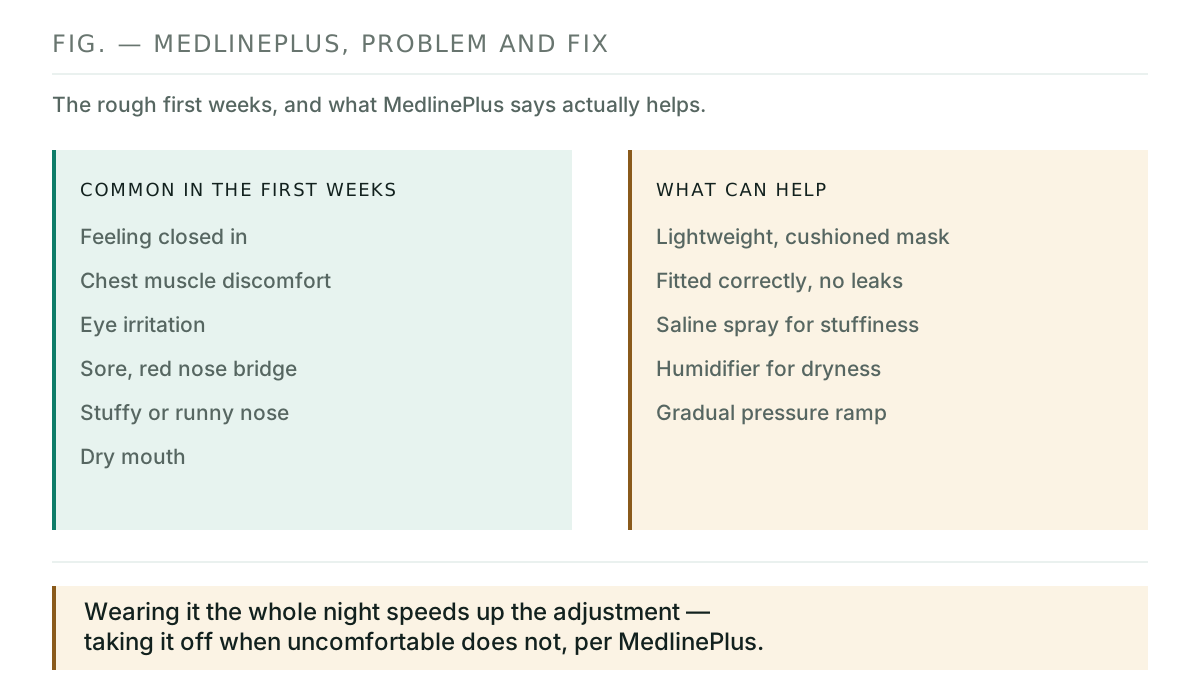
MedlinePlus does not soften this part: it can take time to get used to the setup, and the first few nights are often the hardest — you may not sleep well at first. The specific problems it names, when using the setup for the first time: a feeling of being closed in, chest muscle discomfort that usually fades, eye irritation, redness and sores over the bridge of the nose, a runny or stuffed-up nose, a sore or dry mouth, nosebleeds, and upper respiratory infections.
MedlinePlus is specific about one thing: if you are having problems, you may be tempted not to use the machine for the whole night. But you adjust to it faster, not slower, by wearing it the entire night rather than taking it off partway through when it gets uncomfortable.
Getting the mask right
A provider helps choose the mask that fits, and adjusts the machine's settings based on how severe the apnea is — this usually starts during a night at the sleep center, though some newer self-adjusting machines can be set up and taken home without that step, per MedlinePlus. If symptoms do not improve on treatment, the settings may need to change, either through the provider or, with training, at home.
For the mask specifically, MedlinePlus's practical guidance is simple: ask about a mask that is lightweight and cushioned, and make sure it fits correctly so it does not leak air — not too tight, not too loose. A poor fit is one of the most fixable reasons the first weeks go badly, and it is worth a return trip to the provider rather than tolerating a leaking mask for months.
Troubleshooting the common complaints
MedlinePlus pairs several specific fixes to specific problems: a nasal saline spray for a stuffy nose, a humidifier for dry skin or dry nasal passages, keeping the equipment clean, and placing the machine under the bed if its sound is the problem — most machines are quiet, but if noise is keeping you up, say so. For air pressure that feels jarring when you first lie down, a provider can set a gradual ramp that starts low and increases slowly, and some newer machines handle that automatically.
What actually improves once you stick with it
MedlinePlus lists what regular users report: better concentration and memory, feeling more alert and less sleepy during the day, improved sleep for a bed partner, being more productive at work, less anxiety and depression and a better mood, more normal sleep patterns, and lower blood pressure specifically in people who had high blood pressure to begin with. These are reported outcomes of consistent use, not a guarantee for every individual case.
The honest number: why so many quit
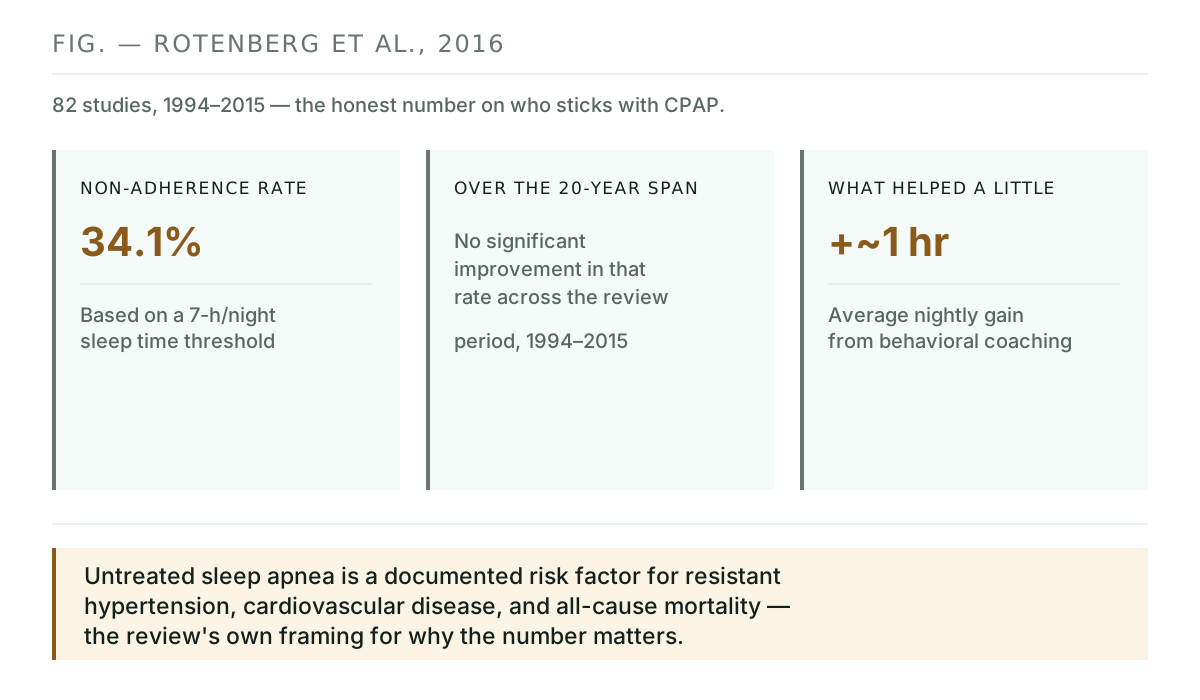
A 2016 systematic review pulled 82 studies spanning 1994 to 2015, specifically measuring CPAP non-adherence based on a 7-hour-per-night sleep time.
The overall CPAP non-adherence rate based on a 7-h/night sleep time that was reported in studies conducted over the twenty year time frame was 34.1%. There was no significant improvement over the time frame. Behavioral intervention improved adherence rates by ~1 h per night on average.
Rotenberg et al., Journal of Otolaryngology — Head & Neck Surgery, 2016The same review is blunt about the stakes: obstructive sleep apnea is a well-documented risk factor for resistant hypertension, fatal and non-fatal cardiovascular disease, neurological disease, and all-cause mortality — which is why a one-in-three non-adherence rate that has not budged in two decades is treated as a real problem, not a minor inconvenience, by researchers in the field.
None of this is a reason to assume the machine will not work for you specifically. It is a reason to treat the first weeks as a problem worth troubleshooting seriously — a new mask, a different pressure setting, a conversation with your provider — rather than something you either tolerate forever or quietly stop using.
It is also worth separating two different failure modes. One is a genuinely poor fit between the machine and your specific anatomy or sleep pattern, which usually does need a provider visit to fix — a different mask style, a pressure adjustment, or in some cases a switch from CPAP to APAP or BiPAP. The other is simply the discomfort of something new, which tends to fade with consistent use, the way MedlinePlus describes the first few nights as the hardest rather than the whole first stretch. Knowing which one you are dealing with before giving up matters, because the first is a device problem and the second is an adjustment period — and only one of them improves just by waiting it out.
Does CPAP fix testosterone too?
Many men expect it to, since untreated sleep apnea is on the list of things that can push a testosterone reading down. The honest answer, covered in full in this site's how to increase testosterone naturally article, is no — two pooled analyses covering 620 men between them found no significant change in total testosterone after CPAP treatment. That does not make CPAP pointless; it treats oxygen drops, daytime alertness and cardiovascular risk, independent of what it does or does not do to one specific hormone.
Key takeaways
- CPAP pumps steady air pressure through a mask to keep the airway open — MedlinePlus says it can treat most people with obstructive sleep apnea.
- Mild apnea without daytime sleepiness may not need it; that judgment comes from the sleep study, not from snoring alone.
- The first weeks are commonly rough — closed-in feeling, dry mouth, mask leaks, nosebleeds — and MedlinePlus pairs each problem with a specific, known fix.
- About 1 in 3 patients don't use CPAP enough to count as adherent, averaged across 82 studies over 20 years, with no improvement over that time.
- Regular use is linked to better alertness, mood and blood pressure — but not, per separate research, to higher testosterone.
Where to go from here
If CPAP is what brought you here, these pages cover the surrounding ground:
- Snoring or Sleep Apnea? What Separates Them — how to tell which one you actually have.
- What Actually Happens at a Sleep Study — the test that leads here in the first place.
- My Wife Says I Stop Breathing When I Sleep — the account of a man who still has not been tested.
- How to Increase Testosterone Naturally: What Works — where CPAP does, and does not, move the number.
- All sleep articles
Frequently asked questions
What is CPAP, exactly?
CPAP stands for continuous positive airway pressure. MedlinePlus describes it as a machine that pumps a steady, gentle pressure of air through a mask and into your airway while you sleep, which keeps the airway from collapsing and blocking your breathing. It is commonly the first treatment offered for obstructive sleep apnea.
Does everyone with sleep apnea need CPAP?
Not necessarily. MedlinePlus notes that CPAP can successfully treat most people with obstructive sleep apnea, but if you only have mild sleep apnea and do not feel very sleepy during the day, you may not need it. That decision belongs to whoever reviewed your sleep study results.
Why does CPAP feel so uncomfortable at first?
MedlinePlus is direct that it takes time to get used to, and the first few nights are often the hardest. Common early problems include a feeling of being closed in, chest muscle discomfort, eye irritation, a sore nose bridge, a stuffy or runny nose, and a dry mouth. Most of these ease with time and the right adjustments.
What if my mask keeps leaking or my nose gets stuffy?
MedlinePlus lists practical fixes: a lightweight, cushioned mask that fits correctly and is not too tight or too loose; a saline nasal spray for stuffiness; a humidifier for dryness; and a gradual pressure ramp at the start of the night if the airflow feels jarring. Tell your provider if problems persist — settings and masks can both be adjusted.
What actually gets better once I stick with it?
MedlinePlus lists better concentration and memory, feeling more alert during the day, improved sleep for your bed partner, less anxiety and depression, more normal sleep patterns, and lower blood pressure in people who had high blood pressure. These are reported benefits of regular use, not guarantees for every person.
Does CPAP raise testosterone?
No, according to two pooled analyses covering 620 men, covered in more depth in this site's article on increasing testosterone naturally. CPAP treats the apnea itself — oxygen drops, daytime alertness, cardiovascular strain — which matter regardless of what it does or does not do to a hormone reading.
Sources
- MedlinePlus (National Library of Medicine) — Positive Airway Pressure Treatment
- Rotenberg BW, Murariu D, Pang KP, Journal of Otolaryngology — Head & Neck Surgery, 2016 — Trends in CPAP Adherence Over Twenty Years of Data Collection: A Flattened Curve
- Patil SP, Ayappa IA, et al., Journal of Clinical Sleep Medicine, 2019 (AASM clinical practice guideline, cited by MedlinePlus) — Treatment of Adult Obstructive Sleep Apnea With Positive Airway Pressure
- Male Health Guide — How to Increase Testosterone Naturally: What Works (companion coverage of CPAP and testosterone)

Male Health Guide Editorial Team
We write about the health problems men over 40 actually search for at 3 a.m. — and we say plainly when the evidence for a popular product is thin. We do not invent credentials and we do not publish sponsored copy as editorial. Read more about how we work.
Medical disclaimer: This article is general information, not medical advice. We are not doctors, and nothing here diagnoses, treats or cures any condition. Whether you need CPAP, and what settings or mask are right for you, requires evaluation by a qualified healthcare professional. Please speak to one about your own situation, and never adjust a prescribed medical device without your provider's guidance.