Sleeping Pills After 40: What Each Kind Actually Does
Short answer
Sleeping pills are not one thing. Four prescription classes do four different jobs, and the sleep medicine guideline rates the evidence for all of them as weak. What matters more after 40 is not which one works best, but what each one costs you in the hours you are not asleep.
A man goes to his doctor because he has not slept properly in months. He comes out with a prescription, a short conversation he half remembers, and a box. He does not know which group the drug belongs to, how it differs from the one his brother takes, how long he is supposed to be on it, or what specifically he should watch for.
That is a fixable problem, and this article fixes it. It covers the prescription classes, what each is actually suggested for, how strong the evidence behind them is, and the risk that matters most to the men who read this site — which is not the one on the leaflet.
We earn nothing from any of this. There are no affiliate links on this site, we are not selling a supplement or a device, and nothing here is sponsored. This page is also not medical advice, and it cannot tell you what to take.
Why “sleeping pill” is not one thing
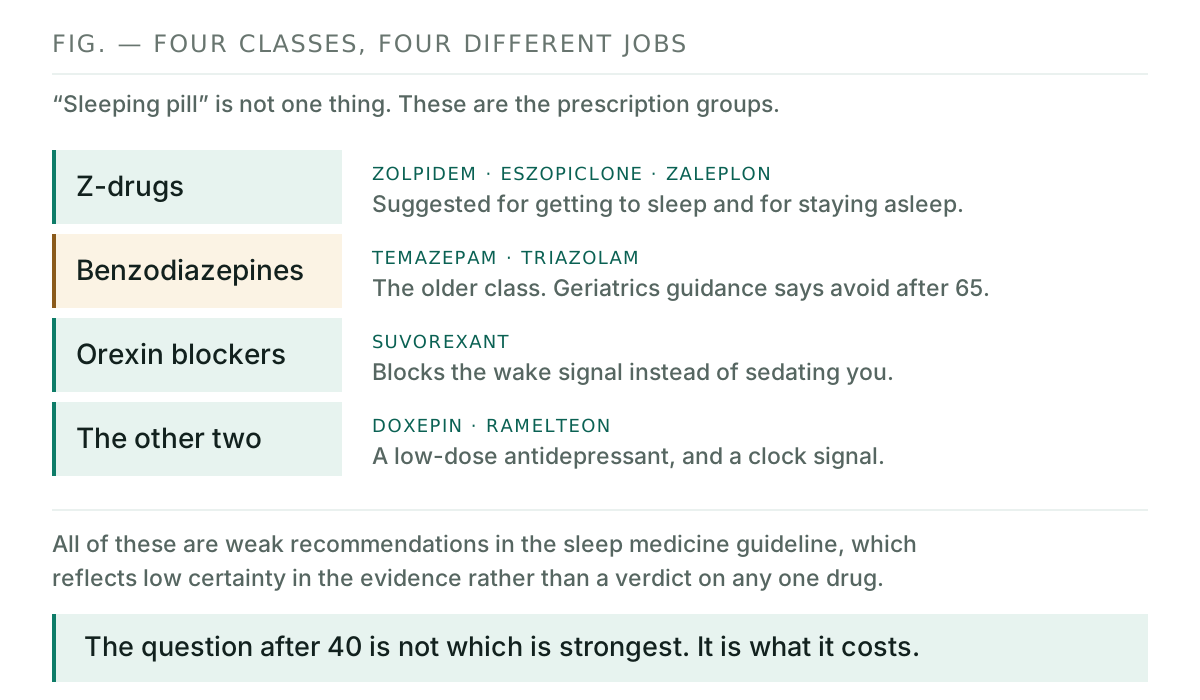
The phrase covers at least four groups of prescription medicine that reach sleep by different routes and are suggested for different problems. Two of them sedate you, one blocks the signal keeping you awake, and one does neither. Being handed “a sleeping pill” tells you almost nothing about which of those you have been given, or what it is supposed to be doing.
That distinction is not academic. The sleep medicine guideline separates its recommendations by whether your trouble is falling asleep or staying asleep, and several drugs are suggested for one and not the other:
| Class | Examples | Suggested for | Boxed warning |
|---|---|---|---|
| Z-drugs | Zolpidem, eszopiclone | Falling asleep and staying asleep | Yes |
| Z-drugs | Zaleplon | Falling asleep | Yes |
| Benzodiazepines | Temazepam | Falling asleep and staying asleep | No |
| Benzodiazepines | Triazolam | Falling asleep | No |
| Orexin blockers | Suvorexant | Staying asleep | No |
| Neither of the above | Doxepin (low dose) | Staying asleep | No |
| Neither of the above | Ramelteon | Falling asleep | No |
Every entry in that “suggested for” column is a weak recommendation, for reasons covered further down. The column that changes a conversation with a doctor is the middle one: if you were handed something for falling asleep and your actual problem is waking at three, the mismatch is right there in the table.
So the first useful question is not “what is the best sleeping pill”. It is “which half of the night is my problem” — which the site's guide to sleep after 40 sorts into five separate problems, and which a prescription can only address one or two of.
The Z-drugs, and the warning that was added to the box
Zolpidem, eszopiclone and zaleplon are the group most people mean when they say “sleeping pill”, and zolpidem alone accounted for the large majority of hypnotic prescriptions in the survey the guideline cites. They are also the three that carry the strongest warning a prescription label can carry, which is a combination worth knowing about before the first tablet rather than after.
In April 2019 the FDA required a boxed warning — the strongest kind of warning a prescription label carries — on all three, after identifying 66 cases of complex sleep behaviours that resulted in serious injury or death over 26 years. Complex sleep behaviours means doing things while not fully awake: sleepwalking, sleep driving, and similar. The FDA also added a contraindication, its strongest warning, against using these drugs in anyone who has already had such an episode.
Two things are worth holding together here. Sixty-six cases across 26 years, against tens of millions of prescriptions, is rare. And the regulator still judged it serious enough for the strongest label it has. Both of those are true, and a page that gives you only one of them is selling you something.
If you have ever woken to evidence that you did something in the night you have no memory of — food gone, a door unlocked, a message sent — that is not a funny story to keep to yourself. It is the specific thing the warning exists for, and it belongs in the conversation with whoever prescribed it.
The older class, and why it moved to the back
Temazepam and triazolam are benzodiazepines, the class that dominated before the Z-drugs arrived. The sleep medicine guideline still suggests both — temazepam for either half of the night, triazolam for getting to sleep — so they have not been withdrawn or discredited. What has changed is who they are considered appropriate for, and that is where age enters the picture.
The complication is age. The American Geriatrics Society Beers Criteria, which exist to flag medicines that are often a poor fit for older adults, advise avoiding benzodiazepines in that group, citing increased risk of cognitive impairment, delirium, falls, fractures and motor vehicle crashes. The same document extends that caution to the Z-drugs, on the grounds that their adverse effects in older adults resemble those of benzodiazepines.
Read that carefully, because it is easy to overread. It is guidance about what is often inappropriate, aimed at prescribers, for adults over 65. It is not an instruction to stop a medicine you are already on. Stopping some of these abruptly is its own risk, which is exactly why the decision belongs to the person who prescribed it.
The class that works by a different route
Suvorexant is an orexin receptor antagonist, and it is worth understanding because the mechanism is genuinely different from everything above it. Orexin is one of the signals that keeps you awake. Rather than sedating you into sleep, this class blocks the signal that is keeping you out of it — which is a different proposition from being knocked down, even though the intended result looks the same from the outside.
The guideline suggests it for sleep maintenance — the staying-asleep half. It is the newest of the groups here, which cuts both ways: less accumulated experience, and also less of the history that put the older classes under scrutiny.
The two that are not sedatives in the usual sense
Doxepin is an old antidepressant used at a very low dose, far below the dose used for depression, and at that dose it is suggested for sleep maintenance. Ramelteon acts on the same receptors as the body's own timing signal, and is suggested for sleep onset.
Neither belongs to the sedative-hypnotic family, and neither carries the boxed warning described above. That does not make them automatically preferable — every one of these drugs has its own profile, and the comparison is a clinical one.
How well any of them actually work
This is the part that tends not to survive the appointment, and it is the most useful thing on this page. Men generally leave with the impression that they have been given something that works well, because that is what being handed a prescription implies. The published evidence is considerably more hesitant than the transaction is.
Every single recommendation in that guideline is weak. Not one drug gets a strong recommendation. The guideline is explicit about what that means: a weak recommendation reflects a lower degree of certainty about the outcome and about whether the strategy suits all patients — and, in its own words, it should not be construed as an indication of ineffectiveness.
That is a careful sentence and it is worth repeating in plain terms. Weak does not mean the drug does nothing. It means the evidence base is thinner than most people assume when they are handed a prescription for it.
Fourteen recommendations. Fourteen of them weak. That is the honest state of the evidence, and it is not what the transaction at the pharmacy counter implies.
There is a second piece of evidence on this, and it is blunter. NICE, assessing zaleplon, zolpidem and zopiclone for the NHS, concluded that because of the lack of compelling evidence to distinguish between them, the drug with the lowest purchase cost should be prescribed. It adds that switching from one to another should happen only if a patient has an adverse effect tied to a specific drug, and that someone who has not responded to one of them should not be prescribed the others.
A national body looked at these drugs, found no compelling evidence to tell them apart, and concluded that the deciding factor should be price. NICE, Technology Appraisal 77
That is worth sitting with. It does not say the drugs do nothing. It says that the differences between them, which is what most of the conversation about sleeping pills consists of, are not well enough established to choose on.
It also explains why the guidelines put a behavioural programme first for long-term insomnia. The NHLBI states plainly that cognitive behavioural therapy for insomnia is usually recommended as the first treatment for long-term insomnia. The site covers what that involves, and why most men think they have already tried it, in the insomnia treatment that works better than pills.
What changes after 40
Three things change after 40, and they compound rather than sitting side by side. The night you are asking the drug to hold together is already more broken than it was at thirty. You are more likely to be taking something else that interacts. And you are far more likely to be on your feet in the middle of the night, which is where the real risk lives.
The night is already broken. Sleep after 40 fragments on its own, so a drug is being asked to hold together a night that has more joints in it than it used to. The arithmetic behind that is in how much sleep you actually need after 40.
You are more likely to be on something else. Blood pressure tablets, prostate medication, anything with a sedating effect of its own. Interaction is a conversation, not a footnote.
And you are more likely to get up in the night. Which brings us to the risk that this site cares about more than any other page on the internet will tell you.
The risk nobody mentions: getting up in the night
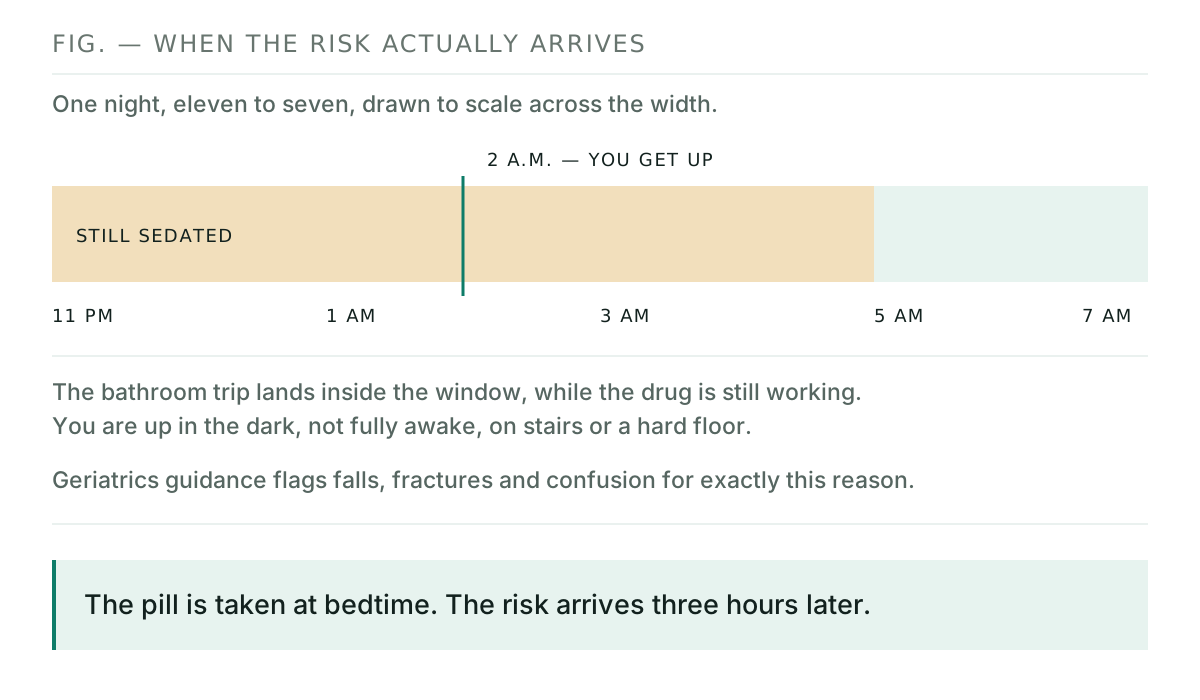
Readers of this site are, disproportionately, men who get up at least once a night to use the bathroom — it is the single most common reason the prostate section of this site exists. That fact turns a general caution about sedatives into a specific one, because it means the drug and the trip are almost guaranteed to meet in the middle of the night.
Now put a sedative on top of that. The drug is taken at eleven. The trip happens at two. The man making it is on his feet, in the dark, possibly on stairs, and pharmacologically not fully awake. The Beers Criteria list falls, fractures and delirium for both of the older classes, and this is the mechanism by which that risk actually reaches a person.
Nobody is going to raise this with you unless you raise it, because the two problems sit with two different specialists. If you get up in the night, say so before the prescription is written, not after.
If a sleeping pill is on the table and you are up in the night, the route between your bed and the bathroom is now a safety question: what is on the floor, whether there is a light, whether there are stairs. It is a dull thing to think about and it is the thing that actually breaks a hip.
There is a second reason to mention the night trips. If the bathroom is what is breaking your night, a sleeping pill is aimed at the wrong problem entirely — and the prior question is whether the bladder is really what wakes you, which the site covers in nocturia or insomnia: which one woke you.
How long they are meant to be taken for
Shorter than most men are on them. These drugs are designed and licensed as short courses, not as something you take nightly for a year, and both the American and the British guidance say so in plain terms. The gap between that intent and what actually happens on repeat prescription is where most of the harm in this subject accumulates.
The NHLBI says benzodiazepines should be taken for only a few weeks, and notes that they can be habit-forming. NICE, the body that advises the NHS, recommends that where hypnotic drug therapy is considered appropriate — and it frames that as a decision taken after due consideration of non-drug measures — hypnotics should be prescribed for short periods of time only.
The design intent is a bridge: something to get you across a bad patch while the actual problem is addressed. Where that goes wrong is when the bridge becomes the road, month after month, and the underlying problem is never looked at — which is precisely the pattern the guidelines are written against.
What should be ruled out first
A sleeping pill treats the symptom of not sleeping. If something is actively waking you, the drug is aimed at the wrong target and will at best mask what needed finding. There are three usual candidates in men over 40, and all three are worth excluding before a prescription rather than after months of one.
- Breathing. If you snore heavily or someone has seen you stop breathing, sedating that situation is not a neutral act. Start with what separates snoring from sleep apnea.
- The bladder. Covered above, and in why you wake up three times a night to pee.
- Lying awake rather than being woken. The pattern in waking at 3 a.m. and not getting back to sleep, where the useful treatment is behavioural rather than chemical.
If the picture is unclear, the night has to be measured rather than described, and what actually happens at a sleep study sets out what that involves.
What to ask before the first prescription
Five questions, and together they take about ninety seconds of an appointment. None of them is confrontational and none of them requires you to know anything about pharmacology. They exist because sleep is the one complaint men tend to hand over without asking a single thing, and because the answers change what you are given.
- Which class is this, and is it for falling asleep or staying asleep? The answer should match your actual complaint.
- How many weeks am I taking this for, and what happens at the end? A plan with an end date is a different thing from a repeat prescription.
- I get up in the night. Does that change what you would choose? The question that is otherwise never asked.
- How does this sit with everything else I take? Bring the list, including anything from a pharmacy shelf.
- What is the plan for the underlying problem? If there is no answer to this one, the prescription is the whole treatment, and guidelines say it should not be.
None of that is confrontational. It is the same conversation you would have about any other medicine, and the only reason it feels unusual is that sleep is the one complaint men tend to hand over without asking anything at all.
Key takeaways
- “Sleeping pill” covers four prescription classes with different mechanisms, and several are suggested for only one half of the night.
- Every recommendation in the sleep medicine guideline is weak — which the guideline says means low certainty, not proven ineffectiveness.
- The FDA added a boxed warning to eszopiclone, zaleplon and zolpidem in 2019 after 66 cases of complex sleep behaviours over 26 years.
- The Beers Criteria advise avoiding benzodiazepines and Z-drugs in adults over 65, citing falls, fractures, delirium and crashes.
- The specific risk for readers of this site is the night-time bathroom trip taken while still sedated.
- Hypnotics are designed as a bridge of a few weeks, not a long-term treatment.
- Guidelines put a behavioural programme first for long-term insomnia, before any drug.
Where to go from here
A prescription answers one of five problems. These cover the other four:
- The Insomnia Treatment That Works Better Than Pills — what guidelines put first for long-term insomnia.
- Nocturia or Insomnia: Which One Woke You? — if bathroom trips are what break the night, a sedative is the wrong target.
- Waking at 3 a.m. and Cannot Get Back to Sleep — the pattern most likely to end in a prescription.
- Snoring or Sleep Apnea? What Separates Them — what should be ruled out before sedating anything.
- How Much Sleep Do You Actually Need After 40? — why the night is already more broken than it used to be.
Frequently asked questions
Which sleeping pill is the safest?
No guideline names one. The American Academy of Sleep Medicine gives every drug it suggests a weak recommendation, meaning low certainty in the evidence rather than a ranking. Which one fits depends on whether your problem is falling asleep or staying asleep, your age, and what else you take.
How long are sleeping pills meant to be taken for?
Short courses. The NHLBI says benzodiazepines should be taken for only a few weeks, and NICE recommends that hypnotics be prescribed for short periods of time only, and only after non-drug measures have been considered. Long-term insomnia is where guidelines point at a behavioural programme instead.
Why do sleeping pills carry a warning about sleepwalking?
In 2019 the FDA added a boxed warning to eszopiclone, zaleplon and zolpidem after identifying 66 cases of complex sleep behaviours, such as sleepwalking and sleep driving, that caused serious injury or death over 26 years. It also added a contraindication for anyone who has had such an episode.
Are sleeping pills riskier after 60?
The American Geriatrics Society Beers Criteria advise avoiding benzodiazepines and the Z-drugs in older adults, citing cognitive impairment, delirium, falls, fractures and motor vehicle crashes. That is guidance to weigh with a doctor, not an instruction to stop a prescription on your own.
Do sleeping pills stop working over time?
Tolerance and dependence are the stated reasons prescribing guidance limits hypnotics to a few weeks. That is a different question from whether they help in the first place, and it is one reason the drugs are framed as a short bridge rather than a long-term answer.
What about melatonin and the things on the pharmacy shelf?
They are a separate category and not covered on this page, which is about prescription medicines. Melatonin in particular works on the timing of sleep rather than by sedating you, which makes it a different kind of product entirely. It gets its own article on this site.
Sources
- American Academy of Sleep Medicine — Clinical Practice Guideline for the Pharmacologic Treatment of Chronic Insomnia in Adults
- American Academy of Sleep Medicine — FDA requires new warning for several insomnia medications
- National Heart, Lung, and Blood Institute (NIH) — Insomnia — Treatment
- NICE (National Institute for Health and Care Excellence) — Guidance on the use of zaleplon, zolpidem and zopiclone for the short-term management of insomnia (TA77)
- American Geriatrics Society — 2023 AGS Beers Criteria for Potentially Inappropriate Medication Use in Older Adults
- MedlinePlus (National Library of Medicine) — Zolpidem
- National Institute on Aging (NIH) — Sleep and Older Adults
- NHS — Insomnia

Male Health Guide Editorial Team
We write about the health problems men over 40 actually search for at 3 a.m. — and we say plainly when the evidence for a popular product is thin. We do not invent credentials and we do not publish sponsored copy as editorial. Read more about how we work.
Medical disclaimer: This article is general information about classes of prescription medicine and is not medical advice. It cannot tell you what to take, and it is not a reason to start, stop or change any prescription. Never stop a sleeping medicine abruptly on your own — with some of these drugs that carries its own risk. Availability, licensing and prescribing practice differ between countries. Please speak to a qualified healthcare professional about your own situation.