Sleep Paralysis: Why You Can't Move, and When to Worry
Short answer
Sleep paralysis is briefly unable to move or speak while falling asleep or waking up, caused by REM muscle paralysis persisting into consciousness. About three in ten people experience it at least once, more often under stress, poor sleep or an irregular schedule. Most episodes pass harmlessly in under a minute; frequent ones are worth mentioning to a doctor.
You are awake. You know you are awake. And you cannot move a single muscle, sometimes with the unmistakable sense that something else is in the room with you. For the handful of seconds or minutes it lasts, it is one of the more unsettling things a body can do to a mind.
It is also, it turns out, extremely common — common enough that the real surprise is how rarely anyone talks about it. This article covers what is actually happening during an episode, how often it occurs, why the hallucinations feel so real, what raises the odds of having one, and when it is worth raising with a doctor rather than shrugging off.
What sleep paralysis actually is
MedlinePlus defines it plainly: sleep paralysis is a condition in which you are unable to move or speak right as you are falling asleep or waking up. The paralysis itself is not the malfunction — it is a perfectly normal feature of sleep arriving at the wrong moment.
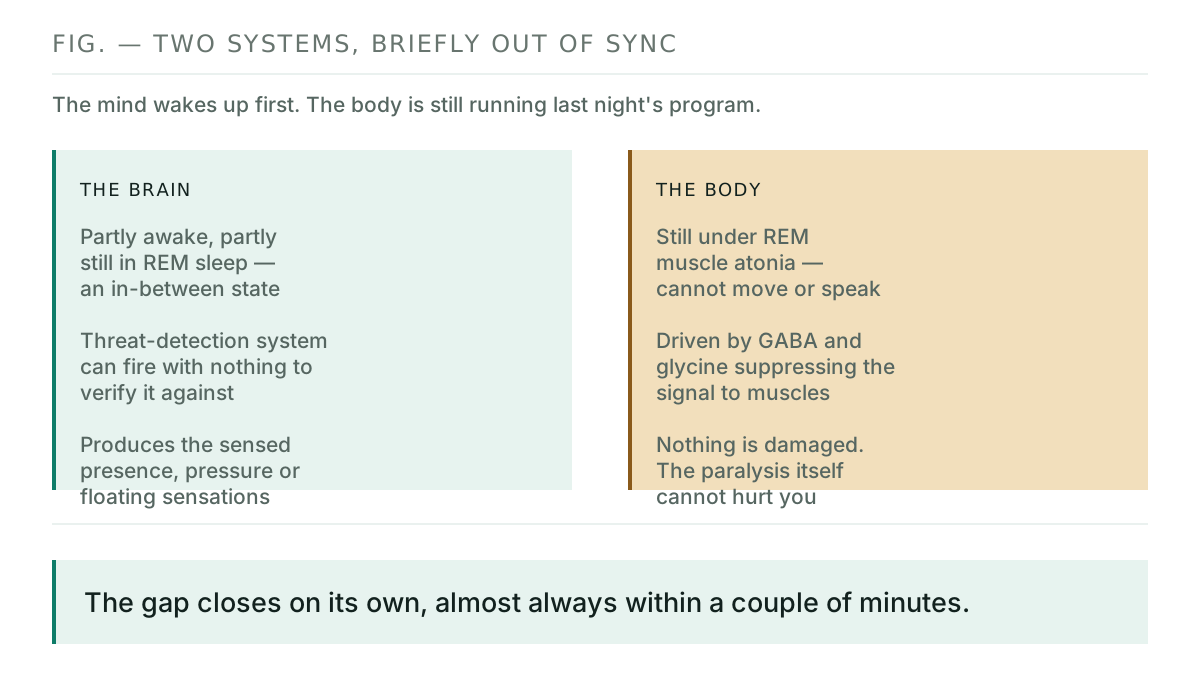
Every night, during REM sleep, your body goes through a stage of near-total muscle paralysis called atonia. It is what stops you from physically acting out your dreams. Sleep paralysis happens when that atonia does not switch off at the same moment your mind wakes up — so for a short window, you are conscious and the paralysis is still running.
How common it actually is
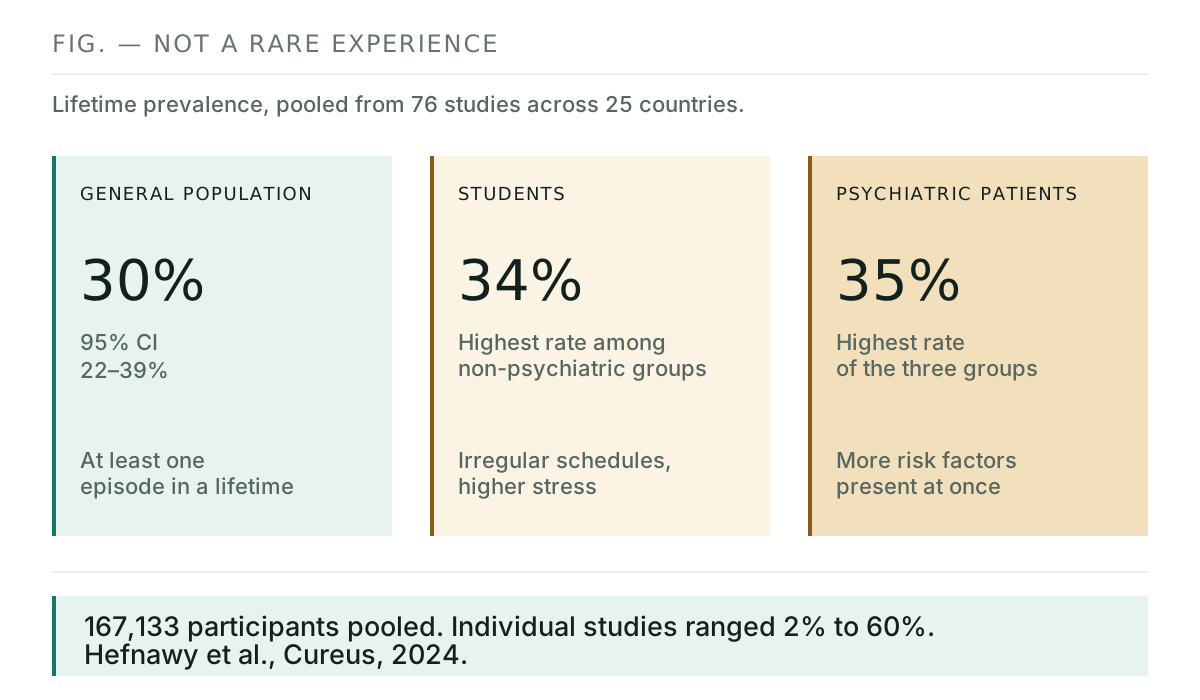
This is not a rare curiosity. The largest analysis of the evidence to date pooled 76 studies from 25 countries covering more than 167,000 participants.
The global prevalence of SP was 30% (95% CI 22–39%). A subgroup analysis showed that the majority of those who experienced SP were psychiatric patients (35%). The prevalence among non-psychiatric patients was among students (34%).
Hefnawy et al., Cureus, 2024Individual studies ranged much wider, from about 2 percent to 60 percent, which the authors attribute to differences in how sleep paralysis was defined and measured across studies — self-report questionnaires versus clinical interviews — rather than the condition itself being inconsistent. Students and psychiatric patients likely score higher on top of that because both groups carry more of the known risk factors — irregular schedules, higher stress, poorer sleep quality — not because the paralysis works differently in them.
Why it happens, mechanically
The muscle atonia of REM sleep is thought to be driven by GABA- and glycine-mediated inhibition of motor neurons — the brain actively suppressing the signal to your muscles, not your muscles failing on their own. Sleep paralysis researchers describe the state as an intermediate one: brain activity during an episode sits somewhere between full wakefulness and REM sleep, which is consistent with a kind of partial, mistimed awakening rather than a clean transition.
That mistiming is the entire mechanism. Nothing is broken, nothing is damaged, and the paralysis itself cannot hurt you — it ends on its own as the REM state fully clears, almost always within a couple of minutes at most.
The hallucinations, and why they feel so real
The part people remember, and the part that sends them searching online at 3 a.m., is usually not the paralysis itself but what came with it.
Auditory and visual hallucinations were reported in 24.25% of patients, with around 4% having only visual hallucinations.
Hefnawy et al., Cureus, 2024Researchers group these experiences into a few recognizable patterns. The first, sometimes called the intruder phenomenon, combines a felt presence with auditory or visual hallucinations and a strong sense of fear — the classic “someone is in the room” experience reported across unrelated cultures for centuries. A second pattern, pressure or weight on the chest, is often described alongside it. A third involves floating, flying or out-of-body sensations rather than a sense of being watched.
A hypervigilant state originating in the midbrain is the leading explanation for the intruder sensation — your brain's threat-detection system firing while you cannot verify anything with your eyes or body, which is a specific and understandable malfunction of timing, not evidence of anything in the room.
What makes it more likely
The same meta-analysis and the broader literature it draws on point to a consistent set of contributors, most of which overlap with ordinary sleep disruption rather than anything exotic.
- Irregular sleep schedule and insufficient sleep. Among the most consistently reported triggers.
- Poor sleep quality and sleep deprivation. Compounds the effect of irregular timing.
- Mental stress, anxiety disorders and exposure to traumatic events. People with PTSD and panic disorder are disproportionately affected.
- Sleeping on your back. Noted specifically by MedlinePlus among the situational triggers.
- Alcohol consumption and higher BMI. Both identified as risk factors in the pooled data.
- Family history. The data hints at a genetically predisposed subgroup, independent of lifestyle factors.
None of these guarantee an episode, and plenty of people with every risk factor never have one. They describe a probability, the same way the site's alcohol and sleep and how much sleep you actually need articles describe probabilities rather than certainties.
When it points to something else
Isolated sleep paralysis, which is what most people experience, is not connected to any underlying disorder. But the condition is also a recognized feature of several others, which is the reason it is worth paying attention to when episodes are frequent rather than occasional.
Narcolepsy is the most direct connection. It is itself a disorder of REM sleep regulation, and sleep paralysis is prevalent among patients who also have cataplexy and sleep-related hallucinations. Obstructive sleep apnea, idiopathic hypersomnia, insufficient sleep syndrome and, rarely, Wilson's disease are also listed among the recognized risk factors in the pooled literature. None of these diagnoses can be made from sleep paralysis alone, and most people with occasional episodes have none of them — but a pattern of frequent episodes is a reasonable prompt to ask about the others, particularly if you also notice the daytime sleepiness covered in sleepy and tired are not the same thing.
Recurrent sleep paralysis can lead to impaired sleep quality and the relationship runs both ways — worse sleep makes further episodes more likely, and frequent episodes themselves can degrade mental health-related quality of life, particularly in people who also have obstructive sleep apnea.
What actually helps
For isolated, occasional episodes, the most evidence-backed response is addressing the risk factors directly rather than looking for a dedicated treatment, because there largely isn't one for the isolated form.
- Keep a consistent sleep and wake time. Directly addresses one of the most consistently reported risk factors.
- Protect total sleep time. Insufficient sleep is one of the most reliable triggers identified.
- Manage stress and anxiety where you can. Both are independently associated with higher frequency.
- Avoid sleeping flat on your back if episodes cluster around it. A specific, low-cost adjustment worth testing.
- Moderate alcohol. Identified as a contributing factor in the pooled analysis.
When episodes occur in the context of narcolepsy specifically, pharmacological treatment with tricyclic antidepressants and selective serotonin reuptake inhibitors can also be prescribed, because these drugs suppress REM sleep. Behavioral approaches such as cognitive behavioral therapy have been proposed, but the researchers are candid that reliable data on their effectiveness is still lacking.
When to actually see a doctor
Most episodes need nothing beyond knowing what they are. MedlinePlus is specific about the threshold that changes that.
Discuss your condition with your provider if you have repeated episodes of sleep paralysis. They may be due to a medical problem that needs further testing.
“Repeated” is doing the work in that sentence. A single episode after a bad week, a long flight or a night of poor sleep is not, by itself, a reason to book an appointment. A pattern — several episodes a month, especially alongside daytime sleepiness, cataplexy-like muscle weakness with strong emotion, or loud snoring with pauses covered in snoring or sleep apnea — is the signal worth acting on.
Key takeaways
- Sleep paralysis is REM muscle atonia persisting a few seconds to minutes after the mind has already woken up — a timing mismatch, not a malfunction.
- A 2024 meta-analysis of 76 studies and over 167,000 people found a global lifetime prevalence of about 30 percent, higher in students (34%) and psychiatric patients (35%).
- About a quarter of episodes include hallucinations — most often a sensed presence, chest pressure, or floating/out-of-body sensations.
- Irregular sleep, insufficient sleep, stress, sleeping on your back, alcohol and higher BMI are the main identified risk factors.
- Narcolepsy, obstructive sleep apnea and idiopathic hypersomnia are recognized risk factors — frequent episodes are worth mentioning to a doctor.
- A single occasional episode needs nothing. Repeated episodes warrant medical evaluation, per MedlinePlus.
Where to go from here
If sleep paralysis is what brought you here, these pages cover the surrounding ground:
- Sleep After 40: What Changed and What Restores It — the complete guide, and the five separate problems.
- Snoring or Sleep Apnea? What Separates Them — one of the recognized risk factors, and worth ruling out.
- Waking at 3 a.m. and Cannot Get Back to Sleep — if interrupted sleep is the bigger pattern.
- How Much Sleep Do You Actually Need After 40? — insufficient sleep is the most consistent trigger.
- Alcohol and Sleep: What a Nightcap Really Costs You — another identified contributing factor.
- Fatigue After 40: Sleepy and Tired Are Not the Same Thing — if daytime sleepiness travels alongside the episodes.
Frequently asked questions
What is sleep paralysis?
Sleep paralysis is being unable to move or speak right as you are falling asleep or waking up. It happens when the muscle paralysis that is normal during REM sleep persists for a few seconds or minutes after the mind has already woken up, leaving you briefly conscious but unable to move.
How common is sleep paralysis?
Very common. A 2024 meta-analysis pooling 76 studies and over 167,000 participants across 25 countries found a global lifetime prevalence of about 30 percent, with students and psychiatric patients reporting it somewhat more often, around 34 and 35 percent.
Why does sleep paralysis cause hallucinations?
Being conscious while the body is locked and the brain is still partly in a dreaming state appears to produce vivid, often frightening sensations. The same meta-analysis found hallucinations in about a quarter of cases, most commonly a sensed presence or intruder, pressure on the chest, or a floating or out-of-body feeling.
Is sleep paralysis a sign of narcolepsy?
It can be, but most people who experience sleep paralysis do not have narcolepsy. Narcolepsy, obstructive sleep apnea and a handful of other conditions are recognized risk factors for it, which is why frequent or severe episodes are worth mentioning to a doctor rather than assuming they are isolated.
What actually helps with sleep paralysis?
For isolated episodes, a regular sleep schedule, enough total sleep and lower stress are the main levers, since insufficient sleep, irregular schedules and anxiety are all established risk factors. When it occurs in the context of narcolepsy, antidepressants that suppress REM sleep are sometimes prescribed; reliable evidence for behavioral treatments is still lacking.
When should I see a doctor about sleep paralysis?
MedlinePlus advises discussing it with your provider if you have repeated episodes of sleep paralysis, since they may be due to a medical problem that needs further testing. A single occasional episode that resolves on its own in under a minute is not usually a reason to seek care.
Sources
- Hefnawy M.T. et al. — Prevalence and Clinical Characteristics of Sleeping Paralysis: A Systematic Review and Meta-Analysis, Cureus, 2024
- MedlinePlus (National Library of Medicine) — Sleep paralysis
- MedlinePlus (National Library of Medicine) — Narcolepsy
- MedlinePlus (National Library of Medicine) — Sleep Apnea

Male Health Guide Editorial Team
We write about the health problems men over 40 actually search for at 3 a.m. — and we say plainly when the evidence for a popular product is thin. We do not invent credentials and we do not publish sponsored copy as editorial. Read more about how we work.
Medical disclaimer: This article is general information, not medical advice. We are not doctors, and nothing here diagnoses, treats or cures any condition. Please speak to a qualified healthcare professional about your own situation, particularly if episodes are frequent or accompanied by daytime sleepiness or other symptoms described above.