Hypersomnia: Why You Stay Sleepy After a Full Night
Short answer
Hypersomnia describes excessive daytime sleepiness, which can occur with insufficient sleep, sleep disorders, medicines or other health conditions. Sleeping longer does not establish the cause. Persistent unintentional dozing deserves assessment, especially if it affects driving or work. Idiopathic hypersomnia is a specific diagnosis, not a label for every sleepy day.
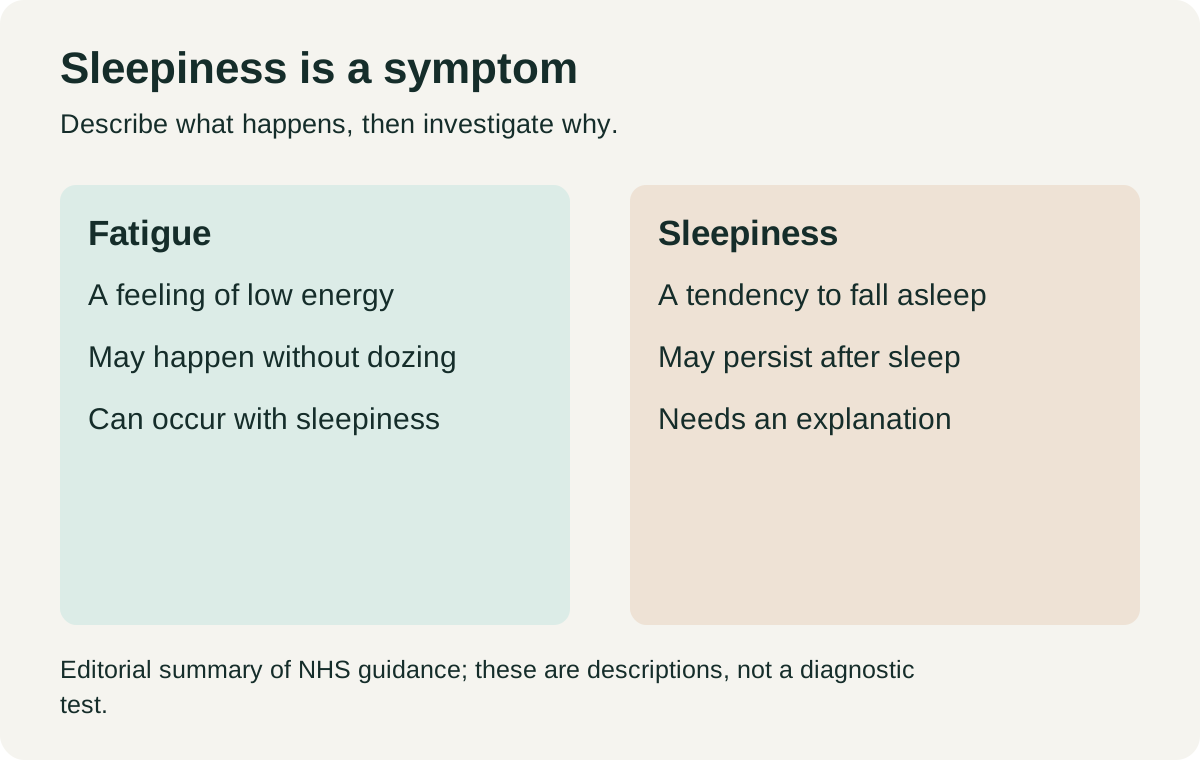
Hypersomnia is not the same complaint as feeling worn out. It is the pull toward sleep: nodding off in a meeting, losing track of a television program, or struggling to stay awake despite believing you had a full night. That distinction changes what needs investigating.
For a man managing work, family and an increasingly interrupted night, it is tempting to call all of this getting older. A better starting point is to describe the actual problem. Are you short of energy, falling asleep unintentionally, or both? This guide focuses on the second question, without turning it into a diagnosis from a symptom list.
What does hypersomnia actually mean?
Hypersomnia refers to excessive sleepiness rather than simply lacking energy. You may repeatedly fall asleep during the day, take frequent naps or remain sleepy despite long nights. The term describes a problem that needs explanation; it does not tell you whether the cause is your schedule, a medicine or a sleep disorder.
The NHS overview of excessive daytime sleepiness distinguishes this from ordinary tiredness. A person can feel drained without being likely to fall asleep. Another can have enough energy for a task but struggle to remain awake when sitting still.
Our guide to fatigue after 40 deals with that broader sorting question. Here the concern is a repeated tendency to sleep when you are trying to stay awake. Describing that tendency is more useful than deciding which medical name fits it.
For example, tell a clinician that you dozed during a conversation or needed someone else to finish a drive. Those are examples of the kind of detail to report, not diagnostic criteria. You do not need to know which sleep condition they might point toward before asking for help.
Why can you feel sleepy after a full night in bed?
Time in bed is not the same as time asleep, and a long night does not guarantee restorative sleep. Breathing interruptions, repeated awakenings, an irregular schedule and sedating medicines may contribute. Persistent sleepiness despite an adequate sleep opportunity needs a review of the nights and the daytime symptoms together.
Start by separating the hours you allowed for sleep from the hours you think you actually slept. The complete guide to sleep after 40 covers fragmented nights. A clock can tell you when you went to bed, but not whether the night was repeatedly disturbed.
A partner's observations can be useful context. Loud snoring, gasping or witnessed breathing pauses are worth mentioning. The NHLBI lists daytime sleepiness among sleep apnea symptoms. Feeling that you slept through the night does not settle that question.
Our practical suggestion is to bring both accounts to the appointment: what the night felt like to you, and what someone else noticed. They do not have to agree. An apparently quiet night from your point of view can still deserve investigation when the daytime consequences are substantial.
What can cause excessive daytime sleepiness?
Possible contributors include too little sleep, sleep apnea, other sleep disorders, certain medicines, alcohol and some mental or physical health conditions. More than one factor can be present. A clinician uses the pattern and history to decide what to investigate instead of assuming that every sleepy person has the same disorder.
The NHS lists several conditions associated with excessive sleepiness, including narcolepsy, sleep apnea, restless legs symptoms and depression. That is a list of possibilities, not a menu for diagnosing yourself. Some explanations also overlap: a medicine may add sleepiness to an already disrupted night.
- Sleep opportunity: record actual bedtimes, wake times and shift work.
- Nighttime symptoms: mention breathing pauses, leg discomfort or repeated awakenings.
- Substances and medicines: include alcohol, prescriptions and nonprescription products.
- Other changes: describe your mood, health and when the sleepiness began.
The purpose of organizing these details is to make a consultation clearer. It does not rank the causes or prove that the first item you recognize explains everything. If your symptoms began after a medicine change, discuss it with the prescriber rather than stopping treatment on your own.
Is hypersomnia the same as idiopathic hypersomnia?
No. Excessive sleepiness is a symptom with several possible explanations. Idiopathic hypersomnia is a specific sleep disorder considered after an appropriate assessment excludes other explanations. It can include prolonged sleep, difficulty waking and feeling unrefreshed. You cannot establish that diagnosis just because you remain sleepy after one long night.
Royal Papworth Hospital describes the diagnostic distinction: sleepiness is assessed clinically and with sleep testing, and an underlying cause is often found. When no explanation is identified, idiopathic hypersomnia may be considered.
The word idiopathic means the cause is not known. It does not mean that the symptom is imaginary, that an investigation was unnecessary, or that treatment cannot help. It also does not mean everyone with a frustrating morning has this disorder.
Symptom first, diagnosis after assessment. Long sleep and difficulty waking can be relevant, but the whole clinical picture matters.
Sources: Royal Papworth Hospital; Trotti and colleagues, Cochrane review, 2021.
For readers who have already received a diagnosis, the useful next question is what treatment aims to improve and how progress will be measured. For everyone else, start with the repeated sleepiness rather than adopting the label in advance.
How is persistent sleepiness assessed?
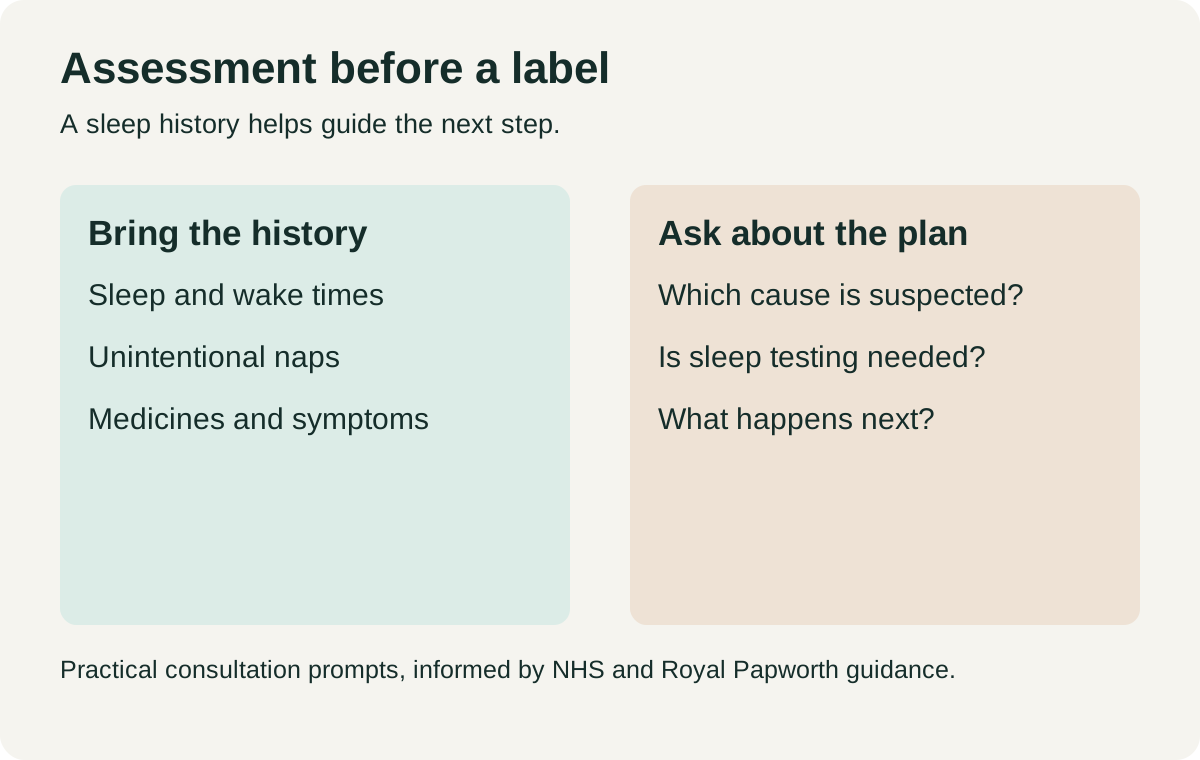
Assessment starts with your sleep schedule, unintentional naps, medicines, health history and the effect on daily life. A clinician may recommend a sleep diary, investigate another condition or refer you to a sleep specialist. Testing is chosen to answer a specific question; not every sleepy person needs the same investigation.
Royal Papworth and NHS patient guidance describe the importance of a clinical assessment rather than a single online score. You may be asked when the problem began, whether you actually fall asleep, and whether the sleepiness persists when you have enough opportunity to rest.
Our suggestion is to prepare a short timeline. Include a typical workday, a day off, naps you intended to take, and episodes you did not intend. Add medication names and the approximate timing of each dose, rather than simply saying you take nothing for sleep.
If a sleep study is recommended, ask what it is intended to investigate. Our guide to what happens at a sleep study explains the practical experience. A consumer sleep tracker can provide observations to discuss, but it should not be treated as a clinical diagnosis or as proof that the problem has been ruled out.
What treatments actually help hypersomnia?
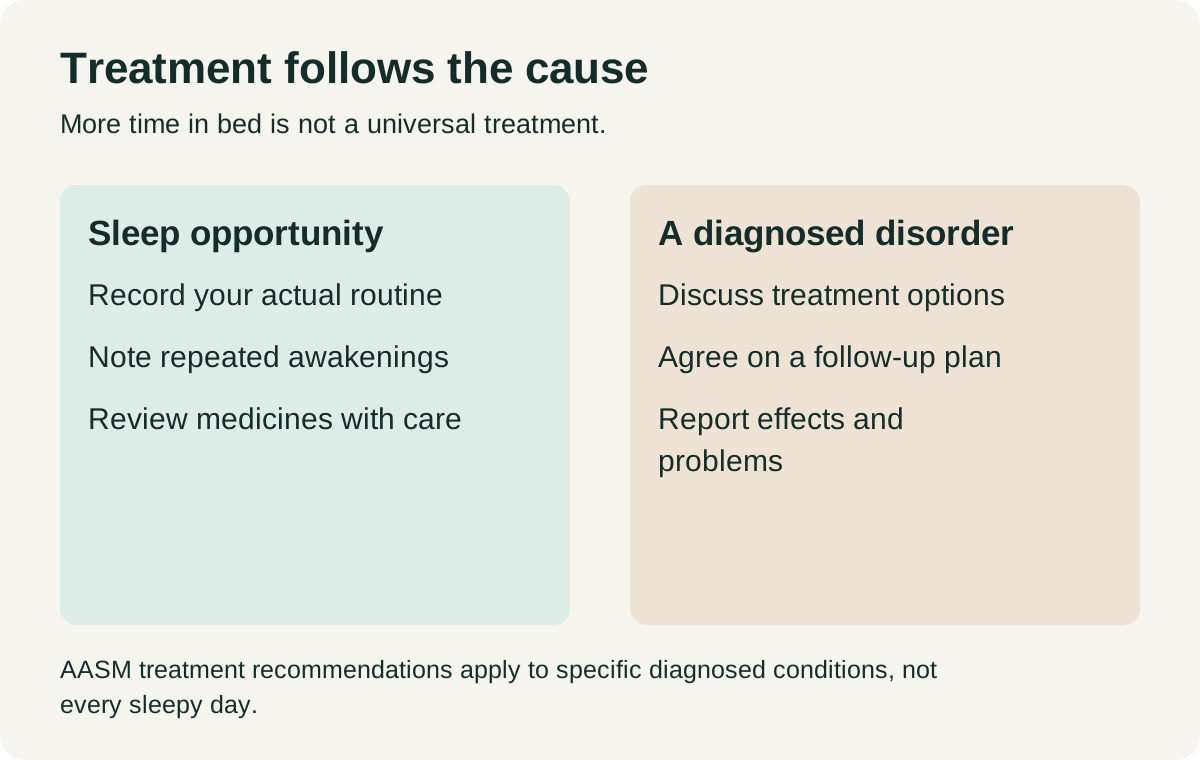
Treatment depends on the cause. Improving sleep opportunity, reviewing sedating medicines or treating a sleep disorder may be appropriate. For diagnosed idiopathic hypersomnia, specialists may use wake-promoting medicines. A recommendation for that disorder is not a recommendation to medicate ordinary tiredness or to treat unexplained sleepiness without an assessment.
The American Academy of Sleep Medicine guideline recommends modafinil for adults with idiopathic hypersomnia. That statement applies to a diagnosed disorder, with treatment selected by a clinician. It does not establish which medicine is right for you.
A Cochrane review of medicines for idiopathic hypersomnia found benefit for modafinil on several measures, while noting that the studies predominantly involved people without long sleep times. The two modafinil trials were small and lasted three weeks, so they cannot establish long-term outcomes. Those limits matter when discussing how closely the evidence fits a particular patient.
A useful treatment conversation has two parts: what benefit is realistic, and what follow-up will check whether you are getting it. Staying awake longer, functioning better at work and feeling safer during routine activities are not interchangeable outcomes. Explain which problem matters most to you, and ask how the clinician proposes to judge improvement.
Will more caffeine or a better bedtime routine fix it?
A consistent sleep schedule and enough time for sleep can help, but they do not rule out or reliably treat every cause of excessive sleepiness. More caffeine is not a substitute for assessment. If you repeatedly doze unintentionally despite making space for sleep, describe that pattern to a clinician.
The NHS notes that changing sleep habits may help someone feel better without curing hypersomnia. That is an important distinction: a sensible routine can be part of care without being the complete answer. It should not become another reason to blame yourself when symptoms persist.
Our guide to caffeine and tiredness covers the separate question of using caffeine to get through a difficult day. For this problem, a practical note about when you use it may be helpful at the appointment. It is not a test of whether your sleepiness is real.
Avoid creating several new experiments at once. Our suggestion is to record the routine you actually live with before trying to produce a perfect week for the clinician. An honest account of shift work, late nights, naps or alcohol is more useful than a diary designed to make your habits look better.
When should sleepiness change your plans for driving or work?
If you are struggling to remain awake, do not drive or operate dangerous equipment. Repeated unintentional dozing, a near miss or a partner taking over the driving deserves prompt attention. Assessment and treatment can help identify the cause, but this article cannot determine whether you are safe to drive.
Sleepiness becomes an immediate practical problem when remaining awake is essential to safety. Arrange another way home rather than relying on a louder radio or an open window. Discuss work involving machinery, heights or driving with a clinician if sleepiness is affecting you.
The NHLBI explains the effects of sleep deficiency on performance and driving. A diagnosis is not required before taking a dangerous episode seriously. Tell the clinician what happened and when, rather than reducing it to a general feeling of low energy.
Rules about driving with a diagnosed sleep disorder vary by place and circumstance. Ask your treating clinician about the requirements that apply to you; this U.S.-focused guide does not substitute the United Kingdom's licensing rules for local advice.
If sleepiness is sudden and severe, or comes with other acute symptoms or a possible medicine overdose, seek urgent medical help rather than treating it as the chronic problem described here.
What should you bring to the appointment?
Bring a short record of sleep times, naps, unintentional dozing, medicines and how symptoms affect daily activities. Include any witnessed snoring or breathing pauses. You do not need a perfect diary before asking for help, and a safety concern should not wait while you collect several weeks of data.
Our suggested opening is simple: I am falling asleep when I do not intend to, and it is affecting these parts of my day. Then name the actual situations. A clinician can work with that account more readily than with a self-diagnosis based on a search result.
Ask what the first investigation is intended to clarify and what to do while waiting. If a treatment is proposed, ask about side effects, follow-up and which symptoms should prompt earlier contact. A diary should support those decisions rather than become another task that delays them.
It can also help to explain the problem to someone close to you. Repeated dozing may otherwise be mistaken for boredom or lack of interest. This is a practical communication suggestion, not a medical test: describe what is happening and what help would make daily life easier while the cause is assessed.
Key takeaways
- Hypersomnia concerns excessive sleepiness, not every form of fatigue.
- A long night in bed does not identify the cause of repeated daytime dozing.
- Idiopathic hypersomnia is a specific diagnosis after assessment, not the starting assumption.
- Medicines may help diagnosed conditions; they are not a substitute for finding the cause.
- Do not drive when you cannot remain alert. Bring actual episodes and safety concerns to the appointment.
Where to go from here
Frequently asked questions
Is hypersomnia just another word for being tired?
No. Hypersomnia refers to excessive sleepiness, including repeated daytime naps or unintended sleep. Fatigue is more about feeling depleted and can happen without a tendency to fall asleep. People can experience both. Describing what actually happens during your day helps a clinician decide what needs investigating.
Can you have hypersomnia after sleeping all night?
Yes. Excessive daytime sleepiness can persist despite a long night, but time in bed does not establish sleep quality or the diagnosis. Breathing interruptions, medicines and other conditions may contribute. A clinician can review the pattern and decide whether further testing or a sleep specialist is appropriate.
Does this mean I have idiopathic hypersomnia?
Not necessarily. Idiopathic hypersomnia is a specific sleep disorder, not a label for every episode of daytime sleepiness. Clinicians assess sleep, medicines, health conditions and other possible explanations before considering it. Long sleep, unrefreshing sleep and difficulty waking are relevant observations, but they do not establish the diagnosis alone.
Can medicines cause excessive daytime sleepiness?
Yes. Some medicines can contribute to sleepiness, as can alcohol and other substances. Bring the names, doses and timing of everything you take, including nonprescription products. Do not stop prescribed treatment without advice; ask the prescriber whether a medicine could be contributing and whether a change is appropriate.
Is there treatment for idiopathic hypersomnia?
Yes. Specialists may prescribe wake-promoting medicines for diagnosed idiopathic hypersomnia. The American Academy of Sleep Medicine recommends modafinil for adults with that disorder, and other options may be considered individually. Treatment choice, side effects and follow-up need a clinician; the recommendation does not apply to all unexplained tiredness.
Should I drive if I keep nodding off?
No. If you cannot stay alert, do not drive or operate dangerous equipment. Arrange another way to travel and discuss repeated dozing or a near miss with a clinician promptly. An online guide cannot assess driving fitness, and licensing requirements for diagnosed conditions depend on your location and circumstances.
Sources
- NHS: Excessive daytime sleepiness (hypersomnia)
- Royal Papworth Hospital: Idiopathic hypersomnia
- NHLBI / NIH: Sleep apnea symptoms
- Maski et al., AASM, 2021: Treatment of central disorders of hypersomnolence: official guideline summary
- Trotti et al., Cochrane, 2021: Medications for daytime sleepiness in idiopathic hypersomnia
- NHLBI / NIH: Sleep deprivation and deficiency: health effects
How we prepared this guide. We compared the named sources listed above on October 24, 2026. Practical suggestions for organizing a consultation are labeled as ours; they are not results of a clinical trial. This article is not medically reviewed, and no personal treatment experience is claimed.

Male Health Guide Editorial Team
We write about the health problems men over 40 actually search for at 3 a.m. — and we say plainly when the evidence for a popular product is thin. We do not invent credentials and we do not publish sponsored copy as editorial. Read more about how we work.
Medical disclaimer: This article is general information, not individual medical advice. We are not doctors. A qualified clinician should assess your symptoms, test results and treatment. Seek urgent care for severe or sudden symptoms.