Free Testosterone vs Total: Which Number Describes You
Short answer
Total is the number the diagnosis is built on. The guideline states plainly that it does not recommend free testosterone as the primary diagnostic method, and that the two are not interchangeable. The free number earns its place in a narrow window — roughly between 230 and 317 ng/dL of total — and adds little outside it.
There is a piece of advice that circulates constantly in this subject, and it sounds sophisticated enough that most men repeat it without checking: total testosterone is the crude number, free testosterone is the one that matters, so insist on the free. It turns up on clinic pages, in forum replies and in the scripts of people selling testing.
The reasoning behind it is not stupid. Only a small fraction of the hormone in your blood is actually unattached and able to act, so it is intuitive that measuring that fraction would be more informative. The trouble is what happens when you go and read what the people who wrote the guideline concluded about it.
We earn nothing from any of this. There are no affiliate links on this site, nothing here is sponsored, and we do not sell testing of any kind, which is why this page can tell you that the extra test you were about to pay for may not answer the question you have.
Testosterone travels in three states, and only one of them is free
Start with the physical picture, because everything else follows from it. Testosterone does not float loose through the bloodstream. Most of it is attached to carrier proteins, and how tightly it is attached is the whole distinction.
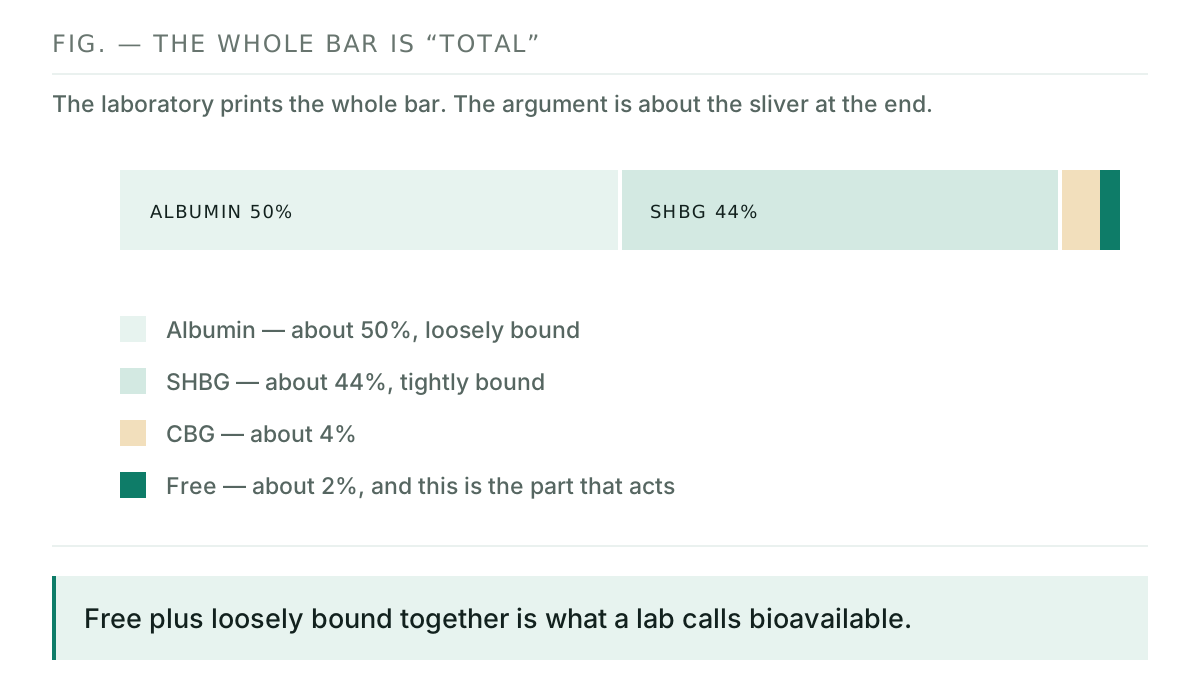
The guideline gives the split. Testosterone is bound to albumin at roughly 50 per cent, and that bond is loose. It is bound to sex hormone binding globulin, SHBG, at roughly 44 per cent, and that bond is tight. Around 4 per cent is bound to corticotropin binding globulin. And approximately 2 per cent circulates as free testosterone.
Albumin 50 per cent, loosely bound. SHBG 44 per cent, tightly bound. Corticotropin binding globulin 4 per cent. Approximately 2 per cent circulating free. The free and loosely bound fractions together are known as bioavailable testosterone. American Urological Association, Testosterone Deficiency Guideline
That last sentence introduces the third term men run into on lab menus. Bioavailable testosterone is not a rival to the other two; it is free plus the loosely bound albumin portion, on the reasoning that a loose bond releases easily at the tissue.
So the argument for measuring free is genuinely about biology. What decides whether you should act on it is not biology but measurement, and that is where it comes apart.
The guideline does not recommend free testosterone as the primary test
This is the sentence that ought to be quoted more often than it is, and the panel states it without hedging. It first acknowledges the case for the other side: some authorities have advocated that free testosterone should be the primary measure used to define testosterone deficiency, on the basis that the free fraction is believed to be the most biologically active component.
Then it gives its reasoning, and its conclusion. Although direct measurement of free testosterone correlates generally well with equilibrium dialysis, it is not reliable because of high variability. The direct method is also time-consuming and labour intensive, so a calculated version is more commonly used instead — and that calculation inherits the variation in total testosterone assays plus the clinical conditions affecting albumin and SHBG.
“The Panel does not recommend using free testosterone measurements as the primary diagnostic method for testosterone deficiency.”
Notice what that does and does not say. It does not say free testosterone is meaningless, and it does not say never measure it. It says do not build the diagnosis on it. Those are different claims, and the difference is the subject of the rest of this page.
The two numbers are not interchangeable, and there is no conversion
The second statement is the one that resolves most of the confusion men arrive with, which is usually some version of “my total says one thing and my free says another, so which is right?”
The guideline answers directly: total and free testosterone are not to be considered interchangeable measures, because there is no clear data pointing to consistent thresholds between the two below which deficiency symptoms are observed and above which therapeutic benefits occur.
Read carefully, that is a stronger statement than it looks. It is not saying the two sometimes disagree. It is saying nobody has established a reliable correspondence between them — no rule that says a total of X reliably means a free of Y, and no matched pair of cut-offs where both point at the same clinical conclusion.
Which means a man holding two numbers that disagree has not caught his laboratory in a contradiction. He is holding two different measurements of two different things, neither of which was ever supposed to translate into the other.
The narrow window where the free number adds something
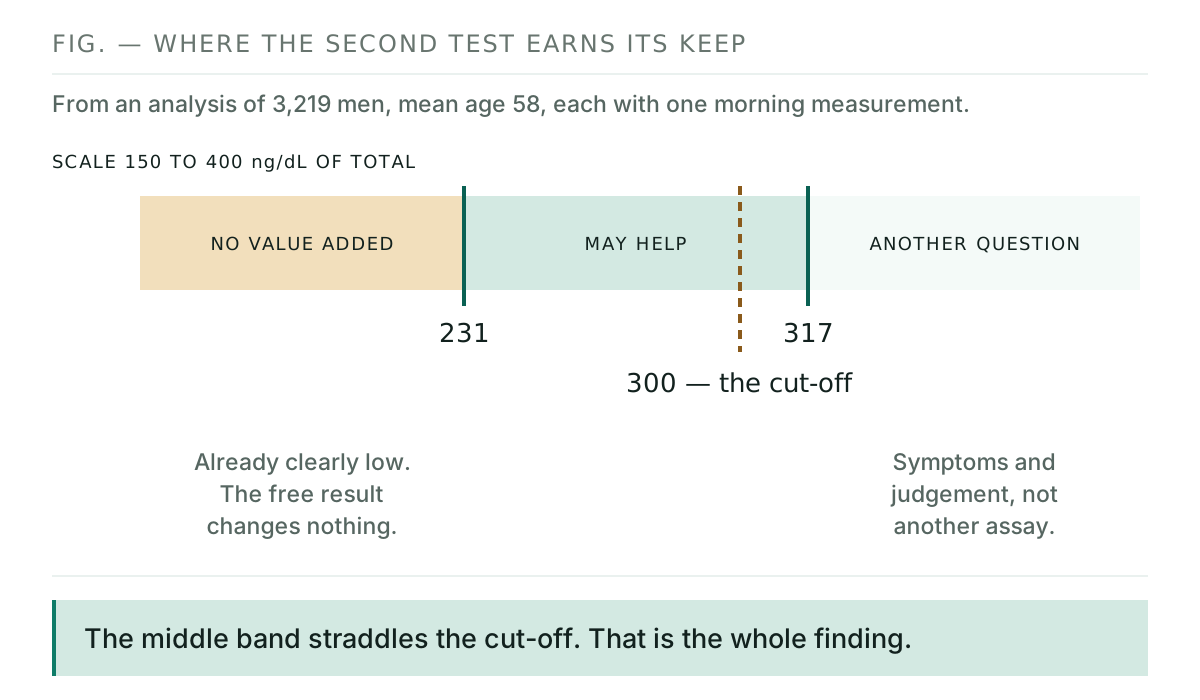
Here is the practical part, and it comes from a specific analysis rather than from opinion. The guideline cites work on 3,219 men with a mean age of 58, each with a single morning testosterone measurement, asking directly what the free number added.
The analysis suggested that using a free testosterone level added no value to the diagnosis of testosterone deficiency when the total testosterone level was below 231 ng/dL. When total testosterone was between 230 and 317 ng/dL, the authors suggested that a free testosterone measurement may be helpful in diagnosis. Cited in the AUA Testosterone Deficiency Guideline
That is an unusually clean answer to a question men actually have. If your total came back clearly low, the free result will not change the conclusion. If it came back in that middle band — the awkward zone straddling the 300 cut-off — the free number has something to contribute.
The guideline adds one more situation in the same breath: free testosterone also has a place in diagnosing deficiency in highly symptomatic patients whose total sits in the low-normal or equivocal range. It goes on to acknowledge openly that clinicians see men above 300 ng/dL who are markedly symptomatic, and urges clinical judgement rather than a rule.
What the cut-off itself means, and why 300 was chosen rather than discovered, is covered in normal testosterone levels by age. The symptoms that make a man symptomatic enough for this to arise are sorted in which symptoms actually point at it.
Four ways to measure free testosterone, with four different error bars
The reason the guideline is cautious becomes obvious once you look at how the number is produced. There is not one free testosterone test. There are several, they do not agree with each other, and the one your laboratory used is rarely printed in a way you would notice.
| Method | Variability reported | What the guideline says about it |
|---|---|---|
| Equilibrium dialysis | Intra-assay 10.0%, inter-assay 6.8% | Gold standard, excellent sensitivity and specificity — but labour intensive and low throughput |
| Calculation (Vermeulen, Sodergard, Nanjee & Wheeler) | Inter-assay 18–30% | Rapid and simple; relies on the accuracy of both the total and the SHBG assay |
| Direct (ultracentrifugation, analog) | Inter-assay 8.9%, intra-assay 10.3% | Shows promise, but additional studies are required across the range of values |
| Bioavailable (ammonium sulfate precipitation) | — | Measures free plus loosely bound together, rather than free alone |
The row that matters is the second one, because it is the one most men actually get. An inter-assay coefficient of variation of 18 to 30 per cent means two runs of the same sample can land a long way apart before anything has gone wrong. For comparison, the SHBG immunoassay that feeds into it runs at 6.7 per cent within an assay and 8.2 per cent between assays.
A calculated free result carries three errors, not one
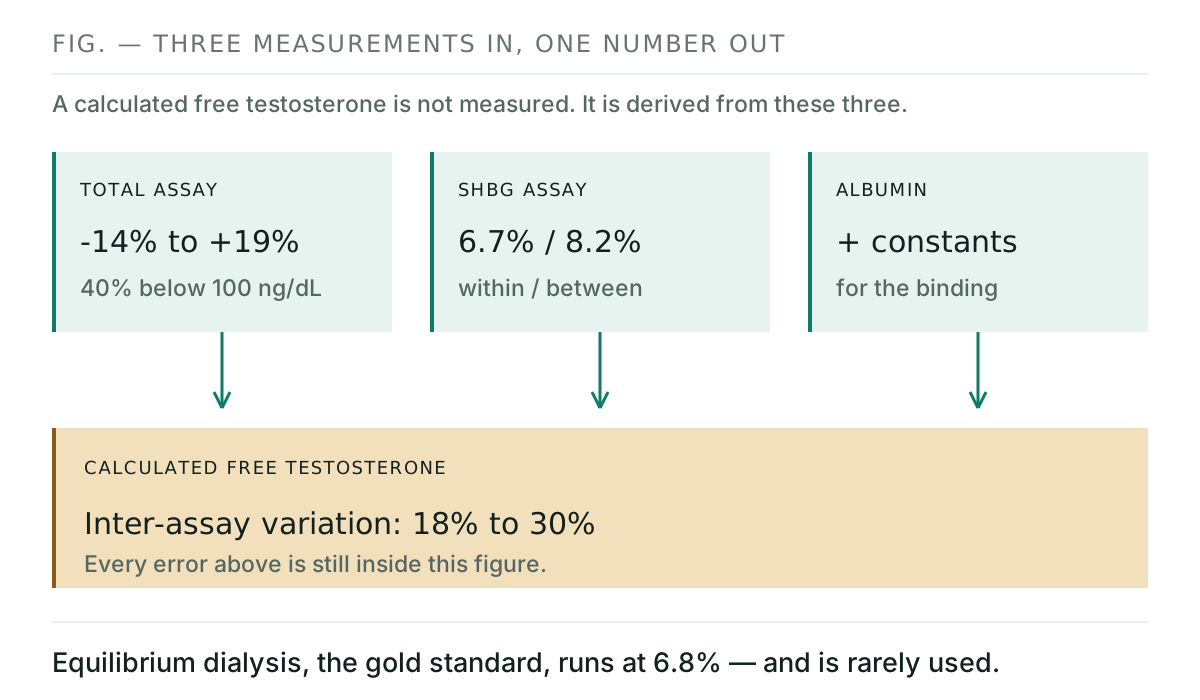
This is the mechanism behind that 18 to 30 per cent, and it is worth understanding because it explains something that otherwise looks like laboratory incompetence. A calculated free testosterone is not measured. It is derived.
The equation takes your total testosterone, your SHBG and your albumin, and applies law of mass action mathematics to estimate how much hormone is left unattached. The guideline notes that accuracy relies on the equilibrium dissociation constants for the binding of SHBG and albumin to testosterone, and that this produces high inter-assay variability.
So three separate measurements, each with its own error, are combined into one figure that inherits all of them. And the guideline has already told us that the first of those three — total testosterone by immunoassay — runs at minus 14 to plus 19 per cent, and reaches 40 per cent in samples below 100 ng/dL.
If you are going to have free testosterone measured at all, ask which method the laboratory uses, and use the same laboratory for any repeat. The guideline already recommends the same laboratory and same instrumentation for serial total measurements; the case is stronger here, not weaker.
Twenty-nine studies used total. Four used free.
There is one more way to see how the evidence base is weighted, and it is the review we cited in the article on reference ranges. It looked at 40 studies covering 37,565 men aged 43 to 82, and recorded which measurement each had used to define low testosterone.
| Measurement used | Number of studies | Range of thresholds |
|---|---|---|
| Total testosterone | 29 | 200–433 ng/dL |
| Bioavailable testosterone | 9 | 69.4–198.4 ng/dL |
| Free testosterone | 4 | 4.6–7.0 ng/dL |
This is why there is no answer to “what is a normal free testosterone” of the kind there is for total. The harmonised work that produced the 264 to 916 range for total, pooling more than nine thousand men against a reference method, has no equivalent for free. Four studies with four different thresholds is not a foundation you can build a personal conclusion on.
Where the guideline does ask for the free number
Having spent this long on the limits, it would be a distortion to leave the impression that the test is never used. It appears in the guideline in a specific and rather revealing place, and it is not at diagnosis.
It is during treatment. When a man on testosterone therapy develops a raised haematocrit, the response depends on his level. In men with elevated haematocrit and high on-treatment testosterone, dose adjustment is the first-line management. But in men with elevated haematocrit and low or normal on-treatment testosterone, the guideline suggests measuring an SHBG level and a free testosterone level using a reliable assay.
That is the pattern to take away. The free number is a tie-breaker for a specific puzzle — a result that does not match the picture — rather than a routine upgrade on the standard test. What that haematocrit business is about, and when it arises, is covered in testosterone side effects and when they show up.
How to read your own pair of numbers
If you are holding a report with both figures on it, the sequence below gets more out of it than staring at the free line and hoping.
- Read the total first, and read it against absolute figures — 300 as the cut-off, 531 as the median of healthy young men in the harmonised data.
- Check where the total sits relative to that middle band. Clearly below 231, the free result is unlikely to change anything. Between roughly 230 and 317, it has a job to do.
- Find out how the free was produced. Calculated from total and SHBG is the usual answer, and it carries the widest error of the available methods.
- Do not try to reconcile them. The guideline says there is no consistent threshold correspondence between the two, so a mismatch is not a finding.
- Ask what the symptoms are doing, because in the equivocal range the guideline explicitly falls back on clinical judgement rather than on either number.
None of that requires arguing with anybody. It requires knowing that the second number is a supporting witness rather than a better one. How the samples have to be taken for either figure to be worth reading is in the testosterone test, and the whole subject is mapped in low testosterone after 40.
Key takeaways
- Roughly 2 per cent of testosterone circulates free; about 50 per cent is loosely bound to albumin and 44 per cent tightly bound to SHBG. Free plus loosely bound is called bioavailable.
- The AUA panel states that it does not recommend using free testosterone as the primary diagnostic method for testosterone deficiency.
- Total and free are not interchangeable: there is no clear data pointing to consistent thresholds between the two.
- In 3,219 men, a free result added no value when total was below 231 ng/dL; between 230 and 317 ng/dL the authors suggested it may be helpful.
- Calculated free testosterone has an inter-assay variability of 18 to 30 per cent; equilibrium dialysis, the gold standard, runs at 6.8 per cent but is rarely used routinely.
- A calculated result combines three separate measurements — total, SHBG and albumin — and inherits the error in all three.
- Across 40 prevalence studies, 29 used total testosterone and only 4 used free, with thresholds spanning 4.6 to 7.0 ng/dL.
- The guideline does ask for it in one specific spot: a raised haematocrit on treatment alongside a low or normal testosterone level.
Where to go from here
This is the second question. These are the pages that answer the first one, and what comes after:
- Low Testosterone After 40: The Number and What It Means — the guide to the whole subject.
- Normal Testosterone Levels by Age — where the 300 cut-off comes from, and what a lab range actually describes.
- The Testosterone Test That Actually Tells You Something — how the sample has to be taken.
- Low Testosterone Symptoms: Which Ones Actually Point at It — the other half of the diagnosis.
- Testosterone Side Effects: What Shows Up, and When — including the haematocrit question above.
Frequently asked questions
Should I ask for free testosterone or total testosterone?
Total, as the main measurement. The AUA panel states that it does not recommend using free testosterone measurements as the primary diagnostic method for testosterone deficiency. Free testosterone is a second question that helps in specific situations, not a better version of the first one.
Is free testosterone more accurate than total?
No. Direct measurement of free testosterone is described by the guideline as not reliable because of high variability, and the calculated version carries an inter-assay coefficient of variation of 18 to 30 per cent. Equilibrium dialysis, the gold standard, runs at 6.8 per cent between assays but is labour intensive and rarely used routinely.
What is a normal free testosterone level?
There is no harmonised range for it in the way there is for total. In a review of 40 prevalence studies, free testosterone was used in only four of them, with thresholds spanning 4.6 to 7.0 ng/dL. The absence of an agreed cut-off is part of why the guideline does not build the diagnosis on it.
Why is my total testosterone normal but my free testosterone low?
Because the two are not measuring the same thing and are not interchangeable. The guideline says there is no clear data pointing to consistent thresholds between the two. A calculated free result also depends on the total assay, the SHBG assay and albumin, so disagreement between them is expected rather than revealing.
What is bioavailable testosterone?
The free fraction plus the loosely bound fraction taken together. Testosterone is bound to albumin at about 50 per cent loosely, to sex hormone binding globulin at about 44 per cent tightly, to corticotropin binding globulin at about 4 per cent, and roughly 2 per cent circulates free.
Can I convert total testosterone to free testosterone?
Not meaningfully by yourself. Laboratories calculate it from total testosterone, SHBG and albumin using equations such as Vermeulen or Sodergard, and the guideline notes that accuracy relies on the equilibrium dissociation constants for binding, giving high inter-assay variability. A number produced that way is an estimate, not a direct measurement.
Sources
- American Urological Association — Testosterone Deficiency Guideline (Testosterone Measurement, Table 4, and the free testosterone discussion)
- Wu et al., New England Journal of Medicine, 2010 — Identification of Late-Onset Hypogonadism in Middle-Aged and Elderly Men (European Male Ageing Study)
- Travison et al., Journal of Clinical Endocrinology & Metabolism, 2017 — Harmonized Reference Ranges for Circulating Testosterone Levels in Men of Four Cohort Studies
- StatPearls (National Library of Medicine) — Physiology, Testosterone
- MedlinePlus (National Library of Medicine) — Testosterone Levels Test

Male Health Guide Editorial Team
We write about the health problems men over 40 actually search for at 3 a.m. — and we say plainly when the evidence for a popular product is thin. We do not invent credentials and we do not publish sponsored copy as editorial. Read more about how we work.
Medical disclaimer: This article is general information about how testosterone is measured and is not medical advice. It cannot interpret your own results, which need to be read by someone who can see them alongside your history and knows which assay your laboratory used. Please speak to a qualified healthcare professional about your own situation.