Unisom for Sleep in Men: The Prostate Warning on the Box

It's 4:40 a.m., and the box in the medicine cabinet says "nighttime sleep-aid." Before you take one, read the small print on the back: the warnings include trouble urinating from an enlarged prostate.
Short answer
Unisom for sleep is two different drugs sold under one name: SleepTabs contain doxylamine, while SleepMelts and SleepMinis contain diphenhydramine. Both are sedating antihistamines, and every label tells men with trouble urinating from an enlarged prostate to ask a doctor first. Sleep doctors suggest not using diphenhydramine for chronic insomnia.
This page reads the actual Drug Facts labels behind Unisom for sleep, then lines them up against the 2017 sleep medicine guideline, the 2023 list of drugs older adults should avoid, and MedlinePlus. This site's sleeping pills article covers the prescription options; this one stays with what you can buy without a prescription.
Unisom is two different drugs under one name
Unisom is a brand name, and the active ingredient changes from box to box. Unisom SleepTabs contain doxylamine succinate 25 mg. Unisom SleepMelts and SleepMinis contain diphenhydramine 25 mg per tablet or capsule, with a label dose of two. Both are first-generation antihistamines, the older allergy medicines that cause drowsiness.
| Unisom product | Active ingredient | Label directions (adults and children 12+) |
|---|---|---|
| SleepTabs | Doxylamine succinate 25 mg | One tablet 30 minutes before bed, once daily |
| SleepMelts | Diphenhydramine HCl 25 mg per tablet | Two tablets (50 mg) at bedtime if needed |
| SleepMinis | Diphenhydramine HCl 25 mg per mini-capsule | Two mini-capsules (50 mg) at bedtime if needed |
| PM Pain | Acetaminophen 325 mg + diphenhydramine HCl 50 mg per caplet | One caplet at bedtime; no more than 1 in 24 hours (liver warning: don't use with other acetaminophen) |
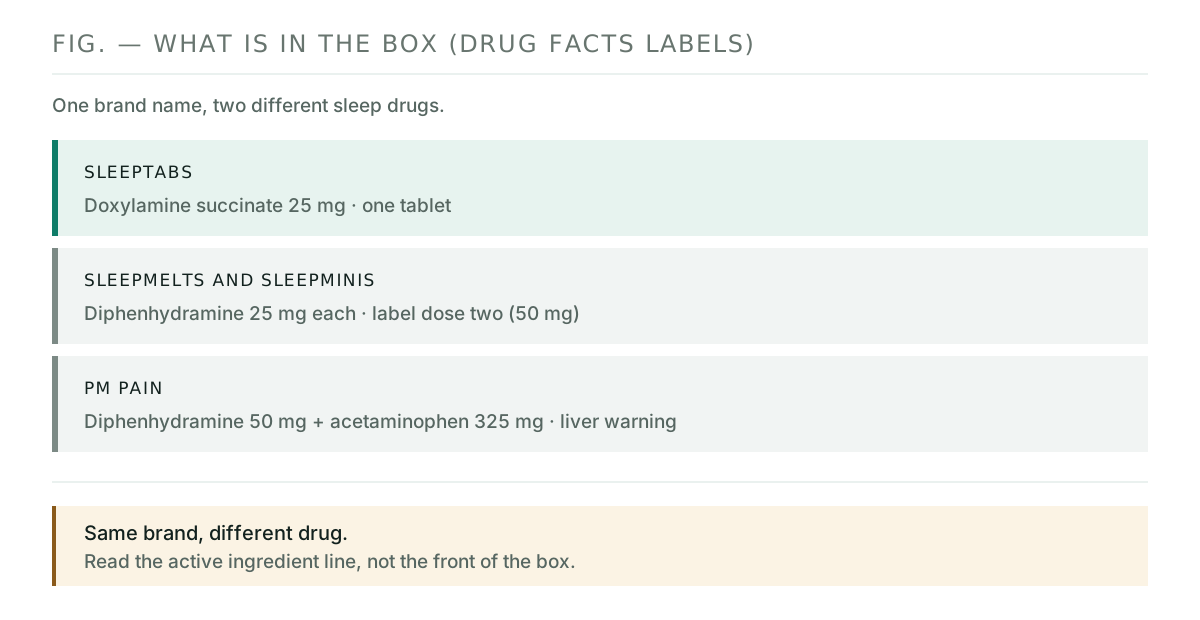
The SleepTabs label says it "helps to reduce difficulty in falling asleep." The SleepMelts and SleepMinis labels say "for relief of occasional sleeplessness." Diphenhydramine is also the active ingredient in many allergy pills and "PM" pain relievers, and its labels warn against using it with any other diphenhydramine product, "even one used on skin."
The enlarged-prostate warning is on every Unisom label
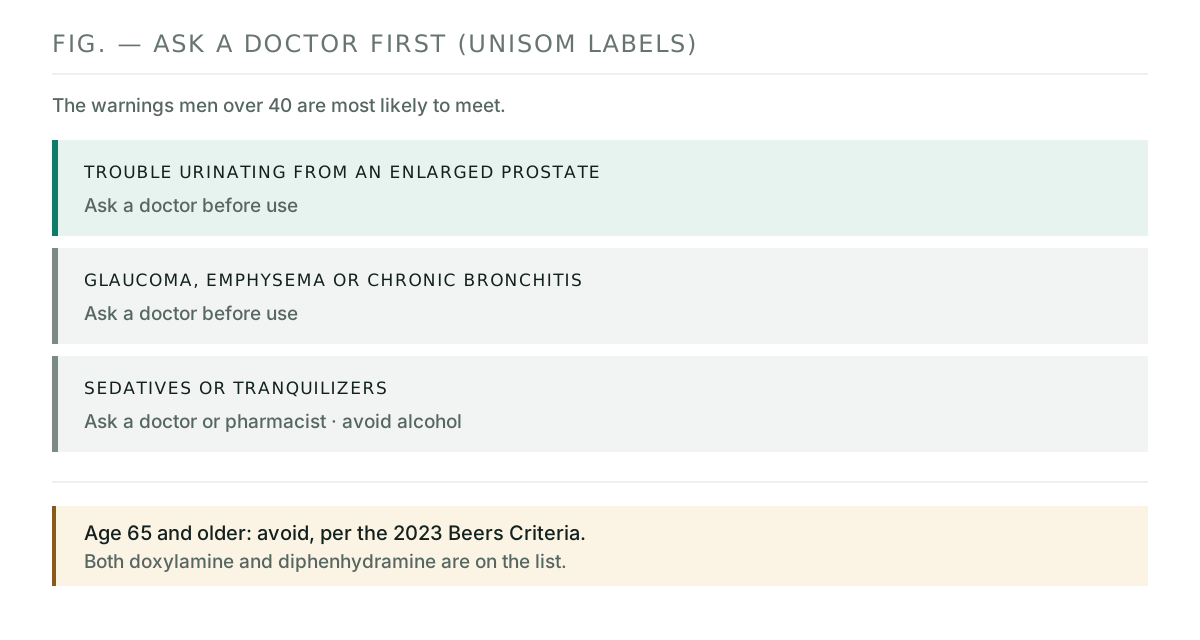
Every Unisom sleep label we read tells men to ask a doctor before use if they have "trouble urinating due to an enlarged prostate gland." The same list includes glaucoma and breathing problems such as emphysema or chronic bronchitis. For men over 40 with an enlarged prostate, that line matters more than anything on the front.
The reason is the drugs' second action. The American Geriatrics Society describes first-generation antihistamines, doxylamine and diphenhydramine included, as "highly anticholinergic." For men 65 and older with an enlarged prostate, its 2023 Beers Criteria say to avoid strongly anticholinergic drugs, because they "may decrease urinary flow and cause urinary retention."
MedlinePlus tells people to let their doctor know before taking diphenhydramine if they have difficulty urinating due to an enlarged prostate. It lists "difficulty urinating or painful urination" among the serious side effects that call for a doctor right away.
MedlinePlus lists difficulty urinating or painful urination, and vision problems, as diphenhydramine side effects that need a call to your doctor immediately. If you already have trouble emptying your bladder, see this site's bladder that won't empty article before trying any antihistamine sleep aid.
The sleep benefit of diphenhydramine is small
For diphenhydramine, the evidence shows only a small sleep benefit. When the American Academy of Sleep Medicine (AASM) reviewed the trials for its 2017 guideline on chronic insomnia, every sleep measure the guideline could quantify for diphenhydramine 50 mg fell below its threshold for clinical significance. It suggests clinicians not use diphenhydramine for chronic insomnia, a weak recommendation.
Pooling two trials, people reported falling asleep about 2.5 minutes faster and sleeping about 18 minutes longer than on placebo. In the one trial with sleep-lab recordings, sleep came 7.9 minutes faster and lasted 12.4 minutes longer. The guideline rated the evidence as low quality and concluded that "the majority of well-informed patients would not use diphenhydramine over no treatment."
Doxylamine, the ingredient in SleepTabs, does not appear in the guideline, so there is no AASM verdict on it either way.
There's also the question of how long the drowsiness lasts. In a small 2002 study, 15 healthy men aged 18 to 50 took diphenhydramine 50 mg twice a day. Daytime sleepiness was clearly higher on day 1, but by day 4 it was no different from placebo. The authors wrote that tolerance to the sedation "develops with remarkable rapidity."
A sleep aid doesn't treat what wakes most men
Unisom treats sleeplessness, not its causes; apart from PM Pain, which adds pain relief, the labels list no other use. For many men over 40 the wake-ups have a cause of their own: a full bladder, snoring that stops breathing, or a racing mind at 3 a.m. A sedating antihistamine does nothing for any of them.
The labels say as much. Each one says to stop and ask a doctor if sleeplessness persists continuously for more than two weeks. The SleepTabs, SleepMelts and SleepMinis labels add that "insomnia may be a symptom of serious underlying medical illness."
This site's sleep after 40 guide maps the usual causes. Three common ones:
- Up to pee: this site's nocturia or insomnia article helps sort out which came first.
- Snoring or gasping: see snoring or sleep apnea before treating it as plain insomnia.
- Wide awake at 3 a.m.: waking at 3 a.m. covers the usual reasons.
Geriatric experts say to avoid Unisom after 65
Geriatric experts list both Unisom ingredients among medicines adults 65 and older should avoid. The American Geriatrics Society's 2023 Beers Criteria name doxylamine and diphenhydramine among first-generation antihistamines to avoid, citing reduced clearance with age, tolerance when used for sleep, and the risk of confusion, dry mouth, constipation and other anticholinergic effects.
The same entry adds: "Cumulative exposure to anticholinergic drugs is associated with an increased risk of falls, delirium, and dementia, even in younger adults." MedlinePlus says diphenhydramine generally shouldn't be used in older adults except to manage serious allergic reactions.
The dementia link comes from years of heavy use
The dementia link comes from studies of long-term, cumulative use, not a single night. The best known followed 3,434 adults aged 65 or older in Seattle for an average of 7.3 years, using pharmacy records to measure 10 years of anticholinergic use. First-generation antihistamines were among the most commonly used drugs counted.
Compared with no use, the heaviest cumulative use, the equivalent of a daily dose for more than three years, was associated with a 54% higher risk of dementia (hazard ratio 1.54). Lower levels of use weren't clearly linked.
It was an observational study, so it shows an association, not proof of cause. One possible alternative is that these drugs are often taken for insomnia and depression, which can be early signs of undiagnosed dementia. The authors tried to account for this by excluding the last 12 months of use, and the higher risk still appeared with heavy use of anticholinergics other than antidepressants, such as first-generation antihistamines.
Who should check before taking Unisom
The Unisom labels list who should ask first. Ask a doctor before use if you have trouble urinating due to an enlarged prostate, glaucoma, or a breathing problem such as emphysema or chronic bronchitis. Ask a doctor or pharmacist if you take sedatives or tranquilizers, and avoid alcohol while using it.
- Other medicines: the SleepTabs label also lists any other sleep aid, other antihistamines and "any other drugs." If you take prostate medicines or anything else daily, ask the pharmacist.
- Driving: the SleepTabs label says not to drive or operate machinery, and not to use it unless you have time for a full night's sleep.
- Alcohol: the labels say to avoid it; this site's alcohol and sleep article explains what it does to the second half of the night.
- PM Pain: its label also says to ask a doctor first if you have liver disease or take the blood thinner warfarin, not to take more than 1 caplet in 24 hours, and warns of severe liver damage with other acetaminophen products or 3 or more drinks a day.
- Overdose: the labels say to get medical help or contact a Poison Control Center right away.
What sleep doctors recommend instead of Unisom
Sleep doctors recommend a non-drug treatment first. The 2017 AASM guideline says that "all patients with chronic insomnia should receive CBT-I as a primary intervention." CBT-I is cognitive behavioral therapy for insomnia, a structured program covered in this site's CBT for insomnia article.
If you and your doctor decide a medicine makes sense, the same guideline gives weak recommendations for several prescription options, compared in this site's sleeping pills explained article. If you've been using Unisom for sleep, bring the box so the doctor sees exactly which ingredient you've been taking.
Key takeaways
- Unisom is two drugs under one name: SleepTabs are doxylamine 25 mg; SleepMelts and SleepMinis are diphenhydramine (label dose 50 mg); PM Pain adds acetaminophen.
- Every Unisom sleep label tells men with trouble urinating from an enlarged prostate to ask a doctor before use.
- The AASM found diphenhydramine's sleep benefits below its threshold for clinical significance and suggests not using it for chronic insomnia; it made no recommendation on doxylamine.
- The labels say to stop and see a doctor if sleeplessness lasts more than two weeks.
- The 2023 Beers Criteria list both ingredients as drugs to avoid at 65 and older, and heavy long-term anticholinergic use has been linked, not proven causal, to a higher dementia risk.
Where to go from here
These pages cover the surrounding ground:
- Sleep After 40 — what changes with age and the map of what keeps men awake.
- Sleeping Pills Explained — the prescription options and their trade-offs.
- Trazodone for Sleep — the antidepressant widely prescribed off-label for insomnia.
- Melatonin for Sleep — the supplement many men try first.
- CBT for Insomnia — the first-line treatment the guideline recommends.
- Enlarged Prostate After 40 — why the prostate warning applies to so many men.
- All sleep articles
Frequently asked questions
Is Unisom doxylamine or diphenhydramine?
It depends on the box. Unisom SleepTabs contain doxylamine succinate 25 mg. Unisom SleepMelts and SleepMinis contain diphenhydramine 25 mg per tablet or capsule, with a label dose of two (50 mg). Unisom PM Pain adds acetaminophen. Read the active ingredient line on the Drug Facts label, not the brand name.
Can men with an enlarged prostate take Unisom?
Only after asking a doctor. Every Unisom sleep label says to ask a doctor first if you have trouble urinating due to an enlarged prostate gland. For men 65 and older with enlarged-prostate symptoms, the 2023 Beers Criteria go further: avoid strongly anticholinergic drugs, which "may decrease urinary flow and cause urinary retention."
Does Unisom work for insomnia?
Not much, on the evidence. The American Academy of Sleep Medicine found that diphenhydramine 50 mg improved sleep by amounts below its threshold for clinical significance, and it suggests clinicians not use it for chronic insomnia. A small study in healthy men found tolerance to its daytime sedation was complete within about three days.
Is Unisom safe for men over 65?
The American Geriatrics Society's 2023 Beers Criteria list both doxylamine and diphenhydramine as medicines adults 65 and older should avoid, citing strong anticholinergic effects, reduced clearance with age, tolerance when used for sleep, and confusion. MedlinePlus says diphenhydramine generally shouldn't be used in older adults except for serious allergic reactions.
Is Unisom linked to dementia?
Not proven, but there is an association. In a 2015 study of 3,434 adults aged 65 or older, the heaviest 10-year use of strong anticholinergics, including first-generation antihistamines, was linked to a 54% higher dementia risk. The study was observational, so it can't prove cause, though the authors took steps to reduce one known bias.
Sources
- U.S. Food and Drug Administration Drug Facts label (DailyMed) — Unisom SleepTabs (doxylamine succinate 25 mg), Chattem, version effective March 25, 2026
- U.S. Food and Drug Administration Drug Facts label (DailyMed) — Unisom SleepMelts (diphenhydramine HCl 25 mg), Chattem, version effective January 14, 2026
- U.S. Food and Drug Administration Drug Facts label (DailyMed) — Unisom SleepMinis (diphenhydramine HCl 25 mg), Chattem, version effective January 14, 2026
- U.S. Food and Drug Administration Drug Facts label (DailyMed) — Unisom PM Pain (acetaminophen 325 mg, diphenhydramine HCl 50 mg), Chattem, version effective January 14, 2026
- Journal of Clinical Sleep Medicine (American Academy of Sleep Medicine) — Sateia MJ et al. Clinical practice guideline for the pharmacologic treatment of chronic insomnia in adults, 2017
- Journal of the American Geriatrics Society — American Geriatrics Society 2023 updated AGS Beers Criteria for potentially inappropriate medication use in older adults
- JAMA Internal Medicine — Gray SL et al. Cumulative use of strong anticholinergics and incident dementia: a prospective cohort study, 2015
- Journal of Clinical Psychopharmacology — Richardson GS et al. Tolerance to daytime sedative effects of H1 antihistamines, 2002
- MedlinePlus (National Library of Medicine) — Diphenhydramine

Male Health Guide Editorial Team
We write about the health problems men over 40 actually search for at 3 a.m. — and we say plainly when the evidence for a popular product is thin. We do not invent credentials and we do not publish sponsored copy as editorial. Read more about how we work.
Medical disclaimer: This article is general information, not medical advice. We are not doctors, and nothing here diagnoses, treats or cures any condition. Don't combine sleep aids, sedatives or alcohol without talking to your doctor or pharmacist. Call your doctor right away if you can't urinate or it becomes painful, and contact a Poison Control Center right away in case of overdose.