Trazodone for Sleep: Widely Used, Weakly Supported
Short answer
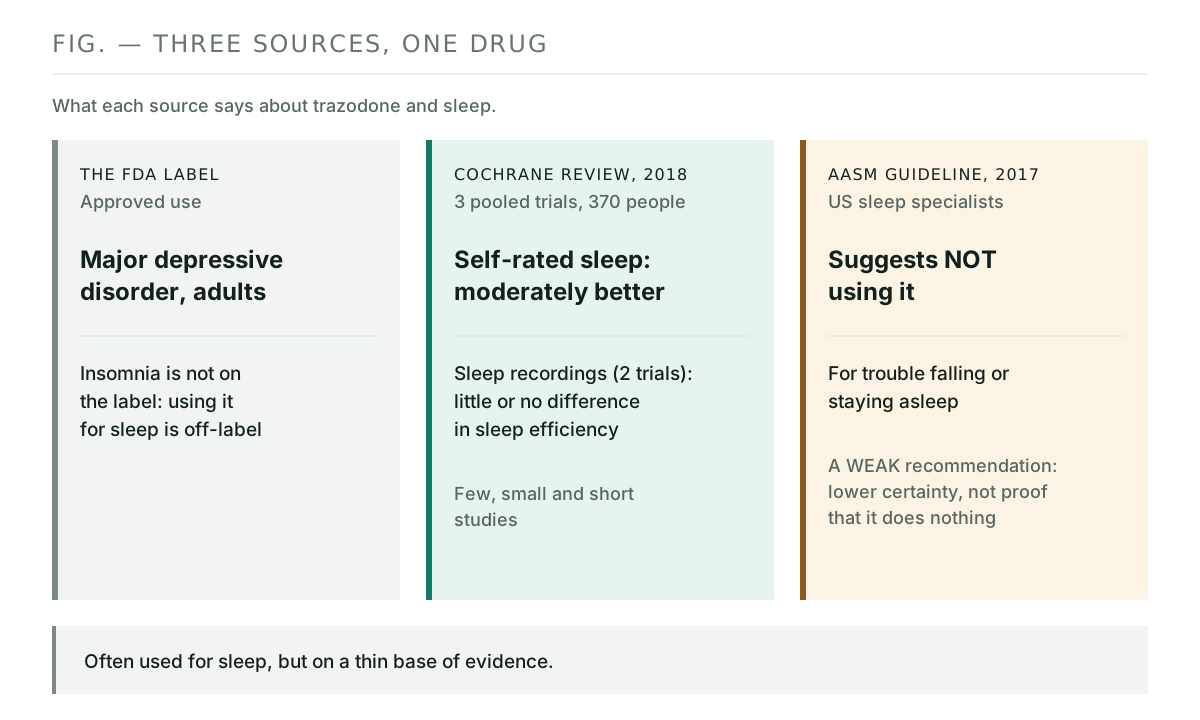
Trazodone is approved for depression, but it's also used off-label for sleep. A Cochrane review found there may be a small improvement in how people rated their sleep, not on sleep recordings, and the American Academy of Sleep Medicine suggests against using it for insomnia. For men, the label warns that an erection lasting over 4 hours is an emergency.
Trazodone is a name many men hear when they finally tell a doctor they can't sleep. It's an antidepressant, and a 2018 Cochrane review describes antidepressant use for insomnia as widespread. What often isn't said in that conversation is that it isn't approved for insomnia, and that the evidence for it is thinner than its popularity suggests.
This article covers what trazodone is approved for, what the trials found for sleep, why the American Academy of Sleep Medicine's guideline advises against it, the warnings that matter most after 40, the one warning that is specific to men, what happens when you stop it, and the alternatives with stronger evidence. It sits alongside this site's guide to sleeping pills, which covers the drugs that are approved for insomnia.
What trazodone is approved for
The FDA-approved label for trazodone tablets says it is indicated for the treatment of major depressive disorder in adults. MedlinePlus, the National Library of Medicine's drug guide, says trazodone is used to treat depression and works by increasing the amount of serotonin in the brain.
MedlinePlus adds that trazodone "is also sometimes used to treat insomnia," along with schizophrenia, anxiety and some other conditions, and advises talking to your doctor about the possible risks of using it for your condition. That makes sleep an off-label use: legal and common, but outside what the drug was approved and tested for.
What the trials found for sleep
A 2018 Cochrane review looked at antidepressants for insomnia in adults. It notes that antidepressant use for insomnia is widespread, but that "none is licensed for insomnia and the evidence for their efficacy is unclear." It found 23 randomized trials of antidepressants overall, seven of them testing trazodone against placebo.
Three trazodone studies, with 370 participants, could be pooled. They showed a moderate improvement in how well people said they slept compared with placebo. But two studies that measured sleep with overnight recordings, called polysomnography, found little or no difference in sleep efficiency, the share of time in bed actually spent asleep. Two studies also found more side effects with trazodone than placebo, including morning grogginess, dry mouth and thirst. The reviewers rated the sleep-recording and side-effect evidence as low quality.
"There may be a small improvement in sleep quality with short-term use of low-dose doxepin and trazodone compared with placebo." They found the studies were few, mostly small and short, and said there was no evidence for long-term antidepressant use for insomnia. In our reading, "small," "short-term" and "may" are the three words to hold onto.
Why the sleep guideline advises against it
In 2017, the American Academy of Sleep Medicine published a guideline on medicines for chronic insomnia in adults. It looked at individual drugs, including some commonly used without an FDA indication for insomnia. On trazodone it was direct: "We suggest that clinicians not use trazodone as a treatment for sleep onset or sleep maintenance insomnia (versus no treatment) in adults."
That is a weak recommendation, which the guideline defines as reflecting a lower degree of certainty, and says should not be read as proof the drug is ineffective. But it puts trazodone on the list of drugs the guideline suggests against, alongside others such as diphenhydramine, while it suggests several drugs that are approved for insomnia, including doxepin and suvorexant. Our sleeping pills guide covers those.
The warnings that matter most after 40
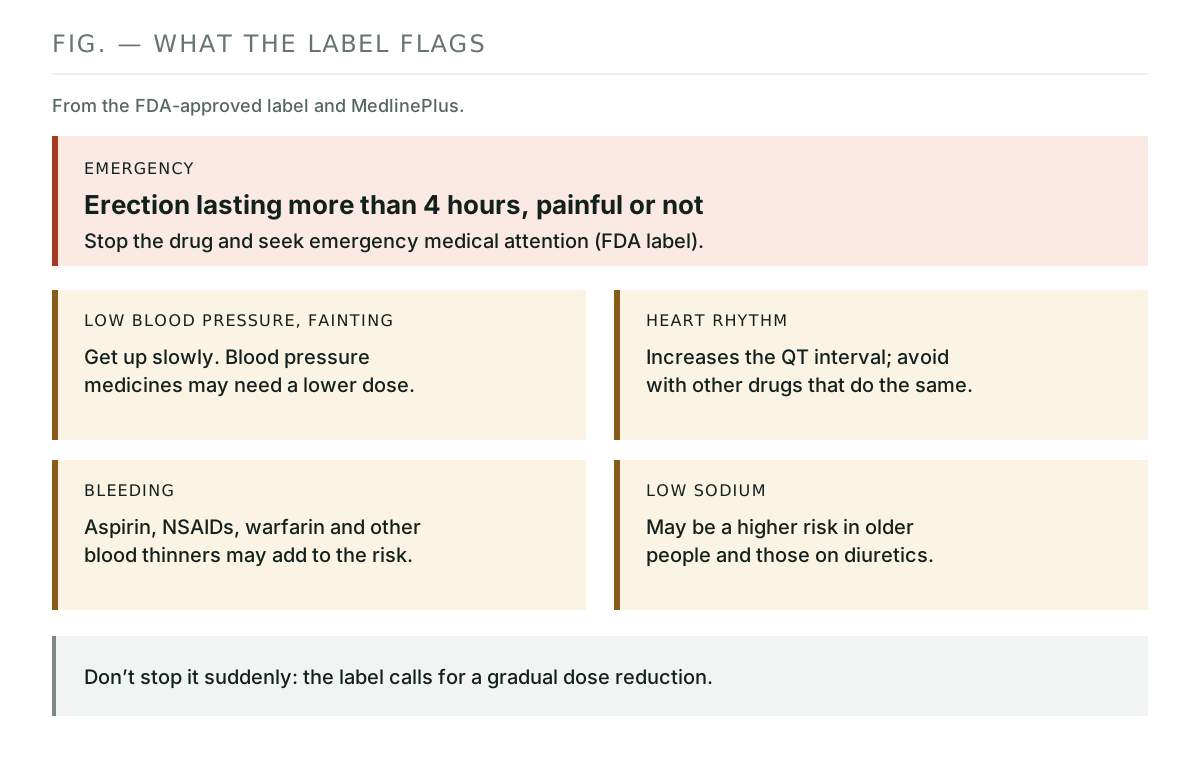
Several warnings on the label are worth reading closely if you take blood pressure medicine, a blood thinner or a daily aspirin, or if you get up at night to urinate, as covered in this site's waking up to pee at night article.
- Low blood pressure and fainting: the label says hypotension, including on standing, and fainting have been reported, and that taking it with a blood pressure medicine may require lowering that medicine's dose. MedlinePlus advises getting out of bed slowly, resting your feet on the floor for a few minutes before standing.
- Heart rhythm: the label says trazodone increases the QT interval and should be avoided with other drugs that do the same and in people with risk factors for a prolonged QT interval. MedlinePlus says to tell your doctor if you or anyone in your family has long QT syndrome, or if you have had a heart attack.
- Bleeding: the label says drugs like trazodone that interfere with serotonin reuptake increase the risk of bleeding events, and that aspirin, NSAIDs, warfarin and other blood thinners may add to that risk.
- Low sodium: the label says serotonergic antidepressants have been linked to low sodium levels, with older people and those taking diuretics possibly at greater risk.
- Drowsiness: MedlinePlus says it may make you drowsy and affect your judgment, and not to drive until you know how it affects you. It says alcohol can make the side effects worse.
On older adults in general, the label says experience is limited and that it should be used with caution. MedlinePlus also lists interactions with St. John's wort, tryptophan, and NSAIDs such as ibuprofen and naproxen, so it's worth telling your doctor about supplements too.
The warning that is specific to men
Trazodone carries a warning about priapism, an erection that will not go down. The FDA-approved label says cases of priapism, which it describes as painful erections lasting more than 6 hours, have been reported in men taking trazodone, and that if it is not treated promptly it can cause irreversible damage to the erectile tissue.
The label says men who have an erection lasting more than 4 hours, "whether painful or not, should immediately discontinue the drug and seek emergency medical attention." Get emergency medical care right away; don't wait to see if it settles. MedlinePlus lists an erection lasting more than 6 hours among the serious side effects that need a call to your doctor immediately or emergency treatment. The 4-hour line in the label's warnings section is the stricter one, and it's the one to follow.
The label advises caution in men with conditions that might predispose them to priapism, such as sickle cell anemia, multiple myeloma or leukemia, or with a physical deformity of the penis, such as angulation, cavernosal fibrosis or Peyronie's disease. MedlinePlus also lists sexual side effects that are less serious but worth reporting if they are severe or don't go away: decreased sex drive, trouble getting or keeping an erection, and delayed or absent ejaculation. This site's article on testosterone and erectile dysfunction covers erection problems more broadly.
Other serious side effects
MedlinePlus lists symptoms that mean calling your doctor immediately or getting emergency treatment. They include chest pain, shortness of breath, dizziness or fainting; a fast, pounding or irregular heartbeat; seizures; unusual bruising or bleeding; and loss of consciousness. It also lists a cluster of fever, sweating, confusion, a fast heartbeat, severe muscle stiffness or twitching, agitation and hallucinations; the label separately warns about serotonin syndrome.
Two more warnings are worth knowing. MedlinePlus says trazodone may cause angle-closure glaucoma, and to call your doctor or get emergency treatment right away for nausea, eye pain, changes in vision such as colored rings around lights, or swelling or redness around the eye. And, like other antidepressants, it carries a warning about suicidal thoughts, which MedlinePlus says was found in people under 24; it lists new or worsening depression and thoughts of self-harm among the symptoms to call your doctor about right away.
What happens when you stop it
MedlinePlus says not to stop trazodone without talking to your doctor. Stopping suddenly can cause withdrawal symptoms, including dizziness, nausea, headache, confusion, anxiety, agitation, trouble falling or staying asleep, extreme tiredness and seizures, and it says your doctor will probably lower the dose gradually. The label also says that when it is discontinued, the dose should be reduced gradually.
In our reading, that's worth knowing before the first prescription, not after: trouble sleeping is on the list of withdrawal symptoms, so poor sleep during a taper isn't necessarily the original problem returning.
The alternatives to discuss
The non-drug approach, cognitive behavioral therapy for insomnia, is covered in this site's CBT for insomnia article, including the evidence behind it. Among medicines, the 2017 sleep guideline suggests using several approved drugs while it suggests against trazodone, and our sleeping pills guide sets out their trade-offs.
It's also worth ruling out the causes that a sedative would only mask. This site's articles cover two worth ruling out: sleep apnea and nighttime urination. If you're waking at the same hour every night, our waking at 3am article covers the usual reasons.
Questions to ask before you start
- Is this for sleep, depression or both? The answer changes the evidence behind it.
- What about my blood pressure pills, blood thinner or aspirin? The label flags all three.
- Has sleep apnea been ruled out? If you snore, or someone has seen you stop breathing, ask first.
- How long am I meant to take it, and how will we stop? The label calls for a gradual reduction.
- What should I do if I get a prolonged erection? The label's answer: stop it and get emergency care right away if an erection lasts more than 4 hours.
Key takeaways
- Trazodone's FDA-approved label covers major depressive disorder in adults; using it for sleep is off-label.
- A 2018 Cochrane review found there may be a small, short-term improvement in self-rated sleep, but little or no difference on overnight sleep recordings.
- The American Academy of Sleep Medicine's 2017 guideline suggests not using trazodone for insomnia, a weak recommendation.
- The label warns of low blood pressure, heart rhythm changes, bleeding risk with aspirin or blood thinners, and low sodium in older adults.
- For men: the label says an erection lasting more than 4 hours, painful or not, means stopping the drug and seeking emergency care.
Where to go from here
If you're weighing a medicine for sleep, these pages cover the alternatives and the causes worth ruling out first:
- Unisom for Sleep in Men — what is in the box, and the prostate warning on the label.
- Sleeping Pills Explained — the drugs that are approved for insomnia.
- CBT for Insomnia — the treatment that isn't a pill.
- Snoring or Sleep Apnea? — a cause worth ruling out first.
- Melatonin for Sleep — the over-the-counter option men ask about, and what the evidence shows.
- All sleep articles
Frequently asked questions
Is trazodone approved for insomnia?
No. Its FDA-approved label covers major depressive disorder in adults. MedlinePlus says trazodone is also sometimes used to treat insomnia, which makes that an off-label use, and a 2018 Cochrane review notes that no antidepressant is licensed for insomnia.
Does trazodone actually help you sleep?
A little, in short trials. A 2018 Cochrane review pooled three trazodone studies (370 participants) and found a moderate improvement in how well people said they slept; the authors concluded there may be a small improvement with short-term use. Two studies using overnight sleep recordings found little or no difference in sleep efficiency, and the studies were few, small and short.
Why don't sleep specialists recommend trazodone for insomnia?
The American Academy of Sleep Medicine's 2017 guideline suggests that clinicians not use trazodone for trouble falling asleep or staying asleep. It is a weak recommendation, reflecting a lower degree of certainty, but it places trazodone among the drugs the guideline advises against rather than those it suggests.
Can trazodone cause priapism?
Yes. The FDA-approved label says priapism has been reported in men taking trazodone and can cause permanent damage if not treated promptly. It says men with an erection lasting more than 4 hours, painful or not, should stop the drug immediately and seek emergency medical attention.
Is trazodone safe for older men?
It needs caution. The label says experience in older adults is limited and advises caution, warns of low blood pressure and fainting, and says it may lower sodium levels, a risk that may be higher in older people and those taking diuretics. MedlinePlus advises getting out of bed slowly.
Can you stop trazodone suddenly?
Not without talking to your doctor. MedlinePlus says stopping suddenly can cause withdrawal symptoms such as dizziness, nausea, headache, anxiety, trouble sleeping and seizures, and that your doctor will probably lower the dose gradually.
Sources
- MedlinePlus (National Library of Medicine) — Trazodone
- DailyMed (National Library of Medicine) — Trazodone hydrochloride tablets: FDA-approved prescribing information
- Everitt H, Baldwin DS, Stuart B, et al. — Antidepressants for insomnia in adults, Cochrane Database of Systematic Reviews, 2018
- Sateia MJ, Buysse DJ, Krystal AD, Neubauer DN, Heald JL — Clinical Practice Guideline for the Pharmacologic Treatment of Chronic Insomnia in Adults: An American Academy of Sleep Medicine Clinical Practice Guideline, Journal of Clinical Sleep Medicine, 2017

Male Health Guide Editorial Team
We write about the health problems men over 40 actually search for at 3 a.m. — and we say plainly when the evidence for a popular product is thin. We do not invent credentials and we do not publish sponsored copy as editorial. Read more about how we work.
Medical disclaimer: This article is general information, not medical advice. We are not doctors, and nothing here diagnoses, treats or cures any condition. Don't start, stop or change trazodone without your doctor. An erection lasting more than 4 hours while taking it is a medical emergency: stop the drug and get emergency care.