Tachycardia: What a Fast Resting Heart Rate Can Mean

Your watch shows a fast pulse while you are sitting still. Tachycardia is the term you may hear, but the number does not tell you whether your heart is responding to something else or whether its electrical rhythm needs attention. Start with how you feel, not another refresh of the screen.
Short answer
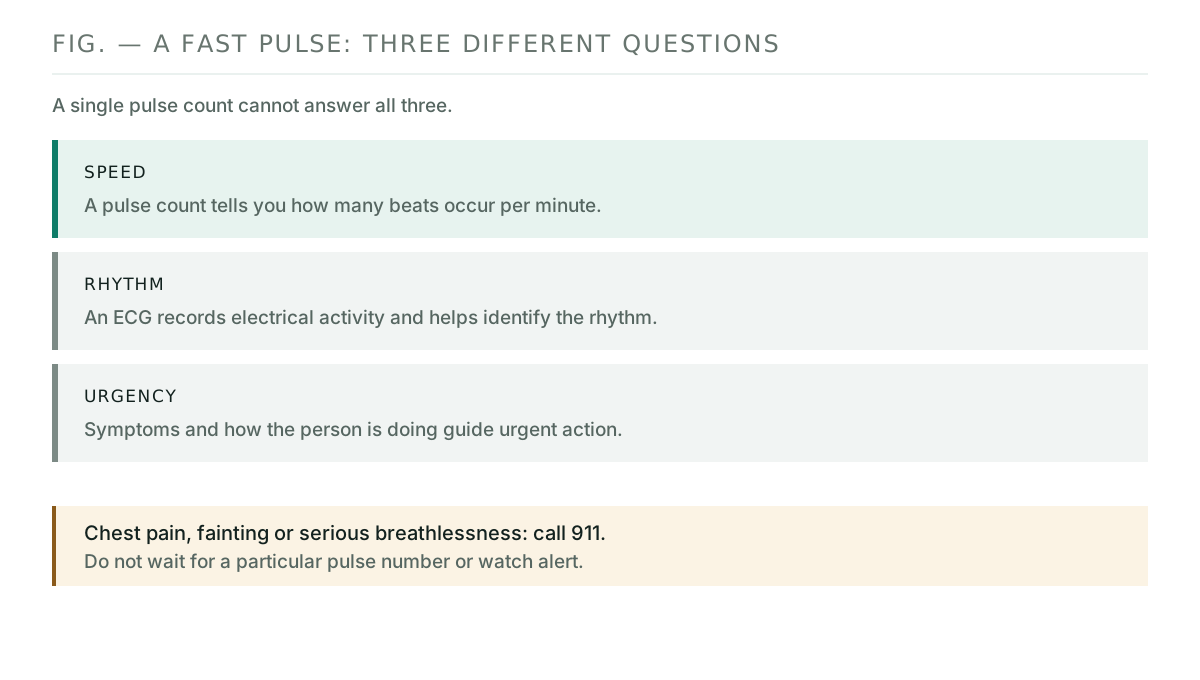
Tachycardia generally means a resting heart rate above 100 beats per minute in adults. Exercise, fever, pain or other conditions can speed up a normal rhythm, while an arrhythmia can start elsewhere in the heart. The number alone cannot tell the difference. Chest pain, fainting or serious breathlessness require emergency care.
This guide explains what a fast resting pulse can and cannot establish, what information helps at an appointment, and why treatment depends on the cause. For the wider picture, see our heart health after 40 guide. If the problem is an irregular or fluttering sensation, our palpitations and atrial fibrillation article covers that related question.
Tachycardia describes speed before it explains the cause
Tachycardia is the term for an adult resting heart rate above 100 beats per minute. It describes how fast the heart is beating, not why. A faster pulse during exercise is a different context from a repeatedly fast pulse while resting. Symptoms and the electrical rhythm determine what the finding means.
The American Heart Association distinguishes sinus tachycardia, supraventricular tachycardia and ventricular tachycardia. They share a fast rate, but they do not share one cause or one treatment.
That distinction keeps the number in perspective. A measurement can tell you that something deserves attention without identifying the problem. The next useful question is not simply how to force the pulse lower. It is what was happening when the reading appeared and whether you have warning symptoms.
Write down the actual reading rather than rounding it into a diagnosis. Include whether you were seated, had just walked upstairs, felt ill, or noticed the episode start suddenly. You are recording an observation for the clinician, not proving one particular type of tachycardia.
A resting pulse needs the context of actual rest
A resting pulse is measured when you are not exercising and are calm and feeling well. Physical activity, stress, temperature and medicines can affect heart rate. If you feel well, recording the circumstances alongside the reading helps make it interpretable. Warning symptoms should prompt medical help rather than repeated measurements.
The AHA's guide to heart rate describes checking the wrist with the index and middle fingers and counting for a full minute. It also notes that the heart does not return to its resting rate immediately after exercise.
Keep the comparison sensible. A number from the middle of a workout and one from a quiet morning are not interchangeable. If you are keeping a record for an appointment, note the situation each time. Avoid turning repeated checks into a substitute for arranging care when the pulse keeps racing at rest.
Pulse and blood pressure are also different measurements. One counts beats; the other describes the force of blood against artery walls. Having a satisfactory reading on a home blood-pressure machine does not explain a new fast pulse. Our blood pressure guide deals with those numbers separately.
A normal pacemaker can speed up, or another rhythm can take over
Sinus tachycardia starts in the heart's usual pacemaker, which may speed up in response to another problem. Supraventricular tachycardia starts above the ventricles, while ventricular tachycardia starts in the lower chambers and can be life-threatening. An ECG helps distinguish these patterns; a pulse count cannot identify them reliably.
| Term | What it describes | Why the distinction matters |
|---|---|---|
| Sinus tachycardia | A fast rhythm from the usual pacemaker | The reason it sped up needs attention |
| Supraventricular tachycardia | A fast rhythm originating above the ventricles | The specific rhythm guides treatment |
| Ventricular tachycardia | A fast rhythm from the lower chambers | It can be dangerous and needs medical assessment |
These are explanations of terms you may hear, not categories to choose from at home. A sudden start, an irregular sensation or a very fast reading can all be worth reporting, but none gives you a dependable rhythm diagnosis without the appropriate assessment.
Likewise, the word palpitations describes a sensation: pounding, racing, fluttering or skipped beats. The NHLBI symptoms guide notes that an arrhythmia may produce those sensations or cause no obvious symptoms. Feeling every beat is not the same thing as knowing where the rhythm begins.
The cause may sit outside the heart's rhythm system
Tachycardia can accompany problems such as fever, pain, anemia or an overactive thyroid, as well as heart disease. Some medicines, stimulants and other substances can also matter. Assessment therefore looks beyond the pulse itself. Treating a contributing illness may be different from treating an abnormal electrical circuit in the heart.
The NHLBI review of arrhythmia causes and triggers covers electrical problems, other health conditions and exposures. It also notes that the cause is not always known. Finding one plausible trigger does not establish that it explains every episode.
Bring a complete list of medicines, supplements and products you use occasionally. Include cold remedies, energy products, caffeine and alcohol. Tell the clinician about a recent illness or a change in symptoms. A product does not need to be prescribed to belong on that list.
Our articles on anemia and dehydration explain two possible surrounding issues. Neither is a diagnosis you should assign from a fast pulse alone. Similarly, feeling anxious during an episode does not establish that anxiety caused it.
Symptoms can make a racing heart an emergency
Tachycardia with chest pain, fainting, severe dizziness or serious breathing difficulty needs emergency assessment. Do not wait for a particular pulse number before seeking help. A device reading is not a clearance test, and the absence of a watch alert does not rule out a dangerous heart or circulation problem.
NHLBI advises emergency care for serious arrhythmia symptoms such as chest pain or difficulty breathing. In the United States, call 911 for a suspected heart emergency. If you feel faint or severely unwell, do not drive yourself to get the reading checked.
The AHA also advises calling 911 if your heart rate suddenly becomes very high for you, especially if you feel dizzy, faint, short of breath, have chest pain or feel that something is wrong. A sudden, marked change is different from a mildly elevated reading discovered during a routine check.
For a fast pulse that is recurring at rest without those warning signs, arrange a medical review. Explain whether it is new, how long episodes last, and whether the pattern is changing. Seek earlier advice if symptoms worsen or if you already have a diagnosed heart condition with an action plan.
Our chest pain article explains why symptoms cannot safely be sorted into harmless and dangerous categories from a screen. Reading more should not delay emergency care when those symptoms are happening now.
A racing heart with chest pain, fainting or serious breathing difficulty needs emergency care. Do not drive yourself if you are faint, dizzy or severely unwell. Do not wait to capture a watch recording or reach a particular heart rate.
An ECG and a longer recording answer different questions
Tachycardia assessment often includes an ECG, which records the heart's electrical activity. If episodes come and go, a clinician may recommend monitoring over a longer period. Blood tests or heart imaging may investigate possible causes or structural problems. The choice depends on the symptoms, examination and suspected rhythm.
The NHLBI diagnosis guide describes ECGs, longer-term monitors, blood tests for substances such as electrolytes and thyroid hormone, and other tests selected for the individual. The list is a set of options, not a checklist that every patient needs.
Ask what each proposed test is intended to establish. Is the aim to record an episode, look at heart structure, or investigate a contributing illness? If the first recording does not capture your usual symptoms, ask what follow-up makes sense instead of assuming the question is settled.
An echocardiogram looks at structure and function; an ECG records electrical activity. You may need one, both or another test depending on the clinical question. The names can sound interchangeable when you are anxious, so it is reasonable to ask the team to explain which is planned.
Lowering the number is not the whole treatment plan
Tachycardia treatment depends on its cause, the rhythm and how the person is doing. It may involve treating an underlying illness, prescribed medicines or a procedure. Trying to slow every fast pulse in the same way can miss the reason it is fast. Treatment should follow a clinical diagnosis.
The NHLBI treatment guide describes medicines, cardioversion and implanted devices for selected arrhythmias. It also explains that some rhythm medicines can themselves worsen arrhythmias. Do not borrow a beta blocker or add a dose because a watch shows a number you dislike.
Vagal maneuvers are sometimes part of a clinician-taught plan for a particular rhythm. They are not a universal response to an unexplained racing heart. If you have been taught a technique, follow your own instructions and emergency plan. Do not use online instructions to delay assessment of new warning symptoms.
For a treatment discussion, ask what success looks like: fewer episodes, better symptoms, a safer rhythm or treating the condition that provoked the fast pulse. Also ask which adverse effects to report and when the plan will be reviewed. Those details matter more than chasing one ideal number without context.
A short episode record can make the appointment more useful
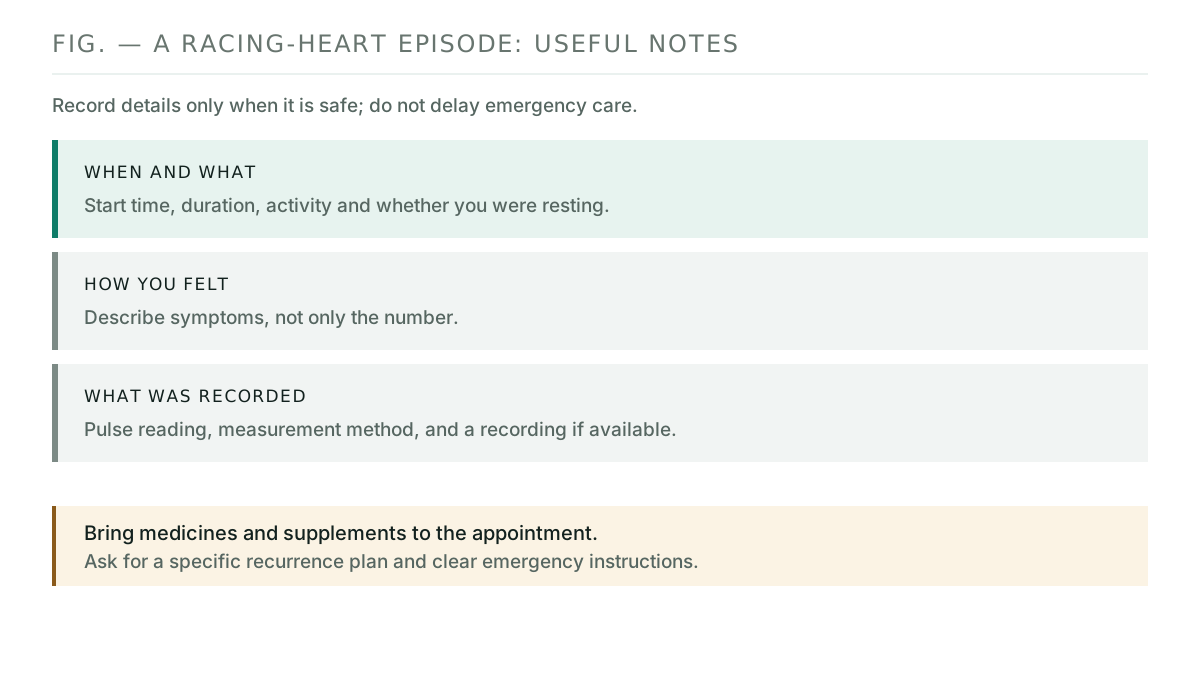
Tachycardia is easier to discuss when you can describe the timing, activity, symptoms and available readings from an episode. A brief record helps the clinician ask focused questions. It should not become a reason to postpone care, repeatedly provoke symptoms, or wait at home during an episode that feels dangerous.
The AHA's arrhythmia care advice recommends keeping a pulse record with the date, time and how you felt, and telling the care team about medicines and supplements. A few clear notes are enough to begin that conversation.
- Timing: when it began, approximately how long it lasted, and whether it stopped abruptly or gradually.
- Context: rest, exercise, an illness, a stressful event or a recently taken product.
- Symptoms: what you felt besides the number, including whether normal activity became difficult.
- Measurement: the actual reading, how it was obtained, and a recording if the device happened to capture one.
Bring questions as well as data. Ask what remains uncertain, how the team wants you to respond to another episode, and which symptoms override the routine plan. If an episode ends before the appointment, describe it anyway. The point of the visit is to decide what needs investigating, not to arrive with a finished diagnosis.
The follow-up should address the reason as well as the rate
Tachycardia follow-up should clarify the working diagnosis, the next test or treatment, and what to do if symptoms recur. A useful plan also reviews contributing conditions and medicines. If the explanation does not fit new or worsening symptoms, contact the care team rather than simply continuing to watch the pulse.
Ask whether there are temporary limits on exercise, work or driving for your situation. A general article cannot provide that clearance. Tell the clinician what you actually need to do, including physical work or a long commute, so the advice is specific enough to use.
Before leaving, repeat the plan back in plain language: what you are taking, what you are recording, when you will be reviewed, and when to seek urgent help. That small step can expose a misunderstanding while someone is available to answer it. Keep emergency instructions somewhere you can find without opening a search engine.
Key takeaways
- Tachycardia generally means an adult resting heart rate above 100 beats per minute; the context still matters.
- A pulse count measures speed, while an ECG helps identify the electrical rhythm.
- Chest pain, fainting or serious breathing difficulty require emergency care, regardless of the displayed number.
- The assessment may look for an underlying illness, medicine effect or abnormal rhythm.
- Keep a brief episode record and follow a clinician's treatment plan rather than trying to lower the number yourself.
Where to go from here
These pages cover the surrounding ground:
- Heart Health After 40 — the broader picture of heart risk and everyday care.
- Heart Palpitations and AFib — how a sensation differs from a rhythm diagnosis.
- Bradycardia Explained — the separate question of a slow heart rate.
- What Happens at an Echocardiogram — what a structural heart test can show.
- All heart articles
Frequently asked questions
What heart rate counts as tachycardia?
Tachycardia generally means a resting heart rate above 100 beats per minute in adults. Exercise, illness, medicines and other circumstances affect the interpretation. A pulse reading alone does not identify the rhythm or cause. Recurrent fast readings at rest deserve medical review, and serious symptoms call for emergency care.
Does tachycardia mean you have heart disease?
Not necessarily. Tachycardia can reflect a response to fever, pain or another condition, as well as an abnormal rhythm or heart disease. The cause cannot be established from the number alone. Tell a clinician when it happens, how long it lasts, and what symptoms or medicines accompany the episodes.
Can anxiety cause tachycardia?
Stress or anxiety can accompany a faster heart rate, but feeling anxious does not prove anxiety is the cause of tachycardia. Other conditions and abnormal rhythms can produce similar experiences. New or recurrent episodes at rest deserve assessment, and chest pain, fainting or serious breathlessness should never be dismissed as anxiety.
Can a smartwatch diagnose tachycardia?
A smartwatch may record a fast pulse or capture information worth showing a clinician, but a pulse reading alone cannot establish the type or cause of tachycardia. Medical assessment may include an ECG and longer monitoring. Do not delay emergency care to obtain a device recording or wait for an alert.
When does tachycardia need emergency care?
Tachycardia with chest pain, fainting, severe dizziness or serious breathing difficulty needs emergency assessment. In the United States, call 911 for a suspected heart emergency and do not drive yourself when faint or severely unwell. Do not wait for the pulse to reach a particular number before seeking help.
How is tachycardia treated?
Tachycardia treatment depends on the cause, the rhythm and symptoms. A clinician may treat an underlying illness, prescribe medicine or recommend a procedure for a specific arrhythmia. Do not change doses or borrow heart medicines to lower a reading. Ask for clear instructions about recurrent episodes, follow-up and emergency symptoms.
Sources
- American Heart Association — Tachycardia: Fast Heart Rate
- American Heart Association — All About Heart Rate
- NHLBI, National Institutes of Health — Arrhythmias: Symptoms
- NHLBI, National Institutes of Health — Arrhythmias: Causes and Triggers
- NHLBI, National Institutes of Health — Arrhythmias: Diagnosis
- NHLBI, National Institutes of Health — Arrhythmias: Treatment
- American Heart Association — Prevention and Treatment of Arrhythmia

Male Health Guide Editorial Team
We write about the health problems men over 40 actually search for at 3 a.m. — and we say plainly when the evidence for a popular product is thin. We do not invent credentials and we do not publish sponsored copy as editorial. Read more about how we work.
Medical disclaimer: This article is general information, not medical advice. We are not doctors, and nothing here diagnoses, treats or cures any condition. Call 911 for a racing heart with chest pain, fainting or serious breathing difficulty. Do not change prescribed medicines or try to treat a new rhythm problem from a pulse reading alone.