Bradycardia: When a Slow Heart Rate Is a Problem
Short answer
Bradycardia means a heart rate below 60 beats per minute. MedlinePlus says it can be normal during sleep and in some physically active people, and that people with mild or no symptoms may not need treatment. Symptoms such as lightheadedness or tiredness are a reason to see your provider. Chest pain, breathing difficulty or fainting mean calling 911.
A slow number on a blood pressure cuff or a fitness watch tends to produce one of two reactions: pride, if you exercise, or worry, if you don't. MedlinePlus explains why neither reaction is reliable on its own. A slow heart rate can occur normally, it says, but bradycardia can also be a sign of a more serious medical condition. In our reading, what separates the two is mostly what comes with the number.
This article covers what counts as bradycardia, how to check your own pulse, why the heart slows down, the causes (including common heart and blood pressure medicines), the symptoms, the age-related condition behind many pacemakers, the tests, the treatment, and when a slow heart rate means calling 911. It sits in this site's Heart section alongside the palpitations vs AFib article, which covers rhythm problems from the other direction.
What counts as a slow heart rate
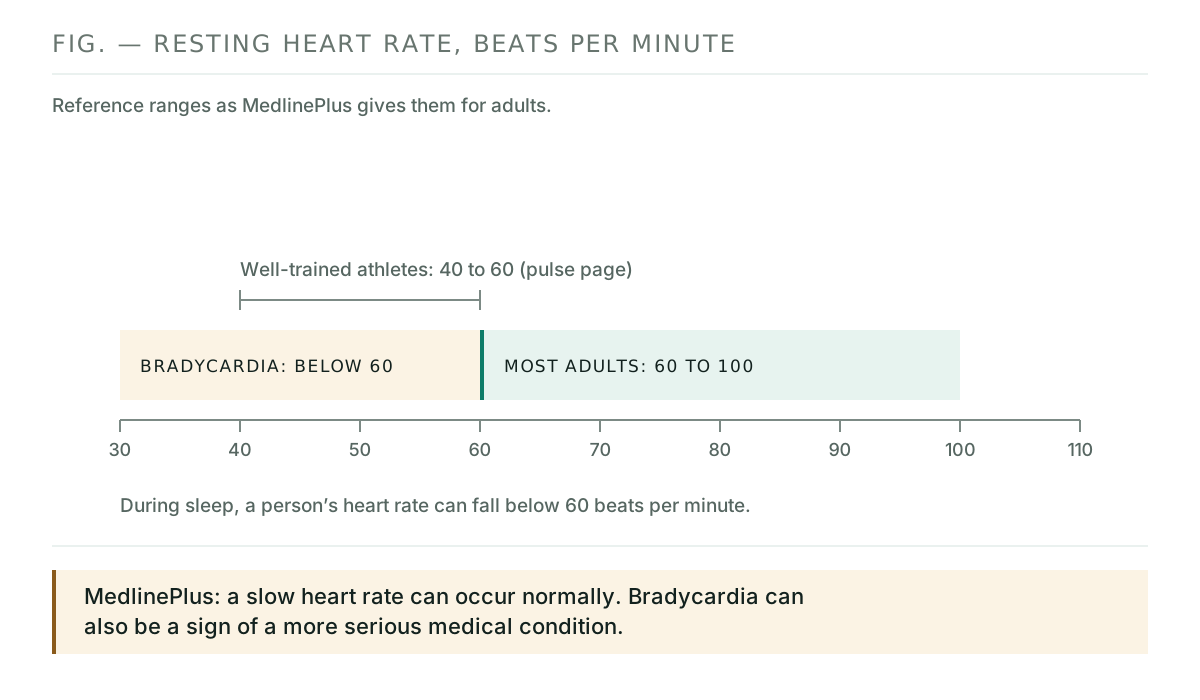
MedlinePlus defines bradycardia as a heart that beats slower than normal, below 60 beats per minute, and says most adults have a normal resting heart rate from 60 to 100 beats per minute. Its page on taking a pulse gives the same adult range, and a separate one for well-trained athletes: 40 to 60 beats per minute.
It is clear that a slow rate is not automatically a problem. During sleep, it says, a person's heart rate can fall below 60 beats per minute, and some physically active people and athletes may have a normal heart rate below 60. The National Heart, Lung, and Blood Institute (NHLBI) puts it this way: some people, especially people who are young or physically fit, may normally have slower heart rates, and if you have a slow heart rate, your doctor can find out whether this is normal for you.
How to check your own pulse
MedlinePlus explains how to measure it. To determine your resting heart rate, you must have been resting for at least 10 minutes. At the wrist, place your index and middle finger over the underside of your opposite wrist, below the base of the thumb, and press with flat fingers until you feel the pulse. Count the beats for 1 full minute, or count for 30 seconds and multiply by 2.
MedlinePlus says to sit or lie down before taking the pulse at the neck, because the neck arteries in some people are sensitive to pressure, and fainting or slowing of the heartbeat can result. It also says not to take the pulse on both sides of the neck at the same time, because doing so can slow the flow of blood to the head and lead to fainting. In our reading, the wrist is the simpler choice.
MedlinePlus says to discuss resting heart rates below the normal values with your health care provider, and that an irregular pulse can also indicate a problem.
Why the heart slows down
MedlinePlus describes the heart as a pump with its own electrical system. The impulse that signals each beat begins in an area called the sinoatrial node (also called the sinus node or SA node), which it calls the heart's natural pacemaker, and travels through the heart along a set electrical pathway. Bradycardia is caused by problems with this conduction system: if the natural pacemaker slows down or the signals are blocked, the time between heartbeats slows down too. A slow heartbeat can be dangerous, it says, if it means your heart can't pump enough blood throughout your body.
The most common type, according to MedlinePlus, is sinus bradycardia, which originates in the sinus node. Other types are sinus node dysfunction (also called sick sinus syndrome) and heart block. The NHLBI calls conditions that slow the heart's electrical signals conduction disorders.
What causes it
MedlinePlus lists several factors that can affect the heart's electrical system and cause bradycardia: age-related changes of the heart; heart conditions such as heart attack or cardiomyopathy; congenital heart disease; inflammatory diseases such as rheumatoid arthritis, scleroderma and lupus; conditions such as amyloidosis, hemochromatosis and sarcoidosis; infections such as endocarditis, Chagas disease and Lyme disease; complications from heart surgery and other cardiac procedures; hypothyroidism; electrolyte imbalances, hypothermia and hypoxia (lack of oxygen); certain medicines; and obstructive sleep apnea.
Age sits at the top of that list, and the NHLBI explains why for heart rhythm problems in general: as we age, changes in our heart such as scarring and the effects of other chronic conditions can raise the risk of arrhythmias, and older adults are also more likely to have conditions such as high blood pressure, heart failure, diabetes and thyroid disease that can lead to them.
The medicines that can slow it
In our reading, this is the most practical section for many readers. MedlinePlus names beta-blockers, calcium channel blockers, antiarrhythmic medicines, opioids and some antidepressants as medicines that can cause bradycardia. Its page on sick sinus syndrome adds digoxin, and says some medicines can make abnormal heart rhythms worse, especially when doses are high. The NHLBI says some medicines can cause low blood pressure or a slow heart rate, and to tell your doctor if you have side effects such as dizziness or palpitations.
Beta-blockers and calcium channel blockers are both among the main families of blood pressure medicine described in this site's blood pressure medication article. MedlinePlus lists lowering the dose or changing the medicine that may be causing a slow heart rate as one of the treatments, and that is a decision for your prescriber.
The NHLBI says not to stop taking your medicines without talking to your doctor, and MedlinePlus's sick sinus syndrome page says the same: do not stop taking any of your medicines unless your provider tells you to do so.
Two causes worth ruling out: sleep apnea and the thyroid
Two items on the MedlinePlus list connect to other sections of this site. The first is obstructive sleep apnea. The NHLBI explains that sleep apnea can stress your heart by preventing it from getting enough oxygen, and names it among the causes a doctor may want to manage. The signs worth noticing at home are covered in this site's snoring or sleep apnea article.
The second is hypothyroidism. MedlinePlus lists it as a cause of bradycardia, and says blood tests may be done to check for underlying conditions such as hypothyroidism or an electrolyte imbalance. The NHLBI likewise lists too much or too little thyroid hormone among the causes of arrhythmias. An underactive thyroid is explained in this site's hypothyroidism article.
The symptoms
MedlinePlus lists the common symptoms of bradycardia as heart palpitations; fainting (syncope) or near fainting; lightheadedness; tiredness; weakness; confusion; breathing difficulty; chest pain; and chest tightness or breathing discomfort during physical activity. Its pacemaker page explains the mechanism: when your heart beats too slowly, your body and brain may not get enough oxygen.
Several of those symptoms are vague. Tiredness and weakness have many causes, as this site's fatigue after 40 article shows. In our reading, the useful question is whether the symptoms line up with a slow pulse you can actually measure, which is something a doctor can check with the tests described below.
Sick sinus syndrome: the age-related form
MedlinePlus describes sick sinus syndrome as a group of heart rhythm problems caused by problems with the sinus node, including a heart rate that is too slow, pauses in the heartbeat, episodes of a fast heart rate, and slow rhythms that alternate with fast ones, sometimes called "tachy-brady syndrome." It most often occurs in people older than age 50, and is often due to scar-like damage to electrical pathways in the heart muscle tissue.
It is uncommon, but not rare, and MedlinePlus says it is the most common reason people need to have an artificial pacemaker implanted. Most of the time there are no symptoms, and symptoms that do occur may mimic those of other disorders. The syndrome is most often progressive, meaning it gets worse over time in most cases. The long-term outlook, it says, is excellent for people who have a permanent pacemaker implanted.
How it is diagnosed
MedlinePlus says your provider will ask about your medical history and the medicines you are taking, listen to your heart with a stethoscope, and measure your blood pressure and pulse rate. The tests it lists first are an electrocardiogram (ECG) and a 24-hour Holter or event monitor recording. Other tests that may be done include an echocardiogram, coronary angiography, an electrophysiology study, an exercise stress test, a heart CT scan, an MRI, and blood tests.
For sick sinus syndrome, MedlinePlus says Holter or longer-term rhythm monitors are effective tools, because they may pick up very slow heart rates and long pauses. What an echocardiogram involves is covered in this site's echocardiogram article.
Treatment, and what a pacemaker involves
MedlinePlus says treatment depends upon the cause of bradycardia and what symptoms you have, and that people with mild or no symptoms may not need treatment. Treatment may include lowering the dose of or changing a medicine that may be causing the slow heart rate, treating any underlying condition, using medicines to increase the heart rate in emergency situations, implanting a heart pacemaker, or a procedure called cardiac neural ablation.
MedlinePlus describes a pacemaker as a small, battery-operated device that senses when your heart is beating too slowly and sends a signal that makes it beat at the correct pace. It says the device is implanted under the skin in a procedure that takes about 1 hour in most cases; you are given a sedative to help you relax, you are awake during the procedure, and most people go home within 1 day. It says pacemakers may be used for people whose heart beats too slowly, and names sinus node disease and heart block as two common problems that cause a slow heartbeat.
On the outlook, MedlinePlus says it depends on the type of bradycardia, your heart function and the underlying cause, and that the outlook is good if the condition is diagnosed and treated early.
When to call a doctor, and when to call 911
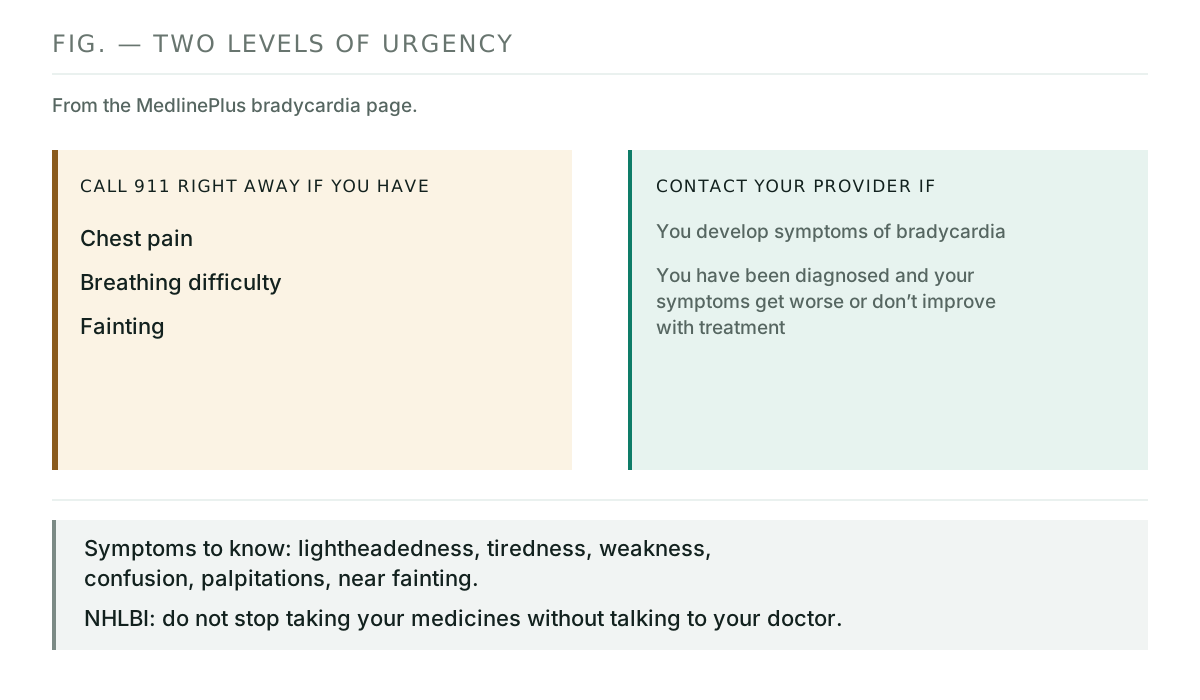
MedlinePlus says to contact your provider if you develop symptoms of bradycardia, or if you have been diagnosed with bradycardia and your symptoms get worse or don't improve with treatment. It says to call 911 or the local emergency number right away if you have chest pain, breathing difficulty or fainting.
The reason to take symptoms seriously is in its list of complications: untreated bradycardia may lead to fainting, heart failure, and, rarely, sudden cardiac arrest. The last two are covered on this site, in the heart failure article and the heart attack vs cardiac arrest article. On prevention, MedlinePlus is modest: not all cases can be prevented, but taking steps to prevent coronary artery disease may help reduce your chance of developing heart rate problems.
Key takeaways
- MedlinePlus defines bradycardia as a heart rate below 60 beats per minute; most adults have a normal resting rate of 60 to 100.
- A slow rate can be normal during sleep and in some physically active people; the NHLBI says your doctor can find out whether it is normal for you.
- Beta-blockers, calcium channel blockers, antiarrhythmics, opioids and some antidepressants can cause it, but do not stop a medicine without your doctor.
- Sick sinus syndrome most often occurs after age 50 and is the most common reason people need a pacemaker, per MedlinePlus.
- Chest pain, breathing difficulty or fainting with a slow heart rate means calling 911 right away.
Where to go from here
If a slow heart rate is what brought you here, these pages cover the surrounding ground:
- Heart Palpitations vs AFib — rhythm problems from the fast side.
- Blood Pressure Medication — two of its main families are on the list of medicines that can slow the pulse.
- Snoring or Sleep Apnea? — one of the causes worth ruling out.
- What Happens at an Echocardiogram — one of the tests you may be sent for.
- All heart articles
Frequently asked questions
What heart rate counts as bradycardia?
MedlinePlus defines bradycardia as a heart rate slower than normal, below 60 beats per minute. It says most adults have a normal resting heart rate of 60 to 100 beats per minute.
Is a resting heart rate in the 50s bad?
Not necessarily. MedlinePlus says heart rate can fall below 60 during sleep and that some physically active people and athletes may have a normal heart rate below 60. The NHLBI says that if you have a slow heart rate, your doctor can find out whether it is normal for you.
Can blood pressure medicine cause a slow heart rate?
Some can. MedlinePlus lists beta-blockers and calcium channel blockers among the medicines that can cause bradycardia, along with antiarrhythmic medicines, opioids and some antidepressants. The NHLBI says not to stop taking your medicines without talking to your doctor.
What are the symptoms of bradycardia?
MedlinePlus lists heart palpitations, fainting or near fainting, lightheadedness, tiredness, weakness, confusion, breathing difficulty, chest pain, and chest tightness or breathing discomfort during physical activity.
When is a slow heart rate an emergency?
MedlinePlus says to call 911 or your local emergency number right away if you have chest pain, breathing difficulty or fainting. It says to contact your provider if you develop symptoms of bradycardia, or if you have been diagnosed and your symptoms get worse or do not improve with treatment.
Does bradycardia always need a pacemaker?
No. MedlinePlus says treatment depends on the cause and your symptoms, and that people with mild or no symptoms may not need treatment. Options include lowering the dose of or changing a medicine that may be causing it, treating an underlying condition, and implanting a pacemaker.
Sources
- MedlinePlus (National Library of Medicine) — Slow heart rate — bradycardia
- MedlinePlus (National Library of Medicine) — Sick sinus syndrome
- MedlinePlus (National Library of Medicine) — Pulse
- MedlinePlus (National Library of Medicine) — Heart pacemaker
- National Heart, Lung, and Blood Institute (NIH) — Types of Arrhythmias
- National Heart, Lung, and Blood Institute (NIH) — What Causes Arrhythmias?
- National Heart, Lung, and Blood Institute (NIH) — Arrhythmias: Treatment
- National Heart, Lung, and Blood Institute (NIH) — Living With Arrhythmias

Male Health Guide Editorial Team
We write about the health problems men over 40 actually search for at 3 a.m. — and we say plainly when the evidence for a popular product is thin. We do not invent credentials and we do not publish sponsored copy as editorial. Read more about how we work.
Medical disclaimer: This article is general information, not medical advice. We are not doctors, and nothing here diagnoses, treats or cures any condition. Do not stop or change a prescribed medicine because of a slow pulse without talking to the provider who prescribed it, and call 911 for chest pain, breathing difficulty or fainting.