Enclomiphene: Testosterone Up, Sperm Kept, Not Approved
Short answer
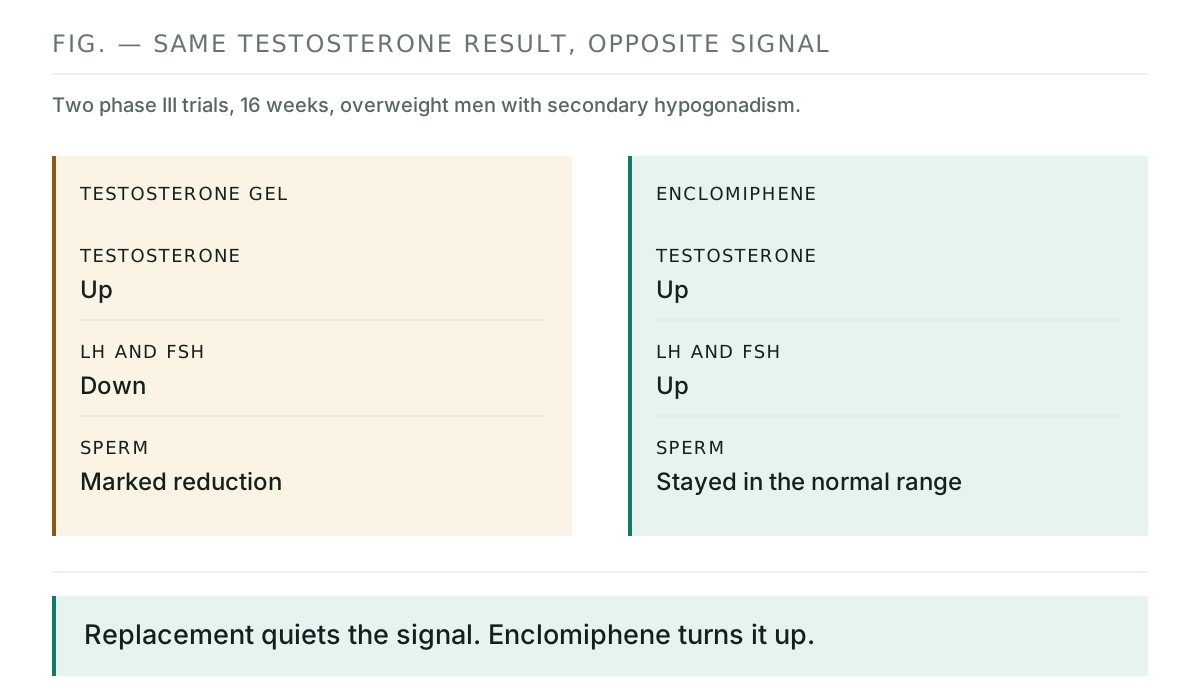
Enclomiphene is a pill that blocks estrogen’s feedback signal in the brain, so the testicles are told to make more testosterone themselves. In trials it raised testosterone about as well as a gel while sperm counts stayed in the normal range. It has never been FDA-approved, and in the United States it is supplied by compounding pharmacies.
This page belongs to the testosterone section, and it covers a drug that section had only mentioned in passing. Enclomiphene comes up in the same telehealth setting described in TRT clinics: the evaluation, and the cost, usually as the option for men who want a higher number without injections or gels. It deserves a page of its own, because its story has two halves that rarely get told together.
The first half is that it does what it is sold to do, in randomized trials, and does one thing testosterone itself cannot. The second half is that regulators have not accepted a higher testosterone reading as enough, and the drug has never been approved. Both halves are true. This page sets them side by side.
We earn nothing from any of this. There are no affiliate links on this site, nothing here is sponsored, and we have no arrangement with any clinic or pharmacy, which is why this page can describe the benefit and the regulatory record in the same breath.
What enclomiphene is: one half of an older drug
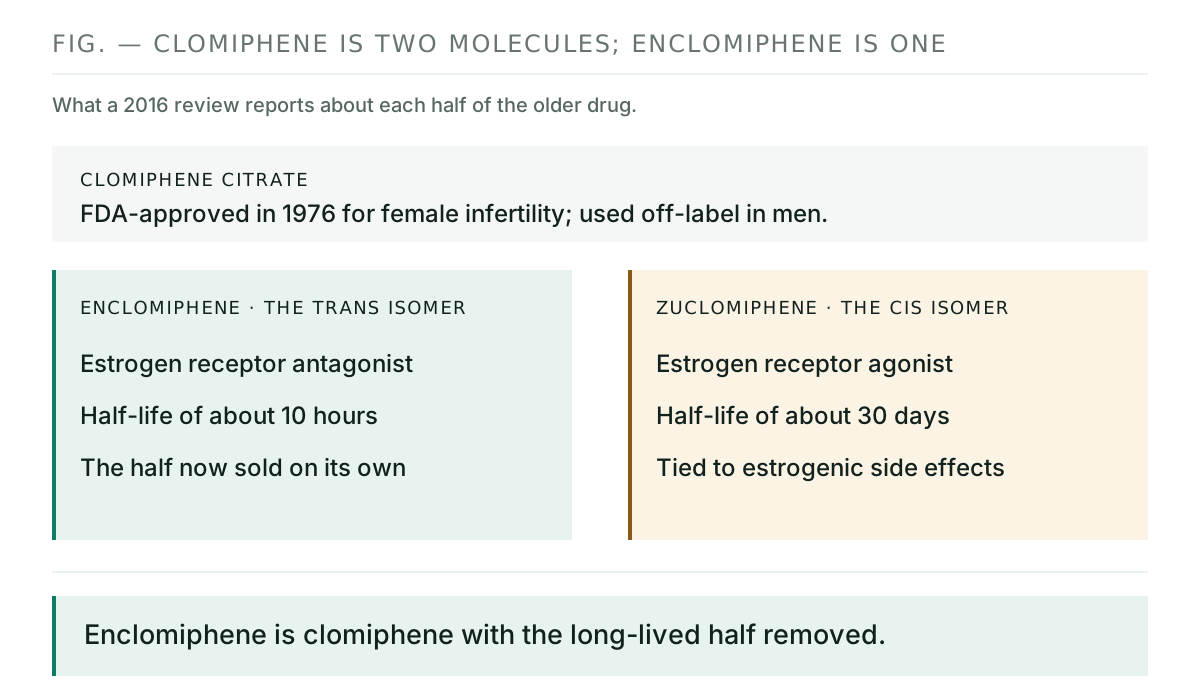
Enclomiphene was not designed from scratch. It is one of the two components of clomiphene citrate, a drug that a 2016 review in Expert Opinion on Pharmacotherapy notes was approved by the FDA in 1976 to treat female infertility, and which has been used off-label for many years in men with low testosterone or infertility.
Clomiphene is a mix of two mirror-image forms of the same molecule, called isomers. The review describes them as behaving differently enough to matter. Enclomiphene, the trans isomer, acts as an estrogen receptor antagonist. Zuclomiphene, the cis isomer, acts as an estrogen receptor agonist, and the review attributes to it the estrogenic side effects often reported with clomiphene.
The review reports that enclomiphene has a half-life of approximately 10 hours, while zuclomiphene was found to have a far longer half-life, 30 days, resulting in persistent side effects lasting beyond the therapeutic effect. Rodriguez et al., Expert Opinion on Pharmacotherapy, 2016
So the idea behind enclomiphene is subtraction. Take clomiphene, remove the long-lived half that pushes in the estrogenic direction, and keep the half that does the intended work.
It turns the signal up instead of replacing the product
The pillar of this section, low testosterone after 40, describes the system as a factory and a signal. The testicles are the factory. The signal is luteinizing hormone, sent from the brain, telling the factory how much to make. The brain decides how loud to make that signal partly by sensing estrogen. When it senses enough, it turns the signal down.
The review describes enclomiphene as promoting testicular testosterone production by occupying estrogen receptors in the hypothalamus, thereby preventing that negative feedback. The brain reads less estrogen than is there, and responds by raising luteinizing hormone and follicle-stimulating hormone. The factory gets a louder instruction.
Testosterone therapy works the other way around. It supplies the product from outside, the brain senses plenty, and the signal falls. That is the mechanism behind the fertility effect we describe in testosterone replacement therapy: what each form does, because sperm production depends on that signal continuing. The phase III paper on enclomiphene put the contrast in its title: restoration instead of replacement.
It only makes sense when the signal is the problem
A louder signal helps only if the factory can respond to it. That limits who this drug is even a candidate for, and it is the detail most likely to be skipped in a short online intake.
The phase II and phase III trials described below enrolled men with secondary hypogonadism: low testosterone together with luteinizing hormone that was low or normal, meaning the signal was not rising to compensate. The phase III studies required a morning total testosterone of 300 ng/dL or under and low or normal luteinizing hormone, each measured on two separate occasions. Where the testicle itself has failed, the picture is different, and the same review states that testosterone is currently the only option for men with primary hypogonadism.
This is why the American Urological Association guideline says, as a strong recommendation, that clinicians should measure serum luteinizing hormone in patients with low testosterone. Without that number nobody knows which of the two problems is being treated. How the test should be done is set out in the testosterone test that actually tells you something.
What the trials found for testosterone
On the outcome the drug is sold for, the trial record is consistent. A phase II trial published in Fertility and Sterility in 2014 found that enclomiphene produced increases in morning serum testosterone similar to those obtained with a topical testosterone gel in men with secondary hypogonadism. Two parallel phase III trials followed, randomized, double-blind and placebo-controlled, comparing two doses of enclomiphene with a testosterone gel over 16 weeks in overweight men aged 18 to 60.
Total testosterone increased between baseline and 16 weeks in all the treatment groups. Luteinizing hormone and follicle-stimulating hormone increased in the enclomiphene groups and decreased in the testosterone gel group. The authors concluded that enclomiphene consistently increased serum total testosterone, restoring normal levels. Kim et al., BJU International, 2016
A 2025 systematic review and meta-analysis in the Archives of Endocrinology and Metabolism pooled randomized trials of this drug class in men with functional hypogonadism. One caution before the numbers: it combined trials of clomiphene and enclomiphene and reported them together as selective estrogen receptor modulators, so its figures describe the class and not enclomiphene alone.
Compared with placebo, this class of drugs improved total testosterone by a mean difference of 273.76 ng/dL, with a 95% confidence interval of 191.87 to 355.66. Heterogeneity was high, at 89%. No significant difference in total testosterone was observed between the drug class and testosterone gel. Hohl et al., Archives of Endocrinology and Metabolism, 2025
High heterogeneity means the individual trials disagreed with each other about the size of the effect, so the average is a rough guide and not a promise of what one man will see. The pooled direction was clear.
What happened to sperm
This is the finding that separates enclomiphene from testosterone, and it showed up at every stage of testing.
The earliest comparison was small: a randomized, open-label study in 12 men with secondary hypogonadism who had previously been treated with topical testosterone. Enclomiphene elevated sperm counts in seven out of seven men at three months and six out of six at six months, with concentrations in the range of 75 to 334 million per milliliter. At three months the gel was ineffective in raising sperm counts above 20 million per milliliter for all five men who received it. Twelve men is a proof of principle, and the authors called it that.
The phase III trials then tested the same question at scale, with men providing semen samples twice at the start and twice at the end. The published result was that enclomiphene maintained sperm concentration in the normal range over the treatment period, while there was a marked reduction in spermatogenesis in the testosterone gel group. The 2016 review, which counted 265 men across the two trials, summarized it as a marked decrease in sperm counts in the testosterone groups of both studies.
That matters because of how firmly the guideline treats the other side of the comparison. As we set out in testosterone side effects, the American Urological Association says exogenous testosterone therapy should not be prescribed to men who are currently trying to conceive, as a strong recommendation. The same guideline says clinicians may use aromatase inhibitors, human chorionic gonadotropin, selective estrogen receptor modulators, or a combination, in men with testosterone deficiency who want to maintain fertility. That statement is a conditional recommendation on its lowest evidence grade, and it names the drug class without singling out enclomiphene.
Why it has never been approved
With results like those, the obvious question is why this is not simply a licensed medicine. The answer is the most useful thing on this page, because it is the same question this section keeps returning to: is moving the number the same as helping the man?
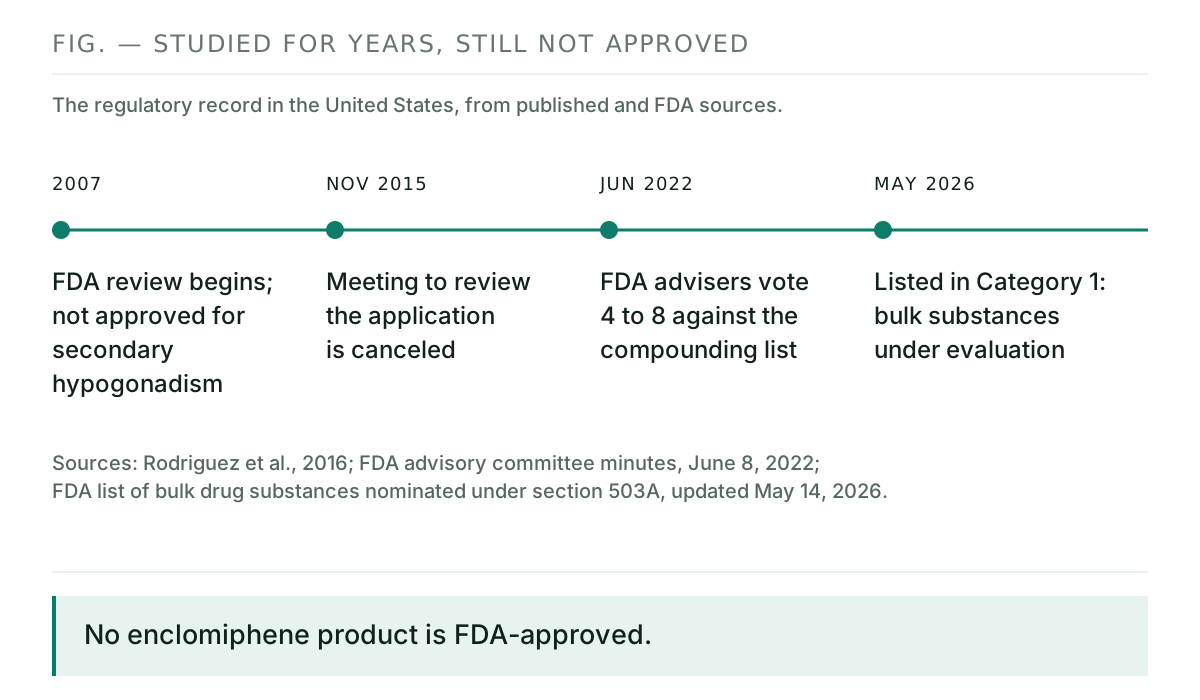
The 2016 review gives the regulatory history up to that point. Enclomiphene had been under review by the FDA since 2007, when it was not approved for the treatment of secondary hypogonadism.
The FDA did not consider increases in testosterone levels alone to be sufficient evidence for a non-testosterone therapy for hypogonadism.
According to the same review, the agency also rejected normalization of luteinizing hormone and quality of life improvements as indications, while remaining willing to reconsider the drug on other grounds, among them fertility as measured by sperm counts. In November 2015 a meeting scheduled to review the new drug application was canceled because of concerns over the bioanalytical method of validation. The reviewers wrote that, at that point, the future of enclomiphene was uncertain.
The question came back in a different form in June 2022, when the FDA’s Pharmacy Compounding Advisory Committee was asked whether enclomiphene citrate should go on the list of bulk substances that pharmacies may use for compounding. The use evaluated was the one in the trials: raising testosterone, luteinizing hormone and follicle-stimulating hormone to normal levels in secondary hypogonadism. The FDA proposed that it not be included.
The committee voted 4 to 8, with no abstentions, against placing enclomiphene citrate on the list. The minutes record that several members who voted no noted a lack of clinical efficacy evidence, and that one member stated more studies need to be conducted. FDA, Pharmacy Compounding Advisory Committee, final summary minutes, June 8, 2022
The two episodes point the same way. In 2007 the FDA said a rise in testosterone alone was not sufficient evidence, and in 2022 several advisers who voted no cited a lack of clinical efficacy evidence. The two votes were about different things, approval in one case and the compounding list in the other, and the published minutes are a summary and not a transcript. It is worth noticing, too, who ran the trials. The lead authors of the 2014 phase II study were employees of Repros Therapeutics, the company developing the drug, which is normal for drug development and is also a reason independent confirmation carries weight.
How it reaches patients anyway
If it is not approved, how is it being prescribed? Through compounding, where a pharmacy prepares a medicine from a bulk ingredient to fill a prescription.
An advisory committee vote is a recommendation, not a final decision, and the FDA’s list of nominated bulk substances, updated on May 14, 2026, still places enclomiphene citrate in Category 1, headed “Bulk Drug Substances Under Evaluation.” The agency explains that it does not intend to take action against a compounder for compounding drugs using substances in that category, provided the conditions in its guidance are met. That is the footing on which the drug is currently supplied. It is not in Category 2, the list of substances the agency says raise significant safety risks.
What that status does not confer is the thing approval exists to provide. The FDA’s own description of compounded drugs is direct.
Compounded drugs are not FDA-approved. This means that FDA does not verify the safety, effectiveness or quality of compounded drugs before they are marketed.
Two practical things follow. The capsule you receive depends on the pharmacy that made it, so which pharmacy that is becomes a fair question. And a status described as “under evaluation” can change, which is worth knowing before building a long-term plan around one drug.
What is known about side effects, and what is not
The short-term picture from the trials looks mild. The 2016 review reports that across the phase II and phase III trials the side effects recorded included elevated estradiol levels, headache and abdominal discomfort, and describes the drug as appearing to be well tolerated, while noting that its adverse effects have not been directly studied. It then adds the sentence that matters most for a man planning to take it for years: the long-term effects of enclomiphene remain unknown.
The one direct comparison with its parent drug comes from a 2024 study at Baylor College of Medicine of 66 men who had been prescribed clomiphene and were later switched to enclomiphene.
The change in estradiol was lower on enclomiphene than on clomiphene, −5.92 against 17.50 pg/mL. Decreased libido, reduced energy and mood changes were reported significantly less often, and the odds of an adverse event were lower, with an odds ratio of 0.18 and a 95% confidence interval of 0.07 to 0.44. The difference in testosterone increase between the two drugs was not statistically significant. Saffati et al., Translational Andrology and Urology, 2024
That is encouraging, and it comes with limits the authors state themselves. It was a retrospective study at a single institution with a small sample, and its scope did not cover long-term effects on bone health, sexual function or body composition. The same men took the two drugs one after the other with no washout period in between, and the enclomiphene change was measured from the levels reached on clomiphene, so the two changes do not start from the same baseline. The authors call that an important limitation. Two of the authors also disclosed consulting relationships with pharmaceutical companies. It supports the idea that removing the long-lived isomer helps. It does not settle what years of use do.
Enclomiphene, clomiphene and testosterone side by side
| Testosterone therapy | Clomiphene | Enclomiphene | |
|---|---|---|---|
| What it does to the signal (LH and FSH) | Lowers it | Raises it | Raises it |
| Sperm production in trials | Marked reduction | Used off-label to raise sperm counts | Stayed in the normal range |
| Regulatory status in men | FDA-approved products exist | Approved in 1976 for female infertility; off-label in men | Not approved; compounded |
| Who it can work for | Primary or secondary hypogonadism | Used off-label in secondary hypogonadism | Studied in secondary hypogonadism |
The table makes one thing clear that the marketing tends to blur. Enclomiphene is not a gentler form of testosterone therapy. It is a different intervention at a different point in the system, with a different evidence base and a different legal status.
Questions worth asking before you take it
None of this argues for or against the drug for any one man. It does suggest what a careful prescriber should be able to answer.
- Was luteinizing hormone measured? The trials enrolled men whose signal was low or normal. Without that result, nobody knows whether you resemble the men who were studied.
- Was the low reading confirmed? The phase III trials required two separate morning measurements at 300 ng/dL or under.
- Is fertility part of the reason? Preserving sperm production is the clearest advantage this drug showed over testosterone. If children are not in your plans, say so, because it changes the comparison.
- Has the reason for the low number been looked for? Weight, sleep and other conditions can all push it down, as how to increase testosterone naturally and testosterone and sleep set out.
- Which pharmacy makes the capsule? It is a compounded product, so its quality rests with the pharmacy and not with an FDA review.
- What gets rechecked, and when? The trials tracked testosterone, estradiol and the two signal hormones. Ask which of those will be followed for you.
- What is the plan if the rules change? The ingredient is listed as under evaluation, not as settled.
Where that leaves it
Enclomiphene is easier to judge once the two halves are held together. In randomized trials it raised testosterone about as well as a gel, by turning up the body’s own signal, and sperm production was maintained where the gel reduced it. For a man with confirmed secondary hypogonadism who wants to keep his fertility, that is a real and specific advantage, and the urology guideline leaves room for this class of drug in exactly that situation.
It is also a drug that has been before the FDA more than once without being approved or cleared for the compounding list, and whose long-term effects the published review describes as unknown. A man can reasonably decide to take it. He should make that decision knowing both things.
Key takeaways
- Enclomiphene is the trans isomer of clomiphene, a drug approved in 1976 for female infertility; a 2016 review gives its half-life as about 10 hours, against 30 days for the other isomer, zuclomiphene.
- It works by occupying estrogen receptors in the hypothalamus, preventing negative feedback, so luteinizing hormone and follicle-stimulating hormone rise and the testicles make more testosterone.
- The phase II and phase III trials enrolled men with secondary hypogonadism, where the signal is low or normal; the same review states testosterone is the only option for primary hypogonadism.
- In two 16-week phase III trials, testosterone rose in all treatment groups, while sperm concentration stayed in the normal range on enclomiphene and fell markedly on testosterone gel.
- The FDA did not approve it for secondary hypogonadism, not considering increases in testosterone levels alone sufficient evidence; in June 2022 an FDA advisory committee voted 4 to 8 against adding it to the compounding list.
- As of the FDA list updated May 14, 2026, enclomiphene citrate is in Category 1, bulk drug substances under evaluation; it is supplied as a compounded drug, which the FDA does not verify for safety, effectiveness or quality.
- Short-term side effects reported in trials were elevated estradiol, headache and abdominal discomfort; the review reporting them notes that adverse effects have not been directly studied and that long-term effects remain unknown.
Where to go from here
Enclomiphene is one option among several, and it only makes sense after the diagnosis is sound. These are the pages on either side of it:
- Low Testosterone After 40: The Number and What It Means — the guide to the whole subject, including the factory and the signal.
- The Testosterone Test That Actually Tells You Something — why luteinizing hormone has to be on the panel.
- Testosterone Replacement Therapy: What Each Form Does — the approved alternative, form by form.
- Testosterone Side Effects: What Shows Up, and When — including the effect on sperm production that enclomiphene avoids.
- TRT Clinics: The Evaluation, and the Cost — the telehealth setting where this drug is often offered.
- How to Increase Testosterone Naturally: What Works — what to try before any prescription.
Frequently asked questions
What is enclomiphene?
Enclomiphene is one of the two isomers that make up clomiphene citrate, a fertility drug approved for women in 1976. It blocks estrogen receptors in the hypothalamus, which prevents negative feedback and raises luteinizing hormone and follicle-stimulating hormone, so the testicles produce more testosterone on their own.
Does enclomiphene raise testosterone as much as TRT?
In trials, roughly yes. A phase II trial found increases in morning testosterone similar to a topical gel, and in two 16-week phase III trials testosterone rose in all treatment groups. A 2025 meta-analysis of this drug class found no significant difference in total testosterone compared with testosterone gel.
Does enclomiphene affect fertility?
In the trials it preserved it. Two phase III studies found enclomiphene maintained sperm concentration in the normal range over 16 weeks, while the testosterone gel group showed a marked reduction in sperm production. That is the main difference between the two, since the urology guideline says testosterone therapy should not be prescribed to men who are currently trying to conceive.
Is enclomiphene FDA-approved?
No. The FDA did not approve it for secondary hypogonadism, and in June 2022 an FDA advisory committee voted 4 to 8 against adding it to the list of substances for compounding. As of the list updated May 14, 2026, it is in Category 1, under evaluation, and is supplied as a compounded drug.
What are the side effects of enclomiphene?
Across the phase II and phase III trials, a 2016 review lists elevated estradiol levels, headache and abdominal discomfort, and describes the drug as appearing well tolerated, while noting that its adverse effects have not been directly studied. The same review states that the long-term effects of enclomiphene remain unknown.
Is enclomiphene the same as clomiphene (Clomid)?
No. Clomiphene is a mixture of two isomers, enclomiphene and zuclomiphene. Enclomiphene is the estrogen receptor antagonist; zuclomiphene acts as an agonist and has a much longer half-life. In a 2024 study of 66 men who took both in turn, enclomiphene was associated with fewer documented adverse events.
Sources
- Kim ED, McCullough A, Kaminetsky J. BJU International, 2016 — Oral Enclomiphene Citrate Raises Testosterone and Preserves Sperm Counts in Obese Hypogonadal Men, Unlike Topical Testosterone: Restoration Instead of Replacement
- Wiehle RD et al. Fertility and Sterility, 2014 — Enclomiphene Citrate Stimulates Testosterone Production While Preventing Oligospermia: A Randomized Phase II Clinical Trial Comparing Topical Testosterone
- Kaminetsky J et al. Journal of Sexual Medicine, 2013 — Oral Enclomiphene Citrate Stimulates the Endogenous Production of Testosterone and Sperm Counts in Men With Low Testosterone: Comparison With Testosterone Gel
- Rodriguez KM, Pastuszak AW, Lipshultz LI. Expert Opinion on Pharmacotherapy, 2016 — Enclomiphene Citrate for the Treatment of Secondary Male Hypogonadism
- Hohl A et al. Archives of Endocrinology and Metabolism, 2025 — Clomiphene or Enclomiphene Citrate for the Treatment of Male Hypogonadism: A Systematic Review and Meta-Analysis of Randomized Controlled Trials
- Saffati G et al. Translational Andrology and Urology, 2024 — Safety and Efficacy of Enclomiphene and Clomiphene for Hypogonadal Men
- Mulhall JP et al. Journal of Urology, 2018 — Evaluation and Management of Testosterone Deficiency: AUA Guideline
- U.S. Food and Drug Administration, June 8, 2022 — Final Summary Minutes of the Pharmacy Compounding Advisory Committee Meeting
- U.S. Food and Drug Administration, updated May 14, 2026 — Bulk Drug Substances Nominated for Use in Compounding Under Section 503A of the Federal Food, Drug, and Cosmetic Act
- U.S. Food and Drug Administration — Bulk Drug Substances Used in Compounding Under Section 503A of the FD&C Act
- U.S. Food and Drug Administration — Compounding and the FDA: Questions and Answers

Male Health Guide Editorial Team
We write about the health problems men over 40 actually search for at 3 a.m. — and we say plainly when the evidence for a popular claim is thin. We do not invent credentials and we do not publish sponsored copy as editorial. Read more about how we work.
Medical disclaimer: This article is general information about enclomiphene and how it compares with other treatments for low testosterone, and is not medical advice. It is not a substitute for diagnosis or treatment, and it is not a recommendation to take or to avoid any drug. Please speak to a qualified healthcare professional about your own situation, and never start, stop or change a prescribed treatment based on what you read online.