TRT Clinics: The Evaluation, and the Cost
Short answer
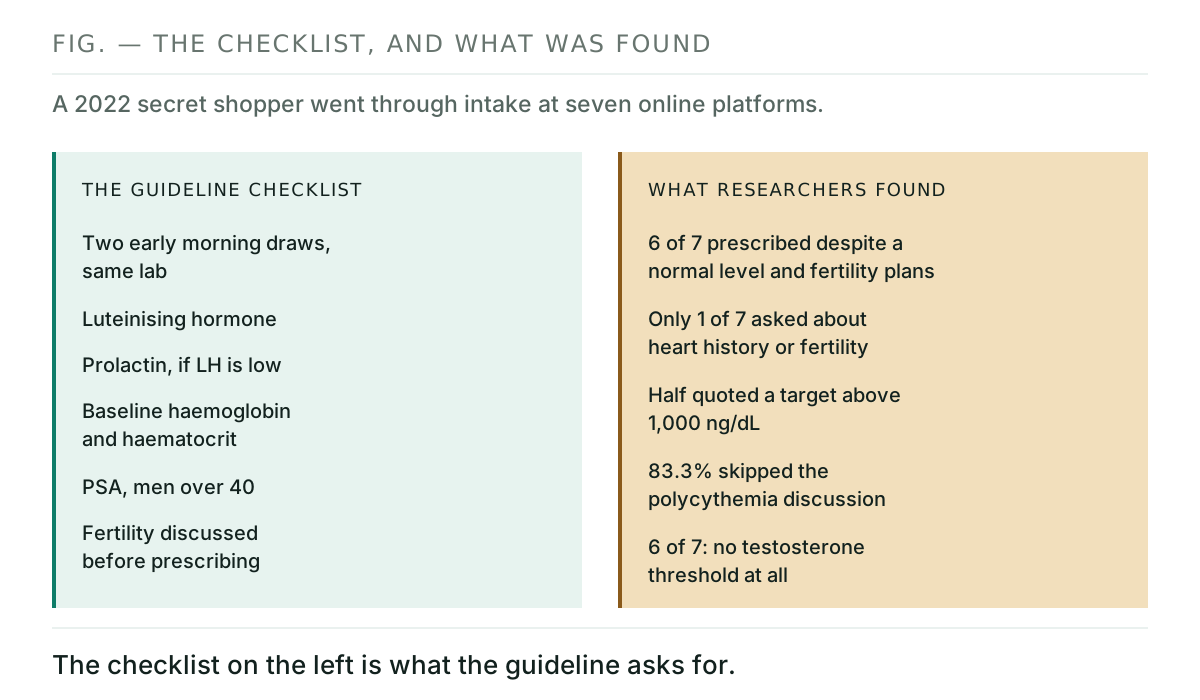
A real TRT clinic evaluation requires two morning blood draws, luteinising hormone, baseline blood counts and PSA before the first dose — not a symptom quiz and a same-day prescription. A 2022 study found six of seven online TRT clinics skipped that standard, and a year of treatment through them can cost three to ten times more than the same drug at a clinic using insurance.
Every article about testosterone clinics on the internet is written by a clinic. That is not a criticism so much as an observation about the search results: the pages that rank for “TRT clinic near me” and “TRT cost” are, almost without exception, advertisements dressed as guides.
This page is not one of those. We do not name any clinic, good or bad, and we do not sell testing, treatment or a referral to either. What follows is what two peer-reviewed studies, the federal drug scheduling for testosterone, and the FDA's own current position actually say about the industry you are about to hand your arm to.
We earn nothing from any of this. There are no affiliate links on this site, nothing here is sponsored, and that is precisely why this page can describe a business model that a paid page cannot afford to.
What a real evaluation is supposed to include
We have covered this ground in detail in the rest of the cluster, so here it is compressed into what to expect walking in. The American Urological Association guideline is specific about the sequence, and none of it is optional if a clinic is actually following it.
| Step | What the guideline requires | Grade |
|---|---|---|
| Testosterone measurement | Two total testosterone levels, both early morning, same laboratory, same assay | Strong |
| Luteinising hormone | Measured in every patient with a confirmed low level | Strong |
| Prolactin | Measured if LH is low or low-normal | Strong |
| Haemoglobin and haematocrit | Baseline before the first dose, to flag polycythemia risk | Strong |
| PSA | Men over 40, before therapy begins | Clinical principle |
| Fertility discussion | If future fertility matters to the patient, before prescribing | Strong |
That sequence is not bureaucracy for its own sake. Two of our earlier articles explain why each piece matters: the testosterone test covers why one draw is a snapshot rather than a measurement, and low testosterone after 40 covers why the same low number can come from three different places, each needing a different answer. A clinic that skips the LH test has skipped the question of why the level is low, not just whether it is.
One detail worth carrying into any conversation with a clinic: the guideline itself avoids the word “replacement.” The Panel explicitly uses the term testosterone therapy rather than testosterone replacement therapy, to reflect that treatment can mean exogenous testosterone or alternatives such as SERMs or hCG — not one product by default.
What a secret shopper found at seven platforms
Description of a standard is one thing. Whether the industry follows it is a separate, answerable question, and it has been answered. In 2022, researchers led by a urologist at Northwestern published a study in JAMA Internal Medicine that did the obvious thing nobody else had done formally: they posed as a patient and went through the actual intake process at seven U.S. telehealth platforms offering testosterone therapy.
The shopper's script was deliberately disqualifying. He reported an above-normal testosterone level and said he wanted to have children in the future — two things that, under the guideline, should have stopped a prescription before it started.
Despite a normal-to-high testosterone level and a stated desire for future fertility, six of the seven platforms offered testosterone therapy through a licensed medical professional. Only one of the seven asked about recent cardiovascular events or future fertility plans at all. Dubin et al., JAMA Internal Medicine, 2022
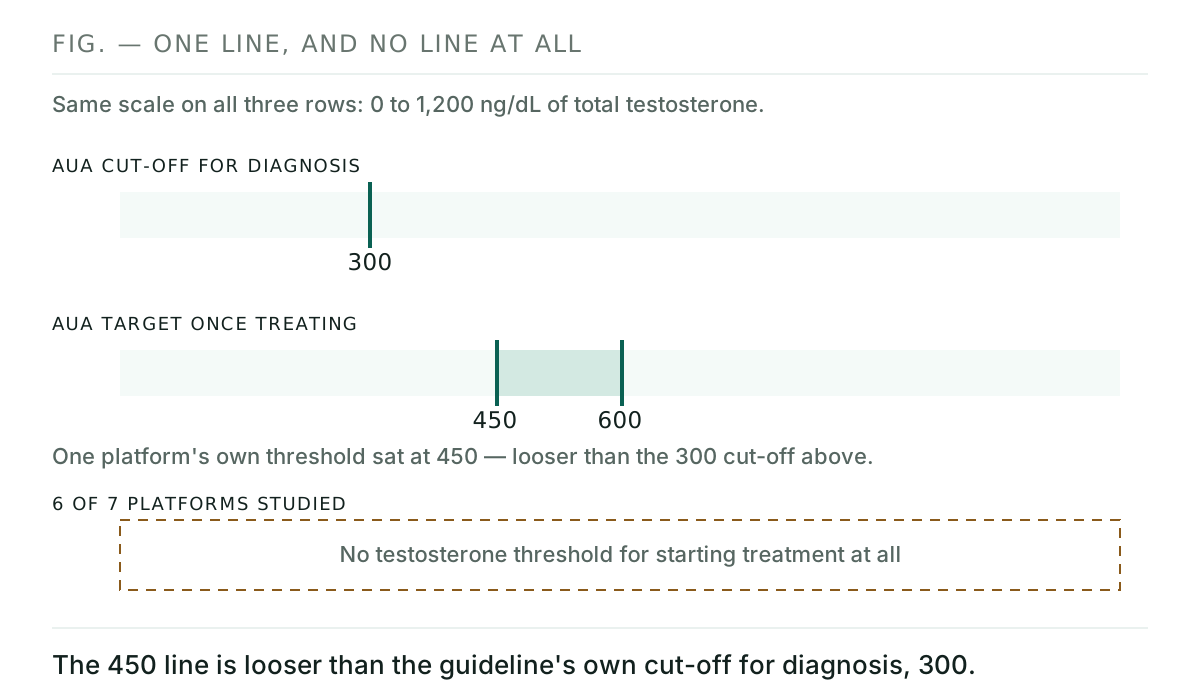
The rest of the findings describe a pattern rather than an isolated lapse. Half of the platforms quoted a treatment target above 1,000 ng/dL without discussing the fertility risk that comes with it — a target roughly double the middle-tertile range of 450 to 600 ng/dL that the guideline itself sets as the aim of therapy. And 83.3 per cent of the platforms did not discuss the risk of polycythemia, the blood-thickening side effect covered in our article on side effects, at all.
The detail that says the most, though, is about thresholds. One of the seven platforms set its own treatment threshold at a total testosterone below 450 ng/dL — already looser than the guideline's 300 ng/dL cut-off, meaning it would treat men the guideline would not. The other six platforms had no testosterone threshold for starting treatment at all.
It means the number on your lab report is not what decides whether you get a prescription. If six of seven platforms will treat regardless of the level, the level was never the gate — the symptom questionnaire and the willingness to pay were.
What the same drug costs, and where
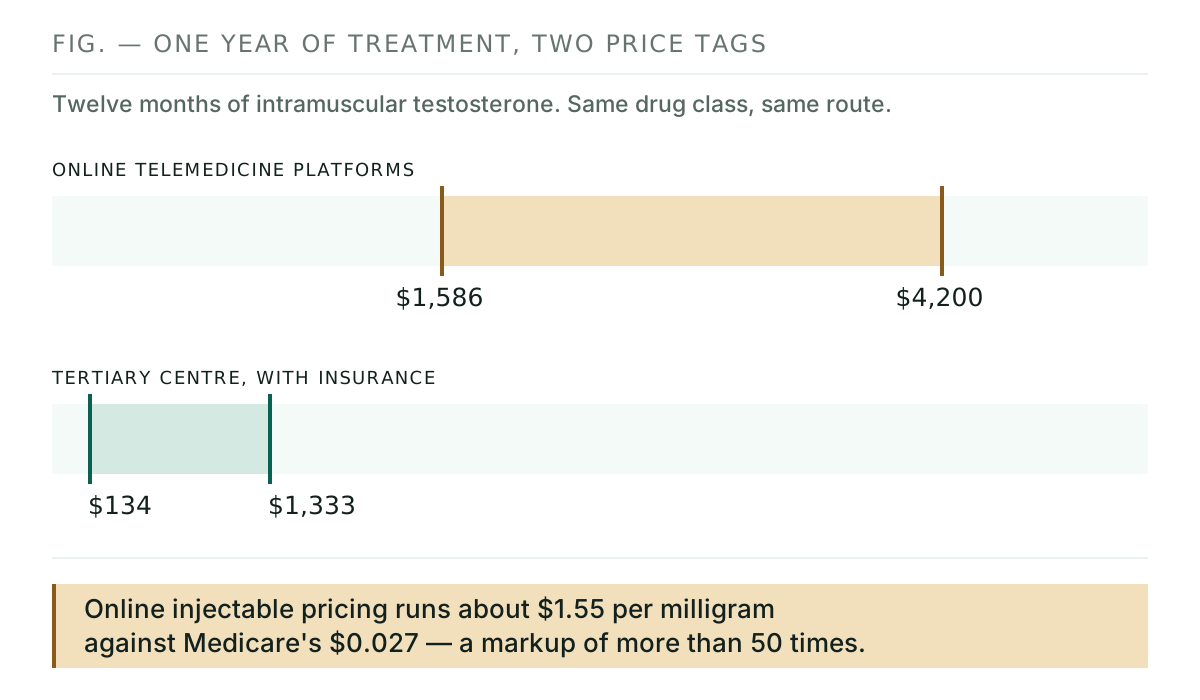
This is the half of the search term that most articles skip, because most articles are written by the businesses being compared. A 2022 cost analysis put real numbers beside real websites, comparing what direct-to-consumer telemedicine platforms charge for testosterone therapy against the estimated cost of the same treatment at a tertiary medical centre using insurance.
A year of intramuscular testosterone treatment cost $1,586 to $4,200 through the online platforms studied, compared with $134.01 to $1,333.04 at a tertiary centre across varying insurance models. Transdermal testosterone showed a similarly wide gap. The initial consultation, by contrast, was cheapest through Medicare and the telemedicine platforms alike — the difference shows up in the months that follow, not the first visit. Jesse et al., The Journal of Sexual Medicine, 2022
Separate reporting found the same pattern from a different angle, looking at the price of the drug itself rather than the whole course of care. Injectable testosterone cypionate costs the Medicare program about $0.027 per milligram. Online sellers offering the same drug directly to consumers were found charging roughly $1.55 per milligram — a markup of more than 50 times.
A separate figure worth knowing before your first call: several telehealth sites price a monthly subscription at $120 to $135, not including an initial mail-back lab kit that runs around $60 more. None of that is illegal. It is simply a business built on a largely uninsured product with room for a very wide margin, and knowing the range before you call is the only leverage a patient has.
Why an uninsured drug can carry that markup
The economics here are not a mystery, and they are worth naming plainly. A health economist studying this market described the mechanism directly: heavy advertising has fuelled demand for a product most insurance does not cover, and that combination — strong demand, weak insurance coverage, low price transparency — is exactly the condition that allows a 50-times markup to survive contact with the market.
It also explains something men frequently ask us: why would a clinic want to treat someone whose level does not clearly require it? A patient on lifelong therapy, paying cash every month, at a price the clinic sets rather than a payer, is a better customer than a patient the clinic diagnoses out of a prescription after one visit.
The statistic almost every ad quotes, and what it leaves out
There is one number that shows up in an enormous share of the marketing for this industry: the claim that testosterone falls roughly 1 per cent a year after 40. It comes from a real 2002 study, and the number itself is not fabricated. What gets left out is who was in it.
A researcher who examined the underlying data pointed out that the sample included older men in deteriorating health, whose falling levels tracked their illnesses rather than ordinary ageing. His conclusion, stated plainly: healthy men do not show that drop.
A statistic drawn from unwell men, applied to you as if it described healthy ageing, is exactly the kind of thing a real evaluation is supposed to catch — by measuring your level and your symptoms, not by assuming a population average applies to your body.
Testosterone is a controlled substance, and that is not incidental
This is the piece of context that almost never appears in consumer writing about TRT, and it changes how the “no threshold” finding above should read. Testosterone is not an over-the-counter supplement being loosely regulated. It is a Schedule III controlled substance under U.S. federal law, in the same category the DEA uses for ketamine, alongside roughly sixty other anabolic steroids swept in by the Anabolic Steroid Control Acts of 1990 and 2004.
Schedule III status means a real, documented medical basis is legally required to prescribe it — not simply a symptom checklist and a card number. A platform with no testosterone threshold at all is not just deviating from a professional guideline. It is operating at the edge of what the drug's legal classification is built to prevent: prescribing based on demand rather than diagnosis.
There is a real nuance here worth stating honestly. Prescribing testosterone off-label — for a use not on the FDA-approved label — is legal, and doctors do it across many conditions. Marketing a drug for an unapproved use is a different matter and is restricted. That distinction is why a clinic can legally treat you outside strict label terms while still being required, separately, to have actually diagnosed you first.
What the FDA itself says testosterone is approved for
The FDA's own current guidance is unambiguous on the point that matters most here, and it is worth quoting directly rather than paraphrasing.
“None of the FDA-approved testosterone products are approved for use in men with low testosterone levels who lack an associated medical condition.” Approved uses require an identified cause — testicular failure, or a problem with the hypothalamus or pituitary gland — not simply a number below a line.
This is the same distinction our pillar article makes about the three origins of a low reading. It is also, as of this year, a moving target worth watching. In June 2026, after reviewing the TRAVERSE cardiovascular trial and other new data, the FDA requested updates to testosterone prescribing information that remove the long-standing limitation stating that safety and efficacy for age-related hypogonadism “have not been established.”
That update does not mean the diagnostic bar has lowered. It means the cardiovascular question — which the 2018 guideline could not answer definitively — has largely been answered by TRAVERSE, covered in our article on side effects. The requirement to actually establish a cause before treating has not moved at all.
Where the guideline is followed less than half the time
Telehealth platforms are not the only setting where this drifts. A U.S. military report found that among male service members who received testosterone therapy in a recent year, fewer than half met the clinical practice guidelines. Off-label use is also described as especially common among veterans, some of whom pay out of pocket precisely because the process outside formal channels is faster.
The reason this belongs in an article about clinics is that it shows the pattern is not confined to obviously commercial telehealth sites. Wherever the diagnostic steps above are skipped — in a rushed appointment, a subscription business, or an informal arrangement — the same gap opens up between what was prescribed and what was actually established.
What to ask before your first appointment
None of the above is a reason to avoid treatment if you genuinely need it — it is a reason to ask a handful of direct questions before you hand over a card number, and to expect real answers rather than reassurance.
- “Will this be based on one draw, or two on separate mornings?” One is the standard the guideline explicitly rejects.
- “Is there a testosterone level below which you would not treat me?” If the honest answer is no, that is the finding from the study above, in real time.
- “Will you check LH, and prolactin if LH is low?” Without it, nobody has asked why the level is low, only that it is.
- “What is the total annual cost, including monitoring, at 6 and 12 months?” Compare it against the ranges above before agreeing to anything ongoing.
- “If I want to have children later, does that change your recommendation?” Only one platform in seven asked this unprompted. You can ask it yourself.
If those five questions get straight answers, you are likely dealing with a clinic following the standard described at the top of this page. If they get a redirect to a symptom quiz, that is itself the answer. What treatment actually involves once the diagnosis is solid is covered in testosterone replacement therapy: what each form does.
Key takeaways
- A real evaluation requires two early-morning total testosterone draws at the same lab, LH, prolactin if LH is low, baseline haemoglobin/haematocrit, and PSA over 40 — all before the first dose.
- A 2022 JAMA Internal Medicine secret-shopper study found six of seven online platforms offered testosterone to a shopper with a normal level and stated fertility plans; only one of seven asked about cardiovascular history or fertility.
- Six of the seven platforms studied had no testosterone threshold for starting treatment at all; half quoted treatment goals above 1,000 ng/dL, roughly double the guideline's 450–600 target range.
- A year of intramuscular testosterone cost $1,586–$4,200 through telemedicine platforms studied, versus $134–$1,333 at a tertiary centre using insurance — and online injectable pricing runs about 50 times the Medicare per-milligram rate.
- Testosterone is a Schedule III controlled substance; a genuine prescription requires an established medical cause, not a symptom checklist.
- The FDA states that none of its approved testosterone products are approved for men with low levels lacking an identified medical condition — and updated that guidance again in June 2026 after the TRAVERSE trial.
- The widely quoted “1 per cent a year” decline statistic comes from a 2002 study whose sample included men in declining health; a researcher who reviewed it says healthy men do not show that drop.
Where to go from here
This article is about the industry around the treatment. These are the pages about the treatment itself:
- Low Testosterone After 40: The Number and What It Means — the guide to the whole subject.
- The Testosterone Test That Actually Tells You Something — how the sample has to be taken.
- Testosterone Replacement Therapy: What Each Form Does — the routes, once the diagnosis is solid.
- Testosterone Side Effects: What Shows Up, and When — including the TRAVERSE trial in full.
- Low Testosterone Symptoms: Which Ones Actually Point at It — what to bring to the appointment.
Frequently asked questions
What should a real TRT clinic evaluation include?
Two total testosterone measurements on separate early mornings at the same laboratory, luteinising hormone, prolactin if LH is low or low-normal, baseline haemoglobin and haematocrit, and PSA in men over 40 — all before the first dose. A single afternoon draw and a prescription the same day is not that.
Do TRT telehealth clinics follow the guideline?
A 2022 secret-shopper study published in JAMA Internal Medicine found that six of seven online platforms offered testosterone to a shopper with a normal level and stated fertility plans. Only one of the seven asked about cardiovascular history or future fertility, and six had no testosterone threshold for starting treatment at all.
Why does TRT cost so much more online than at a clinic with insurance?
A 2022 cost analysis found a year of intramuscular testosterone cost $1,586 to $4,200 through direct-to-consumer telemedicine platforms, against $134 to $1,333 at a tertiary medical centre using insurance. Separate reporting found online injectable testosterone priced at roughly $1.55 per milligram versus Medicare's $0.027, a markup of more than 50 times.
Is testosterone a controlled substance?
Yes. Testosterone is a Schedule III controlled substance under the Controlled Substances Act, in the same category as ketamine and roughly 60 other anabolic steroids. A genuine prescription requires an established medical purpose, not a symptom checklist.
Is it legal for a clinic to prescribe testosterone off-label?
Prescribing off-label is legal; marketing a drug for an unapproved use is not. The FDA states that none of its approved testosterone products are approved for men with low levels who lack an identified medical condition causing them, which is why the diagnostic work-up matters more than the prescription itself.
Does testosterone really drop 1 per cent a year after 40?
That figure, from a 2002 study, is widely quoted by telehealth marketing. A researcher who reviewed the underlying data noted it included older men in declining health, and said healthy men do not show that drop — a distinction the marketing usually leaves out.
Sources
- Dubin et al., JAMA Internal Medicine, 2022 — Guideline-Discordant Care Among Direct-to-Consumer Testosterone Therapy Platforms
- Jesse et al., The Journal of Sexual Medicine, 2022 — Practice Comparison and Cost Analysis of Direct-to-Consumer Telemedicine Platforms Offering Testosterone Therapy
- U.S. Drug Enforcement Administration, Diversion Control Division — Controlled Substance Schedules
- U.S. Food and Drug Administration — Testosterone Information
- American Urological Association — Testosterone Deficiency Guideline
- KFF Health News, 2024 — Telehealth Sites Promise Cure for ‘Male Menopause’ Despite FDA Ban on Off-Label Ads

Male Health Guide Editorial Team
We write about the health problems men over 40 actually search for at 3 a.m. — and we say plainly when the evidence for a popular product is thin. We do not invent credentials and we do not publish sponsored copy as editorial. Read more about how we work.
Medical disclaimer: This article describes published research about the testosterone therapy industry and is general information, not medical advice. It does not name or evaluate any specific clinic and is not a recommendation for or against any provider. Please speak to a qualified healthcare professional about your own situation.