Coronary Artery Disease: Diagnosis and Care After 40
Short answer
Coronary artery disease usually involves plaque building up in the arteries supplying the heart muscle. It is a condition requiring ongoing care, not another name for a heart attack. Assessment distinguishes risk factors from established disease; treatment may combine medicines, daily habits and selected procedures according to your findings and symptoms.
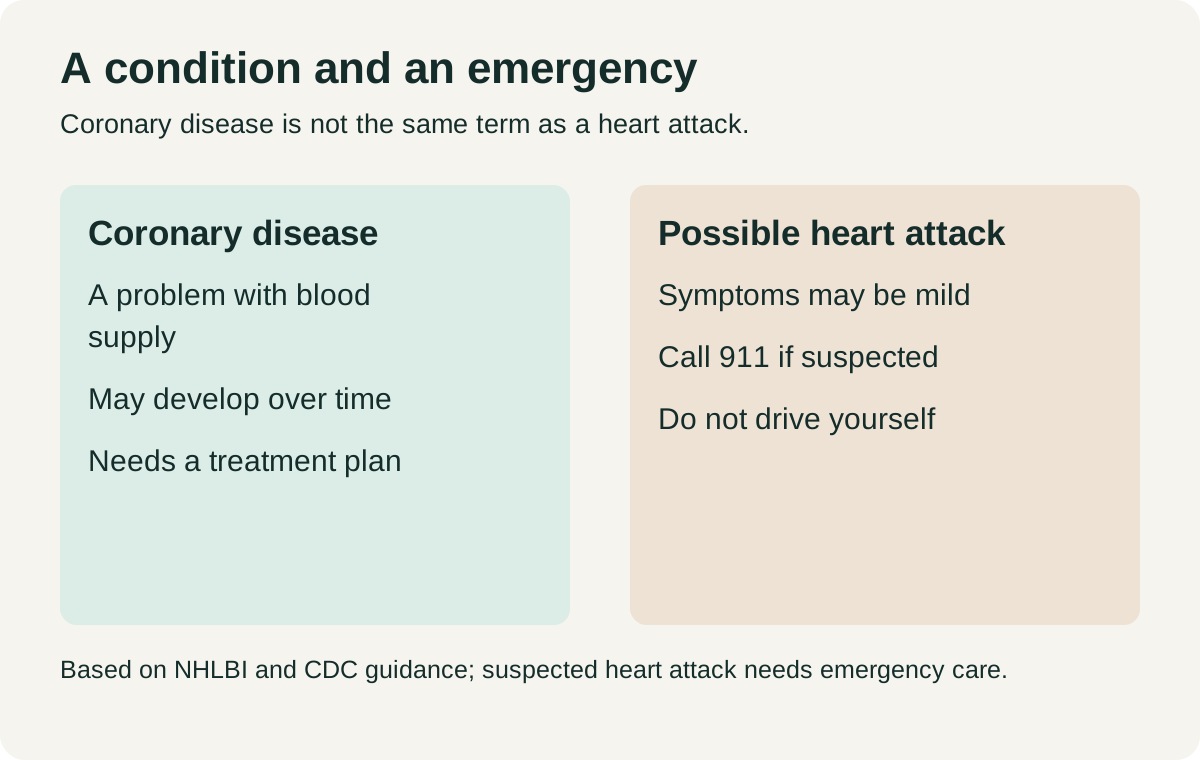
Coronary artery disease is a condition affecting the blood vessels that supply your heart muscle. A diagnosis does not automatically mean you are having a heart attack, need a stent, or should abandon your usual life. It does mean you need a clear explanation of what was found and a plan for ongoing care.
For men over 40, the confusing part may be the paperwork: a cholesterol result, a risk estimate, a scan report and a new prescription can arrive with very little explanation. These are not interchangeable pieces of information. This guide helps you organize the questions, distinguish the tests and prepare for a discussion about treatment.
Safety comes first: if you have new chest pressure or discomfort that could be a heart attack, call 911 immediately. Do not wait for an appointment or try exercising to see what happens. The emergency guidance below applies even if you have never been diagnosed with coronary disease.
What does a coronary artery disease diagnosis mean?
Coronary artery disease usually means plaque has accumulated within the walls of the arteries feeding your heart. Plaque can narrow these vessels and interfere with blood supply. Coronary heart disease is another commonly used name. The diagnosis describes a disease process; it does not, by itself, specify your symptoms or treatment.
The NHLBI overview of coronary heart disease explains the relationship between plaque, narrowing and oxygen delivery. The word coronary identifies the heart's own blood supply. It is not a label for every condition involving the heart.
The CDC explains that plaque contains cholesterol and other substances. The buildup is called atherosclerosis. A cholesterol blood test and a picture of a coronary artery therefore describe related but different things: a blood measurement is not an image of a blockage.
Our editorial suggestion is to start your next conversation with one question: What finding established this diagnosis in my case? Ask the clinician to point to the relevant sentence in your report and explain it in ordinary language. You do not need to interpret every abbreviation before asking.
For example, a reader might arrive saying, My report mentions coronary disease, but I do not know whether that came from my history, a scan or another test. That is an example of a useful opening, not a hypothetical diagnosis. Keep the report beside your questions rather than trying to reconstruct it from memory.
Our heart health guide for men after 40 provides the broader context. This article stays with the meaning of the coronary diagnosis and the practical decisions that follow it.
How is coronary disease different from a heart attack?
Coronary disease can be an ongoing condition; a heart attack is an emergency involving interrupted blood supply and injury to heart muscle. Having the diagnosis does not mean an attack is happening now. However, new symptoms suggesting an attack require immediate emergency help, rather than an assumption that they are familiar angina.
The NHLBI explanation of a heart attack describes a sudden blockage of oxygen-carrying blood flow. Without prompt restoration of that flow, heart muscle can begin to die. A chronic diagnosis and an acute event should not be treated as interchangeable terms.
Call 911 immediately for a possible heart attack. Warning symptoms include chest pressure, heaviness or discomfort, shortness of breath, unexplained sweating, nausea, light-headedness, or discomfort spreading to an arm, shoulder, back, neck or jaw. Symptoms may be mild, develop slowly, or go away and return. You do not need certainty before calling.
The NHLBI heart attack symptom guidance recommends an ambulance. Do not drive yourself or have someone drive you instead. Emergency personnel can assess you and begin care on the way. Do not delay the call to finish reading, search for a home remedy or test yourself with exercise.
For practical preparation, we suggest keeping your address and current medicine list somewhere another person could find them. This is an organizational suggestion for an ordinary day, not a task to complete before calling during an emergency.
After the immediate safety question is settled, our explanation of heart attack versus cardiac arrest can help with the vocabulary. It is background reading, not a decision tool for someone who currently feels unwell.
Can coronary disease be present without obvious symptoms?
Yes. Coronary disease may be silent until a complication occurs. Other people develop chest discomfort or breathlessness during activity or stress. A symptom pattern matters, but symptoms alone do not establish the diagnosis. New, worsening or resting symptoms need assessment; possible heart attack symptoms require an immediate 911 call.
The NHLBI coronary symptom guide describes symptoms that may appear with exertion and ease with rest. That description does not make relief with rest a reliable home test. Do not provoke symptoms by climbing stairs, running or lifting weights to investigate yourself.
Our guide to chest pain after 40 addresses the broader symptom question. For an appointment about an existing diagnosis, describe what happened rather than choosing a label such as cardiac pain, indigestion or stress before the assessment.
Here is an editorial example of a useful account: I noticed pressure while carrying shopping, stopped what I was doing, and the episode changed after I rested. Add when it happened and whether it was different from previous episodes. This example shows how to communicate an event; it does not establish that waiting at home was appropriate.
If your clinician has already provided an angina action plan, ask for an explanation of its instructions and emergency thresholds. Keep the written version accessible. A personal plan should be something you can follow under pressure, not a set of half-remembered comments from the end of a consultation.
For preparation between appointments, our suggestion is a brief note with three headings: what I felt, what I was doing and what changed. Write down events that have already happened. Do not create another episode to complete the note, and do not let documentation delay urgent help.
Does a high risk score prove that an artery is blocked?
No. A cardiovascular risk score estimates the chance of a future event using information about people with similar characteristics. It does not photograph your arteries or measure a particular narrowing. A clinician interprets risk factors, your history, symptoms and any appropriate tests together when deciding whether coronary disease is present.
The NHLBI diagnosis guidance distinguishes risk assessment from diagnostic evaluation. Blood pressure, cholesterol and blood sugar can contribute to that assessment. A high estimated risk is not a prediction that an event is certain, and a lower estimate does not explain away a new symptom.
Our cholesterol guide after 40 covers the blood results that often start this conversation. The practical question is what the result changes in your care, rather than whether a single number makes you a healthy person or an unhealthy one.
For appointment preparation, we suggest separating your paperwork into three groups: measurements, risk estimates and diagnostic findings. Put the cholesterol result with measurements, the calculator output with estimates and the scan interpretation with findings. This is an editorial filing method, not a clinical grading system.
Imagine being told that your risk deserves treatment and concluding that one artery must already be nearly closed. The missing step is a conversation about what the clinician actually knows. Ask: Are we trying to prevent a first event, treating established disease, or investigating a symptom? Write down the answer in the same words the clinician uses.
You can also ask which calculator was used and whether it is appropriate for your situation. You do not need to compare a collection of online scores before the visit. Our suggestion is to bring the original result and ask for its interpretation, rather than presenting a different number from every website you tried.
Why do different heart tests answer different questions?
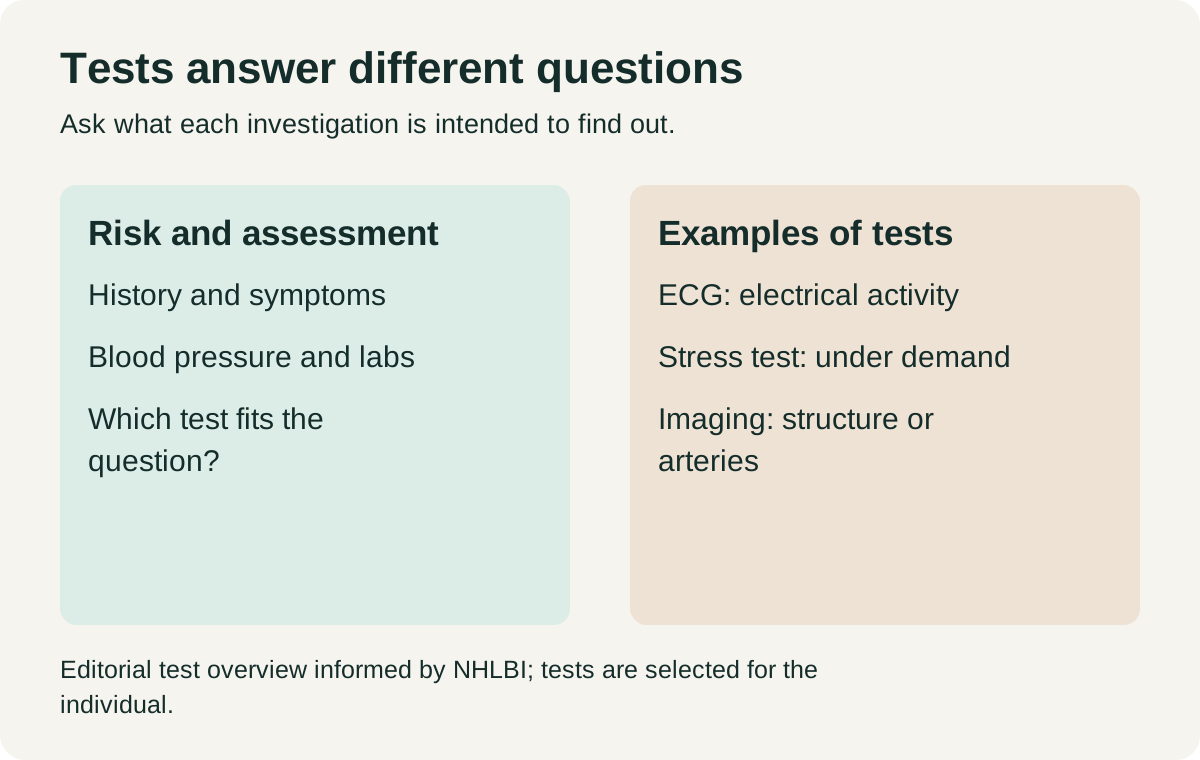
Heart tests examine different features: electrical activity, pumping function, blood flow under stress, or the coronary arteries themselves. A calcium scan measures calcified plaque rather than giving a percentage blockage. The right question is what your particular test was designed to investigate, and what uncertainty remains after the result.
The NHLBI guide to heart tests explains these differences:
- ECG or EKG: records electrical activity.
- Echocardiogram: uses ultrasound to examine heart structure and pumping.
- Stress testing: assesses the heart during exercise or medication-induced stress; nuclear imaging can examine blood flow.
- Coronary imaging: CT imaging or catheter angiography can investigate the vessels; a calcium scan has the separate purpose of measuring coronary calcium.
Our guides to a nuclear stress test and what happens at an echocardiogram help you prepare for those specific appointments. They are different investigations, so their names should not be used as synonyms.
Our editorial suggestion is to write the question above the result: What were we looking for? Underneath, leave space for two answers from your clinician: What did this show, and what did it not establish? That format is more useful for a discussion than collecting the word normal without its context.
For example, you could ask whether the appointment concerns pumping, blood flow or artery anatomy. You are asking the team to explain its reasoning, not choosing the test yourself. If further testing is proposed, ask how its answer could change the next step.
Before a scheduled test, obtain preparation instructions directly from the testing team, including what to do about your usual medicines. Do not improvise a medication break based on a general article. Our organizational suggestion is to keep those instructions with the appointment details so you are not relying on memory on the morning itself.
Why might treatment involve several different medicines?
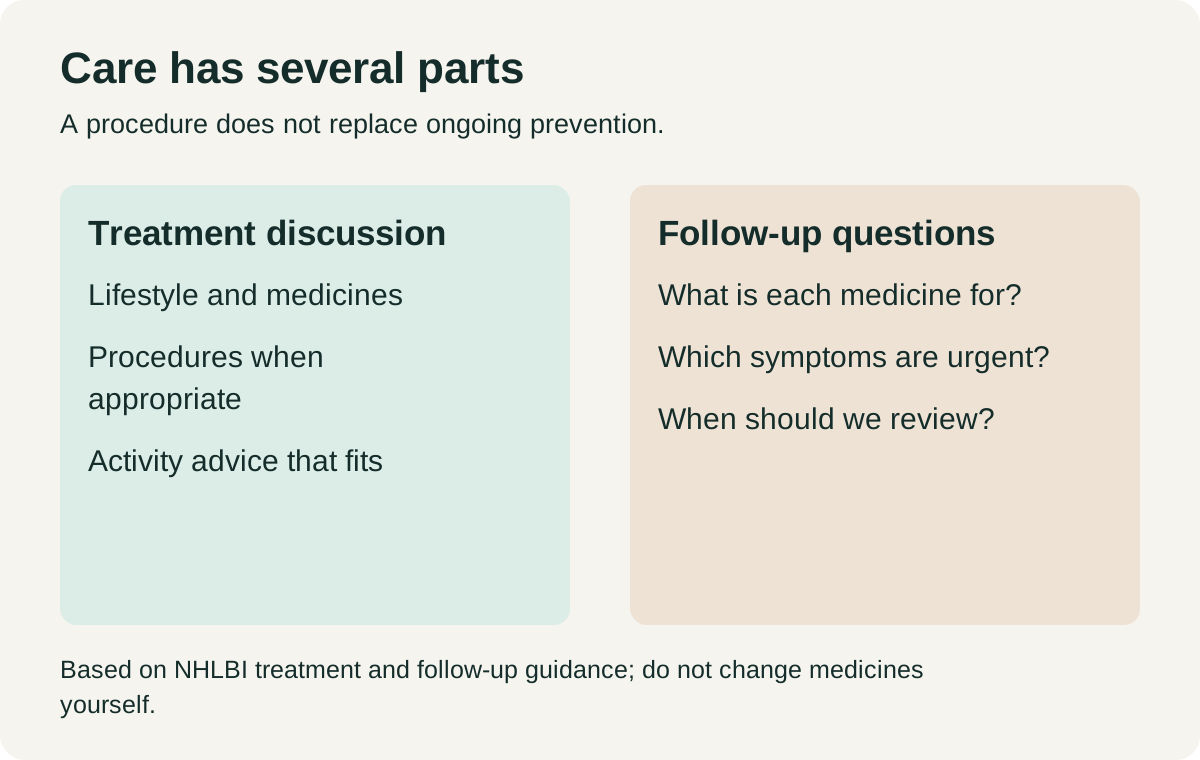
Different medicines have different jobs: lowering cholesterol, reducing blood pressure or the heart's workload, controlling angina, or reducing clot formation when appropriate. Your prescription should match your clinical situation. Ask what each medicine is for, and discuss concerns with the prescriber rather than starting aspirin or stopping treatment yourself.
The NHLBI treatment overview describes several medicine groups. For example, nitrates can relieve or prevent angina, while cholesterol-lowering treatment addresses another part of care. The number of prescriptions is not a simple measure of how blocked an artery must be.
The NHS statin guidance explains that these medicines reduce cholesterol production and are usually taken long term. They may be offered for established cardiovascular disease or increased risk. Taking one does not mean a doctor has necessarily identified a particular coronary blockage. Our guide to weighing statin treatment covers questions to raise about benefits and concerns.
For a practical medication discussion, our editorial suggestion is a simple list: medicine name, purpose, timing, question. A question might be whether a symptom that appeared after a prescription change needs review. Record the sequence rather than deciding on your own that the medicine is responsible.
Tell the prescriber about nonprescription products, supplements and medicines obtained elsewhere. Ask whom to contact about side effects and what follow-up is planned. Do not start daily aspirin because a general coronary article mentions clot prevention, and do not stop prescribed heart medicines without advice. The NHS coronary treatment page specifically cautions against those shortcuts.
If the plan feels overwhelming, ask the team to explain one medicine at a time and provide written instructions. The aim of this suggestion is a usable routine and a clearer conversation, not an independent redesign of your prescription.
How do lifestyle changes, stents and bypass surgery fit together?
Daily habits, medicines and procedures can complement one another. Angioplasty with a stent opens a selected narrowing; bypass surgery creates another route for blood flow. Neither is a reason to assume ongoing prevention has become unnecessary. Whether a procedure is appropriate depends on the findings, symptoms and treatment goals discussed with your team.
The NHS describes angioplasty and bypass surgery alongside medical treatment. Angioplasty may be planned or performed urgently. A procedure offered during an emergency should not be confused with the decision process for someone discussing stable symptoms at an outpatient visit.
The NHLBI recommends heart-healthy changes including food choices, smoking cessation, appropriate physical activity and management of conditions such as high blood pressure or diabetes. Ask your clinician what activity is suitable before beginning an exercise program. A diet or supplement advertised as opening arteries is not a substitute for an individualized plan.
For a planned procedure conversation, our editorial suggestion is to ask for the goal in one sentence. Is the recommendation intended to improve symptoms, address a particular finding, reduce a specific risk, or achieve more than one goal? Then ask what alternatives were considered and what follow-up would still be needed.
For everyday planning, choose a task you can actually organize. An example is preparing a shopping list around the eating plan agreed with your team, or writing down the contact details for smoking cessation support. These are practical examples, not claims that one purchase or one appointment will reverse the disease.
It can also help to name obstacles openly: shift work, caregiving, transport, food costs or uncertainty about exercise. Our suggestion is to bring the obstacle into the plan rather than agreeing to a routine you already know you cannot follow. Ask the team to help make the recommendation workable within your actual week.
What should ongoing care look like after the diagnosis?
Ongoing care includes taking prescribed treatment, reviewing symptoms, monitoring relevant risk factors and arranging follow-up. Some people are referred for cardiac rehabilitation. Ask for a written plan covering routine care, medication questions and urgent symptoms. The aim is a plan you understand, rather than trying to infer your future from a diagnosis alone.
The NHLBI living-with guidance emphasizes regular care, following prescription instructions and discussing new or worsening symptoms. It also describes cardiac rehabilitation as a medically supervised program that may be part of care. Ask whether referral is appropriate in your circumstances.
Our editorial suggestion for the first follow-up is to bring a one-page summary. Include the diagnosis as explained to you, the tests already completed, the current medicine list, any questions about symptoms and the date of the next appointment. This is a communication aid, not a substitute for your medical record.
- Understanding: What exactly have we established?
- Purpose: What is each part of treatment intended to do?
- Review: How will we decide whether the plan needs changing?
- Access: Who should I contact about a non-emergency concern?
- Safety: What are my written emergency instructions?
For men balancing work and family responsibilities, another useful question is what information a partner or trusted person should know. You might choose to share the medicine list and emergency plan without turning every conversation at home into a discussion about your arteries. That is a personal communication choice, not a medical requirement.
Before leaving, explain the plan back in your own words and invite corrections. If you are still unclear about a term, ask again. You do not need to become fluent in cardiology to participate in the decisions; you need to understand what the team recommends, why it recommends it and what you are expected to do next.
Key takeaways
- Coronary artery disease describes an ongoing disease process; it is not synonymous with a heart attack.
- A risk estimate is not a picture of your coronary arteries or a percentage blockage.
- Ask what question each test answers and what its result changes.
- Medicines, daily habits and selected procedures can work together; keep prescription changes with your clinical team.
- For a possible heart attack, call 911 immediately and use an ambulance. Do not drive or exercise to test symptoms.
Where to go from here
Frequently asked questions
Does coronary artery disease mean I have already had a heart attack?
No. Coronary disease and a heart attack are different diagnoses. The disease can be present before an attack occurs, and the label alone does not establish a previous attack. Ask your clinician what your history and test results show, rather than assuming the terms describe the same event.
Can I have coronary disease without chest pain?
Yes. Coronary disease can be silent, so a lack of chest pain does not establish that your arteries are unaffected. Equally, a symptom list cannot diagnose the disease. Ask what finding supports your diagnosis and what monitoring is appropriate, rather than using how you feel as the only measure.
Does a high cardiovascular risk score mean I need a stent?
No. A risk score estimates future cardiovascular events; it does not show a specific narrowing or establish a need for a procedure. Ask whether your current discussion concerns prevention, a confirmed diagnosis or investigation of symptoms. Those questions help clarify why further testing or treatment is being considered.
Will an echocardiogram tell me how blocked my arteries are?
A routine echocardiogram mainly examines heart structure and pumping with ultrasound; it is not a direct map of coronary narrowing. Ask which type of echo you are having and what question it addresses. Your clinician can explain whether your situation calls for a different or additional investigation.
Can I stop my statin if my cholesterol improves?
Do not stop prescribed treatment on your own. Statins are generally intended for long-term use, and stopping can affect cholesterol levels. Ask your prescriber what the improved result means for your plan. If side effects or costs are a concern, bring those specific problems to the discussion.
Should I wait if possible heart attack symptoms come and go?
No. A possible heart attack needs an immediate 911 call even when symptoms are mild, uncertain or intermittent. Use an ambulance rather than driving yourself or arranging a car ride. Do not exercise to test the symptoms or delay the call while searching for reassurance online.
Sources
- NHLBI / NIH: Coronary heart disease: overview
- NHLBI / NIH: Coronary heart disease: diagnosis
- NHLBI / NIH: Coronary heart disease: treatment
- NHLBI / NIH: Coronary heart disease: living with
- NHLBI / NIH: Coronary heart disease: symptoms
- CDC: About coronary artery disease
- NHLBI / NIH: Heart attack: symptoms and emergency action
- NHLBI / NIH: What is a heart attack?
- NHLBI / NIH: Heart tests
- NHS: Coronary heart disease: treatment
- NHS: Statins
How we prepared this guide. We compared the named sources listed above on October 25, 2026. Practical suggestions for organizing a consultation are labeled as ours; they are not results of a clinical trial. This article is not medically reviewed, and no personal treatment experience is claimed.

Male Health Guide Editorial Team
We write about the health problems men over 40 actually search for at 3 a.m. — and we say plainly when the evidence for a popular product is thin. We do not invent credentials and we do not publish sponsored copy as editorial. Read more about how we work.
Medical disclaimer: This article is general information, not individual medical advice. We are not doctors. A qualified clinician should assess your symptoms, test results and treatment. Seek urgent care for severe or sudden symptoms.