Varicocele After 40: Testosterone, Fertility and Red Flags

MedlinePlus says varicoceles are most common between ages 15 and 25. One that appears suddenly later in life is worth a closer look, and MedlinePlus explains why in a single sentence.
Short answer
A varicocele is a swelling of the veins inside the scrotum, like a varicose vein, usually on the left. Found in about 15% of men, it's often harmless. It can lower sperm counts and is linked to low testosterone. A varicocele that appears suddenly in an older man should be checked, because it can be caused by a kidney tumor.
Most writing about varicoceles is aimed at young men worried about fertility. This page covers the questions a man over 40 is more likely to have: what a new swelling might mean, whether a varicocele can affect testosterone, and when treatment is worth it. It draws on MedlinePlus, the European Association of Urology (EAU) guidelines and a 2026 review of the testosterone research.
A varicocele is a varicose vein in the scrotum
A varicocele is a swelling of the veins inside the scrotum, along the spermatic cord that holds up the testicles. MedlinePlus explains that damaged valves in those veins stop blood from flowing properly, so it backs up and the veins widen. It compares this to varicose veins in the legs. Most varicoceles develop slowly.
MedlinePlus says varicoceles are more common in men aged 15 to 25 and are most often on the left side. The EAU guidelines describe varicocele as a common congenital abnormality, present in almost 15% of the normal male population, in 25% of men with an abnormal semen analysis, and in 35% to 40% of men seen for infertility.
Varicocele symptoms can be mild, or absent
Some men with a varicocele have no symptoms at all, MedlinePlus says. When there are symptoms, they include enlarged, twisted veins in the scrotum, a dull ache or discomfort, a painless lump, swelling or bulge in the scrotum, and possible problems with fertility or a lower sperm count.
A doctor checks for a varicocele by examining the groin and scrotum, sometimes feeling a twisted growth along the spermatic cord. Sometimes it can't be seen or felt, especially when you're lying down. The testicle on the affected side may be smaller than the other.
How a varicocele is diagnosed
A varicocele is diagnosed mainly by a physical exam, the EAU guidelines say, with a scrotal Doppler ultrasound used if the exam is inconclusive. MedlinePlus notes that sometimes it can't be seen or felt, especially when you're lying down. An ultrasound of the kidneys may be added.
On ultrasound, the EAU says a maximum vein width of more than 3 mm while standing and bearing down, with blood flowing backward for more than two seconds, correlates with a clinically significant varicocele. The guidelines then grade varicoceles by how easy they are to find:
| Grade | What the doctor finds (EAU) |
|---|---|
| Subclinical | Not felt or seen, at rest or when bearing down; shown only by special tests such as Doppler ultrasound |
| Grade 1 | Felt only when bearing down (the Valsalva maneuver) |
| Grade 2 | Felt at rest |
| Grade 3 | Seen and felt at rest |
A varicocele that appears suddenly later in life needs a check
A varicocele that appears for the first time later in life is different from one a man has had since his teens. MedlinePlus says that a varicocele in an older man that appears suddenly may be caused by a kidney tumor, which can block blood flow from the vein.
Side matters too. The EAU guidelines say that men with an isolated clinical varicocele on the right side should be examined further for abdominal, retroperitoneal and congenital problems. Most varicoceles are on the left, so one only on the right is unusual enough to look into.
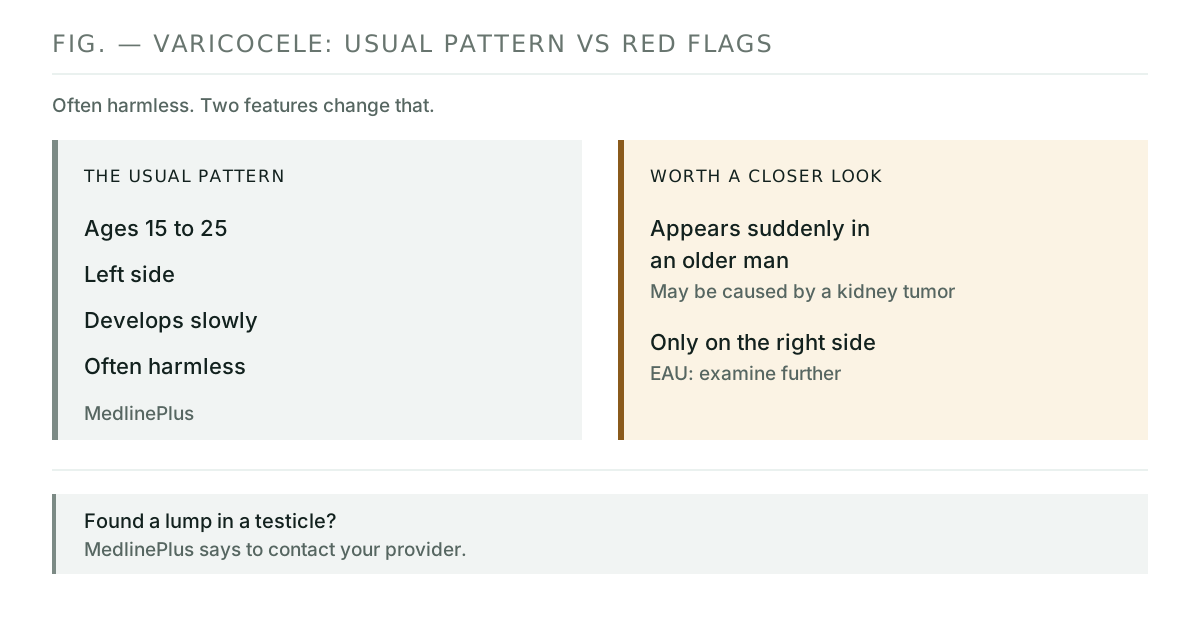
MedlinePlus says to contact your provider if you discover a testicle lump. A varicocele that appears suddenly after 40, or one only on the right side, is a reason to book an exam rather than wait and see.
Varicocele and low testosterone are linked
The EAU guidelines list hypogonadism, meaning low testosterone, among the conditions a varicocele may be associated with, alongside poor growth of the testicle on that side, reduced fertility, and pain or discomfort. For a man being checked for low testosterone, a varicocele is one possible contributor worth knowing about.
A 2026 systematic review and meta-analysis pooled 18 studies of 1,225 men with low testosterone who had a varicocele repaired. Their average ages ranged from the late 20s to the mid-40s, and most had come in for infertility, erectile dysfunction or low libido.
| After varicocele repair (2026 meta-analysis) | Average change |
|---|---|
| Total testosterone | Up about 114 ng/dL |
| Erectile function score | Up about 3 points |
| Luteinizing hormone (LH) | Down slightly |
| Follicle-stimulating hormone (FSH) | No significant change |
The review rated study quality with tools designed for observational and non-randomized studies, so these are largely before-and-after results rather than randomized trials.
The EAU guidelines, citing an earlier meta-analysis that found a smaller average rise of about 34 ng/dL, say repair may be offered to men with low testosterone and a clinically significant varicocele, but that results "must be treated with caution" until randomized trials confirm the benefit. It's a reason to ask about a varicocele if your testosterone is low, not proof that repair will fix it. This site's testosterone test and normal levels by age articles explain the numbers.
Repair helps fertility only in some men
Varicocele repair helps fertility in some men and not others, according to the EAU guidelines. A meta-analysis they cite found surgery significantly improves semen in men with clinical varicoceles and abnormal semen. A 2021 Cochrane review found treatment may improve pregnancy rates compared with delayed or no treatment.
- Subclinical varicoceles: in randomized trials, repairing them did not increase the chance of a spontaneous pregnancy.
- Normal semen: in randomized studies of mainly men with normal semen results, no benefit was found for treatment over observation.
- Timing: semen improvements take up to two sperm-production cycles, and spontaneous pregnancies occurred 6 to 12 months after surgery.
Men on testosterone therapy should know that this site's TRT explained article covers a separate fertility issue: outside testosterone can itself lower sperm production.
Surgery or embolization: what the Cochrane review found
For men with fertility problems, a 2021 Cochrane review is the most complete look at varicocele treatment. It included 48 randomized trials with 5,384 participants. In 13 trials (1,193 couples), treatment compared with delayed or no treatment may improve pregnancy rates, from about 21% to between 22% and 48%, but the evidence was rated low certainty.
- Live births: only two trials reported them, with conflicting results, so the reviewers were uncertain whether treatment improves live birth rates.
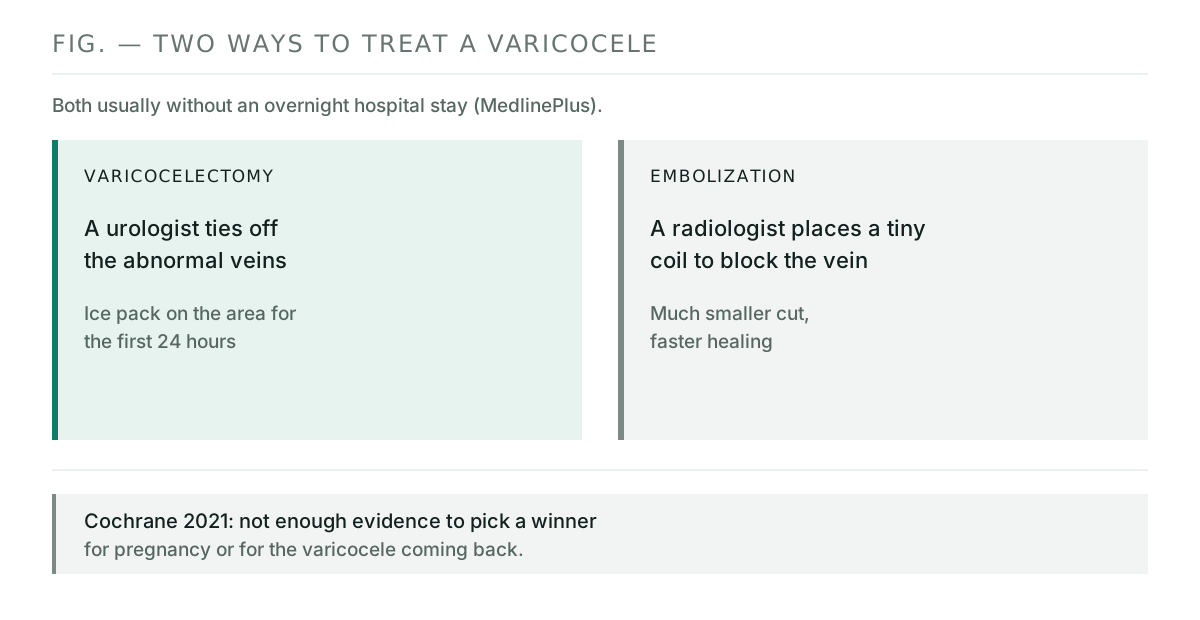
- Surgery vs embolization: the evidence was insufficient to say either is better for pregnancy or recurrence.
- Type of surgery: microscopic subinguinal surgery probably improves pregnancy rates slightly and reduces recurrence compared with other surgical methods: 0.4% to 1.1% of men had the varicocele come back, against 1.4% after other surgery.
The review found no evidence on quality of life, and it called for better head-to-head trials. For a man over 40 whose main concern is pain or testosterone rather than fertility, these trials answer a different question, which is worth raising with the urologist.
Many varicoceles don't need treatment
A varicocele is often harmless and often doesn't need treatment, MedlinePlus says, unless the testicle changes size or there's a fertility problem. For discomfort, it suggests a jock strap or snug underwear. Other treatment may be needed if the pain doesn't go away or other symptoms develop. The EAU reports pain resolving after surgery in 48% to 90% of patients.
There are two main ways to treat a varicocele, both usually done without an overnight hospital stay:
- Varicocelectomy: a urologist ties off the abnormal veins, usually through a cut in the lower abdomen or laparoscopically. MedlinePlus says to keep an ice pack on the area for the first 24 hours.
- Embolization: a radiologist guides a thin tube through a vein in the groin or neck and places a tiny coil to block the abnormal vein. MedlinePlus says it uses a much smaller cut, so healing is faster.
Complications MedlinePlus lists include a shrunken (atrophic) testicle, blood clots, infection, and injury to the scrotum or a nearby blood vessel. It also notes that testicular shrinkage usually doesn't improve unless surgery is done early in adolescence.
Key takeaways
- A varicocele is a swelling of the veins in the scrotum, like a varicose vein; MedlinePlus says it's most common at ages 15 to 25 and usually on the left.
- The EAU puts it in almost 15% of men, 25% of men with abnormal semen and 35% to 40% of men seen for infertility.
- A varicocele that appears suddenly in an older man may be caused by a kidney tumor, MedlinePlus says; a right-sided one alone also needs further checks.
- The EAU links varicocele with low testosterone; a 2026 meta-analysis of non-randomized studies found repair raised testosterone about 114 ng/dL in men with low levels.
- Many varicoceles need no treatment; repair may help fertility in men with a clinical varicocele and abnormal semen, though its effect on live births is uncertain, and it doesn't help subclinical ones.
Where to go from here
These pages cover the surrounding ground:
- Low Testosterone After 40 — symptoms, testing and what counts as low.
- Testosterone Test: How to Get It Right — timing and repeat tests.
- Testosterone Replacement Therapy Explained — what TRT does, including to fertility.
- Klinefelter Syndrome Explained — another cause of low testosterone found at a testicular exam.
- All testosterone articles
Frequently asked questions
Is a varicocele dangerous?
Usually not. MedlinePlus says a varicocele is often harmless and often doesn't need treatment unless the testicle changes size or there's a fertility problem. The exception is one that appears suddenly in an older man, which may be caused by a kidney tumor. MedlinePlus gives no age cut-off, but it should be examined.
Can a varicocele cause low testosterone?
It's linked. The EAU guidelines list low testosterone among conditions a varicocele may be associated with. A 2026 meta-analysis of 18 non-randomized studies in men with low testosterone found repair raised total testosterone by about 114 ng/dL, in studies whose average ages ranged from the late 20s to the mid-40s.
How common is a varicocele?
The EAU guidelines say a varicocele is present in almost 15% of the normal male population, in 25% of men with an abnormal semen analysis, and in 35% to 40% of men seen for infertility. MedlinePlus says varicoceles are more common in men aged 15 to 25 and are most often on the left side.
Does a varicocele go away on its own?
MedlinePlus doesn't describe them going away, but says a varicocele is often harmless and often needs no treatment. A jock strap or snug underwear may ease discomfort. Treatment, either surgery to tie off the veins or embolization to block them, is considered for ongoing pain, a shrinking testicle or a fertility problem.
Does varicocele surgery improve fertility?
In some men. The EAU guidelines say repair improves semen in men with a clinical varicocele and abnormal semen, and a 2021 Cochrane review found treatment may improve pregnancy rates. Repairing subclinical varicoceles, found only by ultrasound, did not increase spontaneous pregnancy in randomized trials, and men with normal semen showed no benefit.
Sources
- Cochrane Database of Systematic Reviews — Persad E et al. Surgical or radiological treatment for varicoceles in subfertile men, 2021
- MedlinePlus (National Library of Medicine) — Varicocele (reviewed July 1, 2025)
- European Association of Urology — EAU Guidelines on Sexual and Reproductive Health: Male infertility, varicocele section
- World Journal of Men's Health — Aboukhshaba A et al. Effect of varicocelectomy on testosterone parameters in hypogonadism: a systematic review and meta-analysis, 2026

Male Health Guide Editorial Team
We write about the health problems men over 40 actually search for at 3 a.m. — and we say plainly when the evidence for a popular product is thin. We do not invent credentials and we do not publish sponsored copy as editorial. Read more about how we work.
Medical disclaimer: This article is general information, not medical advice. We are not doctors, and nothing here diagnoses, treats or cures any condition. Any new lump or swelling in the scrotum should be examined by a doctor.