Prolactin in Men: High Levels, Low Testosterone
Short answer
High prolactin in men can lower sex hormones and cause low sex drive and erection problems. MedlinePlus puts normal at under 20 ng/mL. The most common cause is a noncancerous pituitary tumor, a prolactinoma, but medicines and other conditions can raise it too. Men are often diagnosed later, and for a prolactinoma, medicine usually works.
Prolactin is not a hormone many men have heard of. It tends to come up when a man's testosterone comes back low, or when low sex drive or erection problems don't have an obvious explanation. Then a single extra line appears on the lab request, and sometimes it changes the whole picture.
This article covers what prolactin is, the normal range for men, the symptoms, how it connects to testosterone, the most common causes, why men tend to be diagnosed later than women, how the test works, how high prolactin is treated, and the rare emergency to know about. It belongs to this site's testosterone section, alongside the guides to low testosterone after 40 and getting the testosterone test right.
What prolactin is, and what it does in men
Prolactin is a hormone released by the pituitary gland, a small gland at the base of the brain that regulates many other hormones. MedlinePlus says prolactin stimulates breast development and milk production in women, and that "there is no known normal function for prolactin in men." Its normal level in men is low.
The problem in men is when there's too much of it, a condition called hyperprolactinemia. MedlinePlus says that in men it can affect how the testicles work and can cause a lower sex drive and erectile dysfunction, and that in men it can even signal the body to start making breast milk.
What a normal prolactin level is for men
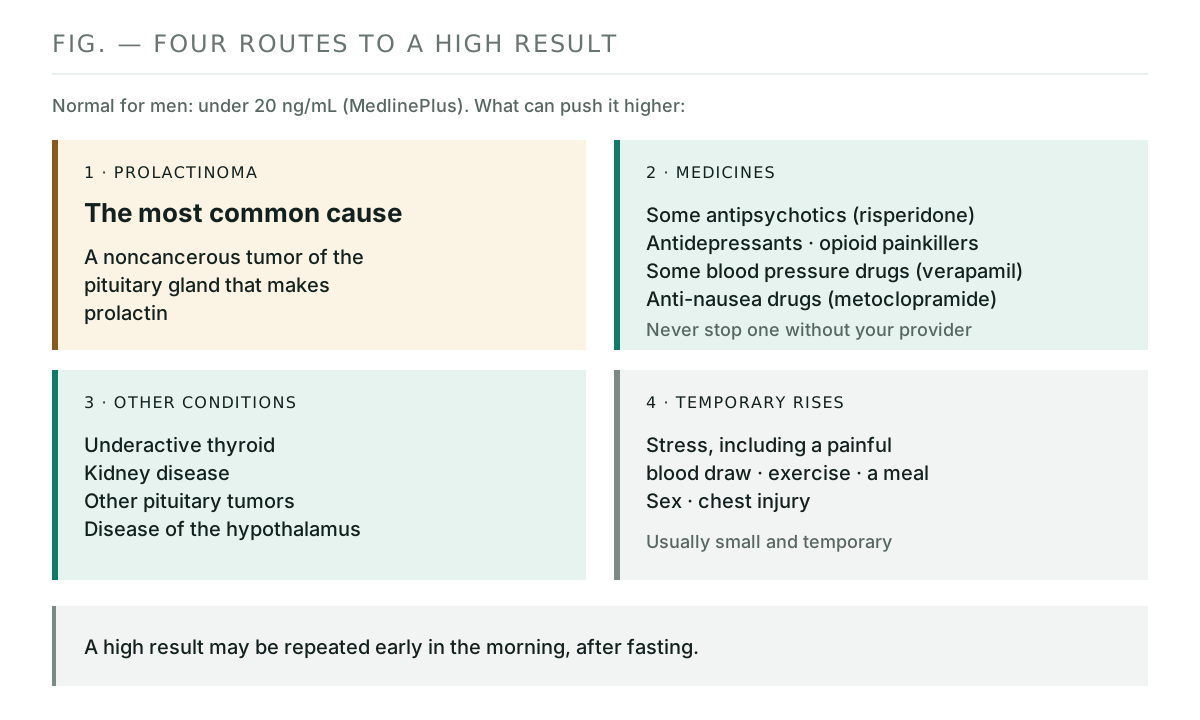
MedlinePlus gives a normal value for men of less than 20 ng/mL (20 µg/L). For comparison, it gives less than 25 ng/mL for women who aren't pregnant and less than 500 ng/mL during pregnancy. It notes that normal ranges may vary slightly between laboratories, and that some labs use different measurements.
MedlinePlus also says that interpreting an abnormally high prolactin result is complicated, and that in most cases your provider will refer you to an endocrinologist, a doctor who specializes in hormones. In our reading, that's a reason not to over-read a single number on a lab portal before that conversation.
The symptoms in men
The NIDDK, part of the NIH, lists the common symptoms of a prolactinoma in men as loss of interest in sex associated with low levels of testosterone, and erectile dysfunction. MedlinePlus's list for men adds decreased peripheral vision, enlargement of breast tissue (gynecomastia), headache, infertility and vision changes.
MedlinePlus says that a larger tumor can also cause symptoms by pressing on nearby structures, including headache, lethargy, nasal drainage, nausea and vomiting, problems with the sense of smell, sinus pain or pressure, and vision changes such as double vision, drooping eyelids or loss of part of the visual field. The NIDDK adds that excess prolactin can lead to bone loss. Then MedlinePlus adds the line that matters most for older men: "There may be no symptoms, especially in older men."
Breast enlargement in men has its own article on this site, gynecomastia explained, which covers the other causes too.
How prolactin connects to low testosterone
The NIDDK says excess prolactin "can lower levels of sex hormones in both women and men," and links the loss of sex drive in men to low testosterone. MedlinePlus says a prolactin test is most often used with other tests to help find the cause of a man's low sex drive or erectile dysfunction, and it lists a testosterone blood level among the tests a man may have when a prolactinoma is suspected.
In our reading, that's why prolactin belongs in the conversation when testosterone comes back low. A low testosterone result can be the end of the story or the start of one, and this site's articles on low testosterone after 40 and on testosterone and erectile dysfunction cover what else to consider. In our reading, if testosterone treatment is on the table, it's worth asking whether prolactin has been checked first.
What causes high prolactin
MedlinePlus says a prolactinoma, a noncancerous tumor of the pituitary gland, is the most common cause of higher-than-normal prolactin. The NIDDK says prolactinomas are the most common type of pituitary tumor, making up about 40 percent of pituitary tumors, and that women are more likely than men to develop one. Other causes fall into three groups.
- Medicines. The NIDDK explains that dopamine helps hold prolactin down, so any medicine that affects dopamine can raise it. Its list includes some antipsychotics such as risperidone (but not others, such as clozapine), some blood pressure medicines, drugs for nausea and vomiting, and opioid pain relievers. MedlinePlus also names antidepressants, metoclopramide and verapamil, and says marijuana products can raise prolactin.
- Other conditions. Both sources list an underactive thyroid and kidney disease. The NIDDK adds shingles affecting the chest, and other large tumors in or near the pituitary. MedlinePlus adds disease of the hypothalamus and chest wall injury or irritation.
- Temporary rises. The NIDDK says prolactin can rise slightly with physical stress such as a painful blood draw, exercise, a meal, sex, nipple stimulation, chest injury and seizures, and that these rises are usually small and temporary.
The NIDDK says that if a medicine is causing high prolactin, levels usually return to normal 3 to 4 days after the drug is stopped. But MedlinePlus is clear: never stop taking any medicine without talking with your provider first. An underactive thyroid can also mimic a prolactinoma, which is why MedlinePlus lists thyroid tests among the tests that may be ordered. This site's hypothyroidism article covers that test.
Why men are often diagnosed later
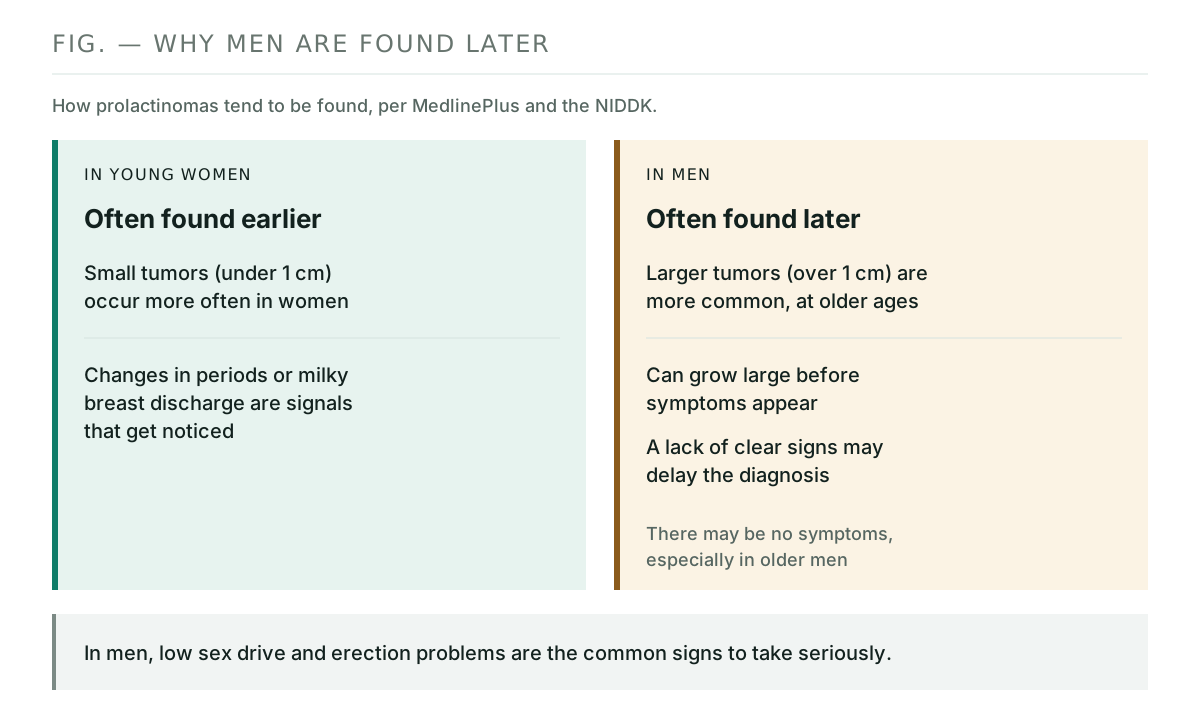
This is the part that's specific to men. MedlinePlus says prolactinomas are often detected earlier in young women than in men, because high prolactin causes irregular menstrual periods. The NIDDK makes the same point: women often report symptoms earlier, while among men "a lack of clear signs and symptoms may lead to a delayed diagnosis."
The tumors also differ. MedlinePlus says at least half of prolactinomas are small, under 1 centimeter, and that these occur more often in women, while "larger tumors are more common in men. They tend to occur at an older age. The tumor can grow to a large size before symptoms appear." In our reading, a low sex drive that's been put down to age or stress for years is exactly the kind of quiet signal that can let that happen.
How the prolactin test works
It's a blood test. MedlinePlus's lab test guide says prolactin levels change through the day, so the sample is usually taken three to four hours after you wake up, and you may be asked to fast for several hours first. Its encyclopedia page says that if a level is high, the test may be repeated in the early morning after an 8-hour fast. Tell your provider about any medicines and vitamins you take, since some can affect the result.
MedlinePlus notes that a prolactin test can't show the cause of a high level. If the result is high, the NIDDK says your doctor will order an imaging test, with MRI as the preferred scan, and may check other hormones after diagnosis and, depending on the tumor's size, your vision. This site's testosterone test guide covers the timing rules for the other hormone men are most often tested for.
How high prolactin is treated
Treatment depends on the cause. For a prolactinoma, the NIDDK says medicines called dopamine agonists "control prolactin levels and shrink the tumor very effectively." The two most commonly used are bromocriptine, taken two or three times a day, and cabergoline, taken once or twice a week, which it calls the preferred drug because it is more effective and has fewer side effects.
For most small prolactinomas, the NIDDK says these medicines bring prolactin back to normal and shrink the tumor in 4 out of 5 patients. Common side effects include nausea, vomiting and dizziness, and it advises taking them with food. It says heart valve damage has been linked to dopamine agonists mainly in people taking much higher doses for Parkinson's disease, and that a doctor may order an echocardiogram if a high dose is needed. Treatment may be long: after 2 years, the medicine may be slowly reduced and stopped if prolactin is normal and the tumor is no longer visible, but it may need to be restarted.
Surgery is an option if the medicines aren't tolerated or don't work. The NIDDK says that, done by an experienced surgeon, it corrects prolactin in about 90 percent of people with small tumors and 50 percent with large ones. Radiation is used more rarely, and it says prolactin returns to normal in 1 out of 3 patients treated with it, sometimes only after years.
The rare emergency to know about
MedlinePlus says untreated pituitary tumors always carry a small risk of suddenly getting bigger, most commonly from bleeding inside the tumor. This is called pituitary apoplexy, and it calls it a medical emergency, noting that most people describe it as the worst headache of their life.
MedlinePlus calls pituitary apoplexy a medical emergency, and says most people with it describe the worst headache of their life. In our reading, a sudden headache like that, especially in a man with a known pituitary tumor, is a reason to get emergency care right away rather than wait. For the slower symptoms of a prolactinoma, MedlinePlus says to contact your provider, and, if you've had one before, to contact your provider if symptoms return. MedlinePlus also lists a sudden worsening of vision among the reasons surgery may be done.
Key takeaways
- MedlinePlus gives a normal prolactin level for men of less than 20 ng/mL, with ranges varying slightly by lab.
- High prolactin can lower sex hormones; in men, the NIDDK lists low sex drive linked to low testosterone, and erectile dysfunction.
- A prolactinoma, a noncancerous pituitary tumor, is the most common cause, but medicines, an underactive thyroid and kidney disease can also raise it.
- Men are often diagnosed later than women, and larger tumors are more common in men; there may be no symptoms, especially in older men.
- Dopamine agonists, with cabergoline preferred, normalize prolactin and shrink small tumors in 4 out of 5 patients, per the NIDDK.
Where to go from here
If prolactin came up because of a hormone or sexual health question, these pages cover the surrounding ground:
- Low Testosterone After 40 — what counts as low and what to rule out.
- Testosterone and Erectile Dysfunction — where hormones fit, and where they don't.
- Gynecomastia Explained — breast enlargement in men and its causes.
- Hypothyroidism Explained — the thyroid condition that can raise prolactin.
- All testosterone articles
Frequently asked questions
What is a normal prolactin level for a man?
MedlinePlus gives a normal value for men of less than 20 ng/mL (20 µg/L), and notes that normal ranges may vary slightly between laboratories. Your own lab report will show the range that lab uses.
What are the symptoms of high prolactin in men?
For a prolactinoma, the most common cause, the NIDDK lists loss of interest in sex associated with low testosterone and erectile dysfunction as common symptoms in men. MedlinePlus adds infertility, breast enlargement, headache and vision changes, and says there may be no symptoms, especially in older men.
Does high prolactin lower testosterone?
It can. The NIDDK says excess prolactin can lower levels of sex hormones in both women and men, and lists loss of interest in sex associated with low testosterone among the common symptoms in men. MedlinePlus says a prolactin test is often used to help find the cause of a man's low sex drive or erectile dysfunction.
What causes high prolactin in men?
The most common cause is a prolactinoma, a noncancerous pituitary tumor, according to MedlinePlus. Others include medicines such as some antipsychotics, antidepressants, opioid painkillers and some blood pressure and anti-nausea drugs, an underactive thyroid, kidney disease, and other pituitary tumors. Stress, exercise, meals and sex can raise it briefly.
Why are prolactinomas found later in men?
The NIDDK says women often notice symptoms earlier, such as changes in their periods, while in men a lack of clear signs may delay the diagnosis. MedlinePlus says larger tumors are more common in men, tend to occur at an older age, and can grow large before symptoms appear.
How is high prolactin treated?
It depends on the cause. For a prolactinoma, the NIDDK says medicines called dopamine agonists are the usual treatment, with cabergoline preferred over bromocriptine, and that they normalize prolactin and shrink the tumor in 4 out of 5 people with small prolactinomas. Surgery or radiation are used less often.
Sources
- National Institute of Diabetes and Digestive and Kidney Diseases (NIH) — Prolactinoma
- MedlinePlus (National Library of Medicine) — Prolactin blood test
- MedlinePlus (National Library of Medicine) — Prolactin Levels
- MedlinePlus (National Library of Medicine) — Prolactinoma

Male Health Guide Editorial Team
We write about the health problems men over 40 actually search for at 3 a.m. — and we say plainly when the evidence for a popular product is thin. We do not invent credentials and we do not publish sponsored copy as editorial. Read more about how we work.
Medical disclaimer: This article is general information, not medical advice. We are not doctors, and nothing here diagnoses, treats or cures any condition. Never stop a medicine to lower prolactin without your provider. MedlinePlus calls pituitary apoplexy, which most people describe as the worst headache of their life, a medical emergency.