Gynecomastia: Breast Tissue or Just Fat?
Short answer
Gynecomastia is an abnormal amount of actual breast tissue in a male, caused by an imbalance between estrogen and testosterone — not the same as lipomastia, which is just fat. MedlinePlus lists low testosterone directly as a cause, along with specific medications including finasteride and dutasteride. It is usually harmless and often resolves on its own, but one-sided growth, a hard attached lump, or bloody discharge need a doctor.
It usually starts the same way: a small, tender lump under one nipple, or a chest that looks fuller than it used to. The first instinct is embarrassment, followed by a guess — weight gain, getting older, nothing to worry about. Sometimes that guess is right. Sometimes it points to something worth a conversation with a doctor.
This article covers what gynecomastia actually is, the hormone imbalance behind it, why it shows up at every age from newborn to 70, the medications linked to it — several of which show up elsewhere on this site — and the specific signs MedlinePlus says warrant prompt medical attention.
What gynecomastia actually is
MedlinePlus defines it plainly: when an abnormal amount of breast tissue develops in males, it is called gynecomastia. The condition may occur in one or both breasts. It begins as a small lump beneath the nipple, which may be tender, and one breast may be larger than the other. Over time the lump may become less tender and feel harder. MedlinePlus adds that enlarged breasts in males are usually harmless, but may cause men to avoid certain clothing or avoid being seen without a shirt — distress it describes as significant, particularly in young men.
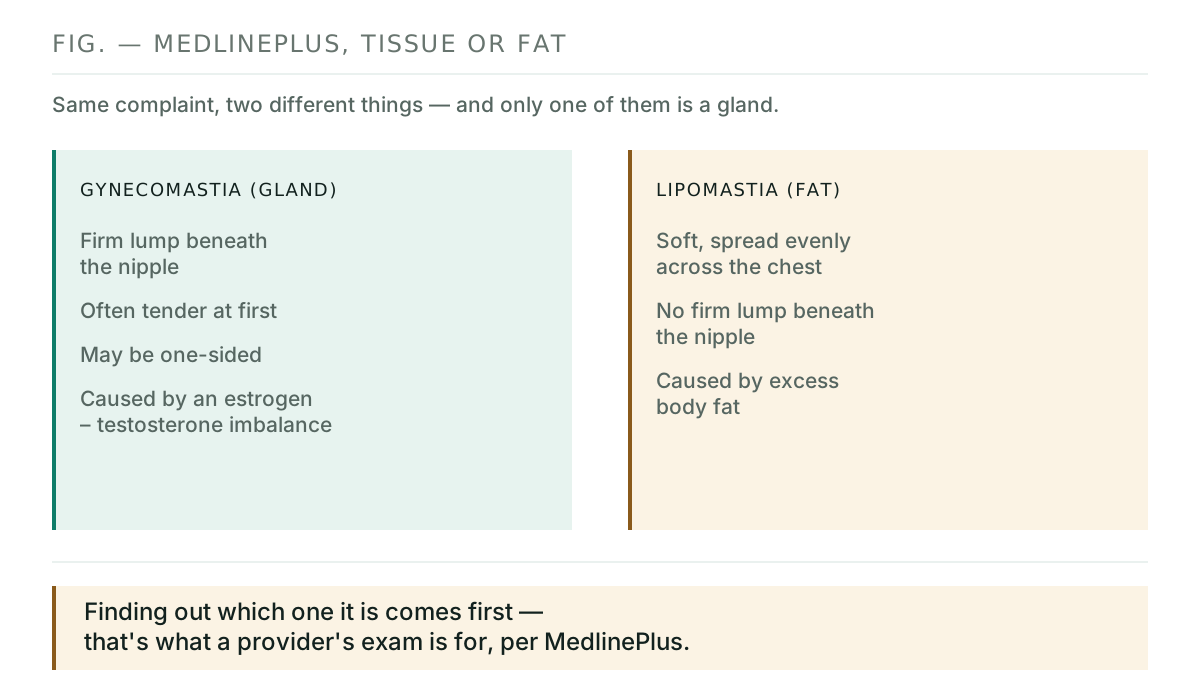
The distinction that matters most, per MedlinePlus, is whether the growth is breast tissue at all. The same excess-chest-tissue complaint can be lipomastia — excess fat tissue in the same area, with no actual glandular growth. The two can look alike from the outside; a provider's exam is what tells them apart.
The hormone imbalance behind it
MedlinePlus states that breast enlargement is usually caused by an imbalance of estrogen (female hormone) and testosterone (male hormone) — and that males have both types of hormones in their body. Changes in the levels of these hormones, or in how the body uses or responds to them, can cause enlarged breasts in males. It is the ratio and the body's response that matter, not simply "too much estrogen" or "too little testosterone" in isolation.
Who gets it, and why it's so common
MedlinePlus is clear that normal hormone changes are the most common cause of breast development in newborns, boys, and men, across three distinct life stages:
- Newborns: caused by exposure to the mother's estrogen. About one half of boy babies are born with enlarged breasts, called breast buds, which usually go away in 2 to 6 months but can last longer. Some newborns also have a milky discharge (galactorrhea) that usually lasts a couple of weeks to months, and in rare cases up to age 1.
- Puberty: caused by normal hormone changes. More than one half of boys develop some breast enlargement during puberty, and it often goes away in 6 months to 2 years.
- Aging men: hormone changes due to aging can cause breast growth, occurring more often in overweight or obese men and in men age 50 and older.
In other words, for most of a male's life, some degree of this is a documented normal pattern, not an anomaly — which is part of why MedlinePlus frames it as usually harmless.
The link men don't expect: low testosterone
Most men assume breast tissue growth points to too much estrogen. MedlinePlus lists something less expected directly among the health conditions that can cause breast growth in adult men: a low testosterone level, alongside chronic liver disease, kidney failure and dialysis, and obesity — which MedlinePlus separately notes is also the most common cause of breast growth due to fat.
If you already track your own hormone levels, or have read this site's coverage of low testosterone after 40 or low testosterone symptoms, this is one more data point worth bringing to that same conversation with a provider — not a separate issue.
Medications already on this site's radar
MedlinePlus lists a long set of medicines and treatments linked to breast growth in men. Several are ones this site's readers are already taking or researching for an entirely different reason:
- Finasteride (Proscar) or dutasteride (Avodart) for an enlarged prostate
- Finasteride (Propecia) for hair loss
- Hormone treatment for prostate cancer, such as bicalutamide
- Heart medicines, including spironolactone (Aldactone), digoxin (Lanoxin), amiodarone, and calcium channel blockers
- Heartburn and ulcer medicines, such as cimetidine (Tagamet) or proton pump inhibitors
- Anti-anxiety medicine diazepam (Valium)
- Opioids, corticosteroids, and anabolic steroids
This site's own prostate medications coverage already discusses finasteride and dutasteride for enlarged prostate; this is the specific side effect MedlinePlus ties to that drug class. MedlinePlus is also direct that you should not stop taking any medicine before talking to your provider — the fix, if one is needed, usually means a conversation about alternatives, not quitting on your own.
When to worry
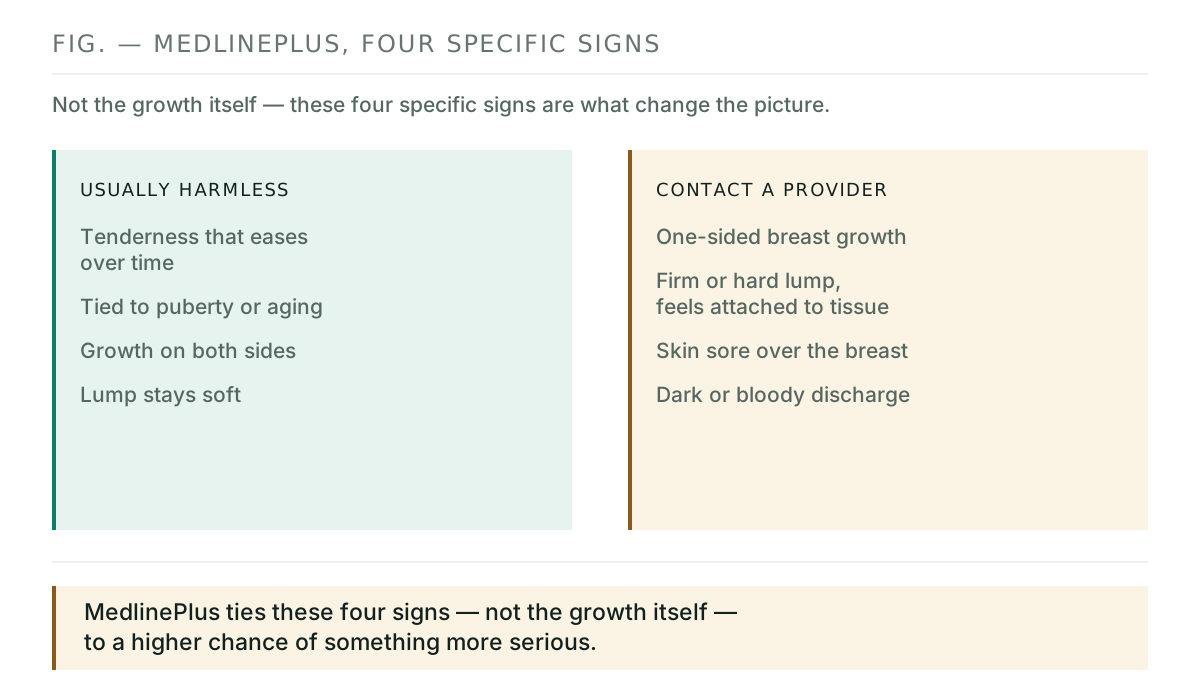
MedlinePlus notes that men with enlarged breasts may have an increased risk for breast cancer, though breast cancer in men is rare. The signs it specifically says may suggest breast cancer: one-sided breast growth, a firm or hard breast lump that feels like it is attached to the tissue, a skin sore over the breast, and bloody discharge from the nipple.
You have recent swelling, pain, or enlargement in one or both breasts; there is dark or bloody discharge from the nipples; there is a skin sore or ulcer over the breast; or a breast lump feels hard or firm — per MedlinePlus. If a son has breast growth before reaching puberty, MedlinePlus says to have him checked by a provider too.
What a doctor actually checks
MedlinePlus describes a medical history and physical exam as the starting point, and notes you may not need any tests at all. When tests are used to check for an underlying cause, they may include blood hormone level tests, a breast ultrasound, liver and kidney function studies, and a mammogram.
Treatment, and what usually happens on its own
MedlinePlus is reassuring on this point: often no treatment is needed, and breast growth in newborns and young boys often goes away on its own. If an underlying medical condition is the cause, treating that condition is the approach. If a medicine or substance is the likely cause, stopping or changing it — always discussed with a provider first — may resolve it.
For growth that is large, uneven, or persistent enough to affect quality of life, MedlinePlus lists two treatments: hormone treatment that blocks the effects of estrogen, and breast reduction surgery to remove the breast tissue. It adds one caveat worth knowing going in: gynecomastia that has been present for a long time is less likely to resolve even if the right treatment is started — which is part of why MedlinePlus recommends having persistent cases evaluated rather than waiting it out indefinitely.
In the meantime, MedlinePlus's home-care advice is simple: cold compresses can help with tenderness, and it is worth asking a provider whether a pain reliever is appropriate. It also specifically recommends stopping any recreational drug use, such as marijuana, and stopping any nutritional supplements or bodybuilding products, since both are on its list of substances linked to breast growth in men.
Key takeaways
- Gynecomastia is real breast tissue growth, caused by an estrogen-testosterone imbalance — different from lipomastia, which is just fat.
- It is a documented normal pattern at three life stages: newborns, puberty, and aging men, especially those overweight or 50-plus.
- MedlinePlus lists a low testosterone level directly as a cause — not only excess estrogen.
- Finasteride, dutasteride, spironolactone, and several other common medications are on MedlinePlus's list of linked drugs.
- One-sided growth, a hard attached lump, a skin sore, or bloody nipple discharge are the specific signs that need a doctor, per MedlinePlus.
Where to go from here
If gynecomastia is what brought you here, these pages cover the surrounding ground:
- Low Testosterone After 40 — the broader picture of what low T does and doesn't explain.
- Low Testosterone Symptoms — the fuller symptom list, including this one.
- Testosterone Side Effects — what changes on treatment, and why estradiol gets measured.
- Prostate Medications Explained — finasteride and dutasteride, from the other side of this trade-off.
- All testosterone articles
Frequently asked questions
What exactly is gynecomastia?
MedlinePlus defines gynecomastia as an abnormal amount of breast tissue developing in males. It is distinct from lipomastia, which is excess fat in the same area — the two can look similar, but one is glandular tissue and the other is fat, and telling them apart matters for figuring out the cause.
Is it fat or actual breast tissue?
It can be either, and MedlinePlus says it is important to find out which one you actually have. True gynecomastia starts as a small, sometimes tender lump directly beneath the nipple, which can feel harder over time. Lipomastia is fat spread more evenly across the chest, without that firm lump.
Can low testosterone cause gynecomastia?
Yes. MedlinePlus lists a low testosterone level directly among the health conditions that can cause breast growth in adult men, alongside chronic liver disease, kidney failure and dialysis, and obesity. The underlying issue is the balance between estrogen and testosterone, not just one hormone in isolation.
Which common medications can cause it?
MedlinePlus's list includes finasteride and dutasteride for an enlarged prostate, finasteride for hair loss, hormone therapy for prostate cancer such as bicalutamide, heart medicines like spironolactone and digoxin, heartburn medicines such as cimetidine, anti-anxiety medicine diazepam, and opioids, among others. It does not mean these medicines are wrong for you — it means the trade-off is worth knowing.
When is it a sign of something more serious?
MedlinePlus flags one-sided breast growth, a firm or hard lump that feels attached to the tissue, a skin sore over the breast, and bloody nipple discharge as signs that may suggest breast cancer — rare in men, but why these specific signs warrant a prompt visit rather than a wait-and-see approach.
Does it go away on its own?
Often, yes. MedlinePlus notes that breast growth in newborns and young boys often resolves on its own, and that often no treatment is needed at all. For growth that is large, uneven, or persistent enough to affect quality of life, treatment options include hormone therapy that blocks estrogen's effects or breast reduction surgery — though longstanding gynecomastia is less likely to resolve even then.
Sources
- MedlinePlus (National Library of Medicine) — Breast Enlargement in Males
- Ali O, Donohoue PA. Gynecomastia. In: Nelson Textbook of Pediatrics, 22nd ed. Elsevier; 2025:chap 625 (cited by MedlinePlus)
- Anawalt BD. Gynecomastia. In: DeGroot's Endocrinology, 8th ed. Elsevier; 2023:chap 108 (cited by MedlinePlus)
- Male Health Guide — Prostate Medications Explained (companion coverage of finasteride and dutasteride)

Male Health Guide Editorial Team
We write about the health problems men over 40 actually search for at 3 a.m. — and we say plainly when the evidence for a popular product is thin. We do not invent credentials and we do not publish sponsored copy as editorial. Read more about how we work.
Medical disclaimer: This article is general information, not medical advice. We are not doctors, and nothing here diagnoses, treats or cures any condition. Whether a change in your chest is gynecomastia, lipomastia, or something that needs further testing requires evaluation by a qualified healthcare professional. Please speak to one about your own situation, especially if you notice any of the warning signs described above.