Narcolepsy: Symptoms, Sleep Tests and Safer Daily Life
Falling asleep unintentionally is different from feeling worn out. If you keep nodding off despite allowing time for sleep, the answer may require more than an earlier bedtime. Narcolepsy is one possible explanation, but it is not the only one.
For men over 40, the useful next step is to describe the pattern and protect safety while it is assessed. This guide explains the symptoms, what sleep testing can show, and why preparing for a test matters as much as getting an appointment.
Short answer
Narcolepsy is a long-term neurological sleep disorder marked by excessive daytime sleepiness. Some people also have cataplexy, a brief loss of muscle tone, or sleep paralysis and dreamlike experiences around sleep. A specialist evaluates symptoms and sleep tests, while checking other explanations. Do not drive when sleepy or change medicines yourself before testing.
Narcolepsy involves sleepiness rather than simply low energy
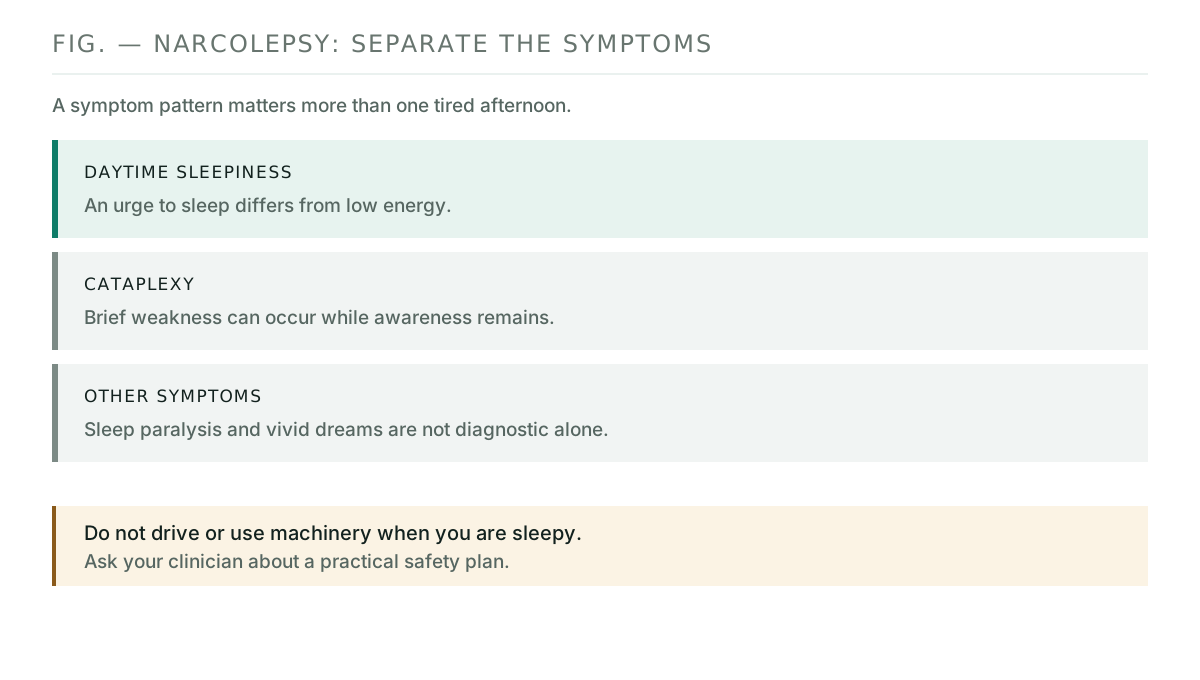
Narcolepsy makes it difficult to regulate sleep and wakefulness. Excessive daytime sleepiness is its central symptom: an urge to sleep or unintended dozing, rather than only exhaustion or reduced motivation. Sleep at night can also be fragmented. Neither feeling tired nor one afternoon nap establishes the diagnosis on its own.
The National Heart, Lung, and Blood Institute describes episodes of sleepiness during ordinary activities, sometimes without warning. A man may describe falling asleep during a conversation or repeatedly losing track of what he was doing. The setting and any safety consequences matter when reporting the problem.
Fatigue can mean lacking energy while remaining awake. Sleepiness means a tendency to fall asleep. They can overlap, but those words should not be treated as interchangeable. At an appointment, say whether you are drained, actually dozing, or experiencing both. Give examples instead of trying to choose the diagnosis yourself.
Symptoms often begin earlier in life, although onset can occur at any age and diagnosis may be delayed. A diagnosis after 40 does not automatically mean the disorder began after 40. Bring the history you remember from school, earlier jobs or previous relationships, along with the problems affecting you now.
Type 1 and type 2 are different diagnostic categories
Narcolepsy type 1 is associated with cataplexy or a deficiency of hypocretin, also called orexin. Type 2 does not include cataplexy and needs other diagnostic findings. These categories are not decided by how sleepy you feel. A clinician interprets the history and testing together rather than assigning a type from an online symptom list.
MedlinePlus Genetics explains that hypocretins help regulate the sleep-wake cycle. Their loss is important in many cases with cataplexy. This is a biological explanation, not a claim that a sleep disorder reflects poor discipline or that changing your attitude will correct it.
Not everyone has the full set of possible symptoms, and the pattern can change over time. The absence of one dramatic feature does not settle the question. Equally, recognizing a familiar symptom in an article does not prove that narcolepsy is the cause.
For the broader context, see the sleep-after-40 guide. It is reasonable to ask which diagnosis fits the findings and what still needs excluding. You do not need to arrive knowing your type or request every possible test before the specialist has reviewed the history.
Cataplexy is brief muscle weakness with awareness preserved
Cataplexy is a sudden, temporary loss of muscle tone, often triggered by emotion such as laughter or surprise. It can affect the face, knees or more of the body, while awareness is usually preserved. It is different from falling asleep. New weakness or collapse still requires assessment rather than a self-diagnosis of cataplexy.
The MedlinePlus narcolepsy overview describes this feature alongside daytime sleepiness. An episode may be subtle rather than a full collapse. When describing one, include what happened just beforehand, which muscles felt weak and whether you could hear or remember what was happening.
Other symptoms can include being briefly unable to move at a sleep-wake transition, vivid dreamlike experiences as sleep begins or ends, and disrupted nighttime sleep. Our sleep paralysis article explains that experience separately. Sleep paralysis alone does not establish narcolepsy.
If someone witnesses an episode, their description may help the consultation. Do not deliberately provoke symptoms to prove what is happening. A new episode with loss of consciousness, persistent weakness or an injury needs its own assessment; do not assume an article about cataplexy explains it.
Write down the sequence in ordinary language: what you were doing, whether an emotion came first, what moved or weakened, and how you felt afterward. Include whether you actually fell asleep. That distinction can be hard to reconstruct weeks later, especially if you have been using the same word, such as “attack,” for several different experiences.
A description does not have to sound medical to be useful. If the event frightened you or someone else noticed something different, include that observation rather than leaving it out because it does not fit the symptom list.
Other sleep problems and medicines can resemble narcolepsy
Daytime sleepiness has several possible explanations, including insufficient sleep, sleep apnea, irregular schedules and medication effects. Narcolepsy can also coexist with another sleep disorder. A careful assessment therefore checks the overall pattern instead of treating sleepiness as proof of one condition or dismissing it as an inevitable part of aging.
Tell the clinician about sleep opportunity, shift work, snoring, breathing pauses, alcohol and all medicines or supplements. Include nonprescription products used occasionally. A product taken for allergies, pain or a difficult night may still matter to a sleep assessment, even when sleep is not its intended purpose.
The snoring and sleep apnea guide covers breathing-related clues. If apnea treatment is already prescribed, bring information about how it is working. The American Academy of Sleep Medicine testing protocol emphasizes effective treatment of relevant existing sleep disorders before interpreting a multiple sleep latency test.
A questionnaire can help describe sleepiness, but it is not a stand-alone narcolepsy diagnosis. Do not interpret a score as permission to drive or proof that a more detailed assessment is unnecessary. Explain practical effects such as near-misses, unintended naps at work or trouble staying awake during ordinary conversations.
Diagnosis usually combines an overnight study with daytime testing
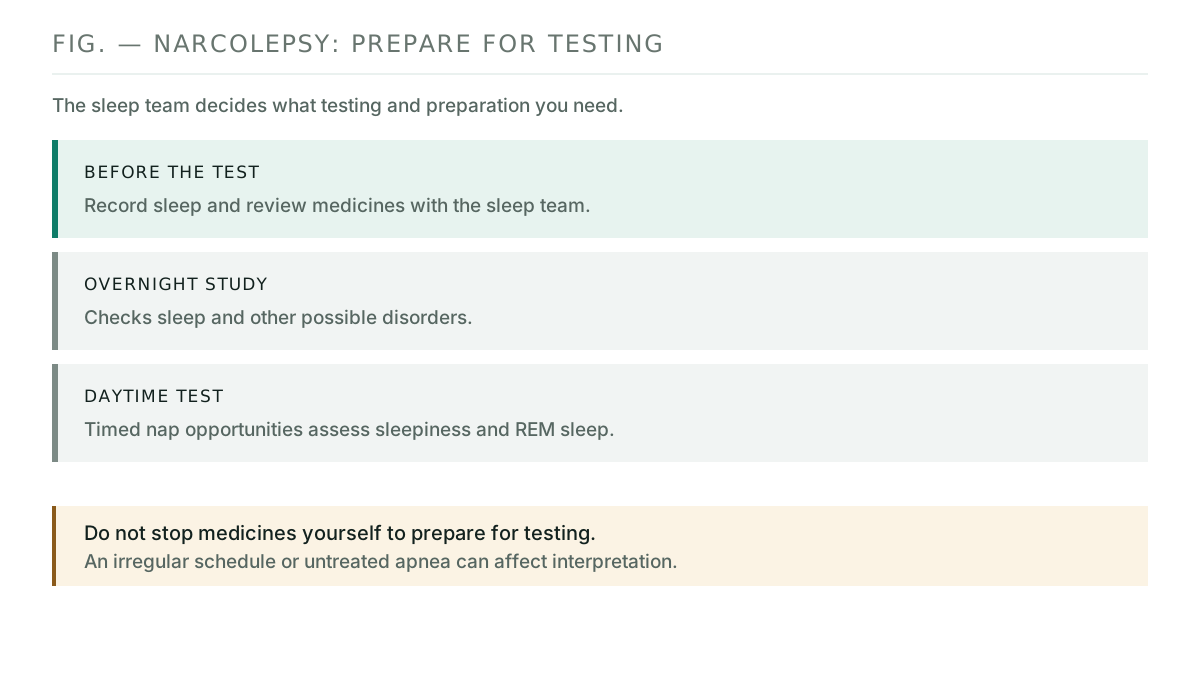
Narcolepsy assessment often includes an overnight sleep study followed by a multiple sleep latency test, or MSLT, during the next day. The tests examine nighttime sleep and how quickly sleep and REM sleep occur during scheduled nap opportunities. Results require specialist interpretation in the context of symptoms, preparation and other possible causes.
The 2021 AASM adult testing protocol describes standardized conditions for reliable testing. An MSLT is not the same as taking an ordinary nap at home. The overnight study also provides information that a daytime description alone cannot supply.
A home sleep apnea test does not substitute for the laboratory overnight study immediately preceding an MSLT. That distinction is useful when scheduling: ask which test has been ordered and what question it is intended to answer. Our sleep-study guide explains the overnight setting.
Some people need additional evaluation, including selected testing of hypocretin in spinal fluid. That is not a routine request everyone should make. Ask why a proposed test would help your case and how its result would change the plan. One laboratory number is not a personal diagnosis without the rest of the assessment.
The preparation plan protects the meaning of the MSLT
Sleep deprivation, shift timing, caffeine and medicines can affect MSLT findings. The sleep team should provide a preparation plan, often including a sleep diary beforehand and an individualized medication review. Do not stop antidepressants, stimulants or other prescriptions yourself. Both continuing a medicine and withdrawing it can change the result or create safety problems.
The AASM protocol recommends documenting sleep-wake timing for two weeks before testing, with actigraphy when appropriate. The goal is to establish adequate, consistent sleep rather than to “perform well” on the test. Tell the team if work or caregiving makes the requested schedule difficult.
Medication changes require planning with the prescribing clinician. Some drugs suppress REM sleep; stopping them abruptly can cause rebound that also interferes with interpretation. A generic instruction found online is not an appropriate taper schedule. Ask the sleep team to coordinate with whoever manages each prescription.
Request written instructions about caffeine, nonprescription products, alcohol, cannabis and any prescribed apnea treatment. If you cannot follow part of the plan, call before the test instead of concealing it. A rescheduling decision or documented limitation is more useful than an apparently precise result obtained under conditions the specialist does not know about.
Also ask about the practical arrangements: arrival time, how long to remain at the center, meals, transport home and whom to contact if you become ill. Keep a copy of the preparation instructions rather than relying on a remembered phone conversation. If two clinicians give conflicting medication directions, have them reconcile the plan before making a change.
Treatment targets the symptoms that affect daily function
Narcolepsy treatment may combine prescribed medicines, planned sleep routines and practical support. Different treatments target daytime sleepiness, cataplexy or disrupted nighttime sleep, so the plan should name the symptom being treated. Treatment can improve function, but narcolepsy is a long-term condition, and a prescription does not automatically resolve every safety concern.
The AASM's summary of its 2021 treatment guideline includes strong adult narcolepsy recommendations for modafinil, pitolisant, sodium oxybate and solriamfetol compared with no treatment. That list is not a ranking of medicines or evidence that each is suitable for every patient.
The clinician should consider other health conditions, interactions, adverse effects and the symptoms that matter most. This article does not compare individual doses or tell you which prescription to request. Ask what benefit the proposed medicine is expected to provide, which effects to report and how the plan will be reviewed.
Scheduled naps and a consistent sleep routine may be part of practical management. NHLBI includes these measures in patient guidance, while the 2021 AASM guideline did not make a formal recommendation for scheduled naps because evidence was insufficient or inconclusive. A guideline evidence gap is not the same as proof that a personal routine cannot help.
| Part of the plan | Question to clarify |
|---|---|
| Daytime sleepiness | Which treatment targets unintended dozing, and how will benefit be assessed? |
| Cataplexy | Does the treatment address weakness episodes as well as sleepiness? |
| Daily schedule | How should sleep timing, planned breaks and work responsibilities fit together? |
| Monitoring | Which side effects need an earlier call rather than waiting for review? |
Bring a brief account of what changed after starting treatment, not just whether a tablet makes you feel more alert. A partner's observations, remaining unintended naps and any difficulty following instructions can all be useful. Ask for help with obstacles rather than quietly changing the plan yourself.
Driving and workplace safety need attention before the diagnosis is settled
Do not drive or operate dangerous equipment when sleepy or at risk of falling asleep. Unintended dozing and episodes of weakness deserve prompt medical assessment, even before a diagnosis is confirmed. Discuss transportation, job duties and treatment follow-up with the clinician. Feeling temporarily better does not by itself establish that a safety-sensitive activity is safe.
Tell the prescribing team plainly about a near-miss, dozing at the wheel or an episode while using equipment. Those details should not be saved for the end of an appointment. Ask how to arrange a safer commute and which activities need restriction while the assessment or treatment adjustment is underway.
For someone already diagnosed, review safety when symptoms change, medicines change or work demands change. Licensing and occupational requirements vary, so ask the treating team and the relevant licensing authority for the rules that apply to you. Do not assume a prescription or a good day automatically provides driving clearance.
At work, a practical discussion may include planned breaks, consistent scheduling or adjustments to tasks. You can ask the clinician how to document the medical needs without sharing an entire health history with everyone around you. The aim is to make the workday safer and more manageable, not to pretend the symptoms are a character flaw.
A review should also address how the condition affects relationships and confidence. An explanation for unintended sleep can help people understand what is happening, but support needs differ. Ask about patient education or counseling if misunderstandings or worry are making daily life harder.
Get emergency help for a collapse with serious injury, difficulty breathing, new one-sided weakness, persistent confusion or inability to wake normally. For recurrent unintended dozing without those emergency features, arrange medical assessment promptly and avoid driving while sleepy.
Before the visit ends, confirm the next step: who will arrange testing, whom to call about symptoms and when the plan will be reviewed. Keep the written instructions with your medication list. A clear route back to the team matters when symptoms interfere with the ability to follow a complicated schedule.
Key takeaways
- Narcolepsy causes excessive daytime sleepiness; it is not the same as feeling low in energy.
- Cataplexy is brief muscle weakness, usually with awareness preserved, and does not occur in every type of narcolepsy.
- Sleep paralysis alone or an online questionnaire cannot establish the diagnosis.
- An overnight study and MSLT need careful preparation, including clinician-directed medication planning.
- Do not drive when sleepy; treatment and safety restrictions need individualized follow-up.
Where to go from here
These pages cover the surrounding ground:
- Sleep after 40 — the broader assessment of sleep and daytime symptoms.
- Hypersomnia explained — other patterns of excessive sleepiness.
- Sleep paralysis — the separate symptom around sleep-wake transitions.
- What happens at a sleep study — the overnight testing setting.
- Snoring or sleep apnea — breathing-related clues worth discussing.
- All sleep articles
Frequently asked questions
What is narcolepsy?
Narcolepsy is a long-term neurological sleep disorder that causes excessive daytime sleepiness and can disrupt nighttime sleep. Some people also have cataplexy, sleep paralysis or dreamlike experiences around sleep. Symptoms and specialist testing must be considered together. Repeated dozing deserves assessment, but it does not automatically establish narcolepsy as the cause.
Can narcolepsy be diagnosed after age 40?
Yes. Narcolepsy can begin at any age, although symptoms often start earlier, and diagnosis may be delayed. A diagnosis after 40 does not prove that symptoms began in midlife. Tell the clinician about your current problems and any earlier history, including unintended naps, weakness episodes or previous explanations for excessive sleepiness.
Does everyone with narcolepsy have cataplexy?
No. Cataplexy is associated with narcolepsy type 1, while type 2 does not include it. The episode usually involves brief muscle weakness with awareness preserved, often after emotion. New collapse or weakness still needs assessment because other conditions can look similar. Do not decide the diagnosis from a description alone.
Does sleep paralysis mean I have narcolepsy?
No. Sleep paralysis can be one feature of narcolepsy, but it is not enough to make the diagnosis. Report recurrent episodes, especially alongside substantial daytime sleepiness or weakness episodes. A sleep specialist considers the full history, other sleep disorders and testing rather than treating one symptom as a stand-alone confirmation.
Should I stop my medicines before a narcolepsy sleep test?
Do not stop prescriptions or supplements yourself before an MSLT. Medicines can influence sleep and REM findings, and withdrawal can also affect results or cause harm. Ask the sleep team to coordinate an individualized plan with your prescribers, including instructions about caffeine, other substances and any treatment already used for sleep apnea.
Is it safe to drive if I have narcolepsy?
Do not drive when sleepy or at risk of falling asleep. Having treatment does not automatically establish that driving is safe. Discuss symptoms, near-misses, medicine effects and any licensing requirements with the treating team and relevant authority. Arrange alternative transportation while safety is uncertain rather than using a good day as clearance.
Sources
- NHLBI — Narcolepsy overview, symptoms, assessment and practical management; updated March 2025
- MedlinePlus Genetics — Narcolepsy description, age at onset, symptoms and hypocretin background
- MedlinePlus Medical Encyclopedia — Narcolepsy symptoms, evaluation and patient care
- American Academy of Sleep Medicine — Recommended protocols for MSLT and MWT in adults, 2021; preparation and MSLT sections read
- American Academy of Sleep Medicine — Official summary of 2021 treatment guideline; adult narcolepsy recommendations read

Male Health Guide Editorial Team
We write about the health problems men over 40 actually search for at 3 a.m. — and we say plainly when the evidence for a popular product is thin. We do not invent credentials and we do not publish sponsored copy as editorial. Read more about how we work.
Medical disclaimer: This article is general information, not medical advice. We are not doctors, and nothing here diagnoses, treats or cures any condition. This article explains narcolepsy and sleep testing, not an individual diagnosis or treatment plan. Do not change medicines yourself before a test. Avoid driving when sleepy, discuss recurrent unintended dozing promptly, and seek emergency help for serious injury, breathing difficulty or new persistent neurological symptoms.