Heart Murmur After 40: When Silence Is the Risk
Short answer
A heart murmur is a whooshing sound caused by turbulent blood flow through the heart, and most are harmless. The less-known half: a large population study of adults 40 and older found that nearly two-thirds of people with real, significant valve disease had no audible murmur at all. Loudness, timing and symptoms matter more than whether a murmur is there.
A doctor pauses mid-checkup, listens again, and says the word “murmur” — and most men hear it as a diagnosis rather than what it actually is: a sound. What that sound means depends entirely on what's making it, and the honest answer splits in two directions most articles on this topic only cover one of.
This article covers what a murmur actually is, how doctors grade how concerning one sounds, the counterintuitive finding that not having a murmur is not the reassurance it seems to be, and the specific combination of symptoms that turns “mention it at your next checkup” into “go now.”
What a heart murmur actually is
MedlinePlus defines it plainly: a heart murmur is a blowing, whooshing or rasping sound heard during a heartbeat, caused by turbulent blood flow through the heart valves or near the heart. It is a sound, not a disease — the same way a creak in a floorboard tells you something is happening underfoot without telling you whether the house is structurally fine or not.
Many heart murmurs are harmless. These types of murmurs are called innocent murmurs. They will not cause any symptoms or problems.
MedlinePlus, National Library of MedicineInnocent murmurs can show up during exercise, pregnancy, fever, anemia or high emotional stress — situations where blood is simply moving faster or under different conditions than usual, with nothing structurally wrong. Abnormal murmurs, by contrast, point to an actual valve disorder (the aortic, mitral or tricuspid valve), a thickened heart muscle, or a structural defect someone has had since birth.
How loud is too loud: the Levine scale
Loudness alone doesn't diagnose anything, but it's one of the fastest signals a clinician uses to decide how quickly to look further. Murmurs are graded on a 6-point scale.
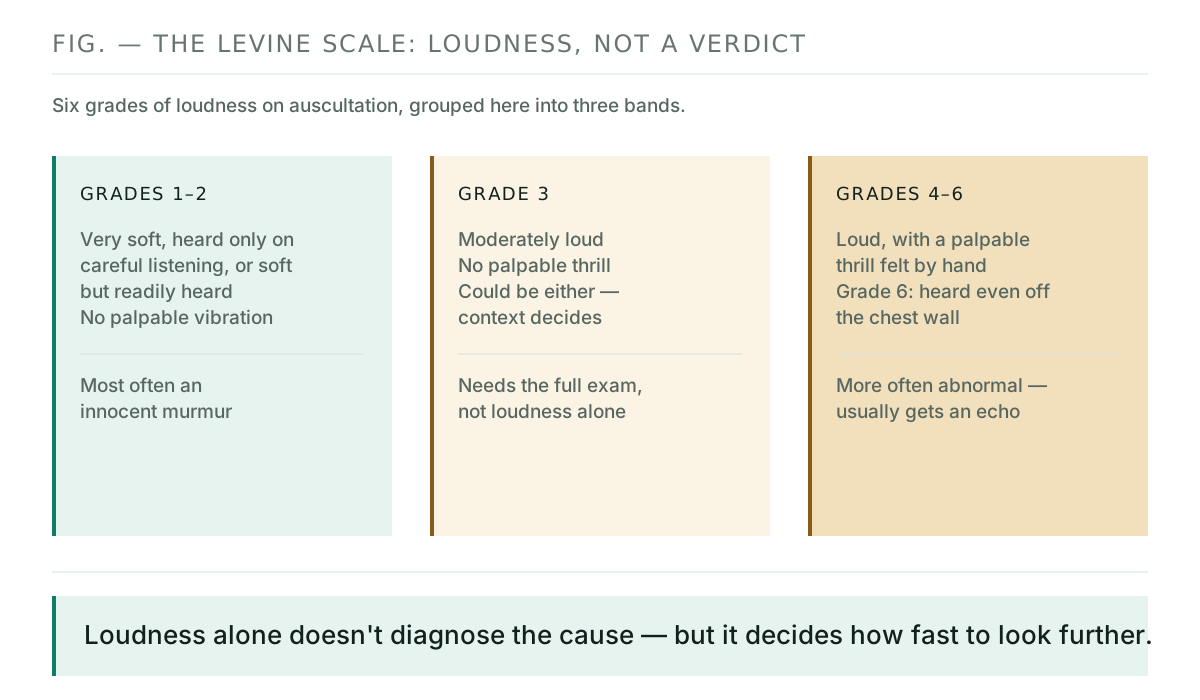
Grade I can barely be heard and is intermittent…When a murmur is more noticeable, the provider may be able to feel it with the palm of the hand over the heart. This is called a ‘thrill’ and means the murmur is grade 4 or higher.
MedlinePlus, National Library of MedicineA soft grade 1 or 2 murmur with no symptoms and a normal exam otherwise is, most of the time, nothing to lose sleep over. A loud grade 4 or higher murmur, especially a new one, moves a doctor toward imaging a lot faster — but grade is one input among several, not the whole answer by itself.
The blind spot runs the other way too
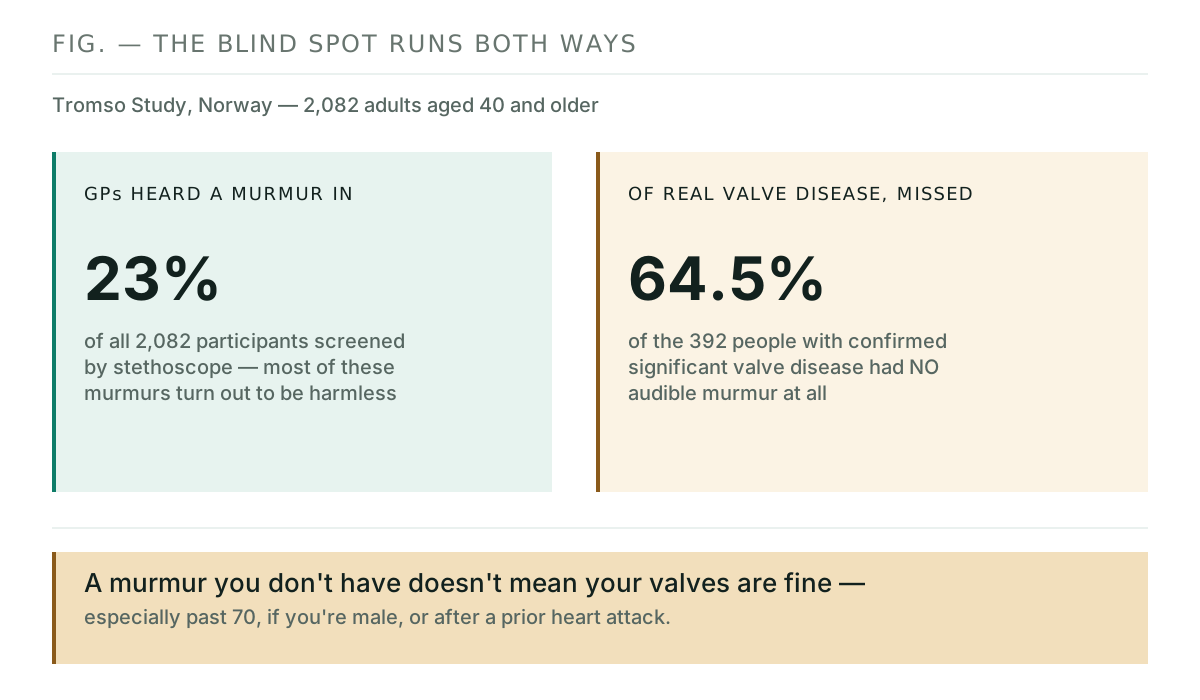
Here is the part almost no consumer article about heart murmurs mentions, and it matters specifically for the age group reading this. A 2015–2016 population study in Norway, the Tromsø Study, examined 2,082 adults aged 40 and older — mean age 63 — and had general practitioners listen to every single one of them.
GPs heard a murmur in 23% of everyone screened — the familiar, expected finding, and most of those murmurs are exactly as harmless as that frequency suggests. The less familiar finding is what happened among the 392 participants who actually had clinically significant valve disease, confirmed separately by echocardiogram.
Only 139 of them (35.5%) had an audible murmur.
Heart murmurs in the general population: diagnostic value and prevalence from the Tromsø StudyRead the other way: 64.5% of people with real, confirmed, significant valve disease made no sound a stethoscope caught. Accuracy also wasn't uniform across valve problems — auscultation caught essentially all cases of aortic stenosis (sensitivity 100%, specificity 78%), but missed most cases of aortic regurgitation (sensitivity 43%) and mitral regurgitation (sensitivity 29%).
Age 70 or older, being male, and a prior heart attack each independently raised the odds of the murmur being a real valve problem rather than an innocent one. None of those three is something a stethoscope needs to detect — they're already in your chart.
None of this means auscultation is pointless — the study's own authors call it “a valuable initial screening tool”, especially for aortic stenosis specifically. It means a clean listen is reassuring evidence, not proof, particularly once risk factors like age, sex and prior heart events stack up. That's also the direct argument for the broader workup covered in heart health after 40 rather than treating the annual stethoscope check as the whole picture.
What actually causes an abnormal murmur
Abnormal murmurs trace back to a short list of mechanical problems: a valve that has narrowed and makes the heart push blood through a tighter opening (stenosis), a valve that doesn't close fully and lets blood leak backward (regurgitation), a thickened heart muscle crowding the space blood flows through, or a structural defect present since birth. Each produces a sound at a different point in the heartbeat, which is part of how a clinician narrows down which one it might be before any imaging happens.
Who actually needs an echocardiogram
Not every murmur needs imaging, and over-testing a harmless sound has its own cost in money and worry. The Tromsø Study's own numbers point to a reasonable, practical rule: auscultation performed best for aortic stenosis specifically, and the factors that raised the odds of real valve disease among people with a murmur were age 70 or older, male sex, and a prior heart attack.
Because every reader of this is already male, that factor is a constant here, not a differentiator — age and a prior heart attack are the two that actually move the needle for this audience. A soft murmur in a man in his 40s with no history of a heart attack and no symptoms is reasonably watched rather than immediately imaged. The same soft murmur in a 72-year-old, or in any man with a prior heart attack, is a different conversation — not because the sound changed, but because the odds behind it did.
What a NEW murmur in adulthood usually means
Context changes everything here. A soft murmur someone has had since childhood, never investigated further and never caused a symptom, carries a very different weight than one that shows up for the first time at 52. New murmurs can still be innocent, particularly during a temporary state like fever or unusual physical stress.
A murmur that is genuinely new in an adult, outside one of those situations, is taken more seriously by default, because it more often signals a valve that has started to change rather than a passing effect of circumstance. This is also why the question “have I always had this, or is it new?” is worth answering as precisely as you can at the appointment — “I don't remember ever hearing that before” and “a doctor mentioned this when I was a kid” point a clinician in genuinely different directions.
When a new murmur is an emergency, not an appointment
Most murmurs, even new ones, are not an emergency. A specific combination of symptoms alongside a murmur is what changes that.
- Chest pain, fainting, or shortness of breath
- Sudden swelling or unexplained weight gain
- Bluish skin or lips (cyanosis), or bulging neck veins
- Fever, chills, or night sweats — which can signal an infection on the valve itself (endocarditis)
Based on MedlinePlus (National Library of Medicine) guidance
That last item deserves its own sentence. An infection on a heart valve is a genuine medical emergency that can develop over days, and fever with a new murmur is exactly the combination that should move someone toward same-day care rather than “I'll mention it next time I'm in.” Outside those specific signs, a murmur found on a routine exam is a “talk to your doctor about next steps” finding, not a reason to go to the emergency room on its own.
What actually happens next
If a murmur is heard, the next step is rarely dramatic. An echocardiogram — an ultrasound of the heart, painless and done while lying down — is the test that actually settles the question an ear alone can't: which valve, how significant, and whether it needs watching, a medication adjustment, or eventually a procedure. What actually happens at an echocardiogram covers the test itself step by step, including the rarer version with a tube down the throat.
An EKG is often added at the same visit to check the heart's electrical rhythm, which is a different question from a murmur and is covered separately in heart palpitations vs AFib for men whose main complaint is an irregular beat rather than a sound someone else heard. For many men, that single scan and a follow-up conversation is the end of it — the test exists to answer the question once, not to open a long chain of appointments.
If a murmur comes up at a checkup, ask directly what grade it is, whether it's new or longstanding as far as your chart shows, and whether your age, sex and history put you in the group where an echocardiogram is worth getting rather than just watching. “It's probably nothing” without any of those specifics is the version of this that quietly goes nowhere.
Key takeaways
- Most heart murmurs are harmless “innocent” murmurs caused by normal blood flow, not a structural heart problem.
- In a population study of adults 40+, 64.5% of people with confirmed, significant valve disease had NO audible murmur — absence of a murmur is not proof the valves are fine.
- Loudness (the Levine scale) is one useful signal — grades 1–2 are usually innocent, grades 4+ more often point to a real problem — but it isn't the whole picture.
- Age 70+, male sex and a prior heart attack each independently raise the odds a murmur is significant, regardless of how loud it sounds.
- Seek immediate care for a new murmur with chest pain, fainting, shortness of breath, swelling, or fever/chills, which can signal a valve infection.
Where to go from here
If a murmur is what brought you here, these pages cover the ground around it:
- Heart Health After 40: What the Numbers Mean — the complete guide to the numbers a man starts hearing about at 40.
- What Actually Happens at an Echocardiogram — what the test mentioned above actually involves, step by step.
- Chest Pain After 40: When It's the Heart, and When It's Not — for when the concern is pain rather than a sound.
- Heart Palpitations vs AFib: Why a Normal EKG Proves Little — the same “absence isn't proof” theme, for an irregular heartbeat instead of a murmur.
- Heart Attack vs Cardiac Arrest: Plumbing vs Electrical — the two emergencies this article's red flags are watching for.
Frequently asked questions
Is a heart murmur dangerous?
Most are not. Many heart murmurs are harmless “innocent” murmurs that cause no symptoms or problems and need no treatment. A murmur becomes a concern based on how loud it is, when in the heartbeat it happens, and whether it comes with symptoms like chest pain or shortness of breath.
What does it mean if my doctor says it's an innocent murmur?
It means the sound is caused by normal, if slightly turbulent, blood flow rather than a structural problem with a valve. Innocent murmurs are typically soft, occur during specific conditions like exercise, fever or pregnancy, and don't require any cardiac treatment.
I don't have a murmur. Does that mean my heart valves are fine?
Not necessarily. In a study of over 2,000 adults 40 and older, nearly two-thirds of people who actually had significant valve disease on echocardiogram had no audible murmur at all. Risk factors like age 70+, being male, or a prior heart attack matter more than the absence of a sound.
How loud does a murmur have to be before it's serious?
Loudness alone doesn't diagnose the cause, but it is one signal doctors use. Grades 1–2 on the 6-point Levine scale are most often innocent; grades 4 and above, where a vibration can be felt by hand on the chest, more often point to a real valve or structural problem and typically lead to an echocardiogram.
When is a new heart murmur an emergency?
Seek care immediately for a new murmur along with chest pain, fainting, shortness of breath, sudden swelling or weight gain, or bluish skin. A new murmur with fever, chills or night sweats also needs urgent evaluation, since it can signal an infection on the heart valve itself.
Can a murmur come and go, or appear suddenly in adulthood?
Yes. Murmurs can appear during temporary states like fever, pregnancy or high emotional stress and fade afterward. A murmur that shows up for the first time in adulthood outside one of those situations is usually taken more seriously than one you've had since childhood, since a new murmur in an adult more often points to a valve problem.
Sources
- MedlinePlus (National Library of Medicine) — Heart murmurs and other sounds
- Heart murmurs in the general population: diagnostic value and prevalence from the Tromsø Study — PMC
- MedlinePlus (National Library of Medicine) — Endocarditis
- Oxford Medical Education — Grades of Murmur Intensity (Levine Scale)

Male Health Guide Editorial Team
We write about the health problems men over 40 actually search for at 3 a.m. — and we say plainly when the evidence for a popular product is thin. We do not invent credentials and we do not publish sponsored copy as editorial. Read more about how we work.
Medical disclaimer: This article is general information, not medical advice. We are not doctors, and nothing here diagnoses, treats or cures any condition. A heart murmur, new or longstanding, always needs to be evaluated by a qualified healthcare professional who can see your own results and history. Please speak to one about your own situation rather than acting on what you read online, and seek emergency care for the warning signs described above.