Finasteride for BPH: The Slow Benefit and the PSA Change

Finasteride can make a prostate blood test look better before you know whether your nights or bathroom trips are improving. That is an expected drug effect, but it changes how the result needs to be read.
We read the current U.S. Proscar label alongside patient guidance to explain the 5 mg prostate treatment: why it works slowly, what happens to PSA, and which side effects deserve a conversation before the first tablet.
Short answer
Finasteride is a prescription medicine for symptomatic benign prostatic hyperplasia, or BPH, in men with an enlarged prostate. It can shrink the gland and reduce urinary retention and surgery risk, but improvement takes months. The usual BPH dose is 5 mg daily. Sexual side effects, mood changes and altered PSA interpretation need discussion and monitoring.
Finasteride targets prostate growth rather than providing quick relief
Finasteride blocks an enzyme that converts testosterone to dihydrotestosterone, or DHT, a hormone involved in prostate growth. For men with symptomatic BPH and an enlarged gland, that can reduce prostate size over time. It does not immediately relax the urinary passage, and it is not a treatment for every cause of urinary symptoms.
The Proscar prescribing information lists three goals: improve symptoms, reduce acute urinary retention, and reduce the need for prostate surgery. Those are benefits assessed over time, not a promise that every man will avoid a procedure.
The distinction matters when a prescription arrives after months of a weak stream or repeated bathroom trips. A slow treatment can be reasonable, but only if the diagnosis, expected timeline and follow-up are clear. Our enlarged-prostate guide explains the broader assessment behind that decision.
Finasteride is also prescribed for male-pattern hair loss at a different dose. This article concerns the 5 mg BPH treatment, not a hair-loss regimen. A familiar ingredient name is not a reason to exchange products, change strengths or use someone else's prescription.
An enlarged gland and a symptom history both matter
Finasteride for BPH is intended for men whose prostate is enlarged and whose symptoms warrant treatment. A weak stream alone does not establish that diagnosis. The prescriber should consider other urinary conditions, assess how much symptoms affect daily life, and explain why a prostate-shrinking medicine fits the findings.
The label specifically says to consider other urological conditions before treatment. Prostate cancer and BPH can coexist. A prescription for benign enlargement therefore does not establish that cancer has been excluded, and a symptom improving does not replace the monitoring plan.
Describe the practical effect of your symptoms: trouble starting, interrupted flow, straining, a sense of incomplete emptying, or getting up at night. Bring any previous urine tests, PSA results and medication list. These details help the clinician distinguish the problem being treated from other reasons for frequent urination.
The label also calls for careful monitoring when a man has a large amount of urine left after voiding or markedly reduced flow. Some men in that situation may not be suitable candidates. Ask whether your bladder is emptying adequately rather than assuming the medicine can safely handle every obstruction.
The dose is daily, but the benefit is measured over months
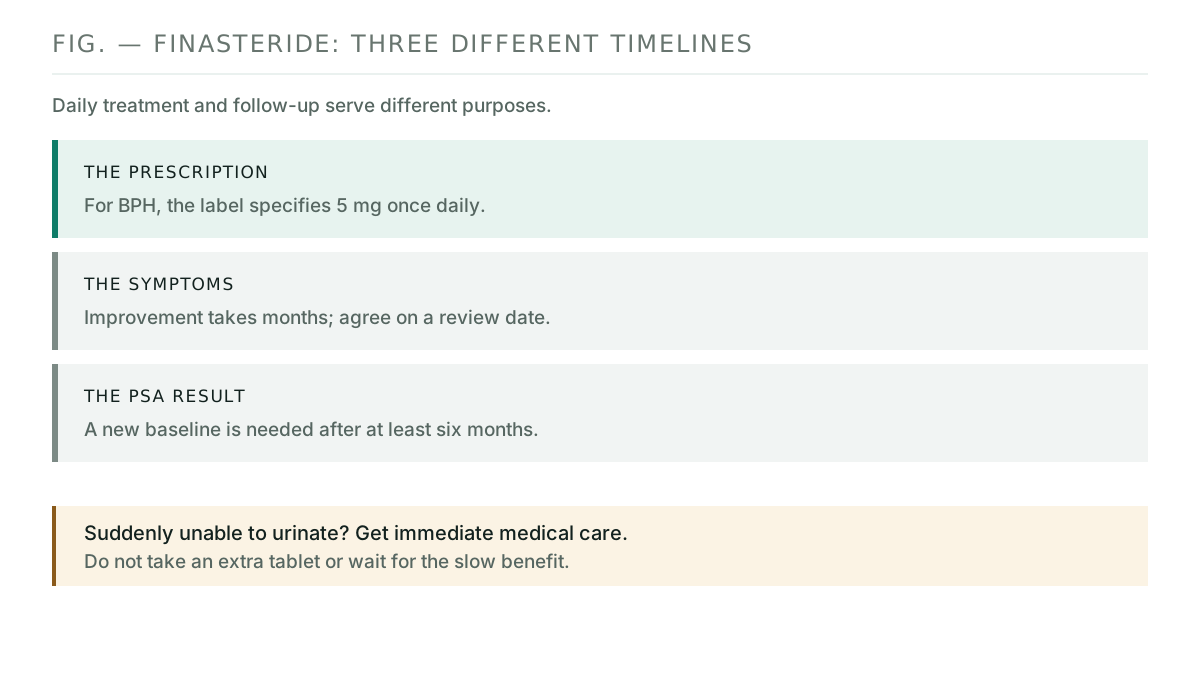
The recommended Proscar dose for BPH is one 5 mg tablet once daily, with or without food. MedlinePlus says symptom improvement may take at least six months. That makes a planned review important: follow the prescribed schedule, but do not treat worsening symptoms or an inability to urinate as something to wait out.
MedlinePlus advises taking finasteride at about the same time each day. If you miss a dose, skip it and continue the regular schedule; do not double the next dose. A pharmacist can clarify the instructions for your exact product.
Before starting, agree on what improvement would look like. It might involve the stream, the effort required to urinate or how much symptoms disrupt your routine. Ask when to report no benefit and which changes require earlier contact. You do not have to wait for a scheduled review if a new problem develops.
Get immediate medical care if you suddenly cannot pass urine. Do not take an extra tablet or wait for finasteride to start working. Fever or chills with painful, urgent urination, blood in the urine, or substantial urinary pain also need prompt medical assessment.
Finasteride changes how a PSA result should be interpreted
Finasteride lowers prostate-specific antigen, or PSA, by approximately 50 percent within six months in clinical studies. The Proscar label calls for a new PSA baseline after at least six months and periodic monitoring. A confirmed increase from the lowest value deserves evaluation, even when the result falls within the usual untreated range.
For an isolated PSA value after six months or more of treatment, the label instructs clinicians to double the result for comparison with reference ranges in untreated men. That is a clinical interpretation rule, not a home cancer test. Adherence and the pattern across several measurements also matter.
Tell anyone ordering or interpreting a PSA test that you take finasteride, when you started, and whether you have missed doses or stopped. The information needs to travel with the number. A laboratory flag viewed without the medication history can leave out an important part of the picture.
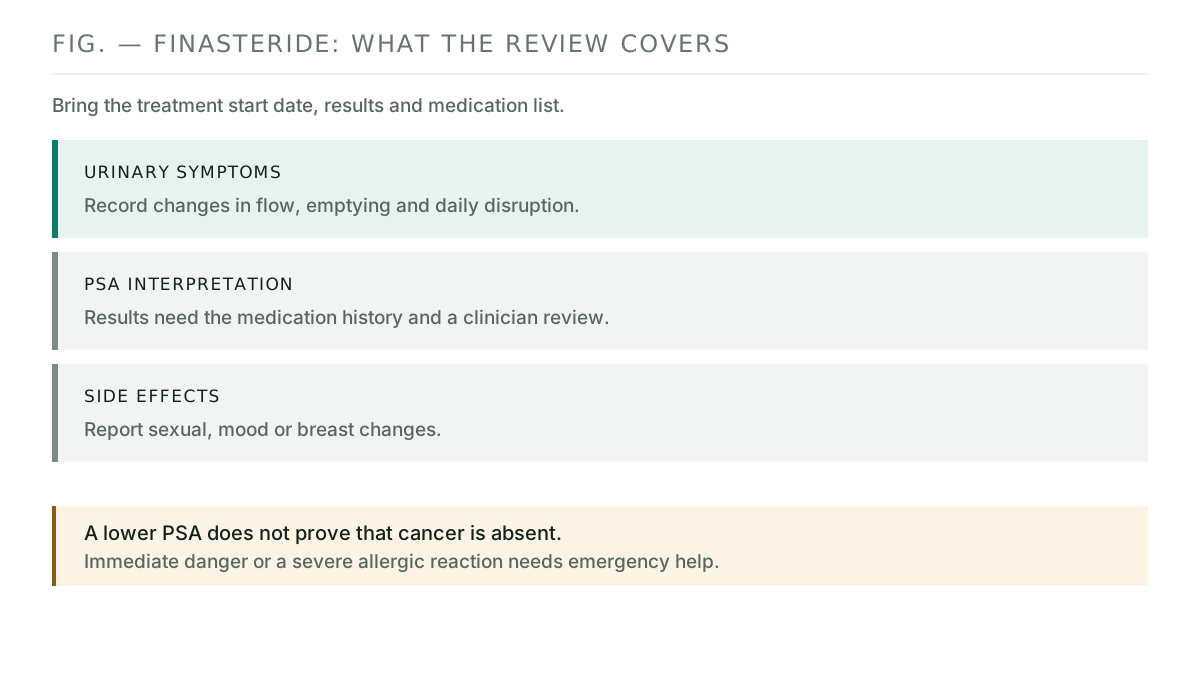
A lower PSA does not prove that prostate cancer is absent. The label says PSA can fall even when cancer is present and retains a warning about high-grade prostate cancer. Finasteride is not approved to prevent prostate cancer. Ask how the clinician balances that warning against the intended BPH benefits.
Our PSA guide explains why interpretation is broader than one cutoff. Keep previous results and the treatment start date together so the follow-up discussion concerns the trend, not an isolated number remembered from a portal.
Sexual side effects need an honest discussion before treatment
Finasteride can cause erection difficulties, reduced sexual desire and changes in ejaculation. The Proscar label also includes reports of sexual dysfunction continuing after treatment stopped. These effects do not happen to everyone, but they should be discussed before treatment, especially if sexual function or fertility is already a concern.
In the first year of the PLESS trial, the label reports impotence in 8.1 percent of men taking finasteride versus 3.7 percent taking placebo. Reduced libido was reported in 6.4 versus 3.4 percent. These are results from one trial population, not a personalized forecast or a comparison with every other prostate medicine.
Postmarketing reports are a different kind of evidence. Because people report voluntarily and the total exposed population is uncertain, those reports cannot reliably establish frequency or the drug's independent causal role. That uncertainty does not justify dismissing a symptom, or describing a persistent problem as inevitable.
Report changes plainly: what changed, when it began, and whether anything else changed at the same time. Mention fertility plans too; the label includes reports of poor semen quality or infertility, with improvement reported after discontinuation. Ask the prescriber how to evaluate the problem and review treatment rather than changing the regimen yourself.
Mood and breast changes belong in the safety conversation
The current Proscar label includes depression and suicidal thoughts among postmarketing reports, alongside breast changes and allergic reactions. New mood symptoms, a breast lump, nipple discharge or a significant rash deserve medical attention. Difficulty breathing, swelling of the tongue or throat, or immediate danger requires emergency help rather than a routine appointment.
The NHS overview also highlights mood changes. Do not assume a new symptom must be unrelated because you have taken the medicine for a while. Tell the prescribing clinician promptly about depression or thoughts of self-harm; seek emergency help if you cannot stay safe.
Breast tenderness or enlargement is not the same finding as a new lump, and an article cannot distinguish them for you. The label advises reporting breast changes. Describe the change and when it appeared so the clinician can decide what examination or testing is needed.
Keep a current medication list and tell the prescriber about liver disease or previous reactions to medicines. A review should consider your health history, other prescriptions and nonprescription products, not only whether you can tolerate swallowing the tablet.
Broken tablets need special handling around pregnancy
People who are pregnant or could become pregnant should not handle crushed or broken finasteride tablets because exposure can harm the development of a male fetus. The Proscar coating prevents contact with the ingredient during normal handling of intact tablets. Keep the medicine in its original, clearly labeled storage arrangement.
If someone who is pregnant touches a crushed or broken tablet, the label says to wash the area immediately with soap and water. MedlinePlus also advises contacting a doctor. Ask a pharmacist how to manage a damaged tablet rather than leaving fragments in a shared pill organizer.
That warning concerns exposure to the active ingredient; it does not mean that being in the same room as a closed bottle is dangerous. Clear instructions are more useful than vague alarm. Anyone helping organize your medicines should know which tablets must remain intact and whom to call with a question.
Finasteride and alpha blockers do different jobs
Finasteride works on the hormonal pathway involved in prostate growth, while alpha blockers relax muscles around the prostate and bladder outlet. A clinician may prescribe both for selected men, but one does not automatically replace the other. The goals, timing and possible side effects should be explained for each medicine.
| Question | Finasteride | Alpha blocker |
|---|---|---|
| Main approach | Reduces DHT and prostate size over time | Relaxes smooth muscle |
| Timing | Months to assess the full symptom benefit | Generally quicker symptom relief |
| Review point | PSA interpretation, sexual and other effects | Blood pressure, dizziness and drug-specific effects |
Our prostate-medication comparison covers the classes, and the tamsulosin article explains a commonly prescribed alpha blocker. Do not add, swap or stop a treatment because another man's prescription sounds simpler. Ask what each drug contributes to your own plan.
A useful review checks the benefit as well as the burden
A finasteride review should cover urinary symptoms, bladder emptying when relevant, side effects, adherence and the PSA monitoring plan. Bring the start date and any previous results. If improvement is insufficient or the burdens outweigh the benefit, discuss alternatives with the clinician rather than simply continuing indefinitely without reassessment.
Write down the questions before the visit: How long should this trial continue? What would count as success? Which symptoms require urgent care? Who will track the PSA trend? A clear answer is more useful than a general reassurance that the tablet is commonly prescribed.
Finasteride is one option in a wider treatment pathway. Persistent symptoms may lead to another medication discussion or a conversation about procedures for BPH. Needing a different plan does not mean you used the tablet incorrectly; the next decision depends on the findings and your priorities.
Key takeaways
- Finasteride 5 mg is a daily treatment for symptomatic BPH with an enlarged prostate, not immediate relief for an obstruction.
- Symptom improvement takes months; sudden inability to urinate needs immediate care.
- PSA commonly falls during treatment, so results need the start date, treatment history and clinician interpretation.
- Sexual effects, persistent symptoms after stopping, mood changes and breast changes deserve an informed discussion.
- Keep broken or crushed tablets away from anyone pregnant or who could become pregnant.
Where to go from here
These pages cover the surrounding ground:
- Enlarged prostate after 40 — the diagnosis and full treatment pathway.
- Prostate medicines compared — how the main classes differ.
- PSA levels and their interpretation — why one result is not the whole assessment.
- Tamsulosin explained — the different job of an alpha blocker.
- All prostate articles
Frequently asked questions
What is finasteride used for in BPH?
Finasteride is prescribed for symptomatic benign prostatic hyperplasia in men with an enlarged prostate. It can improve symptoms and reduce the risk of acute urinary retention and prostate surgery. The 5 mg treatment works over time; it is not immediate relief for someone who suddenly cannot pass urine.
How long does finasteride take to help urinary symptoms?
Finasteride works slowly because it changes a pathway involved in prostate growth. MedlinePlus says BPH symptoms may take at least six months to improve. Follow the prescribed schedule and agree on a review date, but report worsening symptoms sooner. Sudden inability to urinate requires immediate medical care, not another tablet.
Does finasteride lower PSA?
Yes. The Proscar label reports an approximately 50 percent PSA reduction within six months. A new baseline and continuing monitoring are needed. For an isolated value after at least six months, clinicians adjust interpretation. A confirmed increase from the lowest result needs evaluation, even if the number appears within the usual untreated range.
Can sexual side effects continue after stopping finasteride?
The Proscar label includes postmarketing reports of sexual dysfunction continuing after treatment stopped. Those reports cannot reliably establish how often this happens or the medicine's independent role. Erection, desire, ejaculation or fertility changes deserve discussion with the prescriber. Do not assume persistence is inevitable, or dismiss symptoms because their cause is uncertain.
Can finasteride affect mood?
The current Proscar label includes depression and suicidal thoughts among postmarketing reports. These reports do not establish an individual prediction, but new mood symptoms should be taken seriously. Contact the prescribing clinician promptly about depression or thoughts of self-harm. If you are in immediate danger or cannot stay safe, seek emergency help.
What should I do if I miss a finasteride dose?
MedlinePlus advises skipping a missed finasteride dose and continuing the regular schedule. Do not double a dose to make up for it. Take the medicine exactly as prescribed and ask your pharmacist if the instructions are unclear. Tell the clinician about interruptions because treatment history also matters when interpreting PSA results.
Sources
- DailyMed / Organon — Proscar prescribing information, revised March 2026; full label read through openFDA
- MedlinePlus — Finasteride: patient instructions and precautions
- NIDDK — Enlarged prostate: assessment and treatment
- NHS — About finasteride

Male Health Guide Editorial Team
We write about the health problems men over 40 actually search for at 3 a.m. — and we say plainly when the evidence for a popular product is thin. We do not invent credentials and we do not publish sponsored copy as editorial. Read more about how we work.
Medical disclaimer: This article is general information, not medical advice. We are not doctors, and nothing here diagnoses, treats or cures any condition. Do not start, stop or change finasteride based on this page. Discuss your prescription and PSA results with your clinician. Sudden inability to urinate requires immediate medical care; immediate danger or a severe allergic reaction requires emergency help.