Teeth Grinding at Night: Why It's So Hard to Stop
Short answer
Teeth grinding, medically called bruxism, can happen during the day or night, but nighttime grinding is harder to control because you're asleep for it. MedlinePlus says daily stress may be the trigger in many people, and while it isn't dangerous, it can wear down teeth and cause jaw pain, headaches and earaches. Mouth guards, stress reduction and, in some cases, Botox are the main treatments.
A sore jaw most mornings. A partner who mentions a grinding sound in the middle of the night that you have no memory of. An earache that sends you to check for an ear infection that turns out not to be there. Teeth grinding has a habit of showing up sideways, as a cluster of unrelated-seeming complaints, before anyone connects them to the jaw.
This article covers what causes teeth grinding, why the nighttime version is specifically harder to deal with than clenching you do while awake, the symptoms and complications MedlinePlus lists, what actually helps, and where it overlaps with sleep apnea.
What bruxism actually is
MedlinePlus defines bruxism simply: it's when you grind your teeth, sliding them back and forth over each other. People can clench or grind without being aware of it, and it can happen during the day or at night. Some people probably clench or grind their teeth and never feel any symptoms from it at all — whether it causes pain varies a lot from person to person.
What causes it
MedlinePlus is upfront that there is some disagreement about the cause of bruxism, though daily stress may be the trigger in many people. Beyond stress, several factors influence whether grinding ends up causing pain and other problems: how long and how tightly you clench and grind, whether your teeth are misaligned, your posture, your ability to relax, your diet, and your sleeping habits.
The National Institute of Dental and Craniofacial Research (NIDCR) adds a few specific factors to that list: psychosocial factors like stress, mood and nervousness; a person's genes; consuming alcohol or caffeine; smoking; and certain medications used to treat depression, seizures and ADHD, which it says may increase the chances of having bruxism. None of this points to a single cause — it's a condition with several contributing factors that vary from one man to the next, not one trigger with one fix.
Why nighttime grinding is the harder problem
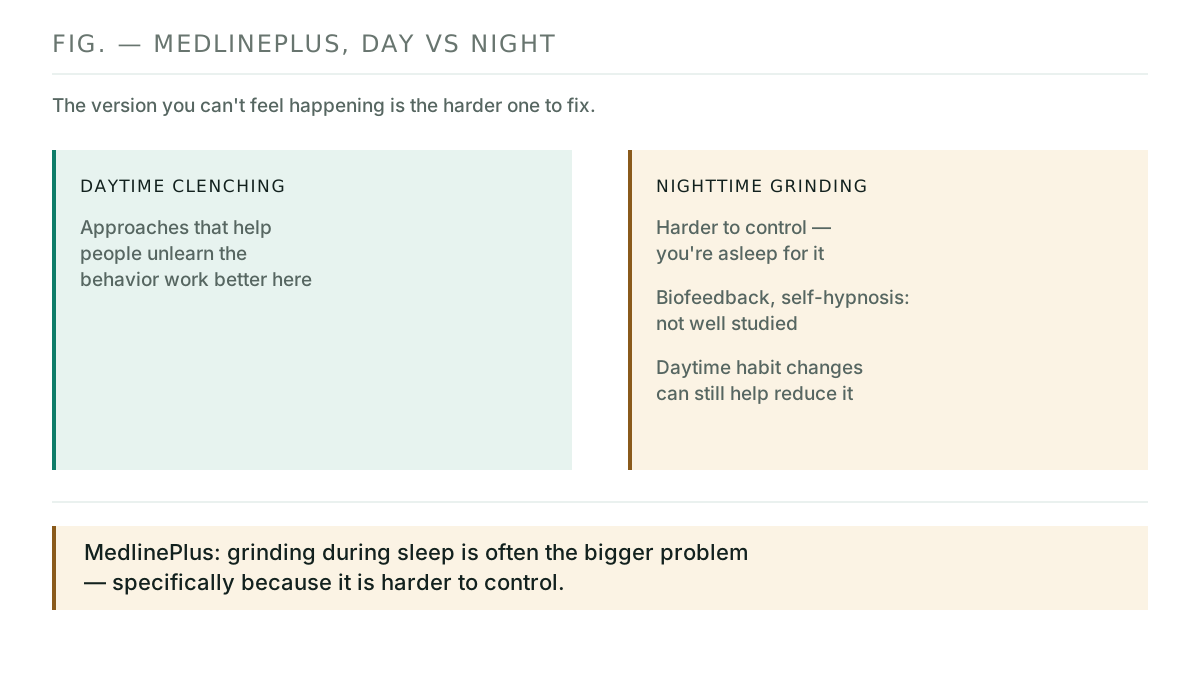
This is the detail that makes bruxism different from most habits: MedlinePlus states plainly that grinding during sleep is often a bigger problem specifically because it is harder to control. You can't catch yourself mid-grind the way you might catch yourself clenching your jaw at a stressful moment during the day. NIDCR adds an interesting wrinkle to this: awake bruxism is actually the more common of the two, but sleep bruxism is the one that has been studied more — researchers have focused more attention on the version people have the least ability to consciously notice or interrupt.
That distinction carries through to treatment. MedlinePlus notes that approaches aimed at helping people unlearn clenching behavior are more successful for daytime clenching. For some people, just relaxing and modifying daytime behavior is enough to also reduce nighttime bruxism. But methods that try to directly modify nighttime clenching — biofeedback devices, self-hypnosis and other alternative therapies — have not been well studied, according to MedlinePlus. That's a real gap, not a minor caveat: it means the version of bruxism you're least able to consciously manage is also the one science has the least direct guidance on.
Symptoms, including the ones that don't look dental
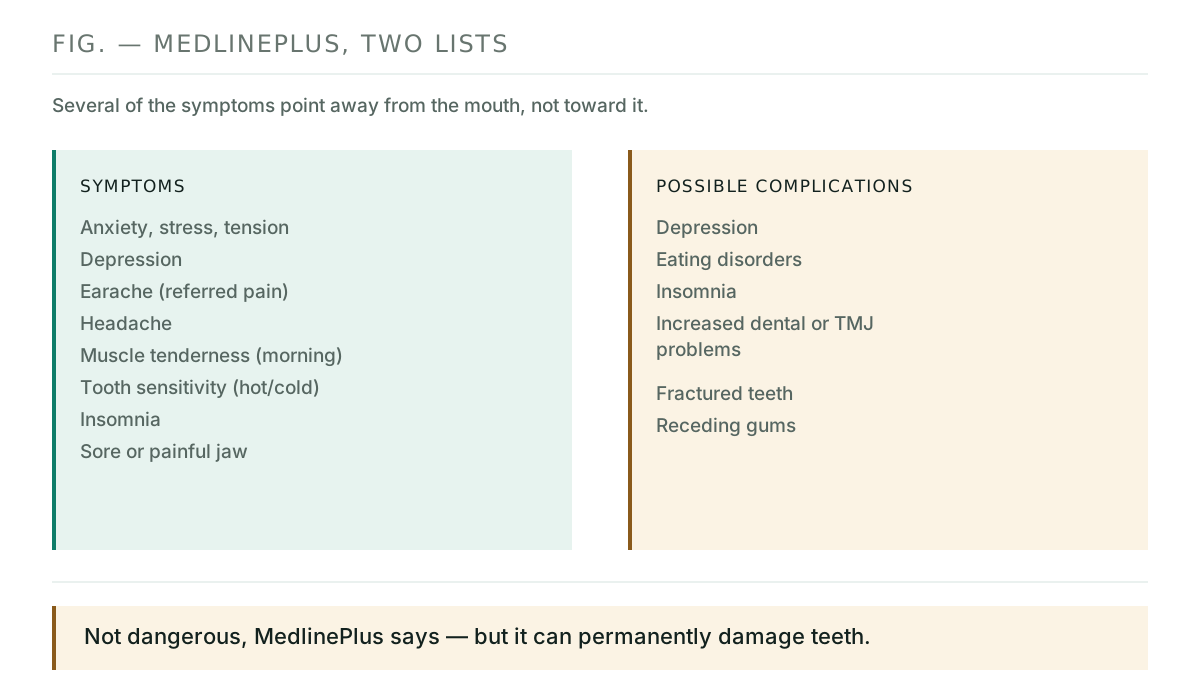
Grinding puts pressure on the muscles, tissues and other structures around the jaw, which is why MedlinePlus's symptom list reaches well past the teeth themselves: anxiety, stress and tension; depression; headache; muscle tenderness, especially in the morning; hot, cold or sweet sensitivity in the teeth; insomnia; and a sore or painful jaw.
Earache is on that list too, and MedlinePlus explains why in a way worth sitting with: partly because the structures of the temporomandibular joint (TMJ) sit very close to the ear canal, and partly because of referred pain, where you feel pain in a different location than its actual source. A man checking himself for an ear infection, finding nothing, and assuming it will pass is a plausible way this condition goes unrecognized for a while.
What it can lead to if left alone
MedlinePlus is reassuring on one point and blunt on another: bruxism is not a dangerous disorder, but it can cause permanent damage to the teeth and uncomfortable jaw pain, headaches or ear pain. The specific complications it lists include depression, eating disorders, insomnia, increased dental or TMJ problems, fractured teeth and receding gums — on top of the more immediate nuisance of grinding loud enough to wake a sleeping partner.
Self-care that actually helps
The goals of treatment, per MedlinePlus, are reducing pain, preventing permanent damage to the teeth, and reducing clenching as much as possible. Self-care steps it lists include applying ice or damp heat to sore jaw muscles, avoiding hard or dense foods like nuts, candy and steak, skipping gum, getting enough sleep, and learning physical therapy stretches for the muscles and joints on each side of the head. Reducing daily stress and learning relaxation techniques are named specifically as a way to help prevent bruxism in people prone to it.
Mouth guards, splints and Botox
To protect the teeth themselves, MedlinePlus points to mouth guards or splints as the standard approach — worn over the top or bottom teeth, sometimes designed to hold the jaw in a more relaxed position. A well-fitting splint should minimize the effects of grinding, though MedlinePlus notes some people find symptoms return once they stop using it, and that a splint may work less well over time; if one type doesn't help, another sometimes will. After splint therapy, adjusting the bite pattern may help some people. Separately, Botox injections into the jaw muscles have also shown some success in controlling clenching and grinding.
MedlinePlus is specific about one trigger for contacting a dentist right away: trouble eating or opening your mouth. It also notes that a wide variety of conditions, from arthritis to whiplash injuries, can cause TMJ-like symptoms, so a full evaluation is worth getting if self-care measures don't help within several weeks — rather than assuming it must be grinding by default.
Where it overlaps with sleep apnea
Teeth grinding and sleep apnea aren't the same condition, but they show up together often enough to be worth knowing about if you have either. This site's article on under-recognized sleep apnea symptoms covers research finding sleep bruxism at markedly higher rates among sleep apnea patients than in the general population — one of several "non-classical" symptoms that paper argues get missed in people who don't fit the stereotype of an obviously sleepy, loud snorer.
None of that means every case of nighttime grinding points to undiagnosed apnea. But if grinding shows up alongside loud snoring, witnessed pauses in breathing, or daytime sleepiness, it's a reasonable prompt to read that article and consider whether a sleep study is worth raising with a doctor, rather than treating the jaw in isolation. NIDCR notes that polysomnography — an overnight sleep study, with sensors monitoring brain activity, heart rate and breathing, usually done in a sleep center — can be used to assess whether teeth grinding is actually occurring during sleep. It's worth knowing that this is the same kind of test used to diagnose sleep apnea, so a single overnight study can sometimes speak to both questions at once.
Key takeaways
- Teeth grinding (bruxism) can happen day or night; MedlinePlus says daily stress may be the trigger in many people, though the cause isn't fully settled.
- Nighttime grinding is the harder problem specifically because you can't consciously control something you're asleep for — and direct fixes for it are poorly studied.
- Symptoms reach beyond the mouth: earache (often referred pain from the nearby jaw joint), headache, and morning muscle tenderness are all on MedlinePlus's list.
- It's not dangerous, but left alone it can permanently damage teeth — mouth guards, stress reduction, and in some cases Botox are the standard treatments.
- It overlaps with sleep apnea often enough that loud snoring or witnessed breathing pauses alongside grinding are worth mentioning to a doctor together.
Where to go from here
If teeth grinding is what brought you here, these pages cover the surrounding ground:
- My Wife Says I Stop Breathing When I Sleep — the sleep apnea symptoms that are easy to miss, grinding among them.
- Snoring or Sleep Apnea? What Separates Them — how to tell which one you actually have.
- What Actually Happens at a Sleep Study — the test that confirms apnea if it's suspected.
- CBT for Insomnia — for the insomnia bruxism can bring with it.
- All sleep articles
Frequently asked questions
What causes teeth grinding?
MedlinePlus says there is some disagreement about the cause, though daily stress may be the trigger in many people. Other factors that influence whether grinding causes pain include how tightly you clench, whether your teeth are misaligned, your posture, your ability to relax, your diet, and your sleeping habits.
Why is nighttime grinding harder to deal with than daytime clenching?
MedlinePlus is direct about this: grinding during sleep is often a bigger problem because it is harder to control. Many approaches to unlearning clenching behavior are more successful for daytime clenching, and methods aimed directly at modifying nighttime clenching, like biofeedback or self-hypnosis, have not been well studied.
Can teeth grinding cause ear pain?
Yes. MedlinePlus lists earache as a symptom, partly because the structures of the temporomandibular joint sit very close to the ear canal, and partly because of referred pain, where you feel pain in a different location than its actual source. A dental or TMJ evaluation is the way to rule that in or out.
Is teeth grinding dangerous?
MedlinePlus states that bruxism is not a dangerous disorder. However, it can cause permanent damage to the teeth, along with uncomfortable jaw pain, headaches or ear pain. Possible complications include fractured teeth, receding gums, and increased dental or TMJ problems over time.
What actually helps?
MedlinePlus lists self-care steps including ice or damp heat on sore jaw muscles, avoiding hard or dense foods, not chewing gum, and stress reduction. For protecting the teeth specifically, mouth guards or splints are the standard approach; Botox injections into the jaw muscles have also shown some success for clenching and grinding.
Is teeth grinding linked to sleep apnea?
They can occur together. This site's article on under-recognized sleep apnea symptoms covers a study finding sleep bruxism at notably higher rates in sleep apnea patients than in the general population, among other non-classical presentations clinicians can miss when someone doesn't fit the stereotype of a loud, obviously sleepy snorer.
Sources
- MedlinePlus (National Library of Medicine) — Bruxism
- National Institute of Dental and Craniofacial Research (NIH) — Bruxism
- Current Opinion in Pulmonary Medicine (2022) — More than sleepiness: prevalence and relevance of nonclassical symptoms of obstructive sleep apnea
- Male Health Guide — My Wife Says I Stop Breathing When I Sleep (companion coverage of the sleep bruxism / sleep apnea overlap)

Male Health Guide Editorial Team
We write about the health problems men over 40 actually search for at 3 a.m. — and we say plainly when the evidence for a popular product is thin. We do not invent credentials and we do not publish sponsored copy as editorial. Read more about how we work.
Medical disclaimer: This article is general information, not medical advice. We are not doctors, and nothing here diagnoses, treats or cures any condition. Whether your jaw or ear pain is bruxism, a dental problem or something else requires evaluation by a qualified healthcare professional. Please speak to one, especially a dentist, about your own situation.