Sciatica: When Leg Pain Starts in Your Lower Back

Your back may only ache a little. What gets your attention is the burning line down your buttock and leg, or the foot that feels strangely numb. Sciatica is one possible explanation. That traveling pattern is worth describing before deciding you have pulled a muscle.
Short answer
Sciatica describes pain from an irritated or compressed nerve, usually traveling from the buttock down one leg. Tingling, numbness or weakness may accompany it. Many episodes improve without surgery. Sciatica on both sides, severe or worsening bilateral weakness or numbness, new bladder or bowel changes, or genital-area numbness need emergency assessment.
This guide separates the symptom from its cause, then follows the decisions that matter: when to seek care, what an examination can establish, and how treatment is chosen. It builds on our joint pain after 40 guide and lower back pain article. It does not replace an examination or prescribe a stretching routine for an undiagnosed leg problem.
Sciatica describes traveling nerve pain, not a final diagnosis
Sciatica is a description of nerve-related symptoms rather than the name of one disease. Pain often travels from the buttock into one leg, sometimes reaching the foot. The cause may be a disk pressing on a nerve root or narrowing around spinal nerves. An examination helps identify what is producing that pattern.
MedlinePlus makes this distinction explicit. Saying you have sciatica describes the problem you feel; it does not explain why it started. That matters when someone offers the same exercise, injection or supplement to everyone who uses the word.
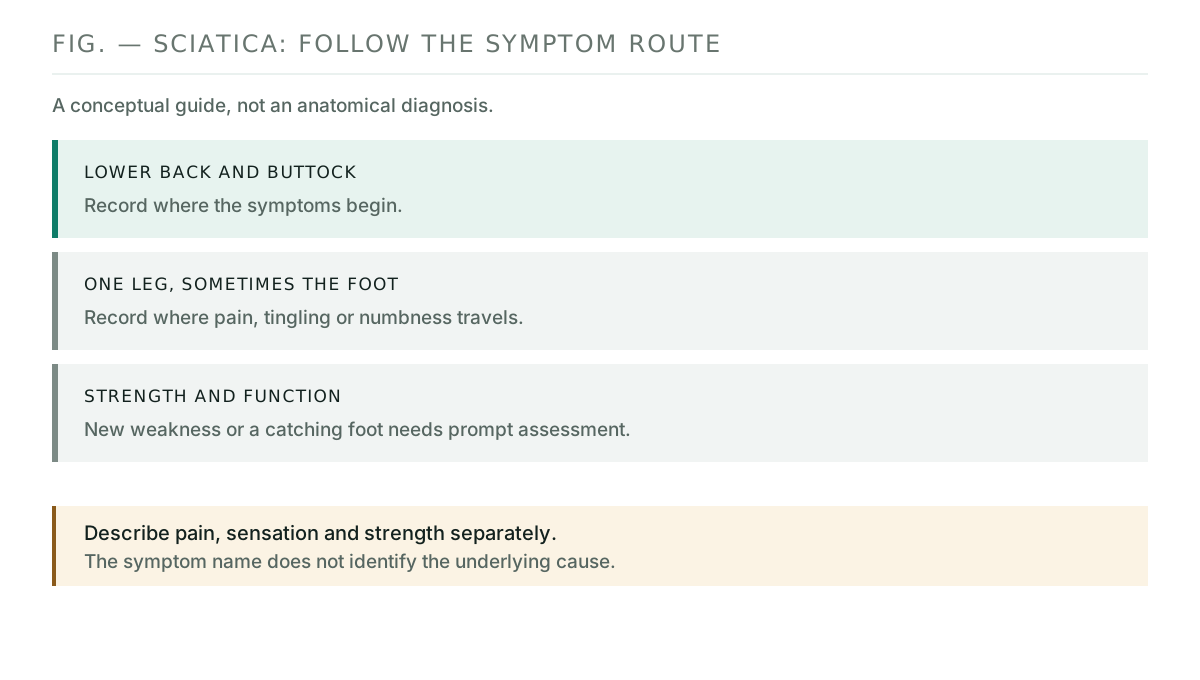
Try describing the route in ordinary language: where it begins, where it ends, and where the sensation changes. A line down the back of the thigh tells a different story from pain confined to the front of a knee. The name can come later. The description is useful from the first appointment.
Leg symptoms can matter more than the backache
Sciatica can make the leg more painful than the lower back. Burning, electric pain, pins and needles, numbness or weakness suggest nerve involvement, especially when symptoms travel rather than remain in one sore spot. Back pain alone is less typical. These clues guide assessment; they do not establish the diagnosis by themselves.
The NHS description of sciatica emphasizes the buttock and back of one leg, often extending into the foot or toes. Coughing or sneezing may aggravate it. A symptom can be relevant even if it seems far away from the spine.
| What you notice | What to describe | What it cannot prove |
|---|---|---|
| Pain traveling into the leg | The exact route and how far it reaches | Which structure is responsible |
| A numb or tingling patch | Location, onset and whether it is spreading | That the problem is harmless |
| Weakness or a foot catching | Which movement has changed | That it is just normal aging |
| Only a localized backache | Movements that aggravate it | That sciatica is the correct label |
If the problem feels centered in the hip, our hip pain guide covers the surrounding possibilities. A useful question for the appointment is whether the clinician thinks the pain comes from the hip joint, the spine, or another structure, and which examination findings support that view.
A disk and spinal narrowing are different starting points
Sciatica can begin when a herniated disk irritates a nerve root or when age-related changes narrow the space around spinal nerves. The same traveling pain can therefore have different causes. Age and the way symptoms began offer context, but neither substitutes for a history and physical examination.
The American Academy of Orthopaedic Surgeons describes nerve-root compression in the lumbar spine and distinguishes disks from bone spurs and arthritis-related narrowing. It does not treat the word sciatica as a complete diagnosis.
Someone whose symptoms began after lifting and someone whose walking has become increasingly limited may both arrive calling it sciatica. Their accounts should still be heard separately. Bring a short timeline rather than trying to match yourself to an online illustration of a particular disk level.
Also mention previous back problems, any recent injury and whether this episode is different. Those details give the clinician a starting point. They are more useful than assuming every new pain after 40 must be wear and tear, or that every symptom following a lift means a disk needs surgery.
New weakness and bladder changes change the urgency
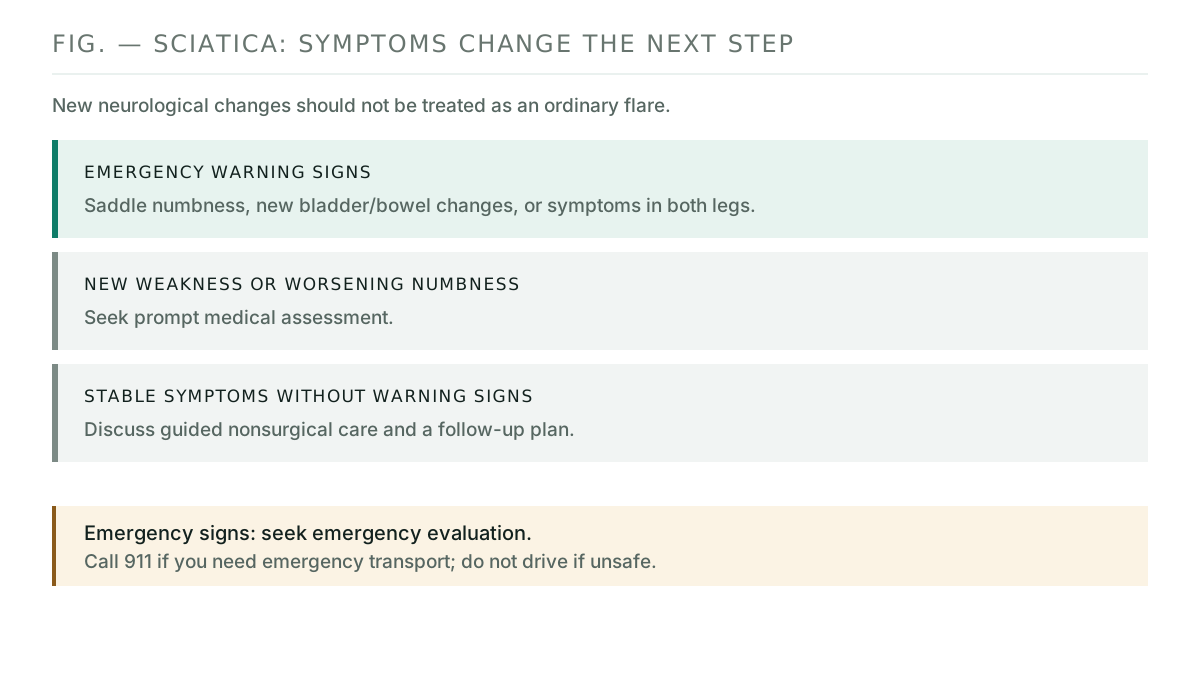
Sciatica needs emergency assessment if it affects both sides, or with severe or worsening weakness or numbness in both legs, new difficulty starting urination, loss of bladder or bowel control, or genital or anal numbness. These can indicate serious nerve compression. Do not wait for a routine appointment or try stretches first.
Seek prompt medical assessment for new leg weakness, a foot that starts catching, worsening numbness, fever with back pain, or pain following a substantial injury. Explain what has changed and when. A familiar backache does not make a new neurological symptom routine.
For men already living with prostate symptoms, the important question is whether urination has changed alongside the back or leg problem. Do not assume a sudden inability to urinate is simply the prostate. Our bladder-emptying article covers that separate issue, but new neurological warning signs belong in emergency care.
New saddle-area numbness, bladder or bowel changes, symptoms on both sides, or severe or worsening weakness or numbness in both legs need emergency evaluation. Call 911 if you need emergency transport. Do not drive yourself if your symptoms make driving unsafe.
The examination helps decide whether a scan will help
Sciatica assessment begins with your history and a physical examination, including strength, sensation and reflexes. Imaging is not automatically necessary for every episode. A clinician may order an MRI or other tests when symptoms are severe, persist, or suggest a problem that would change the treatment plan.
NIAMS explains that X-rays show bones, while MRI can show soft tissues such as disks and nerve roots. These tests answer different questions. An X-ray that does not explain leg pain is not the same thing as a complete assessment of the nerves.
A clinician may check walking, reflexes or the response to raising a straight leg. This is not a challenge to reproduce at home. Describe what happens during normal activities instead: whether the foot catches, which part feels numb, or what distance you can walk before stopping.
Before a scan, ask: what question are we trying to answer, and what would we do differently depending on the result? Afterward, ask how the finding fits the side and route of your symptoms. A useful consultation connects the report to your examination rather than ending with a picture and a medical term.
Recovery usually involves adapted activity rather than bed rest
Sciatica recovery commonly starts with nonsurgical care and activity adjusted to symptoms. Prolonged bed rest is discouraged. Short, manageable movement and a clinician-guided exercise plan may be more practical than forcing a full workout. New weakness, spreading numbness or emergency warning signs require reassessment, not an attempt to push through.
AAOS advises staying as active as possible and notes that a clinician may suggest short walks or physical therapy. This does not mean everyone should perform the same stretch from a video. A useful plan tells you what to do, how much to do, and which changes mean you should stop and call.
Make the plan concrete. Ask how to handle the drive to work, the chair you sit in, and the lifting your job involves. If an exercise repeatedly makes symptoms travel farther down the leg, tell the treating clinician rather than adding more repetitions because the routine was labeled a cure.
Tracking function can make follow-up more useful: what can you do today that you could not do last week? For example, note whether dressing, walking or sitting through a meal has become easier. That record is a conversation aid, not a substitute for reassessing new neurological changes.
Pain relief needs a plan, not a stack of products
Sciatica pain medicines should be chosen with a clinician or pharmacist because nerve pain can be difficult to treat and common painkillers do not help everyone. Review existing medicines and medical conditions before adding anything. An injection or prescription may be considered in selected cases; neither is an automatic next step.
The NHS notes uncertainty about how much NSAIDs such as ibuprofen help sciatica. That is different from saying nobody gets relief. Discuss what you have tried, what changed, and any side effects rather than assuming a stronger dose or another brand must be the answer.
Bring the packages or photographs of their labels. Include medicines you take only occasionally and anything bought for sleep or joint discomfort. Ask which products can be used together, how long the trial should last, and what result would justify continuing.
NIAMS describes injections for selected back-pain problems, including pain traveling down a leg due to nerve irritation or compression. Ask what an injection is meant to accomplish in your case. A temporary change in pain and a long-term solution to the underlying cause are different goals.
Surgery is a decision about symptoms, findings and function
Sciatica does not automatically require surgery. For a herniated disk, an operation may be discussed when appropriate nonsurgical care has not relieved disabling symptoms, or sooner for serious neurological problems. The decision should connect the examination and imaging to the difficulties you are having, rather than rely on the scan alone.
The AAOS guide to lumbar disk herniation explains nonsurgical and surgical options, including removing disk material that is pressing on a nerve. It also describes urgent situations involving weakness or loss of bladder or bowel control. Those situations should not be put through a routine waiting period.
For a planned consultation, write down the outcome you are hoping for. Is the main problem leg pain, weakness, limited walking or trouble working? Ask which symptoms the proposed procedure is intended to improve, which may remain, and what recovery would require from you.
There is no need to make the decision from the word surgery alone. Ask about alternatives, the consequences of waiting in your particular case, and what would make the recommendation change. A second opinion can be useful for a nonemergency decision, provided it does not delay care for urgent neurological symptoms.
A follow-up plan is more useful than a promised recovery date
Sciatica often improves over weeks to months, but the course depends on the cause and the person. A useful recovery plan includes a review date, a way to judge function, and clear instructions for worsening symptoms. Persistent or worsening pain that limits daily activities deserves reassessment rather than indefinite self-treatment.
Ask for the next step before leaving the appointment. If the first plan does not help, whom should you contact? What counts as enough improvement to continue? Which symptoms should bring the review forward? Having those answers avoids turning a short trial of treatment into months without a fresh assessment.
Keep the record brief: symptom route, changes in walking or work, medicines tried and any new numbness or weakness. You do not need to write down every twinge. The aim is to show the direction of change and make it easier to decide whether the current explanation still fits.
Key takeaways
- Sciatica names a nerve-related symptom pattern; identifying the cause is a separate task.
- Pain, altered sensation and weakness should be described separately, including where each travels.
- New saddle numbness or bladder or bowel changes require emergency assessment.
- Most care starts without surgery, with an examination, adapted activity and a follow-up plan.
- Imaging and treatment should answer a specific clinical question, not just attach a label to a scan.
Where to go from here
These pages cover the surrounding ground:
- Joint Pain After 40 — the wider map of joint and surrounding tissue problems.
- Lower Back Pain After 40 — backache assessment and why prolonged bed rest is discouraged.
- Hip Pain Explained — when the painful area may be the hip rather than the spine.
- All joints articles
Frequently asked questions
What does sciatica feel like?
Sciatica may feel like burning, electric or shooting pain traveling from the buttock down one leg. Tingling, numbness or weakness can occur as well. The distribution matters, but symptoms alone cannot identify the cause. An examination is especially important when sensation or strength changes, or when the pain is worsening.
Can you have sciatica without much back pain?
Yes. Sciatica may cause more leg discomfort than backache, and symptoms can reach the foot or toes. A small amount of back pain does not rule it out. Describe the route and any numbness or weakness to a clinician rather than judging the problem only by how much your back hurts.
Does sciatica always need an MRI?
No. Sciatica is often assessed first through the history and a physical examination. An MRI may be appropriate for severe, persistent or concerning symptoms, or when its findings would guide treatment. Ask what question the scan would answer and how the result would change the next step in your care.
Should you stay in bed with sciatica?
Prolonged bed rest is generally discouraged for sciatica. Activity should be adapted to symptoms, and a clinician or physical therapist can help choose appropriate movement. Do not use that advice to push through new weakness, spreading numbness or emergency symptoms. Those changes need medical assessment rather than a harder exercise session.
When is sciatica an emergency?
Sciatica on both sides needs emergency assessment, as do severe or worsening weakness or numbness in both legs, new genital or anal numbness, difficulty starting urination, or loss of bladder or bowel control. Do not wait for an appointment. Call 911 if you need emergency transport and cannot travel safely.
Does sciatica always require surgery?
No. Many people with sciatica improve with nonsurgical care. Surgery may be discussed for disabling symptoms that persist despite appropriate treatment or for serious neurological problems. The recommendation depends on the cause, examination and imaging together. Ask which symptoms the operation is expected to help and which may remain afterward.
Sources
- MedlinePlus, National Library of Medicine — Sciatica: Medical Encyclopedia
- NHS — Sciatica: symptoms, self-care and emergency warning signs
- American Academy of Orthopaedic Surgeons — Sciatica: causes, examination and treatment
- NIAMS, National Institutes of Health — Back Pain: Diagnosis, Treatment, and Steps to Take
- American Academy of Orthopaedic Surgeons — Herniated Disk in the Lower Back

Male Health Guide Editorial Team
We write about the health problems men over 40 actually search for at 3 a.m. — and we say plainly when the evidence for a popular product is thin. We do not invent credentials and we do not publish sponsored copy as editorial. Read more about how we work.
Medical disclaimer: This article is general information, not medical advice. We are not doctors, and nothing here diagnoses, treats or cures any condition. Seek emergency assessment for sciatica on both sides, severe or worsening weakness or numbness in both legs, new saddle-area numbness, or new bladder or bowel changes. Ask a qualified clinician about new weakness or persistent leg pain.