Hyponatremia: When Low Blood Sodium Needs Medical Care

Your blood test says the sodium is low: hyponatremia. The obvious response might seem to be more salt, an electrolyte drink or less water. The problem is that those are different interventions, and the right choice depends on why the number fell.
Hyponatremia can enter a conversation about tiredness, but it is a laboratory finding that needs context. We reviewed patient guidance and a hospital guideline to explain that context, including the symptoms that should not wait for another appointment.
Short answer
Hyponatremia means the sodium concentration in your blood is below normal, commonly defined as below 135 mEq/L. It can cause fatigue, weakness or confusion, although mild cases may have no symptoms. The cause, speed of change and symptoms guide treatment. Seizures, major confusion or reduced consciousness require emergency care; do not try to correct sodium yourself.
A low sodium result is a concentration, not a diet score
Hyponatremia describes a low concentration of sodium in the blood, reflecting the balance between sodium and water. It does not automatically mean that your meals contain too little salt. The National Kidney Foundation uses a level below 135 mEq/L; the laboratory range and your clinical circumstances also need interpretation.
Sodium helps regulate fluid balance and supports nerve and muscle function. A blood result concerns that circulating balance, not a direct count of how much sodium you ate yesterday. The MedlinePlus sodium-test guide explains why the measurement is often part of a metabolic or electrolyte panel.
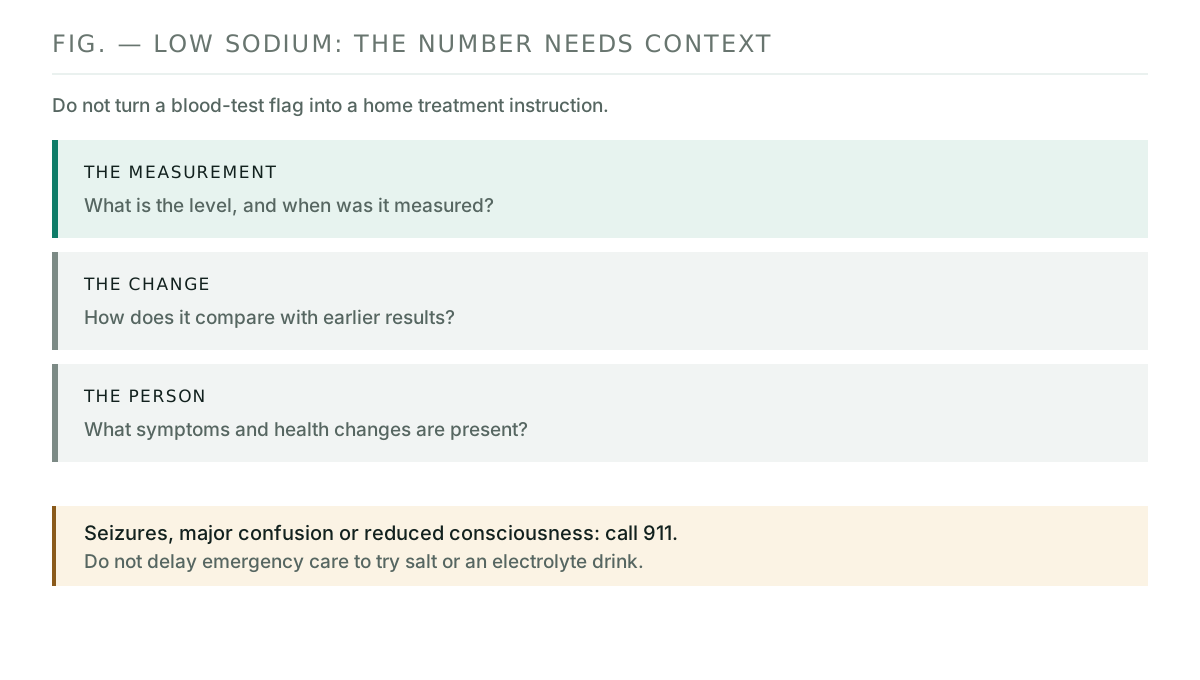
For someone reading a portal at home, the useful first step is to contact the clinician responsible for the test and ask what the result means in context. Include the exact value, units, date, previous results if available, and any new symptoms. Do not turn a colored flag into a treatment instruction.
A result written in mmol/L and one written in mEq/L use the same numerical value for sodium. Reference ranges can differ slightly across laboratories. Compare the number with the range on your report and the clinician's explanation rather than treating an internet cutoff as a complete diagnosis.
Fatigue can occur, but symptoms cannot diagnose hyponatremia
Hyponatremia can cause low energy, weakness, headache, nausea or muscle cramps, but those symptoms have many other causes. Mild hyponatremia may produce no noticeable symptoms. Feeling tired does not establish that sodium is low, and feeling reasonably well does not explain why an abnormal blood result occurred.
The National Kidney Foundation emphasizes that symptoms are more likely when sodium becomes very low or falls quickly. That is why the story behind the result matters: a change during an acute illness is different from a stable finding under active follow-up.
Describe what has actually changed. Is tiredness new, is there vomiting, or has someone noticed confusion? Mention recent illness, changes in medicines and unusual drinking patterns. Clear details are more useful than deciding in advance that the problem is either dehydration or a nutritional deficiency.
For persistent tiredness without an established sodium problem, our fatigue-after-40 guide covers the broader assessment. This article focuses on low blood sodium once it is suspected or measured; it is not a reason to order supplements for every low-energy afternoon.
New confusion or seizures change the urgency
Hyponatremia with seizures, major new confusion or reduced consciousness is an emergency. Call 911 for those signs or if the person is difficult to wake. Do not wait for a particular sodium number, a second blood test or a response to an electrolyte drink before seeking emergency help.
These symptoms can have causes other than low sodium, and an article cannot distinguish them. The emergency action is based on the person's condition. Bring the medication list and any available result, but do not delay getting help while looking for records or trying to arrange a routine callback.
Rapid changes deserve particular attention. MedlinePlus describes hyponatremia developing in less than 48 hours as more dangerous than a slower decline. That does not make every long-standing low value harmless; symptoms and the underlying cause still require assessment.
If a laboratory or clinician tells you a result is critical or directs you to emergency care, follow that instruction even if you feel well. For a low result without clear instructions, contact the ordering team promptly and ask how soon you need assessment.
Water balance, losses and illness can produce the same result
Hyponatremia can develop when the body retains too much water, loses sodium and fluid, or cannot regulate their balance normally. Possible contributors include kidney, heart or liver disease, vomiting, diarrhea, certain medicines and SIADH. Different causes can produce a low result, so they cannot all be managed with the same drink or diet.
SIADH is short for syndrome of inappropriate antidiuretic hormone secretion. In this condition, the body's handling of water is disrupted. The name identifies a mechanism that needs investigation; it does not tell a reader which disease or medicine caused it.
| Possible context | What to tell the clinician | What not to assume |
|---|---|---|
| Vomiting or diarrhea | When it started and whether you can keep fluids down | Every low sodium result means the same fluid loss |
| Heart, kidney or liver disease | Existing fluid instructions and recent changes | Drinking more is always helpful |
| New or changed medicine | Product name, dose and start date | Stopping it yourself is the right correction |
| Unusually high fluid intake | Approximate amounts and why intake changed | Everyone should follow one daily water target |
Our dehydration article covers a related but different question. Hyponatremia is not a synonym for dehydration. A clinician may need to assess whether the person has lost fluid, retained it or has another disturbance before recommending what to drink.
The follow-up tests help explain the low concentration
A sodium blood test identifies the concentration, but additional blood and urine tests may be needed to establish why it is low. The assessment can include blood and urine osmolality, urine sodium, glucose and kidney function. The clinician combines these results with the examination, medication history and recent changes in health.
Osmolality is a measure of how concentrated a fluid is. Blood and urine measurements answer different questions, which is why a urine sample may be requested even after the blood result is known. You do not need to calculate the diagnosis from those values yourself.
The hospital guideline reviewed here also includes checking thyroid function and cortisol when appropriate. That does not mean every reader needs every test. The workup should follow the pattern of results and the clinical assessment, rather than an indiscriminate list ordered to explain tiredness.
High blood glucose can affect how a sodium result is interpreted. Tell the clinician about diabetes and recent high readings; our high-blood-sugar guide explains that separate problem. Do not independently “correct” a number from an online calculator and decide the original result can be ignored.
Ask whether the measurement needs repeating and how soon. If several clinicians are involved, establish who will review the next result and contact you. A follow-up test is useful only when someone has responsibility for responding to it.
The medication list is part of the investigation
Some medicines can contribute to hyponatremia, including thiazide diuretics and certain antidepressants or seizure medicines. A review needs exact names, doses and recent changes, not simply whether you take a water pill. Do not stop a prescribed medicine on your own; the clinician should decide whether an adjustment is appropriate and how to monitor it.
Bring prescription medicines, occasional products and supplements into the same conversation. If a treatment began before the sodium changed, note the timing without assuming that proves the cause. An existing heart or kidney condition may also be relevant to both the prescription and the result.
Ask what to do before the next dose if the treating team thinks a medicine is contributing. That is a specific clinical question, not a reason to use a general article as a discontinuation plan. Make sure any change reaches the pharmacy and the other clinicians involved in your care.
Treatment depends on the cause and needs supervision
Hyponatremia treatment may involve addressing an underlying illness, a clinician-directed medication change, a prescribed fluid limit, or monitored hospital treatment. Some mild cases need close follow-up and repeat testing rather than immediate correction. There is no single treatment that is safe for everyone with a low sodium result.
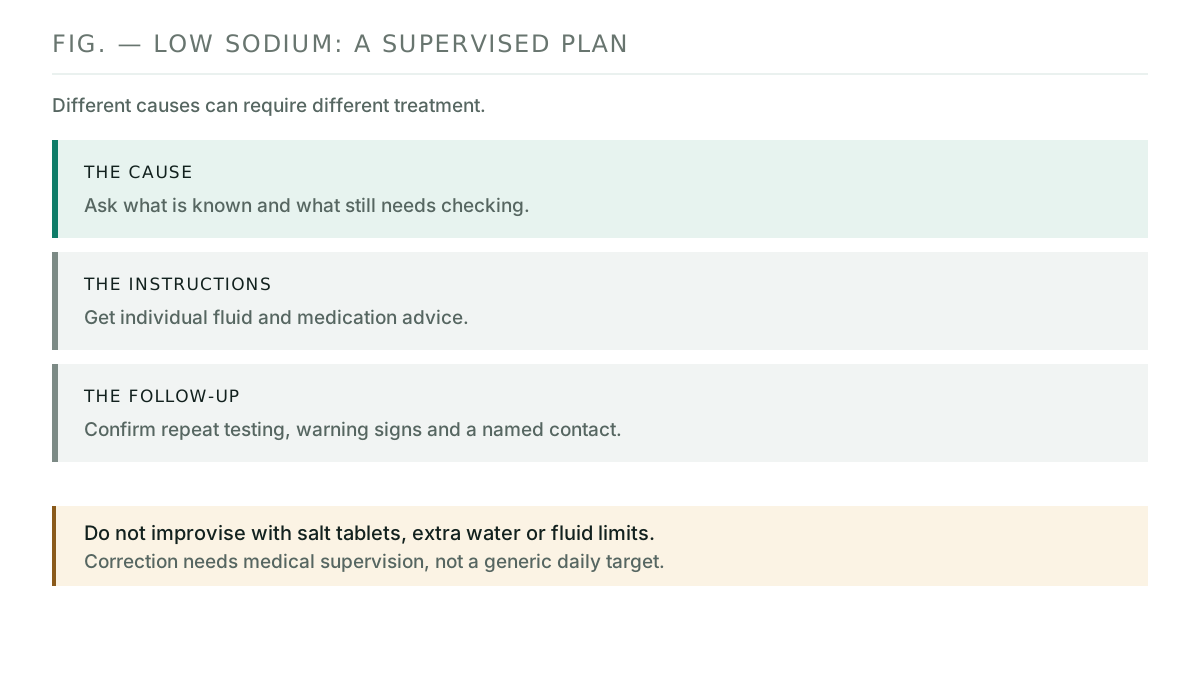
The key distinction is between describing possible treatments and choosing one for yourself. Fluid restriction may be part of one person's plan, while another needs a different approach. Do not start restricting water, drinking extra water or taking salt tablets because one of those options appears in a treatment list.
Severe or symptomatic cases may need intravenous treatment and repeated blood tests in a monitored setting. That care is about improving the person's condition while controlling the sodium change. It is not simply a race to make the laboratory number normal as fast as possible.
The Gloucestershire Hospitals NHS guideline explains the risk of osmotic demyelination when sodium is corrected too quickly. This is serious neurological injury. It is one reason hospital treatment uses carefully monitored changes, not a do-it-yourself replacement calculation.
An electrolyte beverage is not a substitute for that assessment. Neither the word “electrolyte” nor a sodium amount on a label establishes suitability for your cause of hyponatremia. If you already have prescribed fluid or dietary limits, ask the treating team before changing them.
A home plan needs specific instructions and a named contact
After evaluation for hyponatremia, a useful home plan states what caused or may have caused it, which instructions apply to fluids and medicines, when blood tests will be repeated, and whom to contact. It should also explain which symptoms require emergency care. Do not rely on remembering only that you should watch your sodium.
If a fluid limit is prescribed, ask exactly what counts toward it and how to track the amount. If no limit is prescribed, do not invent one. Request written instructions that fit your other conditions and usual routine, particularly if different teams have previously given different advice.
Before the visit ends, confirm the next step if the repeat value is still low. Who calls whom? Is there a number for questions outside normal office hours? A plan for a delayed result is better than repeatedly checking a portal without knowing what action to take.
- Keep the result, date and current medication list together.
- Write down clinician-directed changes, including what remains unchanged.
- Confirm the repeat-test appointment and the person reviewing it.
- Share emergency warning signs with someone who can help if you become unwell.
The sodium result may not explain all of the tiredness
Hyponatremia can contribute to fatigue, but finding a low value does not prove it explains every symptom. Persistent tiredness may need a broader assessment even while sodium is being followed. Report how your energy changes alongside treatment, rather than assuming that either a normal result or continued fatigue settles the whole question.
For the next appointment, describe function rather than only using a label such as exhausted. What can you no longer do comfortably? When did the change begin? Which symptoms improved, stayed the same or appeared after a treatment change? That account helps the clinician decide what still needs attention.
Our main fatigue guide connects the surrounding topics, while the heart-failure article covers one possible underlying condition. Neither replaces an individual explanation of your test. The goal is a safe, documented plan for the finding you actually have.
Key takeaways
- Hyponatremia is low blood sodium concentration, not automatically a shortage of dietary salt.
- Fatigue and weakness are possible symptoms, but mild cases may have none and symptoms alone cannot diagnose it.
- Seizures, major new confusion or reduced consciousness require emergency care; do not wait for a number.
- Causes include fluid imbalance, illness and certain medicines, so treatment is individualized.
- Do not improvise fluid restriction, extra water, salt tablets or medication changes; obtain a supervised plan and follow-up.
Where to go from here
These pages cover the surrounding ground:
- Fatigue after 40 — the broader assessment of persistent low energy.
- Dehydration after 40 — a different fluid problem that should not be confused with every low sodium result.
- High blood sugar — why glucose and the rest of the blood panel matter.
- Heart failure explained — one condition that can affect fluid balance.
- All energy articles
Frequently asked questions
What is hyponatremia?
Hyponatremia means the sodium concentration in your blood is lower than normal. The National Kidney Foundation defines it as below 135 mEq/L. The result concerns water and sodium balance, not simply how much salt you eat. A clinician needs symptoms, treatment history and sometimes additional tests to determine its cause and significance.
Can low sodium cause tiredness?
Yes. Hyponatremia can cause fatigue or weakness, but these symptoms occur in many conditions and do not diagnose low sodium. Mild cases may have no obvious symptoms. A blood test and clinical assessment are needed. New major confusion, seizures or reduced consciousness require emergency care rather than an ordinary fatigue appointment.
Should I eat more salt if my sodium is low?
Do not try to treat a low blood sodium result by adding salt or taking salt tablets without medical guidance. Hyponatremia can arise from several different fluid and sodium problems. Treatment depends on the cause, your other conditions and the severity, so a generic dietary correction may be inappropriate.
Can drinking too much water cause hyponatremia?
Excess water can dilute blood sodium and contribute to hyponatremia, but drinking is only one part of the assessment. Medicines, kidney function and other illnesses may affect water balance too. Do not assume you should immediately restrict fluids; ask the treating clinician for instructions based on your particular cause and results.
When is low sodium an emergency?
Hyponatremia with seizures, major new confusion or reduced consciousness requires emergency care. Call 911 if those signs occur or someone is difficult to wake. Follow any urgent instruction from the laboratory or clinician even if symptoms seem mild. Do not wait for a particular number or try an electrolyte drink first.
Can my medicines contribute to low sodium?
Some medicines can contribute to hyponatremia, including thiazide diuretics and certain antidepressants or seizure medicines. Give the clinician the exact names, doses and timing of changes. Do not stop them yourself: the reason they were prescribed also matters, and any adjustment needs an individualized plan with appropriate monitoring and follow-up testing.
Sources
- National Kidney Foundation — Hyponatremia: definition, causes and supervised treatment
- MedlinePlus — Low blood sodium: symptoms, tests and urgent assessment
- MedlinePlus — Sodium blood test: what is measured and how it is assessed
- Gloucestershire Hospitals NHS Foundation Trust — Hyponatraemia guideline, revised December 2024; assessment and monitored treatment

Male Health Guide Editorial Team
We write about the health problems men over 40 actually search for at 3 a.m. — and we say plainly when the evidence for a popular product is thin. We do not invent credentials and we do not publish sponsored copy as editorial. Read more about how we work.
Medical disclaimer: This article is general information, not medical advice. We are not doctors, and nothing here diagnoses, treats or cures any condition. Do not use this article to choose a sodium correction, fluid limit or medication change. Contact the team responsible for an abnormal result. Seizures, major new confusion or reduced consciousness require emergency care; call 911 and do not delay for home treatment.