Sarcopenia: The Muscle Loss That Starts Before You Notice
Short answer
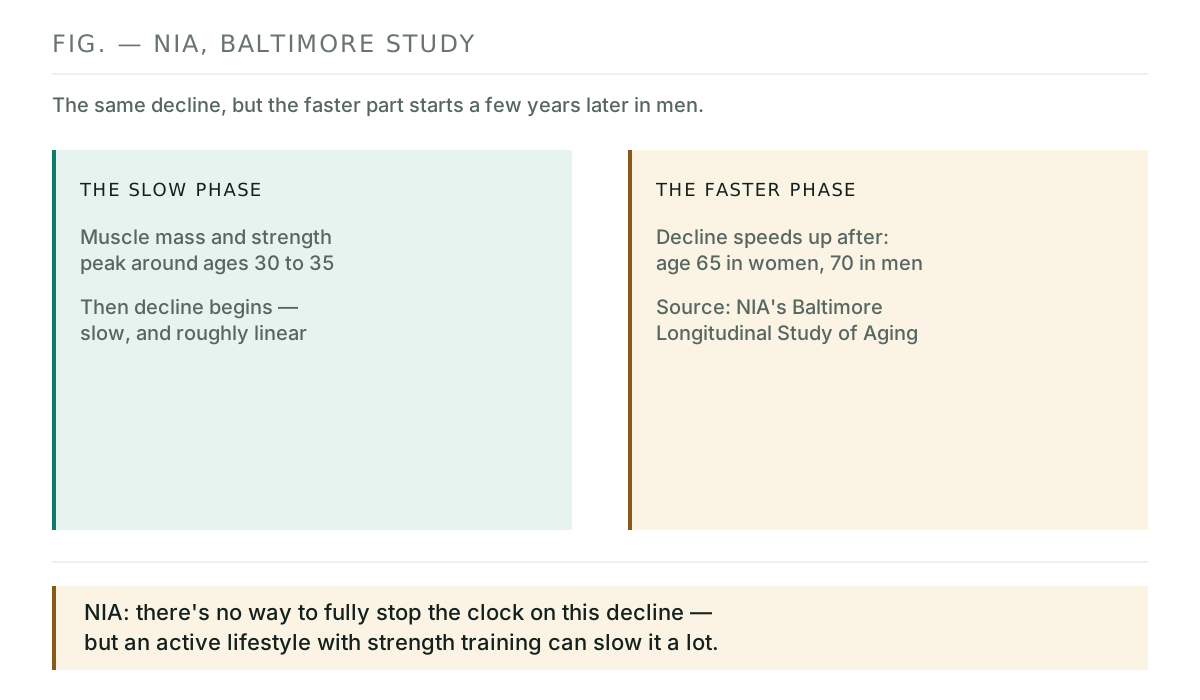
Sarcopenia is the age-related loss of muscle mass, strength and function. The National Institute on Aging says muscle peaks around ages 30 to 35, declines slowly after that, then faster after 65 in women and 70 in men. There is no way to fully stop it, but resistance training combined with walking is the best-supported way to slow it down.
Most men notice sarcopenia long before they have a name for it: the suitcase that used to be no problem, the jar lid that suddenly needs help, the flight of stairs that leaves you more winded than it did five years ago. It rarely announces itself as a diagnosis. It shows up as a string of small, deniable moments.
This article covers what sarcopenia actually is, the age timeline behind it, what it looks and feels like, what drives it, how it differs from (and sometimes overlaps with) low testosterone, and the specific kind of exercise that NIA-supported research has found actually slows it down.
What sarcopenia actually is
The term comes from the Greek root words sarx, meaning flesh, and penia, meaning loss. The National Institute on Aging defines sarcopenia as a decline in muscle mass, strength and function. It is most often associated with older adults, but NIA is specific that some forms of it can also affect middle-aged people — it is not a condition that waits politely until retirement to begin.
NIA connects sarcopenia to weakness, fatigue, lower energy levels, and difficulty standing, walking and climbing stairs. It notes that sarcopenia is more likely to occur in people with chronic diseases, and that it may contribute to a risk of falls, fractures, other serious injuries and premature mortality. Poor nutrition and lack of exercise can increase the odds of developing it.
The timeline: peak, slow decline, then faster
NIA's Baltimore Longitudinal Study of Aging (BLSA) — the longest-running study of human aging — is the source behind the specific numbers. Muscle mass and strength increase steadily from birth and reach their peak around ages 30 to 35. After that point, muscle power and performance decline slowly and roughly linearly at first.
Then the curve changes shape: decline becomes faster after age 65 for women and after age 70 for men, per BLSA — the longest-running study of human aging, which also pioneered the Short Physical Performance Battery (SPPB), a set of tests measuring balance, walking speed and the ability to get out of a chair five times in a row, used to track mobility and muscle performance over time. The practical takeaway for a man in his 40s or 50s isn't that nothing is happening yet — the slow, linear decline is already underway — it's that the years before that later inflection point are exactly when staying active has the most runway to matter.
NIA is direct about the limits here: there is no way to fully "stop the clock" on age-related decline. But it is equally direct that it's possible for many older adults to increase muscle strength with exercise, which can help maintain mobility and independence well into later life.
What it looks like day to day
Beyond the headline numbers, NIA points to a related statistic that makes the stakes concrete: about 30% of adults over age 70 have trouble walking, getting up out of a chair, or climbing stairs. Mobility limitations like these are linked to higher rates of falls, chronic disease, nursing home admission and mortality — not because losing some strength is inherently dangerous, but because of what it tends to drag down with it.
NIA scientist Eric Shiroma, Sc.D., frames the variability plainly: "Some people have a hard time gaining muscle no matter how much they lift, while others have a hard time losing weight even when focusing on aerobic activity." Genetics and environment both play a role in how any one person experiences the decline, which is part of why sarcopenia can be easy to dismiss in yourself — it rarely looks identical from one man to the next.
What drives it
NIA lists the practical risk factors plainly: sarcopenia is more likely in people with chronic diseases, and poor nutrition and a lack of exercise both increase the odds of developing it. Age itself is the backdrop — NIA scientist Roger Fielding, Ph.D., of Tufts University, explains that resistance exercise prompts a cascade of metabolic and chemical responses that make muscle tissue more responsive to the proteins supporting sugar and fat metabolism. Less of that stimulus, over years, is part of what the decline represents.
When muscle loss and weight gain combine
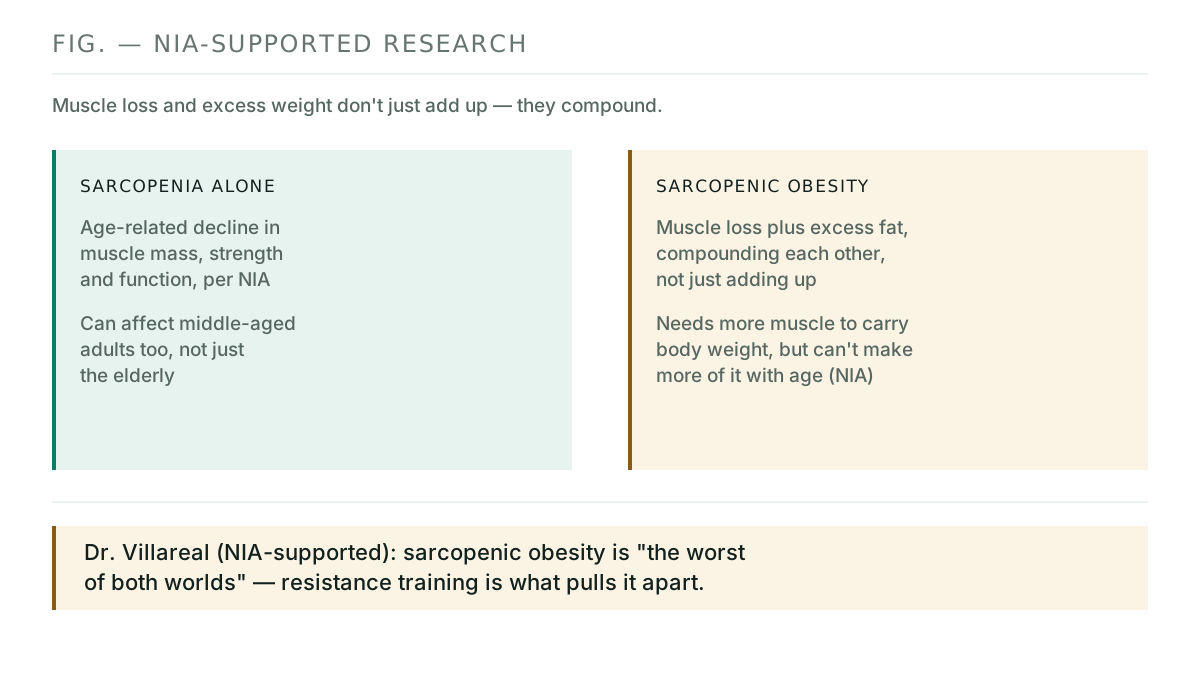
Dennis Villareal, M.D., a Baylor College of Medicine professor supported by NIA, studies exactly this overlap in older adults with obesity. His description is blunt: "Folks with obesity need more muscle mass to carry their body weight. When they get older, they can't compensate by producing more muscle mass, so you get sarcopenic obesity, which is the worst of both worlds."
In Villareal's yearlong exercise and nutrition intervention for older adults with obesity, a workout combining aerobic exercise, resistance training and balance work was most effective for reversing frailty. Resistance training specifically was the component that built muscle and reduced the loss of muscle mass, improving the body-mass-to-muscle ratio so participants lost more fat than muscle. Separately, some volunteers who stuck with the full program exceeded its 10% body-weight-loss target, losing as much as 20% of their body weight.
Dennis T. Villareal, M.D., Baylor College of Medicine, NIA-supported researchThe practical implication isn't that weight loss is dangerous for men carrying extra pounds in midlife — it's that losing weight through diet and aerobic exercise alone, without resistance training, risks losing lean muscle right along with the fat. That's a different failure mode than simply "not losing enough weight," and it calls for a different fix.
Is this just low testosterone?
Not necessarily, and the two are worth separating even though they can look similar from the outside. NIA's definition of sarcopenia — an age-related decline in muscle mass, strength and function — doesn't mention hormones at all. This site's own low testosterone symptoms article covers a different list: the American Urological Association's guideline groups reduced lean muscle mass among the physical symptoms linked specifically to testosterone deficiency, alongside reduced energy, reduced endurance and reduced beard growth.
The two mechanisms are not mutually exclusive — a man could have age-related sarcopenia, low testosterone, or both layered on top of each other, and the muscle loss would feel the same either way. What differs is the rest of the picture: testosterone deficiency tends to come with its own cluster of symptoms (covered in more depth in this site's low testosterone after 40 article), while sarcopenia on its own is defined purely by the decline in muscle itself. A blood test, not guesswork, is what actually distinguishes them.
What actually helps
Fielding's research team has found that the best-supported combination is walking plus resistance training together, not either one alone. Resistance training — also called strength training — is distinct from aerobic exercise like running, cycling or walking on its own. NIA lists several ways to do it: weightlifting with machines or free weights, medicine balls, resistance bands, or bodyweight exercises such as pushups and squats.
The goal, in Fielding's NIA-supported group-exercise programs, isn't a dramatic physique — it's not a perfectly chiseled abdomen or exceptional feats of strength, just consistent use of ankle weights, dumbbells or body weight, adapted to each participant. Fielding himself describes a direct physiological payoff: "When you do resistance or strength training, very important chains of molecules that relay signals between cells are affected, and these changes linger in the body for hours after exercise... Even a low-intensity strength and walking program has substantial benefits." He also emphasizes motivation grounded in specifics — asking people to name the everyday things they want to keep doing, like playing with grandchildren or carrying laundry up the stairs, rather than exercising for its own sake.
Practical tips for staying strong
NIA-supported researchers offer a few concrete habits worth borrowing. Barb Nicklas, Ph.D., of Wake Forest University School of Medicine, advises against comparing yourself to younger people: "We all should think about how to build up a base of strong muscles to prepare for the loss of muscle and strength that we will experience as we age." Her colleague Kristen Beavers, Ph.D., points out that exercises combining mindfulness with balance and movement, such as tai chi and yoga, can help prevent falls tied to low muscle strength.
Villareal's practical advice is to fold movement into the day rather than treating it as a separate errand: walking around the house or office, walking to the store, or taking brief stretching breaks every 15 to 20 minutes if you sit for work. None of this requires a gym membership or a dramatic lifestyle overhaul — it requires treating resistance on your muscles as a habit worth keeping, the same way diet or sleep already are for most men who pay attention to their health after 40.
Key takeaways
- Sarcopenia is the age-related decline in muscle mass, strength and function — NIA says it can start affecting middle-aged people, not just the elderly.
- Muscle peaks around ages 30 to 35, per NIA's Baltimore Longitudinal Study of Aging, then declines slowly until a faster decline begins after 65 in women and 70 in men.
- It is not the same as low testosterone, though the two can overlap — a blood test, not guesswork, is what tells them apart.
- Combined with excess weight, it becomes sarcopenic obesity — NIA-supported researcher Dr. Villareal calls it "the worst of both worlds."
- Resistance training combined with walking is the best-supported way to slow the decline; there is no way to stop it completely.
Where to go from here
If muscle and strength loss is what brought you here, these pages cover the surrounding ground:
- Low Testosterone Symptoms: The Full List — where muscle loss fits among the AUA's recognized symptoms.
- Low Testosterone After 40 — the broader hormone picture this article deliberately sets aside.
- How to Increase Testosterone Naturally: What Works — the hormone side of exercise; this article covers the muscle side.
- All testosterone articles
Frequently asked questions
What is sarcopenia, exactly?
The National Institute on Aging defines sarcopenia, from the Greek words for flesh and loss, as a decline in muscle mass, strength and function. It is most associated with older adults, but NIA notes that some forms can also affect middle-aged people. It has been connected to weakness, fatigue, lower energy levels and difficulty standing, walking and climbing stairs.
At what age does muscle loss start, and when does it speed up?
According to NIA's Baltimore Longitudinal Study of Aging, muscle mass and strength increase from birth and peak around ages 30 to 35. After that, decline is slow and roughly linear at first, then becomes faster after age 65 for women and 70 for men. NIA is clear that an active lifestyle, including strength training, can substantially slow that average decline.
Is sarcopenia the same thing as low testosterone?
No, though the two can overlap. NIA describes sarcopenia as an age-related decline in muscle mass and function. Separately, this site's article on low testosterone symptoms covers the American Urological Association's guideline, which lists reduced lean muscle mass as one recognized physical symptom of testosterone deficiency. Either mechanism, or both together, can show up as noticeably less strength than before.
What is sarcopenic obesity?
It's the combination of age-related muscle loss with excess body fat. Dennis Villareal, M.D., an NIA-supported researcher at Baylor College of Medicine, describes it this way: people with obesity need more muscle to carry their body weight, but with age they can't compensate by producing more muscle, which he calls the worst of both worlds.
Can sarcopenia be reversed, or only slowed?
NIA is direct that there is no way to fully stop the clock on age-related decline. But it says many older adults can still increase muscle strength with exercise, which helps maintain mobility and independence. NIA-supported research has found that combining walking with resistance training produces the best results for avoiding frailty and maintaining mobility.
What kind of exercise actually helps?
NIA-supported researcher Roger Fielding, Ph.D., points to resistance training specifically, not aerobic exercise alone: weightlifting, resistance bands, medicine balls or bodyweight moves like pushups and squats. In a yearlong study of older adults with obesity, the combination of a healthier diet with aerobic exercise, resistance training and balance work produced the best results for reversing frailty.
Sources
- National Institute on Aging (NIH) — How Can Strength Training Build Healthier Bodies As We Age?
- National Institute on Aging (NIH) — Falls and Fractures in Older Adults: Causes and Prevention
- American Urological Association — Testosterone Deficiency Guideline (Table 5, reduced lean muscle mass as a recognized physical symptom)
- Male Health Guide — Low Testosterone Symptoms: The Full List (companion coverage of the AUA guideline on muscle-related symptoms)
- Male Health Guide — Low Testosterone After 40 (companion coverage of the broader hormone-deficiency picture)

Male Health Guide Editorial Team
We write about the health problems men over 40 actually search for at 3 a.m. — and we say plainly when the evidence for a popular product is thin. We do not invent credentials and we do not publish sponsored copy as editorial. Read more about how we work.
Medical disclaimer: This article is general information, not medical advice. We are not doctors, and nothing here diagnoses, treats or cures any condition. Whether a change in your strength is age-related, hormone-related, or something else requires evaluation by a qualified healthcare professional. Please speak to one about your own situation before starting any new exercise program.